Discover Cabeceiras de BastoFree independent guide
ViveCabeceirasYOUR GUIDE TO CABECEIRAS
ENEnglish
SearchSaved

Stories of Cabeceiras

Choose a story to start with. You can change the subject or fine tune the search.

118 leituras · Todos os temas · Pesquisa: folhas

Read the landscape through the plants

Trees, forests, vineyards and fields reveal different ways of occupying the territory.

Escolher uma história · 38
Forest Park · plantation of 2016 and biology of the species

A tree with fan leaves

Ginkgo has an easy signature to search the leaves.

Inclui uma atividade para experimentar →Explorar: Duas árvores, duas formas de olhar →
Read here and consult sources

The leaves of Ginkgo biloba open in fan and can present a central division. In autumn, they become golden before falling, describes the Gulbenkian. The connection to Cabeceiras has a date: the municipal news of 18 March 2016 records the plantation of ginkgo and metasequoia in the Forest Park. The record tells the history of this plantation; it does not confirm the current state of the specimens.

The fan shape also appears in the leaf ribs. Gulbenkian explains that the division into two lobes, when it exists, is at the origin of the bilobe name. It is not necessary that all leaves have an equal cut to belong to the same species.

Ginkgo has male and female individuals. In female trees, seeds are formed with a fleshy cover that can remember a plum, but are not fruits like a plum tree. The interest of this reading is to observe forms and know the reproduction; the municipal news does not identify the sex of the specimen planted in Cabeceiras.

Origin and use are also part of history. Gulbenkian is located at the origin of ginkgo in southeast China and refers to its planting in Portuguese parks, gardens and ruins. It prefers places with sun and soil with water available, but well drained. A garden can therefore gather trees with very different origins: being planted in Cabeceiras does not make a species originally from the municipality.

Palavras desta história: ver explicações →
Source and context

Municipality — World Tree Day, 18/03/2016

Calouste Gulbenkian Foundation — Ginkgo

Accessed: . Editorial summary; the date of consultation is not the date of the facts.
Botanic · general characteristics

A leaf drawn in waves

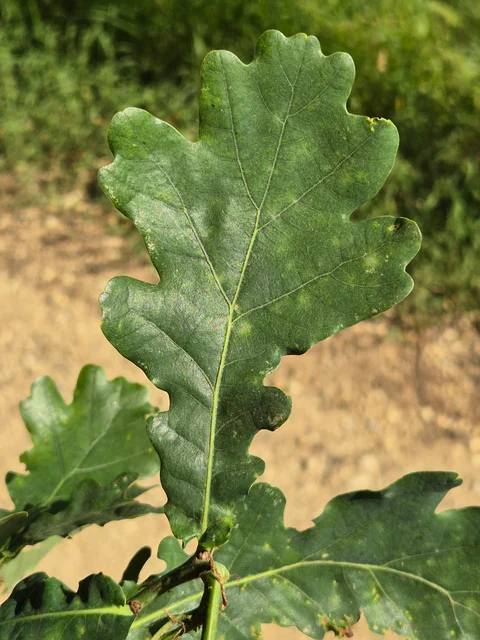
Oak green leaf with margin cut into visible wolves and ribs, still connected to the branch.
Leaf of Quercus robur photographed near Hollenstein, in the forest of Hollabrunn, Austria, in 2025. Illustration of the species; it is not a record of Cabeceiras nor identifies the broteroan subspecies.
Photography: Stefan.lefnaer · CC BY-SA 4.0
About this photograph

Date given at source: . Source consulted in 2026-11-07. EXIF orientation, proportional resizing and WebP conversion; no retouching or clipping of the file.

Request withdrawal or correct authorship

In the oak, notice the contour and the foot of the leaf.

Inclui uma atividade para experimentar →Explorar: A bolota entre a árvore e a história →
Read here and consult sources

The outline of the leaf has broad and unequal lobes: curves that resemble small waves. The description of the University of Évora adds a short petiole, with less than five millimeters, and secondary ribs curves that are not parallel. Instead of just looking at the silhouette, compare contour, ribs and link to the branch.

The fruits appear supported by peduncles and have a dome of brownish scales. The name used by the source is Quercus robur subsp. broteroana. These characteristics help to understand the botanical description; they do not identify the subspecies in the photographs or places of this guide.

The description presents deciduous leaves to marcescents. In the first case, they fall seasonally; in the marcescence, dried leaves may remain trapped for some time. A brown leaf in the branch is therefore not necessarily a living leaf.

The chart associates this oak to humid environments and refers to intolerance to summer drought. The leaf outline describes a structure; moisture and response to drought describe relationships with the environment. They are complementary clues to read the plant and landscape.

Palavras desta história: ver explicações →See the plants photographed in the municipality
Source and context

University of Évora — Quercus robur subsp. broteroana, description by Carlos Vila-Viçosa

Accessed: . Editorial summary; the date of consultation is not the date of the facts.
Local register · Union of parishes of Gondiães e Vilar de Cunhas · general botany

An oak tree can keep dried leaves

Falling in the fall is not the only fate of a leaf.

Inclui uma atividade para experimentar →
Read here and consult sources

The University of Évora describes Quercus pyrenaica, the black oak, with deciduous leaves to marcescents, according to the conditions of the place. In the marcescent plants, the leaves dry and remain in the branches during the unfavorable season. The book The Vegetation in Portugal highlights this behavior in the young plants of the species. It is a general explanation: it does not automatically identify an oak observed in the municipality.

There are other clues in the portrait of this species: new branches and leaves have a hair cover, denser on the lower face of the leaves. Male flowers appear in mints; females may appear isolated or in small groups. The acorn completes this reproductive cycle.

The chart associates the black oak to silicious substrates, including granites and shale, especially in acid soils. It also describes differences in the behavior of the leaves according to the humidity of the place. To know a tree, it is important to add what is observed in the canopy to the environment in which it grows. A dry leaf attached to the branch, alone, does not reveal the identity or health status of the specimen.

The photograph of João Lima, registered in 2025-07-15, shows this species in the Union of parishes of Gondiães e Vilar de Cunhas. It opens the register to compare the visible details with the botanical description. The observation documents this meeting; it does not indicate that the plant is always visible in the same place.

Palavras desta história: ver explicações →
Source and context

University of Évora — Virtual Museum of Biodiversity, Quercus pyrenaica

National Press — Vegetation in Portugal, semi-ducifolia and marcescent leaves

iNaturalist — Quercus pyrenaica, João Lima observation in 2025-07-15

Accessed: . Editorial summary; the date of consultation is not the date of the facts.
Botanic · general characteristics, no local record confirmed

Looks like a leaf, but it's a branch

The burrower hides a little trick in shape.

Explorar: Olhar para a planta inteira →
Read here and consult sources

In Ruscus aculeatus, the true leaves are small scales. The flattened green structures that look like leaves are branches called cladodes, as explained by the Parque Biológico de Gaia. The ripe berries are red and inedible. This species prefers shady places with cool, deep soil. This botanical description does not confirm its presence at a location in Cabeceiras; it helps explain a plant’s structure, without picking or tasting it.

The record of the University of Évora adds a surprising detail: greenish flowers appear in the center of the cladodiums. Later, these structures support the globe fruit. What looks like a leaf with a berry stuck is, after all, a specialized branch.

The plant remains green throughout the year and has a rhizome, from which branched stems develop. The cladodiums are rigid, pointed and end in thorn. The source places the ripening of the fruits between August and March; it is a general botanical indication, not the confirmation of fruits in a place or on a visit date.

Palavras desta história: ver explicações →
Source and context

Gaia Biological Park — Gilbardeira (Ruscus aculeatus)

University of Évora — Biodiversity of Mitra, Ruscus aculeatus

Accessed: . Editorial summary; the date of consultation is not the date of the facts.
Sliding crops · olive trees

One leaf, two faces

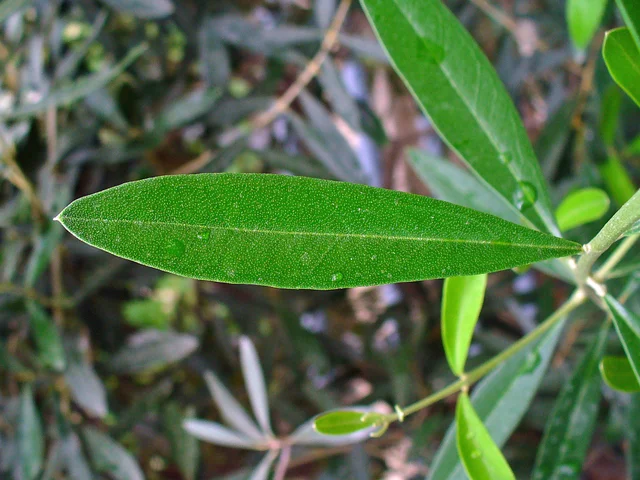
Elongated and green olive leaf, with light central ribbedness and other leaves at the bottom.
Olive leaf photographed in Stutensee, Germany, in 2011. Botanical illustration; it is not a record of Cabeceiras. This frame does not show the two faces of the same leaf.
Photography: H. Zell · CC BY-SA 3.0
About this photograph

Date given at source: . Source consulted in 2026-11-07. EXIF orientation, proportional resizing and WebP conversion; no retouching or clipping of the file.

Request withdrawal or correct authorship

The silver side of the olive tree also tells a story.

Inclui uma atividade para experimentar →Explorar: Da folha ao fruto e ao lagar →
Read here and consult sources

On the half slopes of Cabeceiras, the municipal portrait includes olive trees. The cultivated olive tree has green-gray leaves on top and silver-gray under it, where there are hairs. The small flowers have four white petals joined at the base.

The fruit is olive, an oil-rich drupa. The description of the University of Évora accompanies the change from green to red and dark shades during maturation, but refers to variants that remain green even mature. The color alone does not tell the whole story of the fruit. From tree to olive oil, there is a link that can continue in reading about the Ramil mill.

The record distinguishes the cultivated olive tree from the wild variant, the zambujeiro. In the latter, it describes smaller leaves and fruits and thorny lower branches. The comparison shows why a single characteristic, such as the silvery tone of the leaf, does not solve all the differences.

The olive tree is perennial: it maintains foliage throughout the year. This allows you to return to the same tree at different times and compare leaves, flowers and fruits without expecting all to be present simultaneously.

Palavras desta história: ver explicações →
Source and context

University of Évora — Virtual Museum of Biodiversity, Olea europaea

Municipality — landscape and vegetation

Accessed: . Editorial summary; the date of consultation is not the date of the facts.
Local register · Rio Douro · general botany

Not all leaves sting the same way

The holly holds differences even in its branches.

Inclui uma atividade para experimentar →Explorar: Olhar para a planta inteira →
Read here and consult sources

Referred to Cabreira by Visit Cabeceiras, Ilex aquifolium has persistent leaves. Gulbenkian's record describes thorny margins, but sometimes smooth in older branches or individuals. Red fruits appear in female specimens and are toxic. A detail to observe, no spoon or taste. Flowering usually occurs between April and June; fruits ripen at the end of summer and can remain during winter, according to Gulbenkian.

The small white flowers pass more unnoticed than the fruits. The mistletoe is dioic: there are male and female individuals. This separation helps to understand why not all specimens have red fruits.

It is a slow growing shrub, which can exceed a century of life. Gulbenkian describes it in coals and shrubs, often on dark and moist slopes, with soils slightly acidic and rich in organic matter. Watching the plant therefore includes looking at the environment around it, beyond the contour of the leaves.

The photograph of DVG, registered in 2026-04-03, shows this species in Rio Douro. It opens the register to compare the visible details with the botanical description. The observation documents this encounter; it does not indicate that the plant is always visible in the same place.

Palavras desta história: ver explicações →
Source and context

Visit Cabeceiras — natural heritage of Serra da Cabreira
Accessed:

Calouste Gulbenkian Foundation — Ilex aquifolium, characteristics and habitat
Accessed:

iNaturalist — Ilex aquifolium, DVG observation in 2026-04-03
Accessed:

Editorial summary; the date of consultation is not the date of the facts.

General botany · laurel

The laurel has more than leaves

A well-known tree in the kitchen also gives flowers.

Explorar: O que muda numa árvore? →
Read here and consult sources

The laurel, Laurus nobilis, preserves the foliage throughout the year. Lisbon High School of Education describes small yellow-white flowers and pollination by insects. It is a dioic species: male and female flowers occur in different plants. The leaves are used as condiment, but this reading does not serve to identify plants for consumption. The description is general, without local registration assigned.

The school chart places flowering in Portugal between February and April. Small flowers invite you to pay attention to another part of the tree, besides the aromatic leaf. Entomophilous pollination means precisely that insects participate in the transport of pollen. This calendar is a general reference, not a prediction for a copy of Cabeceiras.

The leaf is simple and has peninervea nervation: a main nerve serves as an axis to lateral ribs, in a drawing similar to a feather. Shape of the leaf, flowers and reproduction organization are different clues. A plant can maintain foliage and still change appearance when flowering.

Palavras desta história: ver explicações →
Source and context

Lisbon High School of Education — Laurus nobilis

Accessed: . Editorial summary; the date of consultation is not the date of the facts.

Serra da Cabreira · regional and general botanical reference

It looks dew, but it's a trap.

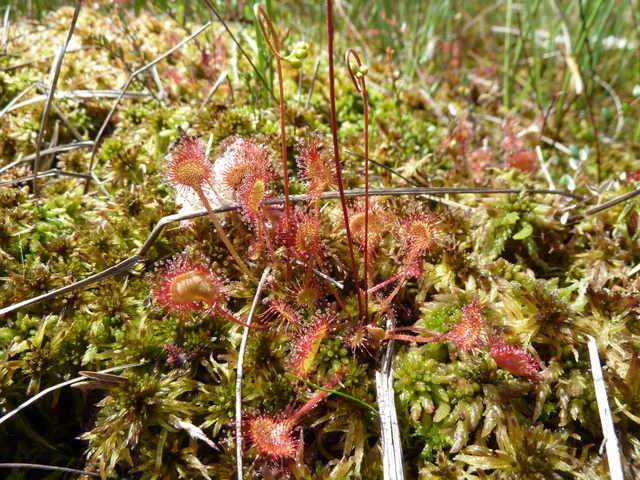
Rounded leaves of rosemary with reddish hair and bright drops between moss.
Rorela in the natural monument Swamp, near Máchovo jezero, Chéquia, in 2013. Illustration of the species; it is not a register of the Cabreira.
Photography: Stanislav Rada · CC BY-SA 3.0
About this photograph

Date given at source: . Source consulted in 2026-11-07. EXIF orientation, proportional resizing and WebP conversion; no retouching or clipping of the file.

Request withdrawal or correct authorship

On the roll, the leaves also capture food.

Inclui uma atividade para experimentar →
Read here and consult sources

The leaves of Drosera rotundifolia have small glandular hairs with a sticky secretion. When an insect gets stuck, enzymes help to decompose it and the plant absorbs nutrients through the leaves. This strategy can be especially useful in soils very poor in nutrients. The species is referred by Visit Cabeceiras to the Cabreira; the mechanism described by the North American forest service is general biology, not an observation made in the mountains.

The trap is not the flower. The leaves are available on a rosette near the base; the flowers appear on a stem and the fruits are capsules with numerous small seeds. The photograph allows for comparing leaves and stems, but does not show the digestion process. In the description of USDA, the leaf can fold around the prey: a sequence in time that a single image does not show.

Palavras desta história: ver explicações →
Source and context

USDA Forest Service — Robin F. Matthews, Drosera rotundifolia, February review, 1994
Accessed:

Visit Cabeceiras — natural heritage of Serra da Cabreira
Accessed:

Editorial summary; the date of consultation is not the date of the facts.

Forest Park · plantation of 2016 and general botany

A conifer who undresses in the fall

Having cones doesn't mean keeping leaves all year round.

Inclui uma atividade para experimentar →
Read here and consult sources

The municipal news of March 2016 records the planting of a metasequoia in the Forest Park, along with a ginkgo. This episode opens a window to meet Metasequoia glyptostroboides, the living species of the genus described by the Botanical Garden of the University of Cambridge. The news does not provide a detailed botanical identification nor confirms the current survival of the specimen.

In Cambridge's description, this conifer loses the leaves and gets shades covered in autumn. Leaves, buds and branches are available in opposite pairs. The bark is split and the tree can reach large size. These are general characteristics, not measured from a tree of Cabeceiras.

Compare it with ginkgo: both can change color and lose foliage, but the shape and organization of the leaves are very different. The calendar of a tree and the drawing of a leaf tell different parts of its history.

The scientific history has a twist: Cambridge reports that the metasequoia was known only through fossils until 1941, the year it was found alive in Sichuan, China. Then the collection and distribution of seeds contributed to its presence in gardens of various countries. The chart distinguishes the limited wild population from the wide use as a cultivated tree. A specimen in a park and a population in the original environment tell different stories.

Palavras desta história: ver explicações →
Source and context

Municipality — World Tree Day, 18/03/2016

Cambridge University Botanic Garden — Metasequoia glyptostroboides, deciduous foliage and layout of leaves

Accessed: . Editorial summary; the date of consultation is not the date of the facts.

Local register · Union of parishes of Gondiães e Vilar de Cunhas · general botany

In the carqueja, the stems also work

Not all photosynthesis is on the leaves.

Inclui uma atividade para experimentar →
Read here and consult sources

The carqueja integrates the municipal description of the serrana vegetation. In the form of the Polytechnic Institute of Castelo Branco, Pterospartum tridentatum presents very small leaves and winged stems that make photosynthesis. The flowers are yellow and the fruit is a pod. These details invite to look at the shape of the branches, beyond the color of the flowers.

The chart describes a woody and rigid shrub, which can be upright or more lying and reach about a meter. The flowers appear in small tight groups. In the fruit, the compressed pod usually holds two to five seeds. Caule, flower and fruit give different clues: yellow color, alone, is not enough to recognize the plant.

The same document mentions rural uses as a bed of animals and incorporation into the crop grounds, along with other forests. They are general uses of the species. To know a local historical reference, follow the reading of Cavez: the memory of 1758 mentions carqueja and other wood in the landscape of coal production, without describing a production recipe.

The photograph of João Lima, registered in 2025-07-15, shows this species in the Union of parishes of Gondiães e Vilar de Cunhas. It opens the register to compare the visible details with the botanical description. The observation documents this meeting; it does not indicate that the plant is always visible in the same place.

Palavras desta história: ver explicações →
Source and context

Polytechnic Institute of Castelo Branco — Pterospartum tridentatum, characteristics

Municipality — landscape and vegetation

iNaturalist — Genista tridentata, João Lima observation in 2025-07-15

Accessed: . Editorial summary; the date of consultation is not the date of the facts.

General botany · birch

A tree of light bark

The birch attracts attention even before we look at the leaves.

Inclui uma atividade para experimentar →Explorar: Flores discretas, estratégias diferentes →
Read here and consult sources

Betula celtiberica's record describes a deciduous tree, silvery white trunk, and elongated to triangular contour leaves, with bite margins. The species is associated with humid environments, including watercourse margins, and needs plenty of light.

The presentation of the Gulbenkian Garden places flowering in April and May and describes small winged fruits scattered by the wind. The bark, leaves and reproductive structures offer different clues throughout the year. It is information about the species; it does not confirm its presence in a parish nor guarantees the same dates in all locations.

The male and female flowers are found in the same tree, but in different structures. Gulbenkian describes the male ones gathered in yellow-green and the female ones initially erect. The word flower does not always mean large and showy petals: observing a tree can require attention to discrete structures.

The chart also highlights shallow roots, with horizontal development, and the ability to burst from the toilet. The visible trunk is only part of the plant; growing by seed and producing new sprouts are distinct processes. They are characteristics of the sheet of Betula celtiberica, without assigning a copy to Cabeceiras.

Palavras desta história: ver explicações →
Source and context

Calouste Gulbenkian Foundation — Celtic betula, trunk and leaves

Accessed: . Editorial summary; the date of consultation is not the date of the facts.

Botanic of the species · with local registration

A fruit with a wing

In the ash, the shape helps travel.

Inclui uma atividade para experimentar →Explorar: Três formas de continuar a viagem →
Read here and consult sources

The fruit of the ash has a wing and receives the name of samara. There is another detail to discover: the leaf is divided into several narrow folioles. Do not confuse each of these parts with an entire leaf.

Fraxinus angustifolia can grow in forests of shores and slopes. The local photograph documents a copy in Gondiães e Vilar de Cunhas; it does not show a fruit in travel or allows to describe its entire habitat.

The Gulbenkian chart describes leaves with three to eleven folioli, of sawed margins. Angustifolia termination refers precisely to this narrow form. In the fruit, the wing prolongs the part where the seeds are: fruit and seed are not the same structure. The tree loses the leaves seasonally; branches, leaves and fruits offer different clues throughout the year.

The ash binds this form of leaf to the availability of water. Gulbenkian plug refers to tolerance to different temperatures, but sensitivity to dryness, and preference for deep soils. It also describes a high and irregular canopy and a dark trunk, deeply cracked. The leaf is not the only part that helps to know the tree: the bark, the canopy and the environment complete the observation, without a single feature sufficient to identify a specimen.

Palavras desta história: ver explicações →
Source and context

University of Évora — BioMontado, chips Fraxinus angustifolia and Hedera hibernica

Portuguese Society of Botany — Flora-On, Fraxinus angustifolia: ecology

Calouste Gulbenkian Foundation — Straits leaves, fruit and habitat

Accessed: . Editorial summary; the date of consultation is not the date of the facts.

Flora · General biology of an invasive species in Portugal

Yellow flowers, space disputed

A showy plant can alter the vegetation around it.

Explorar: Uma paisagem, diferentes formas de crescer →
Read here and consult sources

The mimosa, Acacia dealbata, has yellow flowers gathered in small globo groups and very divided leaves. Originally from south-eastern Australia and Tasmania, it is described by the University of Évora as an invader in Portugal. It can form dense settlements that hinder the development of native vegetation, especially after disturbances such as fires. This chart explains the species; it does not locate a population in Cabeceiras nor identify all acacias by the same name.

There is more to observe than yellow: the leaves persist in the tree and are successively divided into small units, giving the cup a delicate appearance. The chart indicates flowering between January and April and fruits in pods, flattened and reddish brown. They are general characteristics of the species, not a confirmed calendar for a place of the municipality.

The history of the introduction also helps to understand the landscape. The University of Évora refers to ornamental, forest and soil fixation uses. A plant introduced with a purpose can then spread and change the available space for other species.

Source and context

University of Évora — Virtual Museum of Biodiversity, Acacia dealbata

Accessed: . Editorial summary; the date of consultation is not the date of the facts.

Local register · Union of parishes of Gondiães e Vilar de Cunhas · general botany

Blood changes the color of fruits

The shores also have bushes to know.

Inclui uma atividade para experimentar →
Read here and consult sources

The water brine, Frangula alnus, is described by Flora-On in woods and shrubs of the banks, hedges and humid places. The Arouca Geopark plug highlights alternating and deciduous leaves and rounded fruits that go from yellow to red and then black. This change helps to realize that a bush does not always look the same.

The alternating leaves are not born in pairs at the same point in the branch. Dead means they fall at a time of the year: observing in winter can give a different impression of observing with leaves. Besides the margins, Flora-On refers hedges and covered with coals, always in wet conditions. The name “water” does not therefore mean that the bush necessarily lives within the river.

The photograph of João Lima, registered in 2025-07-15, shows this species in the Union of parishes of Gondiães e Vilar de Cunhas. It opens the register to compare the visible details with the botanical description. The observation documents this meeting; it does not indicate that the plant is always visible in the same place.

Source and context

Portuguese Society of Botany — Flora-On, Frangula alnus: names and ecology

Arouca Geopark — Frangula alnus, botanical description

iNaturalist — Frangula alnus, João Lima observation in 2025-07-15

Accessed: . Editorial summary; the date of consultation is not the date of the facts.

Observation · general proposal throughout the seasons

A tree, several visitors

The calendar is also read by returning to the same place.

Inclui uma atividade para experimentar →Explorar: Escolhe uma forma de olhar →
Read here and consult sources

The book The Vegetation in Portugal distinguishes leaves that remain functional during the unfavorable season of marcescent leaves, already dried but still suspended in the canopy. Observing the same tree at different times helps to notice the change. Register what you see before giving a name to the species: green leaves, dried leaves caught, branches without leaves or new sprouts do not all tell the same story.

To compare visits, choose a concrete part of the tree: a visible branch from the same point or the entire canopy. Keep the date and record separately green leaves, dried leaves still attached, flowers and fruits. If you can't see an element, write "I didn't observe"; this is different from stating that it doesn't exist in the tree.

Readings of ginkgo and metasequoia allow you to start the comparison on the screen: both lose the leaves, but the drawing is different. The ash adds another question: are you observing a whole leaf or one of its folioli? Repeat observation and choose well what compares gives more information than trying to immediately guess the name of the species.

Source and context

National Press — Vegetation in Portugal, semi-ducifolia and marcescent leaves

Calouste Gulbenkian Foundation — Ginkgo

Cambridge University Botanic Garden — Metasequoia glyptostroboides, deciduous foliage and layout of leaves

Calouste Gulbenkian Foundation — Straits leaves, fruit and habitat

Accessed: . Editorial summary; the date of consultation is not the date of the facts.

Serra da Cabreira · flora and habitat

A carnivorous plant in the mountains

The turtledove is one of Cabreira's little surprises.

Inclui uma atividade para experimentar →Explorar: A humidade liga estas histórias →
Read here and consult sources

Visit Cabeceiras refers Drosera rotundifolia in the flora of the mountain. Flora-On describes its habitat: drenched meadows, bogs and peat with Sphagnum moss, usually in mountain. The reference is to the Cabreira as a whole; it does not identify a point of observation in this guide.

The review of the North American forest service helps to understand this connection to water: it describes continuously wet situations and soils often acid and poor in nutrients. The plant tolerates poorly prolonged dry periods. This explanation refers to the species in general, not a measurement of soils or water in the Cabreira.

Source and context

Visit Cabeceiras — natural heritage of Serra da Cabreira
Accessed:

Portuguese Botany Society — Flora-On, Drosera rotundifolia
Accessed:

USDA Forest Service — Robin F. Matthews, Drosera rotundifolia, February review, 1994
Accessed:

Editorial summary; the date of consultation is not the date of the facts.

Painzela · gardens and knowledge

Plants that take shape

Cameleiras and teixos are also part of the history of the gardens.

Inclui uma atividade para experimentar →Explorar: O jardim também guarda saberes →
Read here and consult sources

Cameleiras e teixos worked on geometric or animal figures: it is the art of the topiaria. The Portuguese Association of Historical Gardens links this tradition to the school of Manuel Joaquim Alves Soares, continued by the son Joaquim. Casa de Piellas, in Painzela, is part of this story. It is a private property; consult the conditions of visit in the form.

The presentation of the Route of Tâmega associates this garden school with the support of the sisters Emilia Ermelinda and Justina Praxedes Pinto Basto. In the mid-19th century, they will have promoted the learning of Manuel Joaquim Alves Soares in Porto and England. The history of plant forms thus includes the circulation of knowledge and transmission between generations.

Looking at a topiary figure is looking at a plant and a human knowledge. Geometric shapes organize lines and volumes; zoomorphs evoke animals. The association places examples of this tradition in several houses of Basto, not only in Piellas.

Palavras desta história: ver explicações →Getting to know the parish See Fact sheet: Casa de Pielas, jardins e anexos
Source and context

Portuguese Association of Historical Gardens — Route Tâmega

Portuguese Association of Historical Gardens — Casa de Piellas, Painzela

Accessed: . Editorial summary; the date of consultation is not the date of the facts.

Vegetation described for the territory

The forest also has a history

Names that are part of the mountain memory.

Inclui uma atividade para experimentar →Explorar: Ler uma árvore por partes →
Read here and consult sources

Carvalhos and chestnut trees are part of the mountain vegetation described by the municipality. The same source counts the partial replacement of this vegetation by pine-bravo. Therefore, a wooded slope also keeps planting choices and changes in land use. Looking only at the green does not arrive: it is worth noticing the species, spots and spaces between trees. This municipal description is not a current survey of each forest.

The publication Forests do Alto Minho distinguishes soutos, oriented to the production of chestnut, candlesticks, for the production of sticks. They are uses of chestnut, not two species of tree. This regional comparison helps to ask questions about the landscape of Cabeceiras; it does not identify the function of a concrete portion of the municipality.

There is still a forest below the canopy. The sub-basket gathers plants that grow under the trees; dead wood can also sustain insects that feed on it and fungi. A forest landscape is not, therefore, limited to the number of living trunks. To observe it, look for different layers — canopy, low vegetation and fallen wood — without concluding that the species cited for another region are present in that area.

Palavras desta história: ver explicações →
Source and context

Municipality — landscape and vegetation

High CIM Minho — High Forests Minho, sours and candlesticks (habitat 9260)

Accessed: . Editorial summary; the date of consultation is not the date of the facts.

Common names used in source

Medroneiro, carqueja and tojo

Between the trees and the fields there is another landscape to discover.

Inclui uma atividade para experimentar →Explorar: Escolhe um detalhe do mato →
Read here and consult sources

Medronheiro, carqueja, tojo and madresilva appear in the municipal description of the serrana vegetation. The source also associates the altitude forests to the grazing of goats, cattle and sheep, distinguishing them from the pastures cultivated below. Thus, the forest is part of a landscape of plants, animals and work. These common names are a starting point to know the vegetation, not an identification of each plant found.

The municipal presentation relates this vegetation with changes of use: refers to the partial replacement of oaks, chestnut trees and forests by pine-bravo. Reading the landscape implies, therefore, also asking for what was planted and what it has become. A green spot can gather stories of grazing, cultivation and forest.

Start by choosing a detail in the following readings: the stem of the carqueja, the thorns of the tojo, the flowering and the fruits of the medronho or the position of the madresilva on the edge of the forest. Each question approaches the look without requiring that you already know how to identify all the plants.

Source and context

Municipality — landscape and vegetation

Accessed: . Editorial summary; the date of consultation is not the date of the facts.

Local register · Union of parishes of Arco de Baúlhe e Vila Nune · general botany

Flowers and fruits in the same branch

The chickenshit has a calendar that overlaps.

Inclui uma atividade para experimentar →Explorar: Frutos com histórias diferentes →
Read here and consult sources

The medronho, Arbutus unedo, keeps dark green leaves and bright during the year. In autumn, little white bell-shaped flowers appear. The fruits take about a year to mature, so mature medronhos can coincide with the next flowering.

The form of the School of Education of Lisbon distinguishes two encounters with animals: insects, especially bees, participate in pollination; birds that eat the fruits help transport seeds. They are different functions in the plant cycle.

The leaves give other clues besides color: they have serrated margin and secondary ribs distributed from a central rib. The size varies between bush and small tree. The record of the Lisbon Polytechnic refers to tolerance to dry climate and different soils, showing that the fruit calendar is not the only interesting characteristic of the plant.

Food uses include fresh fruit, jams and jams. The same source places the tradition of medronho drinks in the Algarve and other Mediterranean territories; this information does not transform these products into a documented specialty of Cabeceiras.

The photograph of migr, registered in 2025-08-29, shows this species in the Union of parishes of Arco de Baúlhe e Vila Nune. It opens the register to compare the visible details with the botanical description. The observation documents this meeting; it does not indicate that the plant is always visible in the same place.

Palavras desta história: ver explicações →See the plants photographed in the municipality
Source and context

Lisbon Polytechnic — form Arbutus unedo

iNaturalist — Arbutus unedo, migr observation in 2025-08-29

Accessed: . Editorial summary; the date of consultation is not the date of the facts.

Botanic · general characteristics

What's hidden in the hedgehog?

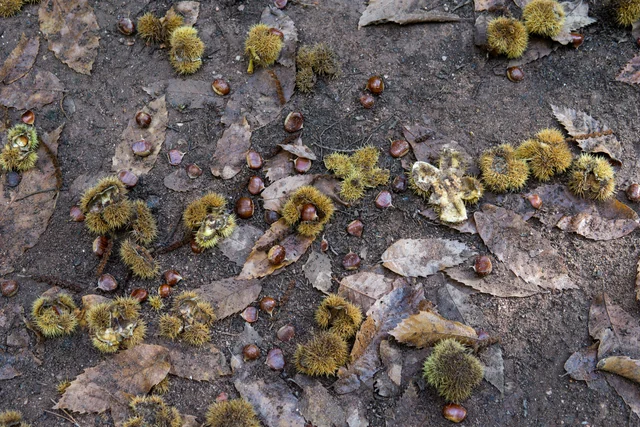
Open urchins and bright chestnuts between fallen leaves.
Chestnuts and hedgehogs on the ground in Guirbaden, Mollkirch, France, in 2020. Botany illustration; not a record of Cabeceiras.
Photography: AudreyMuratet · CC BY-SA 4.0
About this photograph

Date given at source: . Source consulted in 2026-11-07. EXIF orientation, proportional resizing and WebP conversion; no retouching or clipping of the file.

Request withdrawal or correct authorship

The chestnut is the fruit; the hedgehog involves the whole.

Inclui uma atividade para experimentar →Explorar: Do ouriço à semente →
Read here and consult sources

Castanea sativa loses the leaves at the unfavorable time and can reach large size. The form of the Polytechnic Institute of Castelo Branco describes narrow and yellow flowers in long and pendant ears. Later, the chestnuts are grouped within the hedgehog: the chestnut is the fruit, while the hedgehog involves the set.

Notice the layers: the brown and shiny cover belongs to the fruit; inside there is usually a seed, with a yellowish film. The tree also took place in the workshops: the source refers to wood used in carpentry, woodworking, basketry and turnery. They are general characteristics and uses, without assigning a workshop or exemplary to the municipality.

Before the hedgehog there are flowers. UTAD Digital Flora indicates May and June as the flowering season of the species. It is a general botanical reference, not a prediction for a tree of Cabeceiras: to know its rhythm, compare photographs of the same specimen on different dates. A tree without chestnuts on a spring visit does not tell the same story as an open hedgehog in autumn.

The chestnut belongs to the family Fagaceae, the same large botanical family of oaks. Compare the fruits helps to realize that kinship does not mean equal appearance: go back to the reading of the oak and look for what involves the acorn, then return to the scheme of the layers of the chestnut.

Palavras desta história: ver explicações →See the plants photographed in the municipality
Source and context

Polytechnic Institute of Castelo Branco — botanical record of Castanea sativa

UTAD Botanical Garden — Castanea sativa, Flora Digital de Portugal

Accessed: . Editorial summary; the date of consultation is not the date of the facts.

Forest landscape · botanical of the species

Needles come in pairs

A little detail to observe in the pine-bravo.

Inclui uma atividade para experimentar →Explorar: Uma árvore dentro da floresta →
Read here and consult sources

The municipality refers to the pine-bravo in the transformation of the mountain forest landscape. In the description of the University of Évora, Pinus pinaster has persistent, rigid and pointed leaves, needle-shaped. They grow in pairs on a very short branch and can reach 25 centimeters. A pair of needles allows you to begin to repair the tree beyond your canopy.

In the same plant there are male and female reproductive structures. Males form yellowish sets; females give rise to pine cones with woody scales. Also note the trunk: the bark is thick, red-brown and very split. They are general characteristics of the species, not a survey of the municipality pine forests.

The environment adds another clue. The University of Évora associates the pine-bravo to sunny sites and acidic soils, often sandy; inside it also refers to it on shale substrates. It can form pine forests or integrate mixed forests with other pines and oaks.

When looking at a slope, it distinguishes two scales: the tree, with its needles and pine cones, and the set of plants around it. The botanical description gives context, but does not allow to conclude the origin or age of a settlement only by appearance.

Palavras desta história: ver explicações →
Source and context

University of Évora — Virtual Museum of Biodiversity, Pinus pinaster

Municipality — landscape and vegetation

Accessed: . Editorial summary; the date of consultation is not the date of the facts.

Botanic · species registered in the municipality

A plant doesn't need to have flowers

Fetuses tell another story of reproduction.

Inclui uma atividade para experimentar →
Read here and consult sources

The fetuses reproduce by spores, without flowers. The University of Évora describes the serums and spores of Asplenium onopteris, associated with wet and dark sites, including cracks of rocks and walls. Its fronds are persistent. The local record below shows the appearance of the plant; the explanation of reproduction comes from the botanical record.

The leaf of a fetus is called fronde. In this species, the record describes persistent fronds between ten and fifty centimeters and a blade cut into successive divisions. The petiolus, which binds the blade to the base, is dark and can be as long as it is. They are general botanical characteristics, not measured from the local photograph.

Serums gather spore-producing structures. In Asplenium onopteris they are described as elongated or linear, with a covering called indusium. It is a different detail from a flower or fruit: not finding flowers in a fetus does not mean that the plant is without reproduction. The available image may also not show these details.

Palavras desta história: ver explicações →
Source and context

University of Évora — Asplenium onopteris

Accessed: . Editorial summary; the date of consultation is not the date of the facts.

Sobreiro · botany and local landscape

The cork begins in the tree

On the cork oak, the bark is one of the first clues.

Explorar: Uma árvore, diferentes materiais →
Read here and consult sources

Quercus suber has a thick, elastic peel and deeply split: cork. The municipal description includes corks on the half slopes of Cabeceiras. The leaves persist for more than one season; the University of Évora refers up to three years. Persistent foliage does not mean that each leaf lasts forever.

Fruits are acorns. The fiche describes the dome that accompanies them with long and velvety scales. Casca, leaves and fruits offer different clues to observe the tree, without removing cork or pulling branches. The local reference documents the landscape; the botanical description explains general characteristics of the species.

Inside, cork has a structure of microscopic cells with air-like gas. APCOR relates this organization to lightness, compressive capacity and form recovery. The suberin present in the cell walls helps to hinder the passage of liquids and gases. A cork seems simple, but the behavior of the material begins on a scale that the eyes do not reach.

The association also describes the transformation of corks used in granules for new products, such as coatings and soles. It is a general example of reuse, not an industrial activity confirmed in Cabeceiras. Compare with the punches of Outeiro and the containers of Faia: are other stories of materials linked to trees, with different functions and ways of working.

Palavras desta história: ver explicações →
Source and context

University of Évora — Quercus suber, botanical description

Municipality — landscape and vegetation

APCOR — Cork, cellular structure, properties and reuse (page consulted in the staging subdomain)

Accessed: . Editorial summary; the date of consultation is not the date of the facts.

General botany · alder

Seeds that travel through the water

The alder has a close relationship with the rivers.

Explorar: A árvore, o rio e o ofício →
Read here and consult sources

In the form of the University of Évora, published under the name Alnus glutinous, the seeds of the alder have aired tissues that favor dispersion through water. The tree tolerates prolonged periods with submerged roots. The woods in which it dominates are called amial.

The relationship with the water goes, thus, from the installation next to the banks of the journey of the seeds. There is also a change of names to know: Flora-On uses Alnus Lusitanica for Portuguese native aldermen, citing a study of 2017. Each name keeps the link here to its source; the reading does not identify a concrete tree of the municipality.

The form published as Alnus glutinous describes a caducifólia tree: it loses the foliage in a part of the year. The leaves are alternating, with double-bit margin; the peel, smooth as a young man, becomes darker and split. They are characteristics of different parts of the plant and also of different stages of its life.

The flowering indicated in this source runs from December to February. Male flowers appear in elongated groups, the amentos, while the female groups have another form. Winter can thus offer observations that a visit with the canopy full of leaves does not show. This calendar belongs to the description consulted and may vary with the conditions of the place; it does not announce the flowering of a copy of Cabeceiras.

Palavras desta história: ver explicações →
Source and context

University of Évora — Alnus glutinous, breeding and habitat

Portuguese Society of Botany — Flora-On, Alnus: ecology, symbiosis and taxonomic note

Accessed: . Editorial summary; the date of consultation is not the date of the facts.

Botanic of the species · with local registration

White flowers, small red fruits

The woodwork changes appearance throughout the reproductive cycle.

Inclui uma atividade para experimentar →Explorar: Uma folha simples ou um conjunto de folíolos? →
Read here and consult sources

The pine tree, Crataegus monogyna, is a shrub or small deciduous leaf tree. The leaves are simple, alternating and lobulated; the thorns explain the name white thorn. In the description of the Museum of Natural History and Science of the University of Porto, the white flowers have five petals.

The small red fruits are pomos and the fiche refers to a seed in each fruit. Leaves, flowers and fruits allow comparing different moments of the plant. The local photographic record linked to this history documents an observation, not all phases of the cycle or the distribution of the species by the municipality.

The botanical family also helps to make comparisons: the wood and silva belong to the Rosaceae, although they have different leaves and fruits. In the forest, a simple leaf has limbo cut into wolves; in silva, a composite leaf is divided into folioli. Being in the same family does not mean having the same shape.

The collection of the University of Porto associates the Piliteiro to the sub-basket and the forests in well drained soils. The distribution presented extends through Europe, Asia and North Africa. This framework is broader than the local record: a photograph of Cabeceiras documents a meeting, while the botanical record describes the species.

Palavras desta história: ver explicações →
Source and context

University of Porto — living botanical collection, Crataegus monogyna

University of Évora — Rubus ulmifolius, leaves and fruits

Accessed: . Editorial summary; the date of consultation is not the date of the facts.

General botany · know the tojos

A bush of well defended branches

The thorns are part of the silhouette of the tojo.

Inclui uma atividade para experimentar →Explorar: Do mato às estações e ao gado →
Read here and consult sources

The Tojo-arnal, Ulex europaeus subsp. europaeus, is a bush of strong thorns that can reach two meters. The record of the Arboreto de Barcelos associates it to urzais, hedges and edge of forests and refers flowering in winter. Thus, a landscape of forests can have flowers outside spring.

The same source records uses such as fodder, cattle litter and fuel. These uses belong to the general description of the plant; they do not document a specific practice of Cabeceiras. The municipality mentions tojos in the serran landscape, without determining the species of each place.

The Arboreto describes leaves transformed into thorns and a branch that can be opened or compact. The outer form gains another interest when we ask what part of the plant comes from each structure. In the tojo, the record speaks of transformed leaves; in the galvant, what looks like a leaf is a flattened branch. In the carqueja, green stems also participate in photosynthesis. Compare these stories helps to look beyond the silhouette.

Source and context

Arboreto de Barcelos — Ulex europaeus subsp. europaeus

Municipality — landscape and vegetation

Accessed: . Editorial summary; the date of consultation is not the date of the facts.

General botany · silva

A blueberry is a small set

In silva, the fruit has more details than it seems.

Inclui uma atividade para experimentar →Explorar: Uma amora, muitos pequenos frutos →
Read here and consult sources

A blackberry gathers numerous small drupas. Rubus ulmifolius has flowers of five petals, white or pink, and fruits that become black when mature. The leaf is also composed: it is divided into three to five folioli, green on the top face and grayish and hairy on the bottom.

The arched stems form dense silvados. The University of Évora associates the plant to forests, hedges, wastelands and water banks, preferring fresh and humid soils. It is a general botanical description; it does not identify a concrete silvado in the municipality.

A composite leaf may look like a small branch. The difference helps to read the plant: in the silva described by the University of Évora, the three to five folioles belong to the same leaf and are arranged in a typed way, as fingers that depart from a base. The greyish appearance of the lower face is due to dense pilosity, called tomento.

The description also refers to purple and pruinous shoots, with a surface cover of waxy appearance. They are distinct details of the thorns of the stems. The plant also appears in soils altered by human activity; a silvado, by itself, does not show when or why a land has ceased to be cultivated.

Palavras desta história: ver explicações →
Source and context

University of Évora — Rubus ulmifolius, leaves and fruits

Accessed: . Editorial summary; the date of consultation is not the date of the facts.

General botany · ivy

Not all flowers arrive in the spring

Ivy also puts autumn in bloom.

Read here and consult sources

Hedera hibernica's chart places its small yellow-green flowers in September and October. It refers to the importance of flowers and fruits for insects and birds, as well as the use of the plant as a nesting shelter. It is an example of how a climbing plant can participate in various relationships in the ecosystem.

The fiche also explains how the plant occupies space. The ivy is woody and perennial; the long and flexible branches have roots that cling to the surfaces. With support, it climbs through trees, rocks or walls; without a vertical surface, it can extend through the ground. Trepar and cover the ground are thus two forms of growth of the same species.

The described leaves may be oval or have three to five lobes. Compare the shape of a leaf with the position of the branch, but do not use a single detail to name the plant. To observe the calendar, record separately leaves, flowers and fruits: keeping leaves throughout the year does not mean flowering throughout the months.

Palavras desta história: ver explicações →
Source and context

University of Évora — BioMontado, chips Fraxinus angustifolia and Hedera hibernica

Accessed: . Editorial summary; the date of consultation is not the date of the facts.

Arco de Baúlhe · Railway memory

A season that also flourished

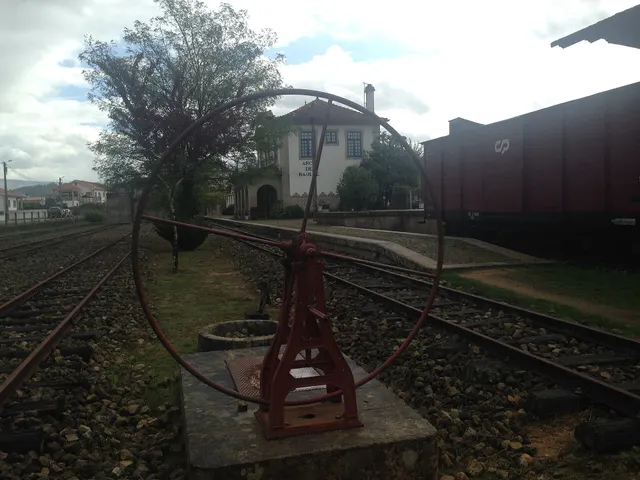
Revolving plate and tracks from the old Arco de Baúlhe station, with buildings and railway equipment at the bottom.
View of the Arco de Baúlhe station and its surroundings. The photograph does not document the distinction of the gardens in 1962.© JP Ribeiroⓘ

Not everything that was kept from the railroad is made of metal.

Inclui uma atividade para experimentar →
Read here and consult sources

The station also has a memory made of flowers. The publication of the museum describes the gardens of roses and recalls the distinction received in 1962 as the most florida season in Portugal.

Next to the machines and rails, the garden adds another way of looking at the place: the landscape of a season includes what grows around it. The prize belongs to the history of space; it is not a current classification of the gardens.

Getting to know the parish See Fact sheet: Núcleo Ferroviário de Arco de Baúlhe
Source and context

Municipality — Land Museum of Basto: a journey through the history of the region, pp. 28–29

Accessed: . Editorial summary; the date of consultation is not the date of the facts.

Registered at Gondiães e Vilar de Cunhas · botanical context

When fetuses occupy the landscape

A fetus can be a detail; many together form a fetal.

Inclui uma atividade para experimentar →Explorar: Da fronde à superfície onde cresce →
Read here and consult sources

Flora-On describes Pteridium aquilinum subsp. aquilinum as a colonizer of burned areas and abandoned pastures, where it can become dominant. This helps to understand how a stain of fetuses forms, but does not prove the history of the photographed terrain. The record of Gondiães e Vilar de Cunhas identifies Pteridium aquilinum at the level of the species: the image does not confirm the subspecies or a previous fire. Compare the set of the hillside with the clipping of a single fron.

The record of the University of Évora describes a long underground rhizome, along which the leaves appear. The green on the surface is only part of the plant: there is a stem that extends under the ground. Rizoma is not synonymous with root.

The frondes have a long petiole and a boundary blade between oval and triangular, divided into segments. The upper face has no hair; the lower has hairiness. The description refers to leaves usually between thirty and one and a half centimeters, and can reach higher dimensions. They are measures of the species, not of the photographed specimen.

This fetus can occur both in the sun and in the shade, including in the sub-basket and on acidic land. The presence of a stain does not demonstrate, alone, whether there was fire, abandonment of agriculture or any other change in that land.

Palavras desta história: ver explicações →
Source and context

Portuguese Society of Botany — Flora-On: Pteridium aquilinum subsp. aquilinum
Accessed:

University of Évora — Biodiversity of Mitra, Pteridium aquilinum
Accessed:

Editorial summary; the date of consultation is not the date of the facts.

Forest landscape · pine-bravo botanical

A pine cone has small seed houses

The woody scales hide a detail.

Explorar: Uma árvore, várias pistas →
Read here and consult sources

In the pine-bravo, Pinus pinaster, the pine contains two seeds per scale, according to the description of the University of Évora. The trunk, in turn, has thick bark, red-brown and very split. After recognizing the needles in pairs, it is worth noticing in these other forms. The municipality mentions the pine-bravo in the mountain landscape; these characteristics help to know it without constituting an inventory of the local pine forests.

In the same tree there are different male and female reproductive structures: the species is monoic. The chart describes males as yellowish clusters and females as squamous structures that form cones. Looking only at a mature pine cone leaves, therefore, part of the cycle undiscovered.

The environment also counts. The University of Évora associates pine-bravo with sunny places, with acidic and often sandy soils, also referring to the presence inside on shale substrates. It can form pine forests or integrate mixed forests. This describes preferences and general forms of occurrence; it does not transform all the slopes with these conditions into pine forests.

Palavras desta história: ver explicações →
Source and context

University of Évora — Virtual Museum of Biodiversity, Pinus pinaster

Municipality — landscape and vegetation

Accessed: . Editorial summary; the date of consultation is not the date of the facts.

Ecology of the municipality landscape

A landscape needs connections

Among the green spaces, the interval also counts.

Inclui uma atividade para experimentar →Explorar: Escolhe uma parte da paisagem →
Read here and consult sources

An isolated green space does not tell the whole story. The municipal report of 2025 explains that fragmentation reduces and separates habitats, interrupting ecological processes. The ecological structure seeks to link natural, agricultural and forest spaces, including gardens, alleys and waterbanks in the village. It is a proposal for reading and planning the territory, not confirmation that all these links already work.

Palavras desta história: ver explicações →
Source and context

Municipality — Environmental Report of the PDM review, February 2025, p. 55
Accessed:

Municipality — Environmental Report, February 2025, pp. 50, 55 and 139
Accessed:

Editorial summary; the date of consultation is not the date of the facts.

Surreal · general ecology and local environment

The cork oak doesn't climb the whole mountains

The altitude also changes the conditions for a tree.

Read here and consult sources

The University of Évora describes the cork oak as sensitive to the minimum winter temperatures and usually absent in the areas above about a thousand meters. The municipal reference places cork oaks on the half slopes of Cabeceiras. Together, these descriptions help to understand why one should not imagine the same vegetation of the valley at the top of the mountain. The approximate limit is a general feature, not a survey of each local slope.

Cold is just a part of the picture. The chart describes preference for land of light to medium texture, acid reaction or neutral, avoiding limestone soils; it also refers to fresh and sheltered places. It is not enough to look at altitude on a map to predict where a cork oak grows.

The persistent, firm-consistency leaves and cork of the trunk help to observe the tree closely. In the landscape, try to change scale: first look at the tree; then at the position of the slope and the shelter around. The name of the species tells one part of the story, the environment tells another.

Source and context

University of Évora — Quercus suber, botanical description

Municipality — landscape and vegetation

Accessed: . Editorial summary; the date of consultation is not the date of the facts.

Flora · general description of Arundo donax

Cane doesn't end where the ground begins

Underneath the stems is another part of the plant.

Explorar: Das margens ao acompanhamento →
Read here and consult sources

The cane, Arundo donax, is a perennial herb of large size. The ICNF describes robust and hollow stems, which can reach six meters, and a rhizomatous structure, which extends under the ground. Knowing the part that is not seen helps to look at a cane beyond the tall stems. The national distribution indicated in the form does not confirm a record in a concrete site of Cabeceiras.

The flowers appear together in large, branched sets, of violet tone; the fiche indicates flowering from August to October. The leaves are long, narrow and end in tip. The description helps to separate three parts of the plant: the tall stems, the leaves accompanying them and the floral structures.

Viable flowers and seeds are not the same. The ICNF describes fruits that, outside the native area, do not produce viable seeds, so seeing a flowering cane is not enough to conclude how it is multiplying. The underground structure remains part of the question.

Source and context

ICNF — SIVEEI, Arundo donax; updated record 09/03/2023

Accessed: . Editorial summary; the date of consultation is not the date of the facts.

Gardens · General ecology and seasons

A flower calendar

For pollinators, it is important to have flowers at different times.

Inclui uma atividade para experimentar →Explorar: Um jardim, vários momentos →
Read here and consult sources

In the orientation of entomologists Renata Santos and Albano Soares, a green space gains interest for pollinators when it offers flowers in various times, with different shapes, colors and sizes. Spontaneous plants can also contribute. Medronho, with autumnal flowering, is one of the examples mentioned. It is an idea to observe the cycles of a garden, not a guaranteed calendar for all altitudes and conditions of Cabeceiras.

Source and context

Calouste Gulbenkian Foundation — explanations of entomologists Renata Santos and Albano Soares, 07/06/2022

Accessed: . Editorial summary; the date of consultation is not the date of the facts.

Wetlands plants · general botany

Some plants prefer water slowly

The long board is connected to wetlands.

Inclui uma atividade para experimentar →Explorar: Três ambientes, diferentes pistas →
Read here and consult sources

Typha latifolia, called the large board in Flora-On, occurs in ditches, ponds, lakes and streams of slow current water. The chart highlights soggy soils for much of the year. To confirm the species, it indicates a characteristic of the flowers: male and female inflorescences are leaning against. This general description does not confirm a population in the municipality nor replaces the identification of a specimen.

Lentic is the term used for standing or slow-moving waters. This clue speaks of the environment; the position of the two flower sets speaks of the plant. Separating the two questions helps to observe better: how is water and what structures can I distinguish? A wet ditch alone does not confirm the species, as an isolated stem does not describe the whole environment.

Flora-On refers to fresh or slightly mineralized waters and preference for substrates rich in bases. It adds that the increase in phosphorus concentration in the water may favor the plant. It is an ecological relationship described for the species; observing a board does not replace the measurement of nutrients nor allows to conclude that there is a discharge.

The comparison with the reed helps to separate environments: the wet meadow and the soaking soil next to slow water are not identical descriptions. The layout of this reading allows you to explore these differences.

Palavras desta história: ver explicações →
Source and context

Portuguese Society of Botany — Flora-On: Typha latifolia

Portuguese Society of Botany — Flora-On: Juncus effususus subsp. effususus

Portuguese Society of Botany — Flora-On, Frangula alnus: names and ecology

Accessed: . Editorial summary; the date of consultation is not the date of the facts.

Refojos de Basto · history and mission of educational equipment

A green space can also teach

In Vinha de Mouros, leisure meets environmental education.

Inclui uma atividade para experimentar →Explorar: Escolhe o que queres observar →
Read here and consult sources

The Centro de Educação Ambiental of Vinha de Mouros was inaugurated in 10 August 2001. In the municipal presentation, preserving and valuing the local flora and fauna is part of its mission, together with the educational work with the schools. The space was designed to bring together different public heritage of the municipality.

The same presentation brings together different functions: lunch park, play areas, mini golf, maintenance circuit and support the pedagogical program. Therefore, a visit can start with a pause and continue with questions about the landscape. The practical form distinguishes the equipment and conditions of use; this story does not announce a guided activity marked.

A useful question is to separate what one sees from what one interprets. The park’s photograph shows trees and tables, but it does not identify all plants nor shows that an animal species lives there in freedom. The following readings help to look at leaves, soil and relationships between living beings, without turning examples of general biology into an inventory of Vinha de Mouros.

See Fact sheet: Vinha de Mouros
Source and context

Municipality — Centro de Educação Ambiental of Vinha de Mouros: origin and objectives

Accessed: . Editorial summary; the date of consultation is not the date of the facts.

The life you don't always see

Knowing animals begins by perceiving the territory and respecting the distance.

Escolher uma história · 10
Birds · General biology in Portugal

An acrobat between the leaves

The blue chapim seeks food even upside down.

Read here and consult sources

The barrette and the blue wings, the white faces and the dark line next to the eyes help to recognize Cyanistes caeruleus. The yellow breast completes the contrast. But it is worth looking at the movement: the University of Évora describes this small bird jumping through the branches and hanging upside down while feeding.

The foliage works as a search zone for insects and spiders. In autumn and winter, fruits and seeds can also enter the diet. The food does not fit in an equal list for all seasons: changes what the bird enjoys in the landscape.

The chapim-blue is resident and is distributed across the continental territory. Gulbenkian's chart describes varied wooded environments, from the woods to the galleries near the rivers, orchards, hedges and gardens. A garden and a wooded margin can offer different contexts to know this bird. These sources explain the species in Portugal; they do not document a meeting in a parish of Cabeceiras.

Palavras desta história: ver explicações →
Source and context

University of Évora — Biodiversity of Mitra: Cyanistes caeruleus

Calouste Gulbenkian Foundation / João E. Rabaça — Blue Chapim

Accessed: . Editorial summary; the date of consultation is not the date of the facts.

Life of the soil · general ecology

Worms also change the landscape

A gallery can put leaves on the road.

Inclui uma atividade para experimentar →Explorar: Uma folha pode seguir vários caminhos →
Read here and consult sources

Many worms eat plant remains or transport them through the galleries they dig. A fallen leaf can thus continue its course below the surface.

By transforming organic matter and modifying the place where they live, these animals are described as engineers of the ecosystem. It is a general function: it does not identify species present in the municipality.

Not all feed in the same place. FAO synthesis distinguishes earthworms that use debris near the surface and others that feed in deeper layers. Also galleries vary: they can be predominantly vertical or horizontal, lasting or temporary shelters under unfavorable conditions.

The material crosses the digestive tube and returns to the soil in wastes that aggregate particles, organic matter and microorganisms. Thus, the work does not boil down to opening a tunnel: there is transport and transformation. The galleries favor aeration, drainage and penetration of roots. A scale activity of a small animal can change the space available for water, air and other living beings.

These differences explain why we should not imagine all earthworms as copies of the same species. Reading describes general functions and ways of life; it does not allow to count populations or measure the fertility of a land only by the presence of an animal.

Source and context

Calouste Gulbenkian Foundation / Wilder — Cristina Cruz, Teresa Dias and Silvana Munzi (FCUL), 26/03/2024

FAO — Earthworms: food, galleries and soil structure

Accessed: . Editorial summary; the date of consultation is not the date of the facts.

Biology of the species · photograph registered in the municipality

A corner hidden in the green

Sometimes a bug can be heard before you see it.

Inclui uma atividade para experimentar →Explorar: Som, luz ou imagem? →
Read here and consult sources

The large-salt-green, Tettigonia viridissima, can go unnoticed between leaves and branches. According to the Gulbenkian record, adult males reveal themselves in the corner, while males and females tend to hide in dense vegetation. The species occurs in environments with shrubs and trees, including gardens and urban green spaces.

The nymphs already look like adults, but have little developed wings. Compare life stages is different from identifying a behavior: the photograph recorded in Cabeceiras shows the insect on wood, without documenting the corner. The background of the image is also not enough to characterize the entire habitat where it was observed.

The development phase also changes what is easier to observe. The chart suggests looking for nymphs in herbaceous and shrubby vegetation, while adults are often hidden. The sound and image provide different clues: hearing a corner without seeing the animal and photographing an insect without hearing it are not equivalent records. In the local photograph, it preserves only what the frame allows to recognize.

Palavras desta história: ver explicações →
Source and context

Calouste Gulbenkian Foundation — Great Green Rocket

Accessed: . Editorial summary; the date of consultation is not the date of the facts.

Biology of the species · photograph registered in the municipality

A grasshopper through the winter

The name Egyptian grasshopper does not limit the species to a country.

Inclui uma atividade para experimentar →
Read here and consult sources

The name Egyptian grasshopper does not limit Anacridium aegyptium to a country. Gulbenkian’s record refers to its distribution by Europe, North Africa and the Middle East and its presence in mainland Portugal, in orchards, gardens, forests and open forests.

In the Gulbenkian Garden in Lisbon, adults are described to spend the winter and enjoy the sun on trees and bushes on bright days. This observation helps to know the species, but does not automatically transfer to Cabeceiras. The local photographic record was made in September: it shows a meeting on that date, not the behavior during winter in the municipality.

In the description of the Lisbon garden, the observation sites include rosemary hedges, medronhos, olive trees and other trees that preserve leaves. The vegetation enters history as part of the environment used by adults. These references do not indicate where to look for the locust in Cabeceiras; they help to understand why a record can gather insect, season and plants. By comparing the September photograph with the winter report, it always records date and place separately.

Source and context

Calouste Gulbenkian Foundation — Anacridium aegyptium

Accessed: . Editorial summary; the date of consultation is not the date of the facts.

Species registered in the municipality · general ecology

An old log still feeds life

For the larvae of a beetle, decaying wood can be home and food.

Inclui uma atividade para experimentar →Explorar: Uma fotografia, várias fases da história →
Read here and consult sources

The larvae of Dorcus parallelipipedus live and feed on decomposing wood, according to The Wildlife Trusts. The photograph of the catalogue documents an adult observed in the municipality; it shows no larvae or confirms the tree where they developed. Add this story to that of wood fungi: an aging trunk can sustain different life forms. To observe, you don't have to undo your shelter. In the adult, The Wildlife Trusts highlights the wide head, jaws, and wing covers entirely black. They are clues to compare with the available photograph, without concluding that all dark beetles belong to this species.

Source and context

The Wildlife Trusts — Lesser stag beetle, Dorcus parallelipipedus
Consultations: ,

Editorial summary; the date of consultation is not the date of the facts.

Serra da Cabreira · regional reference and biology of the species

A triton between water and earth

The skin also follows the change of environment.

Inclui uma atividade para experimentar →Explorar: Do ovo à mudança de ambiente →
Read here and consult sources

The orange triton, Lissotriton boscai, has smoother skin in the aquatic phase and more rough in the terrestrial phase. To reproduce it can use ponds, streams of little current and even tanks. Out of water finds refuge in moist places, between roots, stones and trunks. The orange belly helps explain the name.

It is mentioned among the amphibians of the Cabreira by the municipal portal of Vieira do Minho, without an associated observation point.

The description of the University of Évora refers to four fingers on the front legs and five on the back, besides a flattened tail laterally. They are characteristics of the species, not a reason to remove it from the water. The same source indicates a total length up to nine centimeters and females usually larger and more robust than males.

Also the mating season can change the look. The University of Évora describes a small crest on the tail and, in males, a whitish longitudinal strip, more marked next to the end. Compare two images therefore requires attention to sex and the phase of the year, besides the name of the species. Not all visible differences mean animals of different species.

Food follows the change of environment. According to the Charcos with Life project, larvae and aquatic adults capture small invertebrates from the water; on land, adults eat mostly soft-body animals, such as worms and slugs. The female lays eggs individually on aquatic plants or leaves, over several days. The scheme below connects these phases without assigning them dates of occurrence in the Cabreira.

Source and context

University of Évora — Virtual Museum of Biodiversity, Lissotriton boscai

Vieira Tourism of Minho — fauna of Serra da Cabreira, regional reference

Charcoals with Life / CIIMAR — Orange belly triton, life cycle and feeding

Accessed: . Editorial summary; the date of consultation is not the date of the facts.

Life of the soil · general ecology

Underfoot, a mixed world

The soil also has water and air.

Inclui uma atividade para experimentar →Explorar: Do chão à água, segue as ligações →
Read here and consult sources

The ground is not a compact block: mineral particles and organic matter share space with water, air and organisms. The rock, climate and living beings participate in the formation of the soil.

Looking only at the surface leaves much life undiscovered. This explanation helps to explore gardens and forests, but does not replace a soil analysis of Cabeceiras.

Life is not distributed equally. FAO describes areas of intense activity near the roots, where plant remains accumulate and on the walls of earthworm galleries. The immediate vicinity of a root has a name: rhizosphere. Thinking about these small areas helps to understand why two portions of nearby land can offer different conditions to organisms.

There are inhabitants that we will hardly see on a walk. Bacteria participate in the transformation of organic matter; some are associated with roots and contribute to nitrogen fixation. Fungi also decompose remains and can establish relationships with plants. Not all do the same work: the soil gathers activities that intersect, from the food to the transformation of materials.

A cover of leaves is not only a finish of the forest. It is a matter that can feed this community. In the interview published by Gulbenkian, researchers recommend keeping part of the dead blanket in green spaces and avoiding often moving the soil in depth. They are general conservation guidelines, not an evaluation or recipe for each land of the municipality.

Palavras desta história: ver explicações →
Source and context

Calouste Gulbenkian Foundation / Wilder — Cristina Cruz, Teresa Dias and Silvana Munzi (FCUL), 26/03/2024

FAO — What is soil biodiversity?

Accessed: . Editorial summary; the date of consultation is not the date of the facts.

Life of the soil · general ecology

There are little animals grazing in the fungi

The collars fit in a world of millimeters.

Inclui uma atividade para experimentar →
Read here and consult sources

Some mites and collars feed on fungi in the soil. This relationship binds small animals to the decomposition of the leaves and to the circulation of nutrients.

Colles are microarthropods, with dimensions of a few millimeters. Many have a bifurcated structure, the furca, which allows to jump and escape predators. The description helps to imagine the hidden life in the soil; it does not identify species present in Cabeceiras.

The scale helps to tell this story. According to FAO, the feeding of mites and collars on bacteria and fungi can affect microbial communities in a small area of the soil. At the same time, larger animals modify the structure where this life develops. The climate, plants and land properties complete the scenario.

Therefore, a feed network under the feet is not an isolated sequence of meals. What an organism eats and the spaces that another transforms can influence itself. Following a fallen leaf to fungi and small animals is a way of entering this net, without assuming that all the hives have exactly the same food.

Palavras desta história: ver explicações →
Source and context

Calouste Gulbenkian Foundation / Wilder — Cristina Cruz, Teresa Dias and Silvana Munzi (FCUL), 26/03/2024

FAO — What is soil biodiversity?

Accessed: . Editorial summary; the date of consultation is not the date of the facts.

General ecology · how to study a river

The life of the river also tells a story

It is not enough to look at the transparency of water.

Inclui uma atividade para experimentar →Explorar: Lê o rio por diferentes pistas →
Read here and consult sources

To study a river, it is interesting to know which organisms live in it and in what abundance. The Portuguese Environment Agency includes benthic invertebrates among the elements used in biological evaluation, together with other groups, such as fish and plants.

The evaluation also considers chemical, physicochemical and hydromorphological aspects. It is necessary to combine observations, sampling and analysis: transparent water or a single animal is not enough to classify a river. This explanation does not attribute a current state to watercourses of Cabeceiras.

Palavras desta história: ver explicações →
Source and context

APA — Rivers and albufeiras: benthic invertebrates and biological evaluation

APA — Environmental State Report: Water status assessment

Accessed: . Editorial summary; the date of consultation is not the date of the facts.

Cavez · local register and general biology

A shell, lots of drawings

Not all snails of the same species wear the same pattern.

Inclui uma atividade para experimentar →
Read here and consult sources

João Lima photographed this snail in 15 May 2024. The record is identified as Cepaea nemoralis and the published point is in Cavez, at the intersection with the limits CAOP2025. In the image, the dark bands accompany the turns of the shell between wet leaves.

The Carnegie Museum of Natural History describes a shell that can have bands of different widths or not present bands. The edge of the opening is usually brown, but not always. The species can also be confused with Cepaea hortensis. Color, drawing and shape need to be seen together; a photograph that hides the opening leaves part of the clues out of sight.

Try to follow the spiral with your eyes.

Source and context

Carnegie Museum of Natural History — Cepaea nemoralis

Accessed: . Editorial summary; the date of consultation is not the date of the facts.

A world under the leaves

A first look at the fungi. Continue in the gallery to see the local records already documented.

Escolher uma história · 29
General ecology · decomposition

A fallen leaf still has its way

On the ground, matter changes hands.

Inclui uma atividade para experimentar →Explorar: Três maneiras de um fungo se alimentar →
Read here and consult sources

A fallen leaf can become food for decomposing fungi. These absorb nutrients from dead organic matter and participate in its recycling. Support makes a difference: there are fungi linked to leaves, wood or humus. Decomposition is a relationship with food; the form of a hat alone does not explain this way of life.

Protecting this underground life also goes through the way the soil is treated. In the interview of the Gulbenkian Garden, Susana Gonçalves explains that excessive mobilization and compaction can harm mycelium networks. It is a general orientation of conservation, without evaluating the state of any land of the municipality.

The names also keep clues about the support: foliage grows on the fallen leaves, lignite in the wood and humícolas in decomposing vegetable residues. They are words to describe where they live, not names of species. In the same landscape, different materials offer different possibilities of food; leaving a leaf or branch in the place also preserves part of this context.

Palavras desta história: ver explicações →See local fungal records
Source and context

Silvestrian Resource Competence Centre — General Mycology
Accessed:

Gulbenkian Garden — ecology of fungi, with Susana Gonçalves (17/04/2023)
Accessed:

Editorial summary; the date of consultation is not the date of the facts.

Abadim · local register and general biology

Looks like a leaf, but it's a partnership.

Among mosses, there's a lichen that deserves a second look.

Inclui uma atividade para experimentar →Explorar: Continua pelo mundo pequeno →
Read here and consult sources

The Pedro Andrade record of 31 January 2025, shows Lobarina scrobiculata in Abadim, according to the crossing of the published point with CAOP2025. Light lobes and surface depressions stand out among green mosses.

The ITALIC portal of the University of Trieste describes a foliaceous stalk and an association with cyanobacteria of the genus Nostoc. The leafy appearance does not make it a plant: this lichen results from an association between partners.

The source describes color differences between the dry and wet stalk. An isolated image does not show this change over time. It is worth comparing visible shapes and reliefs without watering or removing the lichen to try.

The description of ITALIC places the species in ancient caducifoli trees and rocks with mosses, in wet and open forests. It also refers to a reproduction mainly asexual, through sorédios. They are general characteristics of the species; the record of Abadim documents the published photography and location, not a study of all these processes on site.

The wide, rounded lobes contrast with the lichen Lasallia pustulata, also photographed in Abadim. Compare the two helps to realize that having a leafy appearance does not mean having the same shape or the same fixation mode.

Palavras desta história: ver explicações →
Source and context

University of Trieste — ITALIC 8.0, Lobarina scrobiculata

Accessed: . Editorial summary; the date of consultation is not the date of the facts.

General biology · no local occurrence assigned

The plant also has life inside

A healthy leaf can harbor invisible fungi.

Explorar: Uma planta, diferentes relações →
Read here and consult sources

Not all fungi live in sight. Endophytes inhabit the interior of living and healthy plants; they are distinguished from epiphytes that grow on the surface. Edinburgh Botanical Garden studies these communities, including those living in conifer needles.

Being inside the plant does not always mean playing the same role. Some relationships are beneficial, others can be harmful and many remain poorly understood. Certain fungi are associated only with certain hosts.

The relationship can also change over time. Some endophites decompose tissues after they die. Others can cause disease, especially when the plant is under stress. The word endophius describes where they live at this stage, not a promise of permanent protection.

It is a story that cannot be solved by looking at a leaf: researchers combine laboratory isolation and genetic material analysis. This general explanation does not identify the fungi of a tree of Cabeceiras.

Source and context

Royal Botanic Garden Edinburgh — Fungal Endophytes

Accessed: . Editorial summary; the date of consultation is not the date of the facts.

Fungal habitats · general explanation

From tree bark to meadow floor

Casca, leaves, wood or soil: looking at the support opens a first clue.

Inclui uma atividade para experimentar →Explorar: Começa pelo suporte →
Read here and consult sources

A fallen trunk, a layer of leaves and a pasture offer different environments to fungi. CCRES uses words that help describe them: corticultures live in the bark of trees; praticultures develop in the soil of meadows and pastures.

There are other clues in this vocabulary. Lignícolas grow in dead wood, foliage in fallen leaves and humícolas in decomposing plant residues. Coprófilos are associated with animal excrement. They are descriptions of support or environment, not species names.

In an observation, it begins by recording where the visible structure appears: on bark, wood, leaves or soil? It keeps this description separate from the identification. Knowing the place where it grows helps to formulate questions; it is not enough to say what fungus it is, how it feeds in each case or whether it is edible.

Palavras desta história: ver explicações →
Source and context

Silvestrian Resource Competence Centre — General Mycology

Accessed: . Editorial summary; the date of consultation is not the date of the facts.

General knowledge · national guide

The mushroom is just a part

There's a net the eyes don't always find.

Inclui uma atividade para experimentar →Explorar: O cogumelo, o micélio e os esporos →
Read here and consult sources

The mushroom is a reproductive structure; the body of many fungi is a network of filaments, the mycelium. Each filament is called hypha. The CCRES describes this network to colonize living organic matter or decomposition, from where the fungus gets nutrients.

The fruity body develops from the mycelium and allows to disperse spores. If they find favorable conditions, they can give rise to a new mycelium. The visible mushroom counts only one part of the cycle; not all fungi produce structures with the appearance of a hat.

In the cultivation of some decomposing species, mycelium can develop in inoculated trunks. The same support can produce mushrooms for several years, while there are conditions and nutrients. This general explanation does not identify a species or document an occurrence in Cabeceiras.

The net can also be organized into cords called rhizomorphs. In certain wood fungi, these help to cross intervals between branches or trunks and reach another food. An outer layer protects the interior hyphae during this exploration.

Another strategy is to form sclerotics: compact masses of hyphae with a resistant cover. They allow you to cross unfavorable periods and, when conditions improve, they can originate mycelium or reproductive structures. They are forms of growth and resistance described by the Australian botanical garden, not local records.

Palavras desta história: ver explicações →
Source and context

DGADR / ICNF — Mushroom Collector's Guide, June 2013
Accessed:

Centre for Silvestre Resources Skills — production mushrooms
Accessed:

Silvestrian Resource Competence Centre — General Mycology
Accessed:

Australian National Botanic Gardens / Centre for Australian National Biodiversity Research — The mycelium
Accessed:

Editorial summary; the date of consultation is not the date of the facts.

General ecology · mycorrhizae

Roots have partners

A trade that happens out of sight.

Inclui uma atividade para experimentar →Explorar: A parceria entre raízes e fungos →
Read here and consult sources

In mycorrhizae, plant and fungus establish a partnership. The plant provides organic compounds; the mycelium associated with roots helps to obtain water and nutrients.

Oaks, chestnut trees and pine trees can participate in these relationships. A nearby tree gives context to observation, but does not itself reveal the name of a mushroom.

The researcher Susana Gonçalves also distinguishes ectomycorrhizes: in these associations, the fungus involves the ends of the roots. The example helps to realize that there are different forms of relationship between plants and fungi, beyond the visible appearance of mushrooms.

The partnership expands the area from which the plant can obtain resources: the roots connect to the network of the fungus. But the relationship does not always have the same participants. There are fungi able to associate with several plants and others with very specific partners. That is why knowing the trees of a place helps to understand the environment, without replacing the identification of the fungus.

Palavras desta história: ver explicações →See local fungal records
Source and context

Silvestrian Resource Competence Centre — General Mycology
Accessed:

Gulbenkian Garden — ecology of fungi, with Susana Gonçalves (17/04/2023)
Accessed:

Editorial summary; the date of consultation is not the date of the facts.

Responsible observation

Know without proving

A photograph is not an authorization to eat.

Read here and consult sources

Some lookalike species can cause serious poisoning if confused. Do not eat wild mushrooms based on this page or an image identification. Start with observation and learning alongside someone knowledgeable; common names can also vary between regions.

Source and context

DGADR / ICNF — Mushroom Collector's Guide, June 2013

Accessed: . Editorial summary; the date of consultation is not the date of the facts.

General knowledge · national guide

Blades, pores and other forms

Not everyone has the same drawing under their hat.

Inclui uma atividade para experimentar →Explorar: Que forma desperta a tua curiosidade? →
Read here and consult sources

The guide distinguishes groups with blades, folds, pores or specks. Naturalis describes white blades in Amanita muscaria and light pores tubes in Gyroporus cyanescens. There are two different ways to organize the surface under the hat. An isolated feature does not allow identifying a mushroom or deciding whether it can be consumed. Not everyone has a foot: some hats grow directly from wood. The guide to Australian botanical gardens also shows shapes of cup and fine coating on wood. When you observe, you can start with three questions: what is the contour, where support grows and what surface can you see without moving?

Palavras desta história: ver explicações →
Source and context

DGADR / ICNF — Mushroom Collector's Guide, June 2013
Accessed:

Naturalis Biodiversity Center — Amanita muscaria
Accessed:

Naturalis Biodiversity Center — Gyroporus cyanescens
Accessed:

Australian National Botanic Gardens / Australian National Herbarium — Types of fungal fruiting bodies, Heino Lepp
Accessed:

Editorial summary; the date of consultation is not the date of the facts.

General ecology · wood and biodiversity

A log can be a small house

Decomposing wood is still full of relationships.

Inclui uma atividade para experimentar →Explorar: Um tronco abre várias histórias →
Read here and consult sources

A fallen log is still part of the forest life. Fungus decomposes wood, which also sustains other organisms, including insect larvae. The researcher Susana Gonçalves explains that certain tree cavities result from fungal activity and can then serve as an animal shelter. A tree with cavities and a trunk on the ground offer different situations to observe. In green spaces, conserving old trees requires assessing and monitoring the risk of falling. This ecological explanation does not confirm an association between the beetle photographed in Cabeceiras and a specific tree.

But the wood does not always break down in the same way. In white rot, the fungi degrade lignin and cellulose; the wood can become clear, fibrous or spongy. In brown rot, the degradation reaches mainly cellulose and hemicellulose, becoming a brownish residue rich in lignin. The wood can become fragile and fragmented into small blocks. The University of California distinguishes these processes by the effect on the components of the wood.

White and chestnut describe decomposition, not the color of a mushroom hat. Nor are species names. A reproductive structure visible in the trunk shows only part of the story: decomposition can extend up or down and remain hidden. A photograph does not allow to measure this extension or evaluate the stability of the tree.

Palavras desta história: ver explicações →See local fungal records
Source and context

Gulbenkian Garden — ecology of fungi, with Susana Gonçalves (17/04/2023)

University of California — Wood Decay Fungi in Landscape Trees (revised August 2019)

Accessed: . Editorial summary; the date of consultation is not the date of the facts.

General biology · yeasts

Some fungi don't have a hat.

From the forest to fermentation, the kingdom of fungi has many scales.

Explorar: Da célula à fornada →
Read here and consult sources

The yeasts are also fungi, but many live as a single cell. The CCRES gives the example of Saccharomyces cerevisiae and its alcoholic fermentation capacity. Mushrooms are only one of the most visible forms of a group that includes microscopic organisms. In bread dough, yeasts consume sugars and produce carbon dioxide. The gas gets stuck in small pockets and helps the dough grow. It is the general explanation of fermentation, without identifying the microorganisms present in traditional yeasts of Cabeceiras. Many yeasts multiply by gemulation or division: they can form a new cell from one bud or separate into two. They don't depend on producing a mushroom.

Palavras desta história: ver explicações →
Source and context

Silvestrian Resource Competence Centre — General Mycology
Accessed:

Institute of Food Science & Technology — Raising agents: biological (fermentation)
Accessed:

American Phytopathological Society — Introduction to Fungi: reproduction and growth
Accessed:

Editorial summary; the date of consultation is not the date of the facts.

General biology · reproduction

A journey hardly anyone sees

A mushroom can release thousands of spores.

Inclui uma atividade para experimentar →Explorar: A saída e a viagem dos esporos →
Read here and consult sources

The structure we see on the surface helps the fungus reproduce and disperse its spores. When they find favorable conditions, they can give rise to a new mycelium. Thus, the appearance of a mushroom is a time of a larger cycle, which remains out of our eyes. The wind and animals can carry spores. There are also fungi capable of generating independent networks from fragments of your mycelium: not all reproduction depends on spores. A spore is not a miniature seed: the American Phytopathological Society explains that it does not contain an embryo, although it has reserves to germinate.

Palavras desta história: ver explicações →
Source and context

Silvestrian Resource Competence Centre — General Mycology
Accessed:

Royal Botanic Gardens, Kew — Mycelium: Exploring the hidden dimension of fungi, Eddie Johnston and Grace Brewer
Accessed:

American Phytopathological Society — Introduction to Fungi: reproduction and growth
Accessed:

Australian National Botanic Gardens / Australian National Herbarium — Spore release and dispersal, Heino Lepp
Accessed:

Editorial summary; the date of consultation is not the date of the facts.

Knowledge of nature · General biology

A lichen is a partnership

The world of fungi goes far beyond hats.

Inclui uma atividade para experimentar →Explorar: Da superfície às relações invisíveis →
Read here and consult sources

In a lichen, a fungus is associated with an algae or cyanobacteria capable of photosynthesis. The photosynthetic partner provides nutrients; the fungus helps protect it from dryness and radiation.

The University of Évora describes crusty, leafy and fruity forms, among others. It is a new way of repairing surfaces and textures without confusing a color with an identification. This reading explains the biology of lichens; it does not constitute an inventory of species confirmed in Cabeceiras.

Reproduction can also transport the partnership: lichen fragments can disperse the two partners together. The fungus spores need to find a photosynthetic partner to form a new lichen.

The shapes may remember a crust, cut leaves or small shrubs. They are words to describe the appearance, with limits that are not always rigid. The lichens are also not moss: these are plants, while the lichens are classified with fungi.

Support also deserves attention: lichens can grow on rocks, shells, soil and artificial surfaces. The University of Évora explains that identification crosses the look with the substrate and habitat; sometimes requires microscopy or other specialized methods. A photograph can record the encounter without solving the name.

Another facet is the study of air. Lichens can accumulate compounds from the atmosphere and are used as bioindicators or biomonitors. The presence of a spot on a wall does not allow, by itself, to classify the air quality of a village. This conclusion requires an appropriate study, as the evaluation of a river combines different observations.

Palavras desta história: ver explicações →
Source and context

University of Évora — Biodiversity of Mitra: Lichens

Australian National Botanic Gardens / Australian National Herbarium — What is a lichen?, Heino Lepp

Accessed: . Editorial summary; the date of consultation is not the date of the facts.

Abadim · photographed record and general biology

The stains of a hat also change

A photograph fixes only one moment of the mushroom.

Explorar: Do chapéu à vida escondida →
Read here and consult sources

Naturalis describes Amanita muscaria with white spots that can disappear and a hat whose red can pass to lighter shades, orange or yellowish. Therefore, the appearance is not always the same. The record photographed in Abadim shows light spots in a red hat; it does not follow the evolution of the same specimen. These details serve to understand the species, not to identify mushrooms for consumption.

The shape also changes: Naturalis describes an initially globoso hat that expands until flat. The blades are white. Color, stains and shape belong to a developing organism, so an image should not be treated as an unchanging mold of the species.

There is also a story under the ground. The source indicates that Amanita muscaria forms ectomycorrizas, associations with tree roots. It refers to environments with broad and coniferous leaf trees, in sandy or peat soils. The record of Abadim documents the mushroom photographed; it does not identify the partner tree nor demonstrates that underground link at that point.

Source and context

Naturalis Biodiversity Center — Amanita muscaria

Accessed: . Editorial summary; the date of consultation is not the date of the facts.

Saint Nicholas · photographed registration and general biology

Blue in mushroom, straw in spores

In a fungus, colors can tell different stories.

Read here and consult sources

In Gyroporus cyanescens, Naturalis describes meat that changes to greenish blue when damaged. On the other hand, the color of the spore, the set of spores deposited, is light straw. The local photograph shows a blue zone in a specimen already cut but does not show the spores. It is a comparison between the characteristics of the scientific description; do not cut or taste mushrooms to try to confirm an identification.

Under the hat, the description features tubes and pores of light tones, which can blue when damaged. It is a different organization of the blades described in Amanita muscaria. Compare the two readings helps to distinguish a structure from the color it presents, without manipulating new copies.

Naturalis associates the species to woods with deciduous trees, such as oaks and beech trees, in sandy soils, acids and poor, with little leaf cover. It also indicates the formation of ectomycorrizas. These characteristics describe the general ecology; they are neither an analysis of the soil nor an identification of the tree associated with the registration of St. Nicholas.

Palavras desta história: ver explicações →
Source and context

Naturalis Biodiversity Center — Gyroporus cyanescens

Accessed: . Editorial summary; the date of consultation is not the date of the facts.

General biology · growth of fungi

Why do mushrooms grow in a circle?

On the surface appears the drawing of a hidden growth.

Inclui uma atividade para experimentar →Explorar: O círculo é só o princípio →
Read here and consult sources

Some myceliums expand from a point, searching for nutrients in the outer areas. Mushrooms can appear in this margin of growth and form a ring. The visible circle thus accompanies the expansion of the fungus in the substrate. Not all fungi make these drawings; this general explanation does not confirm a circle observed in the municipality.

The net grows by stretching and branching the hyphae. There are also links between the filaments, which allow the distribution of nutrients through the mycelium. Imagine several paths connected: the ring of mushrooms, when it appears, does not show all this underground design.

Growth does not have to draw a perfect circle. The distribution of nutrients and conditions of the environment influence the direction of expansion. The explanation of Australian botanical gardens describes further development in favorable areas; the circle is a way of understanding the process, not a mandatory mold.

Source and context

Australian National Botanic Gardens / Centre for Australian National Biodiversity Research — The mycelium

Accessed: . Editorial summary; the date of consultation is not the date of the facts.

General biology · feeding of fungi

A meal prepared outside

Fungi don't need a mouth to get food.

Inclui uma atividade para experimentar →Explorar: Transformar, absorver e distribuir →
Read here and consult sources

A fungus does not need to ingest a leaf to take advantage of its nutrients. Mycelium releases enzymes to the outside; these decompose organic matter into simpler compounds, which are then absorbed by hyphae.

The web of filaments also grows and branches. The links between hyphae allow to transport nutrients to other areas of the mycelium. Thus, what seems immobile may be exploring new spaces and redistributing resources, without seeing a mushroom on the surface.

The way to grow also accompanies the distribution of food. The presentation of the Australian National Botanical Garden describes greater branching and slower advancement in nutrient-rich zones; where these run out, the hyphae can stretch faster and branch less. The network does not always need to have the same density.

Some fungi form hyphae strings, called rhizomorphs. These can help to cross spaces between food sources, such as two separate pieces of wood. When they reach new wood, the hyphae can branch and occupy it. It is an explanation of growth strategies, not a confirmed description for any filament found on a sidewalk.

Palavras desta história: ver explicações →
Source and context

Australian National Botanic Gardens / Centre for Australian National Biodiversity Research — The mycelium

Accessed: . Editorial summary; the date of consultation is not the date of the facts.

Ecology of fungi · General explanation

There are fungi that live off others

Cooperation and parasitism are different relationships.

Explorar: Que relação está em causa? →
Read here and consult sources

The parasitic fungi use resources from living organisms: plants, animals or other fungi. They can cause disease and, in some cases, the death of the host. This explanation of the CCRES helps distinguish ways of life; it does not diagnose trees or animals observed in the municipality.

An example helps to understand the difference between what we see and what happens on the ground. In the British investigation of the Royal Horticultural Society on Armillaria, fungi can feed on roots or buried dead wood. Mushrooms do not always come against the trunk: the link can pass through the roots or cords of mycelium, the rhizomorphs.

The survey brought together 170 suspected cases in British parks and gardens, with photographs in 113. These figures describe the contributions received, not the frequency of the disease in a forest or the situation of Cabeceiras.

Palavras desta história: ver explicações →
Source and context

Silvestrian Resource Competence Centre — General Mycology
Accessed:

Royal Horticultural Society — Honey Fungus Hunt, British survey results and context
Accessed:

Editorial summary; the date of consultation is not the date of the facts.

Micorrizas · general ecology

Not all roots are partners

Some associations are more specific.

Inclui uma atividade para experimentar →Explorar: Da raiz à paisagem →
Read here and consult sources

Partnerships are not all the same: some fungi are associated with different plants, while others depend on a plant species.

Therefore, observing vegetation helps to ask questions about what is happening under the ground. It does not confirm, however, what is the association present at that point.

The partnership can involve trees, shrubs or herbaceous plants. The plant provides organic compounds and the association between roots and mycelium expands the exploitation of water and nutrients. The plant partner is part of the ecology of the fungus, not only of the scenario around the mushroom.

Imagine two different questions: “What plants are there in this forest?” and “What plant is this fungus associated with?”. The first can guide observation; answering the second requires knowing the association. Even in a forest with various types of tree, the visual proximity of a mushroom to a trunk does not automatically identify the underground partner.

Source and context

Silvestrian Resource Competence Centre — General Mycology

Accessed: . Editorial summary; the date of consultation is not the date of the facts.

Fungi · cultivation conditions, general context

More water is not always better

Fungi need certain conditions, not just rain.

Inclui uma atividade para experimentar →Explorar: Da rede invisível ao cogumelo →
Read here and consult sources

When growing saprotrophic mushrooms, moisture in the substrate and air affects development. The Centro de Competências dos Recursos Silvestres explains that dryness can limit mycelium growth and deform mushrooms, while excessive moisture encourages contamination. Temperature, available nutrients and ventilation also matter. This explains cultivation; it does not predict wild mushroom growth or provide guidance on choosing edible species.

It is also important to distinguish two phases: expand the mycelium in the substrate and produce reproductive structures. In the cultivation described by the CCRES, the conditions of temperature and illumination can change from one phase to the other. No photosynthesis does not mean that the light is indifferent: it can influence the shape and coloring of mushrooms.

The substrate is both support and food. Its composition and acidity help explain why one species grows well in a material and another does not. Thus, the same amount of water does not make two substrates equivalent. These factors interact; a rainy afternoon alone does not allow for a fruiting.

Palavras desta história: ver explicações →
Source and context

Centre for Silvestre Resources Skills — production mushrooms

Accessed: . Editorial summary; the date of consultation is not the date of the facts.

General biology of fungi · no local occurrence attributed

Look deeper.

The difference starts in the cells.

Explorar: Do que é feito ao modo como vive →
Read here and consult sources

The fungi belong to a kingdom of their own. Unlike plants, they have no chlorophyll to perform photosynthesis: they get food from the environment. Their cellular walls contain chitin, a material also present in the outer skeleton of insects. This comparison, explained by Kew's botanical gardens, helps to understand why a mushroom is not a small plant.

The comparison continues in energy reserves: plants store starch, while fungi store glycogen. They also differ in cell wall materials: cellulose in plants, chitin in most fungi. They are not characteristics that confirm themselves by observing a hat on the way.

How does food come then? Many fungi release enzymes that decompose organic matter outside and absorb the products of this transformation. That is why a decomposing trunk, a fallen leaf and a living root open different questions about the feeding and relationships of each fungus.

Source and context

Royal Botanic Gardens, Kew — What in earth? Understanding what fungi really are, Eddie Johnston (07/10/2022)

Accessed: . Editorial summary; the date of consultation is not the date of the facts.

General biology of fungi · no local occurrence attributed

A fungus without a hat

The world of fungi also fits under the microscope.

Explorar: Três escalas para descobrir →
Read here and consult sources

Not all fungi form the mushrooms we recognize. Kew describes microfungals, including molds, which can produce spores directly in the hyphae. Therefore, searching only visible hats leaves out a part of this realm. It is an explanation of biological diversity, without identifying molds in food or plants of the municipality.

Even among fungi with larger reproductive structures, not everything appears above the ground. Kew presents truffles as an example of underground fruitification and explains the role of animals in dispersing their spores. A walk that only looks for hats on the surface shows, therefore, only a part of the diversity.

The mycelium networks also meet each other. The source distinguishes the competition between incompatible fungi from the union between compatible partners. It is another reason not to imagine the soil as a unique and undifferentiated network: there are different organisms and relationships, which a photograph of mushrooms does not reveal.

Source and context

Royal Botanic Gardens, Kew — What in earth? Understanding what fungi really are, Eddie Johnston (07/10/2022)

Accessed: . Editorial summary; the date of consultation is not the date of the facts.

General biology of fungi · no local occurrence attributed

A drop can put spores to travel

Rain also participates in dispersion.

Inclui uma atividade para experimentar →Explorar: O que põe os esporos em movimento? →
Read here and consult sources

In certain rounded fungi, the mature spores remain in a bag with an opening. A drop of rain compresses the air inside and causes a small cloud of spores to come out. The impact starts the release; the wind can continue the transport.

The Australian source also describes other ways of paving the way. In Scleroderma, the resistant outer layer breaks and exposes the spores to water and wind. In Calvatia and Pisolithus, the outer cover disintegrates. The image of a bag compressed by a drop does not therefore explain all the rounded fungi.

Freeing and transporting are two stages. A fungus may depend on an impact for the first and air currents for the second. In other cases, it is the reproductive mechanism itself that launches spores. Comparing these processes helps you realize why there are such different ways. These are general examples, without assigning these genera to Cabeceiras.

Source and context

Australian National Botanic Gardens / Australian National Herbarium — Spore release and dispersal, Heino Lepp

Accessed: . Editorial summary; the date of consultation is not the date of the facts.

General biology of fungi · no local occurrence attributed

Insect hitchhiking spores

Not the whole trip starts with the wind.

Inclui uma atividade para experimentar →
Read here and consult sources

Some fungi have the spores in a sticky outer layer with intense smell. The odor attracts flies that can transport them elsewhere. The Australian source also describes colors that, in some cases, resemble meat and attract insects associated with it.

They are examples of dispersion, not a characteristic of all fungi or flies. They do not identify the species photographed in the municipality.

Freeing and transporting are not necessarily the same step. In passive dispersion, the fungus depends on another agent to remove spores from the reproductive structure. In the example of flies, the sticky layer gathers spores and the insect participates in transport. In other fungi, a drop can trigger release and the wind continue the journey.

Therefore, a single arrow with the word “wind” would leave part of the story out. Compare the beginning of the journey, the agent who transports and the place where the spore arrives. The arrival also does not guarantee that a new mycelium is formed: they are different stages of the cycle.

Source and context

Australian National Botanic Gardens / Australian National Herbarium — Spore release and dispersal, Heino Lepp
Accessed:

Silvestrian Resource Competence Centre — General Mycology
Accessed:

Editorial summary; the date of consultation is not the date of the facts.

General biology · forms of fungi

♪ Corals that don't live in the sea ♪

The drawing of a fungus may remind branches or folds of gelatin.

Inclui uma atividade para experimentar →Explorar: Formas para comparar →
Read here and consult sources

Australian botanical gardens describe fungi with reproductive structures in the form of small clades or branched corals. They usually appear in the soil and, in some cases, in decomposing wood. Others have a gelatinous appearance and grow on wood to decompose. These names describe shapes, not a single species. A visual comparison helps ask questions, but does not replace identification. The source presents examples of general biology without confirming these forms at a site of Cabeceiras.

Historical illustrations also require critical reading. The source shows drawings of corals published by Robert Kaye Greville in the 19th century: they have historical interest, but represent the production of spores according to an interpretation then used and corrected today. A beautiful drawing can preserve an ancient hypothesis, not just a form.

Source and context

Australian National Botanic Gardens / Australian National Herbarium — Coral and jelly fungi, Heino Lepp

Accessed: . Editorial summary; the date of consultation is not the date of the facts.

General biology · example of Cyathus striatus

A nest without birds

What looks like eggs are small structures with spores.

Explorar: O que conta este pequeno ninho? →
Read here and consult sources

Kew presents Cyathus striatus as a fungus whose mature reproductive structures resemble tiny nests. The small bodies inside contain spores; raindrops help expel them. The species gets nutrients from decaying matter. It is an example described by Kew, not a confirmed record in Cabeceiras.

Kew's description adds details to the comparison: the structures are funnel-shaped, pilous exterior and grooved interior walls. The small bodies transported by rain are not animal eggs. The nest appearance belongs to reproduction, while the feeding is made from decaying matter, such as vegetable remains of the forest. Form, dispersion and food are three different questions about the same organism.

Source and context

Royal Botanic Gardens, Kew — In pictures: Fungi spotting season at Kew, Grace Brewer, 24/10/2019

Accessed: . Editorial summary; the date of consultation is not the date of the facts.

General biology · example of Laetiporus sulphureus

Shears that grow in a log

The reproductive form can project itself to the side.

Read here and consult sources

In Laetiporus sulphureus, Kew describes yellow reproductive structures that are available as shelves on trees. The fungus acts on the dead wood of the interior of larger trunks and branches, contributing to their decomposition. The description explains a form of growth; it does not confirm the presence of this species in Cabeceiras nor allows to recognize other fungi only by color.

Yellow belongs to the structure that is seen outside; the activity of the fungus extends to wood. Kew describes a decomposition that makes it brown and can leave cavities inside. Looking only at the shelves is therefore looking at a part of the process. The presence in a tree does not mean that all its parts are dead: the text refers to dead wood inside trunks and branches. This description does not evaluate the stability of concrete trees.

Source and context

Royal Botanic Gardens, Kew — In pictures: Fungi spotting season at Kew, Grace Brewer, 24/10/2019

Accessed: . Editorial summary; the date of consultation is not the date of the facts.

Abadim · local register and general biology

Small fans, a life in wood

The top and bottom tell different stories.

Inclui uma atividade para experimentar →
Read here and consult sources

Pedro Andrade photographed these small white fans in 31 January 2025. The record is identified as Schizophyllum commune and the published point was crossed with CAOP2025, placing it in Abadim. In the image, the structures exit laterally from a branch and have a pilous surface.

The Naturalis guide describes an inferior face with radial folds divided longitudinally. It is an important detail that this photograph from above does not reveal. Community identification belongs to the complete record, which includes other images.

The source describes the fungus as saprophyte, linked to trunks and branches: it obtains food from dead organic matter. Small fans are reproductive structures, not the whole set of life of the fungus in wood.

Palavras desta história: ver explicações →
Source and context

Naturalis — Interactive Guide to Mushrooms and other fungi, Schizophyllum commune

Accessed: . Editorial summary; the date of consultation is not the date of the facts.

Abadim · local register and general biology

A small landscape on the stone

The protrusions of a lichen give relief to the rock.

Inclui uma atividade para experimentar →Explorar: Continua pelo mundo pequeno →
Read here and consult sources

In the photograph of Pedro Andrade, of 31 January 2025, a brown-gray lichen has rounded protrusions over rock. The record is identified as Lasallia pustulata and located in Abadim by crossing the public point with CAOP2025.

The University of Évora describes this species as Saxon, that is, linked to rocks. The stem is umbilicalized: it is attached to the support only by the central zone. The protrusions of the upper face are another detail described by the source.

The photograph allows you to observe the relief, but does not show the fixture point hidden below. Compare what you see with what the description explains is a way to learn without lifting or highlighting the lichen.

The record of Évora describes a single wolf, which can reach ten centimeters, and small structures branched on the margins, the isids. The surface can present a whitish coating, called pruin. Edge, margin and relief are three different observations; no measurements of the photograph should be estimated without a known scale.

Palavras desta história: ver explicações →
Source and context

University of Évora — Biodiversity of Mitra, Lasallia pustulata

Accessed: . Editorial summary; the date of consultation is not the date of the facts.

Gardens and conservation · general ecology

A garden can also accommodate an invisible world

More habitats, more stories to find out.

Inclui uma atividade para experimentar →Explorar: Do desenho às relações ecológicas →
Read here and consult sources

A garden does not need to look the same in the whole area. In the interview published by Jardim Gulbenkian, researcher Susana Gonçalves proposes combining small habitats and varied native plants to favor the diversity of fungi. A meadow, a small forest and an embroidery offer different contexts.

Care remains under the feet: keeping the soil covered helps prevent drying and erosion. Branches and dead wood can sustain decomposers and other organisms. Keeping old trees requires, however, evaluation and monitoring of the risk of falling.

This is a proposal to understand ecological relationships, not a survey of Cabeceiras gardens. Try looking at a green space as a set of environments: what is exposed, what is shaded and where is there plant matter on the ground?

Source and context

Gulbenkian Garden — ecology of fungi, with Susana Gonçalves (17/04/2023)

Accessed: . Editorial summary; the date of consultation is not the date of the facts.

Crafts and memories

In the hands, at the table and in the community: little stories of how one lives and what one transmits.

Escolher uma história · 17
Arco de Baúlhe and Refojos · history of trade

When the metal sheet was forming

From the workshop came objects to the house, the countryside and the fair.

Explorar: Para que servia o metal? →
Read here and consult sources

João Pacheco, no Arco de Baúlhe, and Luziário Pereira de Magalhães, with their son António, in Refojos, are protagonists in the investigation of the Museum on lattice. The workshop of Luziário and António was in the Beco dos Ofícios; the nearby fair was the main point of sale. Teresa Soeiro relates the decline of craft with the diffusion of aluminum and plastic.

The inventory brings this work closer to everyday gestures: the MTB 241 copper mug served to make coffee, the MTB 240 cantara contained water and the lamps lit. The functions are documented for identified pieces. Knowing the objects helps to understand the workshop, but the collection does not confirm that these craftsmen or establishments continue in activity.

Teresa Soeiro's investigation gave rise to the exhibition The Art of lattice in Cabeceiras de Basto, in the Museum's facilities in Arco de Baúlhe. The work retreated to the artisans who began using white iron, or flander leaf, at the beginning of the Modern Era. The collection of the last professional routes was thus linked to a longer history of materials.

The objects reveal the variety of tasks: lighting a house, transporting wine, watering plants or storing oil for a locomotive. The craft passed through the house, field and transport. Comparing these functions helps to discover metallurgical work in gestures that seem to belong to separate worlds.

Palavras desta história: ver explicações →Getting to know the parish
Source and context

Basto Land Museum — Latoaria, Teresa Soeiro text and inventory of pieces

Accessed: . Editorial summary; the date of consultation is not the date of the facts.

Faia · sacred art, 2025

Roots and light give another life to the chapel

In Lady of Amparo, the materials also tell a story.

Inclui uma atividade para experimentar →Explorar: Material, memória e transformação →
Read here and consult sources

Olive roots shaped the new altar and the ambão of the chapel of Our Lady of Amparo. The news of the Archdiocese of Braga of 6 October 2025 assigns the work to Atelier Amadeus and describes a remodeling centered on the altar. A suspended cross integrates the element called Body of Light.

The parish priest Rui Filipe Marques Araújo explained the symbolism of enlightenment: sets of lights refer to the Trinity, the Evangelists and the Apostles. The publication also highlights the contribution of artists, technicians, workers and community. The intervention shows a heritage that continues to receive new forms and meanings; the account of 2025 does not indicate visiting hours.

The report presents the celebration as a meeting of the Faia with the communities of Arco de Baúlhe e Vila Nune, presided over by José Cordeiro. The choice of roots also receives a religious interpretation: according to the parish priest, the transformation of previously discarded material expresses renewal and redemption. It is the symbolic reading attributed to the responsible in the news, distinct from the description of the materials. To understand the work, we can look at these two layers: how it was made and what meaning it was given.

Getting to know the parish See Fact sheet: Capela da Senhora do Amparo da Faia
Source and context

Archdiocese of Braga — renewal of Lady of Amparo, news of 06/10/2025

Accessed: . Editorial summary; the date of consultation is not the date of the facts.

Outeiro · history of the clog

A craft learned alongside the master

In Outeiro, the art of clogs passed from hand to hand.

Inclui uma atividade para experimentar →Explorar: Três apoios do trabalho do tamanqueiro →
Read here and consult sources

In the study published in 2017, Teresa Soeiro tells that Manuel Alves Leite, born in Pinhel in 1899, learned from Bernardino José Pereira, Sobreira's tamanqueiro. The knowledge was transmitted to the descendants. This learning history brings the tamancaria closer to families and places, without assuming that the workshop remains open.

The inventory of the Museum allows you to enter the work space. It calls craft to the low table used by Manuel António Teixeira Leite. A bank with a small strain served as support in the finishing of the sticks; a form of wood and leather links production to the generation of Manuel Alves Leite. The objects show different supports of the work, without reconstructing the disposition of a concrete workshop.

The measures help distinguish the supports: table T15 is 82 cm long, 74 wide and 55 high; seat T14, 87 long, 28 wide and 50 high. Despite close lengths, they offer very different surfaces. The inventory connects the seat to the finish of the sticks, supported by a small stem.

Palavras desta história: ver explicações →Getting to know the parish
Source and context

Teresa Soeiro — Soqueiros and Tamanqueiros, municipal edition of 2017, chapter The tamanqueiros of Outeiro, p. 68
Accessed:

Land Museum of Basto / Teresa Soeiro — In the country of Tamanco, introduction and inventory T10/T13/T16–T19
Accessed:

Editorial summary; the date of consultation is not the date of the facts.

Pedraça and Basto · material culture

Carry and measure in the same container

Two pitchers, two documented capabilities.

Inclui uma atividade para experimentar →Explorar: O nome não diz a capacidade toda →
Read here and consult sources

The inventory of the Museum distinguishes two pieces of zinc foil: the cantaro L 16, Pedraça, 12, and the cantara L 62, Devesa, Basto, with seven. Both measured and transported wine.

The capabilities belong to these objects, not to a universal measure. Comparing them shows why the name of a container is not enough to know how much it takes.

The dimensions add a surprise: the 12 liter cantaro is 46 cm high and 16,7 in diameter; the seven-litre cantara is lower, with 34,5 cm, but it is 23,3 in diameter. A larger width does not in itself mean more capacity.

The inventory associates the first piece to Fátima Magalhães, from Pedraça, and the second to Álvaro Magalhães, from Devesa. They are registered owners, not an attribution of authorship. These names help connect the objects to the people who kept them.

Getting to know the parish
Source and context

Basto Land Museum — Latoaria, Teresa Soeiro text and inventory of pieces

Accessed: . Editorial summary; the date of consultation is not the date of the facts.

Cavez and Basto · material culture

The light fit into a small piece

The lamps tell another story about the house.

Inclui uma atividade para experimentar →
Read here and consult sources

Two candeias of the House of the Bridge, in Cavez, appear in the inventory with heights of 46 and 17 centimeters. The lamp of hanging oil L 53, of the Devesa, Basto, is of flandre leaf and measures 27 centimeters.

The common function was to illuminate, but the pieces did not all have the same size or configuration. The record allows you to compare them without assuming how they were placed in each house.

Getting to know the parish
Source and context

Basto Land Museum — Latoaria, Teresa Soeiro text and inventory of pieces

Accessed: . Editorial summary; the date of consultation is not the date of the facts.

Material memory · Basto (Santa Senhorinha)

A funnel also made dark circles

The kitchen needed tools with very own functions.

Inclui uma atividade para experimentar →
Read here and consult sources

The zinc foil funnel L 65 was used to make bales. The inventory connects it to Devesa, Basto, and records 6,1 cm high and 12 in diameter.

In the same collection there are funnels intended to transfer wine. The word funnel gathers objects with different functions; this form does not document a recipe or confirms current exposure.

Source and context

Basto Land Museum — Latoaria, Teresa Soeiro text and inventory of pieces

Accessed: . Editorial summary; the date of consultation is not the date of the facts.

Land Museum Collection of Basto

A “gum” for the harvest

The name of a play may be a little surprise.

Inclui uma atividade para experimentar →
Read here and consult sources

The MTB 437 “tumour” of the Basto Land Museum served to cut grape clusters. It is zinc foil and measures 4,5 cm high. The inventory documents the utensil, without explaining how it was used or attributed to it a village of origin.

The registered diameter is 2,7 centimeters: a small piece, with a very specific task. Name, function and dimensions give different clues. ‘Unha’ is the inventory name; cutting curls is the documented use.

The chart links the work of the vineyard to the craft of transforming metal. By going to the stories of the grape varieties and wine containers, we changed the scale: from a small tool to the plant, the harvest and the circulation of the product.

Source and context

Basto Land Museum — Latoaria, Teresa Soeiro text and inventory of pieces

Accessed: . Editorial summary; the date of consultation is not the date of the facts.

Arco de Baúlhe · railway collection

A little tin would help take care of the train.

The railroad also depended on discreet objects.

Inclui uma atividade para experimentar →
Read here and consult sources

A locomotive needed maintenance, and the inventory of the museum conserves a clue of this work: the AB 295C rail station, of the Railway Center of Arco de Baúlhe. It was made of zinc plate, stored three liters of oil and was intended for lubrication of parts of the locomotive.

The chart records 34,5 cm in height and 18 in diameter. These measures help imagine the scale of the container next to the large machines. The inventory identifies the function and the object, but not the concrete locomotive in which it was used nor its current exposure.

See Fact sheet: Núcleo Ferroviário de Arco de Baúlhe
Source and context

Basto Land Museum — Latoaria: MTB251 and AB295C inventory

Accessed: . Editorial summary; the date of consultation is not the date of the facts.

Cabeceiras de Basto · hydraulic heritage documented in 2011

The water also had a built path

A levada isn't always a stone-cut channel.

Inclui uma atividade para experimentar →
Read here and consult sources

According to the Museum, the levadas lead the water from the dams or from the puddles to the mills. In Cabeceiras, the study describes both granite channels worked as well as streams on firm terrain or dug in the rock. To perceive a mill, it is important to look at the set: building, capture and conduction of the water. It is an explanation of the documented heritage, not an indication of access to the canals.

The materials also tell what has changed. The article of 2011 mentions reconstructions in cement or fiber cement that altered the original configuration of some levadas. Distinguishing the old form of later interventions helps to read this heritage as a history of adaptations, not as a landscape that stood still in time.

Source and context

Basto Land Museum — Mills of Cabeceiras de Basto: water capture and conduction, 07/07/2011

Accessed: . Editorial summary; the date of consultation is not the date of the facts.

Pedraça · inventoried object 2015

One almude, two colors in memory

The inventory records more than the form of an object.

Inclui uma atividade para experimentar →
Read here and consult sources

The Almude L023, associated with the Casa de Passo de Vides, in Pedraça, served to transport and measure wine. The plug of 2015 gives it 28 liters and describes zinc plate painted brown, with paint to peel; the original color was blue. The capacity belongs to this invented piece, not to all almudes. Even a layer of paint helps to tell the life of an object.

The record indicates 55 cm tall and 28 in diameter and identifies Jacqueline Vilela Passos as owner. External measurement, capacity and property are distinct information: joints make the description more useful than the name of the object alone.

The brown painting and the traces of blue also show that a piece may have been transformed throughout use. The inventory does not give the date of repainting. The observation of the ink allows to count a change, but does not reconstruct all the episodes of the almude's life.

Source and context

Basto Land Museum — Latoaria in Cabeceiras de Basto (05/11/2015), L023

Accessed: . Editorial summary; the date of consultation is not the date of the facts.

Lands of Basto · everyday objects

Two funnels, close tasks

A familiar form can hold different uses.

Inclui uma atividade para experimentar →Explorar: Transferir, medir e servir →
Read here and consult sources

In the inventory of 2016, the L63 funnel appears linked to the transfer of wine; the L18, to the passage of liquids between containers. Both of them are zinc foil. Reading the registered function avoids guessing the use only by form. Compare them to the muffler funnel: a similar object can enter another task.

The L63 is 17 cm tall and 17,7 in diameter; the L18 is smaller, 12,5 cm tall and ten cm in diameter. The inventory associates the first to Álvaro Magalhães, from the place of Devesa, Basto, and the second to Maria da Conceição Magalhães, no Arco de Baúlhe. These are data from registered owners, not indications of who manufactured the parts.

Measures, material and function make the comparison more concrete. A larger diameter does not in itself reveal how many liters passed through the funnel or what work was done in a given house.

Source and context

Basto Land Museum — Latoaria in Cabeceiras de Basto V (18/01/2016), L63, L18 and MSRM88

Accessed: . Editorial summary; the date of consultation is not the date of the facts.

Lands of Basto · from fibre to fabric

Yarn is not weaving

Between the fiber and a cloth, there's a small world of tools.

Inclui uma atividade para experimentar →
Read here and consult sources

The Basto Land Flax Specs Note distinguishes yarn preparation from fabric construction. In the wiring can enter the spindle and spindle, but the document also refers to the spindle. The wire passes through with the trouble and can then form threads in the folding. To weave, you have to prepare the web and the thread that will cross it. The shuttle, shaped like a small boat, carries the plot between the threads of the web. This description covers the Lands of Basto; it does not identify a specific workshop of Cabeceiras.

Palavras desta história: ver explicações →
Source and context

AMBT / CETRAD–UTAD — Land Linen Specification of Basto, pp. 19–27

Accessed: . Editorial summary; the date of consultation is not the date of the facts.

Faia · witness on municipality fairs in 1758

The year was also counted by the fairs

The Abbot of Faia left a calendar that went beyond the parish.

Inclui uma atividade para experimentar →
Read here and consult sources

In the response of 1758, the abbot of the Faia mentions the São Miguel fair, started on September 28 and lasting three days. He also mentions São Tiago, 21 and 22 of July, and a monthly fair on the day 2, at the head of the municipality.

Olela appears on several occasions throughout the year, including Santa Catarina, December and São Matias in February. It is important to keep the origin of the description: this is the calendar counted by the abbot of Faia, not a list of fairs all held in the parish. The dates belong to 1758 and are not advertisements of the current agenda.

Source and context

Municipality — Parish Memoirs of Faia, João de Lima Lobo de Noronha, 23/05/1758

Accessed: . Editorial summary; the date of consultation is not the date of the facts.

Arco de Baúlhe · material culture

A cantar to measure brandy

The same name could accompany different functions and capabilities.

Read here and consult sources

The L19 cantara of the inventory of the Basto Land Museum was a measure of spirits with a capacity of five liters. Made of zinc foil, it is 37 cm tall and 15 in diameter. The record identifies as owner Maria da Conceição Gonçalves de Magalhães, Arco de Baúlhe.

Compare it to the seven-litre cantara used in wine: the name approximates the pieces, but the function and capacity distinguishes them. The numbers belong to these documented objects, not to a universal conversion of the word cantara.

Source and context

Basto Land Museum — Latoaria, Teresa Soeiro text and inventory of pieces

Accessed: . Editorial summary; the date of consultation is not the date of the facts.

Painzela · transformation of mills in the 20th century

When the mill changed energy

In Painzela, the story continued beyond the levada.

Inclui uma atividade para experimentar →
Read here and consult sources

The municipal inventory of 2008 describes the Lagar do Senhor Novo, in place of the Church, as successor of the Lagar Velho. Built in 1971, it used electric motorization. It was recovered in 2001 and deactivated shortly thereafter.

The change allows us to compare two ways of moving a mill in the same parish. The survey is historical and does not confirm the operation or current visits.

Source and context

Municipality — Lagares inventory, LA13, survey of 06/05/2008

Accessed: . Editorial summary; the date of consultation is not the date of the facts.

Pedraça · industrial heritage documented in 2008

Behind the factory, another time

Souto do Rego guardes the passage from water to electricity.

Inclui uma atividade para experimentar →
Read here and consult sources

In Pedraça, the survey of 2008 related two equipments of Souto do Rego. The old mill received water from Levada das Águas Santas; the factory that replaced it had four presses and electric motorization.

The fact sheet placed the decommissioning of the factory in the 1990 decade. It is two moments of olive processing, documented in private properties, without confirmation of current public access.

Source and context

Municipality — Lagares inventory, LA15–LA16, survey of 12/03/2008

Accessed: . Editorial summary; the date of consultation is not the date of the facts.

Alvite e Passos · irrigation documented in 2008

The water has changed its way

A lance can disappear in sight and remain in memory.

Inclui uma atividade para experimentar →
Read here and consult sources

The municipal record of Poça do Monte, raised in 14 April 2008, describes a transformation into Alvite: the canal in natural land was channeled by the consorts in 2001. It was about a kilometer and used water from the source of Ribeiro Furado.

The record identifies seven consorts and refers to a steep slope in the initial part. This story helps distinguish the old open channel from pipe conduction. The document does not allow to conclude how the network is today nor presents a path to walk.

Source and context

Municipality — inventory of levadas, L2, survey of 14/04/2008

Accessed: . Editorial summary; the date of consultation is not the date of the facts.

The flavours of Cabeceiras

From the garden to the pot, from the oven to the table.

Escolher uma história · 9
Pedraça · 2011 food memory

The bread also entered the cabbages

The cabbages with migas used the tender leaves of spring.

Explorar: Uma cozinha ao longo do ano →Ver ingredientes e preparação →
Read here and consult sources

Maria da Conceição added broa, beans and sausage to the cabbages. The collection of February 2011 associates the dish to April and May. It is a family testimony, distinct from the cabbages with beans. After the preparation, the broa, garlic and olive oil were added together in an alguidar. The same container went to the table.

The dish accompanies the calendar of the garden: in the memory of Maria da Conceição, April and May brought new and tender cabbages. The recipe also holds gestures — thin cutting, running, involving — and an object of service, the alguidar. Ingredients, time and utensils count different parts of the same memory.

Getting to know the parish
Source and context

Basto Land Museum — testimony of Maria da Conceição Gonçalves Mouta, collected by Maria de Fátima Carvalho in 2011

Accessed: . Editorial summary; the date of consultation is not the date of the facts.

Sub-region Basto · characteristics of Azal

A ripe grape can remain green

In Azal, color doesn't tell the whole story.

Explorar: Uma vinha, várias pistas →
Read here and consult sources

Azal is a late-maturing white variety, adapted to dry and well-exposed land from the interior of the region of the Vinhos Verdes, including Basto. The technical file describes compact bunches that maintain a greenish even mature tone. Looking only at the color is not enough to decide whether the harvest time has come.

The adult leaf is rounded and thick, with regular teeth and quite pilosity on the lower face. The curl has a lateral branch, described as wing. These clues show why the description of a caste brings together leaves, curls and development phases, rather than being limited to the color of the grapes.

Azal has a long cycle: the fiche distinguishes early bloom from late maturation. One early start phase does not mean that all others also do so. The caste can be used alone or in batch wines with Arinto, Batoca and Loureiro; recognizing a variety in the landscape and knowing the composition of a wine remains different questions.

Palavras desta história: ver explicações →
Source and context

CVRVV — Technical data sheets of the varieties Batoca and Azal

Accessed: . Editorial summary; the date of consultation is not the date of the facts.

Cabeceiras · Vine vocabulary

Perdiz foot, but in the vineyard

The same caste can change its name from earth to earth.

Inclui uma atividade para experimentar →
Read here and consult sources

The Committee of Green Wines identifies Pé de Perdiz as a name of Arinto in Cabeceiras de Basto. It also mentions Pedernã in the region and Perdigão in Mondim. Knowing these names helps to hear the stories of the vineyard: a local designation does not in itself mean a different variety.

The CVRVV portrait adds large and compact bunches, with small berries. The grape variety enters both wines made only with Arinto and in combinations of white grape varieties. Traditional name, grape appearance and wine composition are three different clues to explore the same story.

Source and context

Viticulture Commission of the Green Wine Region — Grape varieties, chart Arinto

Accessed: . Editorial summary; the date of consultation is not the date of the facts.

Faia · agriculture and food memory

At Faia, the fruit also counts

Cherries, wine and olive oil help you discover this agricultural landscape.

Inclui uma atividade para experimentar →Explorar: Da fruta aos recipientes →
Read here and consult sources

The municipal presentation highlights the cherry in agriculture of Faia and associates the parish with the production of wine. The tannaria, linked to wooden containers, adds a artisanal dimension to this agricultural landscape.

In May 1758, the abbot described a greater abundance of wine, fruit and olive oil than cereal. The two sources allow different seasons to approach, but do not tell an exact continuity of cultures: the ancient document speaks of fruit in general, without identifying cherries. Comparing them is a way to discover as much as we know and what remains to be clarified.

Getting to know the parish
Source and context

Council — Faia
Accessed:

Municipality — Parish memories of Faia, 23/05/1758, transcript of José Viriato Chapel (2003)
Accessed:

Editorial summary; the date of consultation is not the date of the facts.

Saint Nicholas · agriculture described in 1758

Not all the cereal was the same

Rye, target corn and million appear side by side in the old account.

Inclui uma atividade para experimentar →Explorar: O que sustentava a mesa? →
Read here and consult sources

In 1758, the parish priest of São Nicolau distinguishes rye, target corn and million among the crops. He adds wine, olive oil, chestnuts and other fruits, describing a production to support the growers. In speaking of the fields on the hills, he highlights mainly rye. The variety of words invites to read the agriculture of the past without reducing all the cereals to a single crop.

The report places the fields in the low areas, among mountains that separated the places. The water entered this organization: mentions mills, dams and levadas that served fields and farms. Cultivating was not only choosing a seed; it also depended on the land and access to water.

For the animals of labor, the farmers turned to the hills for part of the year, for lack of pasture in the fields, collecting them at night. Read together, these passages show fields, mountains, animals and water as parts of the same rural life. They are observations of the parish priest in 1758, not quantities of production or current agricultural rules.

Source and context

Basto Land Museum — St Nicholas Parish Memories (1758)

Accessed: . Editorial summary; the date of consultation is not the date of the facts.

Local gastronomy · publication of 2025

These quails come from the tree

A winter dessert with a name that arouses curiosity.

Explorar: Da sobremesa às árvores da vila →Ver ingredientes e preparação →
Read here and consult sources

The presentation of Cabeceiras in the Gastronomic Weekends of 2025 identifies quails as a local fruit linked to winter traditions. In the described preparation, they are roasted in the coals until they soften and serve hot, peeled, with red or wine-free green wine. It is a way to discover the fruit through the cooking gestures. The recipe documents a gastronomic proposal; it does not guarantee that it is available daily in restaurants.

Source and context

Porto and North Tourism — Gastronomic Weekends 2025, December, Section Cabeceiras de Basto (p. 3 of the PDF)

Accessed: . Editorial summary; the date of consultation is not the date of the facts.

Sub-region Basto · vine cultivation

Cheat: a caste that likes company

A name particularly linked to the sub-region of Basto.

Explorar: Compara três castas de Basto →
Read here and consult sources

The Viticulture Commission describes Batoca as a grape variety grown mainly in Basto. It produces large bunches, but the production is irregular. It usually appears in white batch wines, combined with Arinto or Azal; it is rare to use it alone. A bottle can therefore gather different varieties. The regional link does not identify the varieties planted in a concrete farm of Cabeceiras.

The chart describes a large and clear sheet, with a reddish area at the beginning of the ribs. It refers to medium maturation; Azal, on the contrary, is late. Sharing the region does not mean having the same calendar. That is why meeting several grape varieties makes the landscape of the vineyard more interesting than a simple green spot.

Also the names travel: the record records Alvaraça in the Douro, Espadeiro Branco in Lousada and Sedouro or Sá Douro in the south of the region. They are not new castes added to the lot; they are designations of Batoca in different places.

Source and context

CVRVV — Technical data sheets of the varieties Batoca and Azal

Accessed: . Editorial summary; the date of consultation is not the date of the facts.

Refojos · kitchen memory collected by the Museum

The hanger was held on Sunday

A recipe of Refojos also holds a weekly habit.

Inclui uma atividade para experimentar →Explorar: À mesa de quem contou a receita →Ver ingredientes e preparação →
Read here and consult sources

On Sunday, the cabidela took place in the kitchen described by Isabel Sousa, a natural and resident in Refojos. In the version she shared, the chicken accompanies the rice; onion, garlic, blonde and parsley enter the seasoning, along with white wine, blood and vinegar. The publication also keeps words of preparation, such as the strut and testus.

Conceição Magalhães collected the recipe in 2013, and the Museum published it in October 2014. The indication of Sunday gives the dish a place in the family calendar, but does not establish a rule for the whole municipality. It is the voice of an identified cook, with an occasion and a way of telling what he was doing.

Palavras desta história: ver explicações →
Source and context

Basto Land Museum — The hanger was held on Sunday, publication of 10/10/2014

Accessed: . Editorial summary; the date of consultation is not the date of the facts.

Refojos · kitchen memory collected by the Museum

A recipe learned at parties

Shroud popes also tell how knowledge circulates.

Inclui uma atividade para experimentar →Explorar: A palavra papas guarda diferenças →Ver ingredientes e preparação →
Read here and consult sources

Maria Helena da Mota Lopes da Silva Almeida, resident in Refojos since childhood, told that she had learned these popes in the early 21st century. The master was a cook from Porto who came to Cabeceiras to work in baptisms and marriages. The parties were also places where techniques and recipes were learned.

The version collected in June 2011 combines different meats, cornmeal, cooked pig blood, red wine and cumin. The report situates the preparation in winter until the end of March. The publication, July of that year, documents the transmission of a knowledge and its usual time; it does not indicate a menu available today.

Source and context

Basto Land Museum — A recipe learned at parties, publication of 06/07/2011

Accessed: . Editorial summary; the date of consultation is not the date of the facts.

Between rivers and mountains

Water and relief form the municipality. Choose a name and follow the landscape.

Escolher uma história · 6
Landscape · Rio Douro

Moscoso look at the valley

mountains houses, a stream and a name that stays in your ear.

Inclui uma atividade para experimentar →
Read here and consult sources

Moscoso, in the parish of Rio Douro, is presented by Visit Cabeceiras as a preserved nucleus of rustic houses of Serra da Cabreira. The village turns to the valley of the river of Cavez, where the description is located the Nariz do Mundo. In the vicinity, it also mentions the waterfall of the Poço das Relvas.

To read this landscape, try to separate three elements: the houses, the valley and the relief in the background. Then put them back together: the village gains context when it is no longer just a set of buildings. The places chips help to continue the discovery; this description does not define a path between them.

See Fact sheet: Moscoso See Fact sheet: Nariz do Mundo
Source and context

Visit Cabeceiras — village Moscoso

Accessed: . Editorial summary; the date of consultation is not the date of the facts.

Geographical framework

Cabreira, Barroso and Lameira

Three names to guide the look.

Inclui uma atividade para experimentar →Explorar: Da serra ao rio, escolhe o caminho →
Read here and consult sources

The municipal description uses three mountains to frame Cabeceiras: Cabreira and Barroso to the north, Lameira to the west. They are orientation references, not mountains entirely contained in the municipality.

Neighbors help complete the design: Montalegre and Boticas to the north, Vieira from Minho to the northwest and Fafe to the west. Reading the landscape is also to perceive continuities beyond the administrative line. Start with the names and directions; then approach the look of villages and differences of altitude.

Source and context

Municipality — geographical framework

Accessed: . Editorial summary; the date of consultation is not the date of the facts.

Outeiro · hydrographic network

A small river also draws the map

In Outeiro, Trout connects to Peio.

Inclui uma atividade para experimentar →Explorar: Um afluente e os trabalhos da água →
Read here and consult sources

The municipal description identifies the Trutas River as a small tributary of Peio that bathes Outeiro. Knowing this link helps to look at the watercourses as a network, beyond the best known rivers. The name Trotas, by itself, does not confirm the current presence of these fish.

The position of Outeiro also helps to situate this network: the parish occupies the western bank of the municipality, next to Fafe. The municipal description presents a slightly wavy plateau, with agriculture among the economic activities mentioned. Reading the territory is to join these scales: the border between municipalities, relief and the small water line that follows for Peio.

Try representing these relationships in a simple design. You do not need to reproduce an exact map: an arrow can indicate the connection of the rivers and another mark locate Outeiro on the western side of Cabeceiras.

Palavras desta história: ver explicações →Getting to know the parish
Source and context

Municipality — Outeiro, relief and hydrographic network

Accessed: . Editorial summary; the date of consultation is not the date of the facts.

Municipal hydrographic network

The water from here also reaches the Douro

The rivers are part of a larger network.

Inclui uma atividade para experimentar →Explorar: O caminho da água até ao Douro →
Read here and consult sources

Gold, Beça and the Cavez stream enter the right bank of the Tâmega, which is affluent of the Douro. The municipal environmental report allows to follow this link between rivers: a map of Cabeceiras continues far beyond the municipality limits.

A watershed includes the territory that leads water through streams and rivers to a common exit to the sea. It is not only the blue trace of a map. APA also distinguishes the sub-basin, whose flow converges to a point of a watercourse, for example a confluence.

In the scheme of this reading, the names show links between watercourses; they do not draw the boundaries of the respective basins. To perceive the river, it is necessary to include the land that makes it reach water. It is this link that allows to pass from the history of the tributaries to soil erosion and to the life of the banks.

Palavras desta história: ver explicações →
Source and context

Municipality — Environmental Report of the PDM review, February 2025, p. 56

Portuguese Environment Agency — water resources and associated concepts

Accessed: . Editorial summary; the date of consultation is not the date of the facts.

Abadim · intervention in Peio in 2017

Wood, stone and coconut on the shores of Peio

In Ranha, recovering the river also went by choosing the materials.

Inclui uma atividade para experimentar →Explorar: Cuidar das margens, de várias maneiras →
Read here and consult sources

In Ranha, the margin also tells a history of construction. The intervention inaugurated in 17 June 2017 combined stone, wood, coconut fiber and autochthonous plants. According to the municipal news, sought to stabilize the banks of Peio, recover the riverside vegetation and ecologically rehabilitate the leisure area in Abadim.

The work extended to the support spaces: parking, building and sanitary facilities, bridge and support wall of the road. The intervention in the river was part of a set that articulated the landscape and public use of the place.

The Municipality has framed the project in the compensation and minimization measures associated with the dam of Davões, with financial support from Iberdrola. This link helps to understand the context of the work, in addition to the visible materials. The news documents 2017; it does not prove the current operation of the equipment or the quality of the water for bathing. Consult the practical information in the form of Ranha.

See Fact sheet: Zona de Banhos da Ranha
Source and context

Municipality — inauguration of the renaturalization of Peio margins, news of 20/06/2017

Accessed: . Editorial summary; the date of consultation is not the date of the facts.

Climate of the municipality · characterization in the report of 2025

The landscape has a rhythm of rain and heat

The same place tells different stories throughout the year.

Inclui uma atividade para experimentar →Explorar: A mesma paisagem, diferentes perguntas →
Read here and consult sources

The environmental report of 2025 describes colder and rainy winters, with higher rainfall in December and January, and warmer and drier summers. July and August stand out by the heat. It is a characterization of the weather, not a forecast for the next visit. To know a place, compare it in different months: water, leaves and flowers can offer new clues.

The IPMA explains that climate normals use periods of 30 years. They gather monthly and annual values of elements such as temperature and precipitation. An isolated month and a series of decades therefore answer different questions.

When comparing graphs, look for the location and the reference period: averages calculated for different intervals do not have to match. The long series allow you to study variations and trends. The observations you make on a tour help you get to know that day and that place; they do not replace a climate series and alone describe all the altitudes of the municipality.

Palavras desta história: ver explicações →
Source and context

Municipality — Environmental Report, February 2025, pp. 50, 55 and 139

IPMA — Climate normals: periods and reference values

Accessed: . Editorial summary; the date of consultation is not the date of the facts.

Time travel

Documents, details and traditions: there is more to discover than a date on a stone.

Escolher uma história · 9
Testimony of 2012 · Gondiães

A stick measures sharing

At the Feast of Popes, serving is also a ritual.

Inclui uma atividade para experimentar →
Read here and consult sources

In the visit to Gondiães January 2012, a stick marked the intervals between the sets of bread, ribs and popes at the tables. Each group then distributed these foods among the participants. Preparation brought together return residents and emigrants.

The piece of bread was called carolo. The account presents the protection of São Sebastião as a legend of origin, without documentation that fixes the beginning of the party.

Palavras desta história: ver explicações →Getting to know the parish
Source and context

Basto Land Museum — Visit to the Feast of Popes, published in 22/01/2012

Accessed: . Editorial summary; the date of consultation is not the date of the facts.

Bucos · transport in 1758

A small bridge, a long way

Married was in the way of a lot of people.

Inclui uma atividade para experimentar →Explorar: Caminhos que serviam a vida da aldeia →
Read here and consult sources

In Casares, a wooden bridge integrated the real road to Braga and communications with Trás-os-Montes, according to the memory of 1758. Before the movement, the vicar defended building it in stone. It was a request, not the confirmation of a work.

The source distinguishes this passage from small walkways made with a wooden beam, for pedestrians. Different paths responded to different uses.

The passage not only served the village. The vicar describes a public road and very frequented, linking Braga to the term of Basto and Trás-os-Montes. The bridge emerges, as a local point of a larger network. The recommendation to replace it by chanting shows the author to assess a need, besides inventing what existed.

In the same rivers, the water moved mills and was used by farmers in the fields. The crossing, grinding and watering appear in the same portrait of the territory. A bridge can be read by what it allows to do: reach another place, maintain a communication or approximate works separated by water.

Palavras desta história: ver explicações →Getting to know the parish
Source and context

Municipality — Parish memories of Bucos (1758)

Accessed: . Editorial summary; the date of consultation is not the date of the facts.

Rio Douro · archeology and oral tradition

The village that stayed in memory

The traces of the Old Village of Toninha count for another time.

Inclui uma atividade para experimentar →Explorar: Outras pistas no território →
Read here and consult sources

In the Old Village of Toninha, the municipal inventory proposes occupation between the 13th and 16th centuries. It compares the constructive remains with other serran settlements, including examples in Lindoso and the abandoned village of Juriz in Montalegre. Already the plague that would have caused the people to leave belongs to the popular tradition. They are different paths to know the place: comparing buildings and collecting memories.

There is a third clue: the Investigations of 1258. The inventory proposes that the village may correspond to one of the ten couples then assigned to Juguelhe. It is a probable identification presented by the author, not an equivalence demonstrated. Comparisons with other places help to formulate this interpretation.

Imagine three cards on the table: the buildings, the document of 1258 and the narrative of the plague. Each opens a different question. What forms are repeated in other villages? What places appear in the document? What explanation conveyed the tradition? The discovery begins by crossing these clues without confusing them.

Getting to know the parish
Source and context

Municipality — Old village of Toninha: proposed chronology, parallels and inquiries of 1258

Accessed: . Editorial summary; the date of consultation is not the date of the facts.

Alvite · Couto organisation in 1758

One land, two skills

In 1758, not all issues were decided by the same power.

Inclui uma atividade para experimentar →Explorar: O território visto por diferentes regras →
Read here and consult sources

The account of St. Pedro of Alvite distinguishes the civil subjects, linked to the Abbot and the convent of Refojos, from the criminals, attributed to the municipality judge of Cabeceiras. The Couto thus had an organization that is not limited to a line on the map. It's a historical description, no correspondence with the current administration. There is an important territorial distinction: the answer places Petimão in the term of Celorico of Basto. The skills of the Couto are described for other places, avoiding reading the entire parish as a single jurisdiction.

Getting to know the parish
Source and context

Basto Land Museum — Parish Memories of 1758: Alvite

Municipality — Alvite Parish Memories, 1758; transcription of José Viriato Chapel (2003)

Accessed: . Editorial summary; the date of consultation is not the date of the facts.

Refojos · carving and artistic assignment

Three faces for a little sculpture

Major altar tokers deserve a long look.

Read here and consult sources

In the announcement of the restoration of six tocheiros, in 2014, the Municipality describes pyramidal structures with three decorated faces, gold leaf, floral motifs and heads of angels. It proposes a probable assignment to Frei José Vilaça and a conclusion between 1764 and 1767. The source presents this authorship as hypothesis, distinct from the confirmed assignment of the furniture of the sacristy.

The news also included the cross of the main altar between the pieces under treatment at the Santa Bárbara Workshops in Porto. The intervention was financed by a patron. This episode links the conservation of the heritage to the specialized work and the support of those who assume its costs.

Getting to know the parish See Fact sheet: Mosteiro de São Miguel de Refojos
Source and context

Municipality — Restoration of tokers and furniture, 14/11/2014

Accessed: . Editorial summary; the date of consultation is not the date of the facts.

Refojos and Coimbra · historical route of the chalice

From Refojos to Coimbra, a history in motion

Objects also go through changes in institutions.

Inclui uma atividade para experimentar →
Read here and consult sources

According to the study of 1995, the chalice remained in Refojos until the mid-16th century and went to the College of São Bento de Coimbra, in the context of the work of Frei Diogo de Murça. After the extinction of religious orders in 1834, he passed to the Treasure of the Sé de Coimbra. The record of the Machado de Castro Museum documents its current connection to the collection. This journey adds a material history to the relationship between Refojos and Coimbra.

See Fact sheet: Mosteiro de São Miguel de Refojos
Source and context

Portvgalia, new series, volume XVI (1995) — study of medieval goldsmithry, analysis of the cup of Refojos

Museu Nacional de Machado de Castro — Cálice, ficha da coleção no Google Arts & Culture

Accessed: . Editorial summary; the date of consultation is not the date of the facts.

Cunhas · heritage and legends in the municipal guide

A village between a manor and two legends

In Cunhas, the built heritage finds the oral tradition.

Inclui uma atividade para experimentar →
Read here and consult sources

The municipal guide of the villages highlights in Cunhas a nucleus of concentrated old houses and the manor of Teixeiras Pereiras. It is a reference to the architecture of the village, without indication of access to the interior of the building.

The same guide tells two legends: one associates the name of Cunhas to a soldier called Cunha de Pau, linked to the fight against the Moors; another says that Santa Senhorinha had house in the locality. They are narratives of popular memory. The publication does not present them as proven events nor allows to locate a house of the saint.

Source and context

Municipality — Village Guide of Serra da Cabreira: landscape, work and heritage

Accessed: . Editorial summary; the date of consultation is not the date of the facts.

Gondiães · inventory documented assets without current access verification

Three bridges, three passing stories

The name of a bridge doesn't tell you everything about its construction.

Inclui uma atividade para experimentar →
Read here and consult sources

The municipal inventory links the Arame Bridge of Padroselos to the tin exploration. The form Po.27 describes iron, wood and ruin, without filling the date of survey.

The Freixo Bridge, no Torneiro, integrated the path between Cunhas and Torneiro. The record Po.28 records granite and no guards. In Po.29, the Arames Bridge over the Beça appears with a concrete board supported by five pillars. These two chips are 20 March 2008.

There are three different references. The inventory allows to know the memory of the connections, but does not confirm current conditions or propose crossings.

Source and context

Municipality — Inventory of bridges, tokens Po.27–Po.29, PDF pages 28–30; Po.28 and Po.29 raised in 20/03/2008, Po.27 without completed date

Accessed: . Editorial summary; the date of consultation is not the date of the facts.

Vila Nune · settlement described in 1758

A parish, many small places

Telling neighbors wasn't the same as counting people.

Inclui uma atividade para experimentar →Explorar: Lugares, pessoas e caminhos →
Read here and consult sources

In May 1758, the vicar of Vila Nune registered 55 neighbors and 239 people. He numbered fourteen places, some with only one resident, and marked uninhabited houses in the place of Serra.

These numbers describe different categories of the document. They should not be added or confused with a current census. The small scale of the places helps imagine a scattered settlement, observed from the parish.

The enumeration allows to approach the look: Silva assigns eight neighbors; to Vale and Rossada, five to each. Fojães and Ribeira da Covilhã appear with one resident. The church was in Granja, near the Valley. The religious center was not confused, therefore, with the place called Vila Nune.

The vicar Domingos Leite de Andrade adds that there were unmarried women in poverty between neighbors and people from other parishes. It is the social description of an author and of a time, without allowing the life of each person to be reconstructed. By preserving the terms and date, the document allows different domestic conditions to be observed within the small places.

Source and context

Municipality — Parish Memoirs of Vila Nune, 23/05/1758

Accessed: . Editorial summary; the date of consultation is not the date of the facts.

YOUR LOCAL GUIDE

What would you like to discover?

Take a closer look.