Nature and landscape
Santa Bárbara de Pedraça — capela e miradouro
A religious and landscape reference mentioned in the presentation of Pedraça.
Pedraça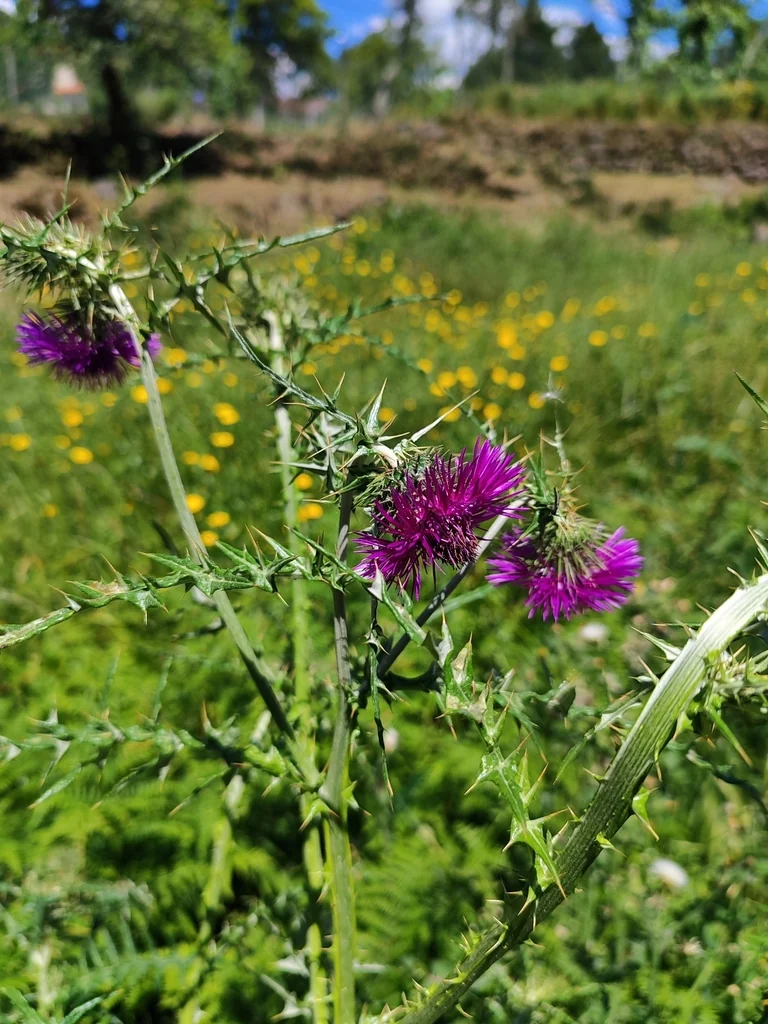
Flowers and leaves of Galactites tomentous, photographed on Pedraça on 10 May 2024. Register of georeferenced flora; it is not a view of the settlement.
ⓘAmong the bridges and stories of Nuno Álvares Pereira, discover Pedraça.
Administrative name: Pedraça
A selection of what is documented in the guide. Confirm visiting conditions in the charts.
Slide to see more places →
A religious and landscape reference mentioned in the presentation of Pedraça.
PedraçaA house associated with local narratives about Nuno Álvares Pereira and Leonor de Alvim.
PedraçaSanta Marinha, a bell tower and a portrait of Pedraça in the memoirs of 1758.
PedraçaAmong the valleys of Tâmega and Peio, the history of Pedraça is also told by the work: the cultivation of flax and the crafts of wood appear in the municipal characterization.
The municipal presentation relates the designation Pedraces to the Inquiries of 1258.
The memory of Nuno Álvares Pereira and Leonor de Alvim is associated with Casa de Pedraça.
Knowledge, landscapes and memories linked to this parish.
Choose from 15 activities here →
3 guides with stories from here → · To follow a story by chapters.
A winter dish with roots in rural life.
Panos and quilts are also heritage.
In the 1258 inquiries, it appears as Pedraços.
The cabbages with migas used the tender leaves of spring.
A small portion of mass attached one batch to the next.
The kitchen had the work schedule.
A recipe learned from Grandma of Cavez.
The flour broth took place in January and February.
Wine soups are part of the food memory collected in Cavez and Pedraça.
A family gesture kept the old pot alive.
Meal names also save other rhythms.
Not all of the bread's memory begins in corn.
The batch was also done with attention to what was seen.
The kitchen connects people, generations and parishes.
The same mass could have another destination.
In the scrambled, dessert is born in the pot.
Two pitchers, two documented capabilities.
Learning from someone else is also part of the heritage.
Local knowledge gets into the shoe design.
The inventory records more than the form of an object.
Souto do Rego guardes the passage from water to electricity.
In 1758, the parish priest's choice pointed out to the council.
Beyond the church, there is a housing landscape.
The tradition of the Constable deserves to be counted as tradition.
We don't have any revised events here yet. Go back to the schedule to find out the schedule available.
Among the bridges and stories of Nuno Álvares Pereira, discover Pedraça. The connection of the constable and Leonor de Alvim to Casa de Pedraça belongs to the local tradition. The matrix, the bridge of Pontinha and Santa Barbara are other references to look at the heritage and landscape of the parish.
Among the valleys of Tâmega and Peio, the history of Pedraça is also told by the work: the cultivation of flax and the crafts of wood appear in the municipal characterization. Church, cruises, alminhas and bridges add small and great references to this landscape of agricultural tradition.
The municipal presentation relates the designation Pedraços with the Inquisitions of 1258. In the relation of 1758, the parish appears in the municipality of Cabeceiras de Basto, with matrix dedicated to Santa Marinha and presentation of the rector linked to the college of São Jerónimo de Coimbra. They are documents of different times, useful to study names, institutions and power relations.
The memory of Nuno Álvares Pereira and Leonor de Alvim is associated with Casa de Pedraça. The report of a picket used by the Constable is presented as a local tradition, without converting it into proof of the use of that space. Santa Bárbara is a reference of devotion and landscape, along with Santa Marinha and São Gonçalo. The bridges known as Roman require their own study to fix their chronology.
In addition to the news of 1758, the municipal page refers to an obligation relating to the conservation of the hermitage of Santa Bárbara in 1624. The reference adds a documental landmark to the devotion and place recognized today as a viewpoint. It does not determine the initial date of construction of the temple nor shows that the building fully preserves the six-century configuration. The reading made in this research is from the transcribed reference, without examination of the original document.
The Casa de Parada, which the municipality is characterized by Brazilian taste, joins the houses of the Paço, the Baron of Basto and Paço de Vila in the housing landscape. On another scale, the Alminhas da Ponte de Tábuas and the cruise mark references of devotion along the paths. The cultivation of flax and wood milling allow to complete the reading of the territory with the memory of work, beyond the tradition linked to the Constable.
Pedraça · Holy Waters · Stopping · Board Bridge
This list preserves the places referred to in the selected documentation, without constituting a complete census.
Getting to know the history of the municipality
Main source consulted in 04/11/2026.
Publication at that source: Unidentified. Registered documentary verification: 2026-11-04.
Method recorded in that review: Documental review in 04/11/2026 of the municipal pages, historical transcripts and references indicated. Unglued manuscripts. Archivistic descriptions, studies of oral tradition and dated observations are identified. Visually revised photographs from the Commons archive consulted in 03/11/2026; camera position does not equal object survey. Photo revised in 04/11/2026: position of capture/cross observation with CAOP2025; subject, author, date and individual license identified. No face-to-face confirmation.
Editorial review: 2026-11-06. The editorial review is neither a visit to the site nor a real-time update. Additional times and sources may have their own consultation dates, indicated in the form.
Did you find any different information? Suggest correction