What is hidden inside a chestnut burr?
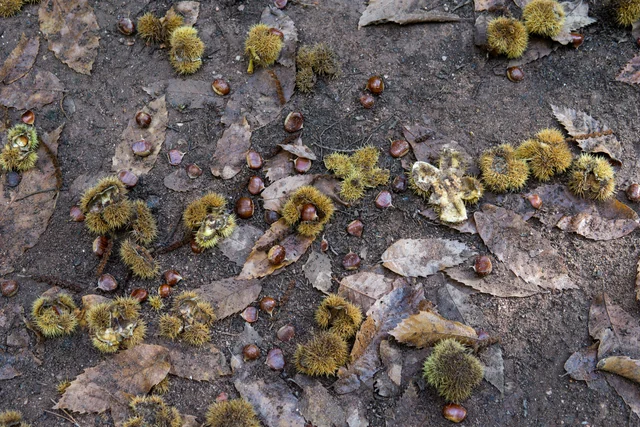

About this photograph
Date given at source: . Source consulted in 2026-11-07. EXIF orientation, proportional resizing and WebP conversion; no retouching or clipping of the file.
The chestnut is the fruit; the burr encloses the cluster.
Explore this story
Your choice is saved only in this browser.
Castanea sativa sheds its leaves in the unfavourable season and can grow into a large tree. The Castelo Branco Polytechnic profile describes narrow yellow flowers in long hanging spikes. Later, chestnuts develop together inside a prickly burr: the chestnut is the fruit, while the burr encloses the cluster.
Notice the layers: the shiny brown covering belongs to the fruit; inside there is usually one seed, with a yellowish skin. The tree also had a place in workshops: the source mentions wood used in carpentry, cabinetmaking, basketry and woodturning. These are general characteristics and uses, without attributing a workshop or individual tree to the municipality.
Flowers come before the burr. UTAD’s Digital Flora gives May and June as the species’ flowering period. This is a general botanical reference, not a prediction for a tree in Cabeceiras: compare photographs of the same tree on different dates to learn its rhythm. A tree without chestnuts on a spring visit tells a different story from an open burr in autumn.
Chestnut belongs to the Fagaceae family, the same broad botanical family as oaks. Comparing their fruits shows that kinship does not mean identical appearance: return to the oak story and look for what surrounds the acorn, then revisit the chestnut’s layers.
From Gold to Seed
Opens each layer to realize what involves what.
1 · The hedgehog
It is the structure that involves the set of chestnuts.
2 · Chestnut
It's the fruit.
3 · The seed
There is usually one in each chestnut, with a yellowish film.
From tree to memory of meals →
Source and context
Polytechnic Institute of Castelo Branco — botanical record of Castanea sativa
UTAD Botanical Garden — Castanea sativa, Flora Digital de Portugal
Accessed: . Editorial summary; the date of consultation is not the date of the facts.