Discover Cabeceiras de BastoFree independent guide
ViveCabeceirasYOUR GUIDE TO CABECEIRAS
ENEnglish
SearchSaved

Stories of Cabeceiras

Choose a story to start with. You can change the subject or fine tune the search.

46 stories · All themes · Search: vinho

The flavours of Cabeceiras

From the garden to the pot, from the oven to the table.

Choose a story · 27
Vila Nune · feed in 1758

There was wine, but you bought bread

A small difference reveals how the table was supplied.

Includes an activity to try →Explore: Produce, buy, transform →
Read here and view sources

In 1758, the vicar of Vila Nune pointed the wine as the most abundant production, but said that almost all the residents bought bread. Olive oil arrived for the population and there was little chestnut left. The table therefore depended on both the crops and the purchases.

In the same memory, the parish priest described a land situated in a small valley and on the descent of mountains. The abundance of a product did not mean producing everything that was eaten. The document allows making this comparison, but does not say where the bread was bought or how much it cost.

Getting to know the parish
Source and context

Municipality — Parish Memoirs of Vila Nune, 23/05/1758

Accessed: . Editorial summary; the date of consultation is not the date of the facts.
Outeiro · 2013 collection

The red wine also reached the sweet

A version of French toast held in Outeiro.

Explore: The bread also arrives for dessert →View ingredients and preparation →
Read here and view sources

In this version of Dídia Teixeira, of Pans, the bread passes by the red green wine and the egg before being fried. Sugar and cinnamon accompany the layers in the platter.

Fátima Magalhães collected the recipe in 2013; the Museum published it in 2014, associating it to Christmas and New Year. It is an identified version with which it counted, without presenting it as the recipe for all houses of Outeiro.

Source and context

Basto Land Museum — Wine French toast (2014; 2013)

Accessed: . Editorial summary; the date of consultation is not the date of the facts.

Santa Senhorinha · agricultural production described in 1758

Bread, wine and oil filled the portrait of the earth

The parochial memory also spoke of what was being harvested.

Includes an activity to try →
Read here and view sources

In the response of 1758, the abbot of Santa Senhorinha highlighted bread, wine and olive oil among the most abundant productions and praised the variety of fruits. The document allows to bring the table closer to the work of the fields. It does not list here the varieties, cereals or fruit varieties: this detail should not be added by assumption.

Source and context

Municipality — Memória de Santa Senhorinha, 23/05/1758, replies 15, 19 and 20; transcription of José Viriato Capela (2003)

Accessed: . Editorial summary; the date of consultation is not the date of the facts.

Moimenta, Cavez · landscape of the vineyard

The vineyard climbs the hillside

Before the wine reaches the table, there is a landscape to discover.

Includes an activity to try →Explore: The vineyard has more than one story →
Read here and view sources

In Moimenta, Cavez, the vineyards occupy terraces on the slopes of a sheltered valley. The municipal description connects this landscape to the production of green wine. Looking at the steps on the ground is another way to know the wine culture. The visits to Thursdays and the tastings depend on the conditions of each space.

The municipal guide presents the terraces as a dominant mark of the slopes and also highlights the Casa do Valle and Casa da Ponte. The vineyard does not appear isolated: it is part of a village with built heritage, agriculture and livestock. This framework helps to look beyond the bottle and recognize the work inscribed on the ground.

The landscape, however, does not reveal alone the variety of each plot. To continue, it compares the names of the grapes described in the other readings of Basto with the utensils used in the harvest. They are different clues to know the wine culture.

Getting to know the parish
Source and context

Municipality — Village Guide of Serra da Cabreira: landscape, work and heritage
Accessed:

Municipality — parish of Cavez and places of Moimenta
Accessed:

Editorial summary; the date of consultation is not the date of the facts.

Food memory · testimony of 2011

A snack with bread still warm

Wine soups are part of the food memory collected in Cavez and Pedraça.

Read here and view sources

In a testimony collected in February, 2011 by Maria de Fátima Carvalho, Maria da Conceição Gonçalves Mouta recalls a winter meal made with bread, green wine and sugar. It was preferred the bread out of the oven; on other occasions, a slice was heated in the coals. It is a familiar memory published by the Museum of Lands of Basto.

The occasion is part of the story as well as the ingredients: the collection situated the lunch in the middle of the afternoon and associated it with the winter. The bread connected the meal to the rhythm of the oven or the use of embers. The learning came from the grandmother of Cavez; the report was recorded with the granddaughter resident in Recovos, showing a family transmission between places.

Source and context

Basto Land Museum — testimony of Maria da Conceição Gonçalves Mouta, collected by Maria de Fátima Carvalho in 2011

Accessed: . Editorial summary; the date of consultation is not the date of the facts.

Green wines · regional diversity

Green can also be red

The name of the region is not the color of the wine.

Explore: Behind the names of the wine →
Read here and view sources

The region of Vinho Verdes produces white, pink and red. The regional commission highlights Vinhão by its intense color, sometimes close to violet. Thus, the expression Vinho Verde does not mean that all wines are white. It is an introduction to regional diversity, without assigning characteristics or certifications to a concrete bottle.

Diversity goes beyond the best known varieties. CVRVV refers to varieties that have lost space in the vineyards, among them Batoca, Amaral and Borraçal, and describes a work of recovery developed by researchers and producers. The objectives include conserving the genetic heritage, diversifying the wines and keeping more options before climate changes.

An unusual name can thus open an important story. In Basto, Borraçal is also known as Bogalhal or Eye of frog. They are names linked to the same variety, while Vinhão is another variety. Distinguishing region, caste and local name helps to better read the memories of the vineyard.

Source and context

CVRVV — Vinhos Verdes: Borraçal, Vinhão and regional diversity

Accessed: . Editorial summary; the date of consultation is not the date of the facts.

Faia · agriculture and food memory

At Faia, the fruit also counts

Cherries, wine and olive oil help you discover this agricultural landscape.

Includes an activity to try →Explore: From fruit to containers →
Read here and view sources

The municipal presentation highlights the cherry in agriculture of Faia and associates the parish with the production of wine. The tannaria, linked to wooden containers, adds a artisanal dimension to this agricultural landscape.

In May 1758, the abbot described a greater abundance of wine, fruit and olive oil than cereal. The two sources allow different seasons to approach, but do not tell an exact continuity of cultures: the ancient document speaks of fruit in general, without identifying cherries. Comparing them is a way to discover as much as we know and what remains to be clarified.

Getting to know the parish
Source and context

Council — Faia
Accessed:

Municipality — Parish memories of Faia, 23/05/1758, transcript of José Viriato Chapel (2003)
Accessed:

Editorial summary; the date of consultation is not the date of the facts.

Regional context · wine sub-region of Basto

Summer also chooses grapes

In the vineyard, relief and seasons are part of history.

Read here and view sources

The Viticulture Commission describes Basto as the most inland sub-region of the Green Wines, protected from maritime influence. Cold and rainy winters follow hot and dry summers. These conditions favor later ripening varieties, such as Azal, Espadeiro and Rabo-de-Anho. It is a regional reading: it does not describe the time of a specific year or the conditions of all plots of Cabeceiras. But it helps to look at a hillside with vines and realize that each harvest begins long before the harvest.

Source and context

CVRVV — Learn all about the Green Wine Region, sub-region of Basto, PDF sheet 17

Accessed: . Editorial summary; the date of consultation is not the date of the facts.

Wine culture · regional context

This Baker grows in the vineyard

A family name can hide a caste.

Read here and view sources

Baker of Basto is one of the names of the ink Baker variety, according to the Viticulture Commission of the Green Wine Region. The same source includes it among the sub-region varieties of Basto, next to others such as Espadeiro and Vinhão. Names keep clues of the wine culture, but do not allow to conclude that a grape variety exists only in one place. After Pé de Perdiz, another name to find out when talking about vineyards and harvests.

Source and context

CVRVV — Castas: Baker / Baker of Basto and sub-region of Basto

Accessed: . Editorial summary; the date of consultation is not the date of the facts.

Sub-region Basto · vine cultivation

Cheat: a caste that likes company

A name particularly linked to the sub-region of Basto.

Explore: Compare three varieties of Basto →
Read here and view sources

The Viticulture Commission describes Batoca as a grape variety grown mainly in Basto. It produces large bunches, but the production is irregular. It usually appears in white batch wines, combined with Arinto or Azal; it is rare to use it alone. A bottle can therefore gather different varieties. The regional link does not identify the varieties planted in a concrete farm of Cabeceiras.

The chart describes a large and clear sheet, with a reddish area at the beginning of the ribs. It refers to medium maturation; Azal, on the contrary, is late. Sharing the region does not mean having the same calendar. That is why meeting several grape varieties makes the landscape of the vineyard more interesting than a simple green spot.

Also the names travel: the record records Alvaraça in the Douro, Espadeiro Branco in Lousada and Sedouro or Sá Douro in the south of the region. They are not new castes added to the lot; they are designations of Batoca in different places.

Source and context

CVRVV — Technical data sheets of the varieties Batoca and Azal

Accessed: . Editorial summary; the date of consultation is not the date of the facts.

Area of Basto · traditional names of grape varieties

Toad-eye, but in the vineyard

A caste can have several names.

Read here and view sources

The Viticulture Commission of the Green Wine Region identifies Bogalhal and Sapo-Eye as names of the Borraçal ink variety used in the area of Basto. In other lands there are different designations. This vocabulary brings the vineyard closer to local language: a name heard in a conversation can hide a known variety. The reference is regional, without identifying a portion or producer of Cabeceiras.

In the botanical description, Borraçal presents small bunches and berries of unequal size. Compare with Arinto: it may also have small berries, but its bunches are large. These pictures help ask questions; an isolated similarity in a photograph does not identify a caste.

Source and context

CVRVV — Vinhos Verdes: Borraçal, Vinhão and regional diversity

Accessed: . Editorial summary; the date of consultation is not the date of the facts.

Sweets · contest of 2019

The beans also arrive for dessert

Miguelitos have a history with a date and author.

Read here and view sources

The Miguelitos de Alice da Conceição de Magalhães Alves won the Sweet Cabeceirense Contest, announced on Casa do Tempo in 18 May 2019. The municipal news describes a preparation wrapped with yellow beans, flour and green wine, stuffed with eggs and honey. The contest was part of the Monastery of Emotions program. In February 2020, the Municipality again highlighted them as dessert of the Gastronomy Weekend, next to the stew as the main dish. The candy thus passed from the competition to the promotion of the head table; the news does not confirm current availability.

Source and context

Municipality — Miguelitos win the Sweet Head Competition, 20/05/2019
Accessed:

Municipality — Gastronomic Weekend announcement, 07/02/2020
Accessed:

Editorial summary; the date of consultation is not the date of the facts.

Products referred to by the Municipality

Bread, smoke and honey

Tastes that invite you to know what the earth produces.

Explore: Pick a flavor and follow your story →
Read here and view sources

The municipal gastronomic presentation highlights the broa, the smoker, the Mel of Basto and the wines of the region. They are starting points to discover the relationship between agriculture, food conservation and minhota table. The presence in this selection does not mean that all restaurants have these products daily.

Source and context

Municipality — gastronomy

Accessed: . Editorial summary; the date of consultation is not the date of the facts.

Local and regional cuisine

A taste of Minho

Veal, rojões, cod, and sahrabulho.

Explore: Before choosing the dish →
Read here and view sources

These specialties are part of the municipal description of local gastronomy, accompanied by the reference to green wines. The goat of the Highlands of Minho and the meats Barrosã and Maronena are also part of this regional repertoire. It is worth asking for the specialty of the house and the availability of the day.

Source and context

Municipality — gastronomy

Accessed: . Editorial summary; the date of consultation is not the date of the facts.

Rio Douro · agriculture in 1758

From valley to hill, the harvest changed

The landscape also chose the pantry.

Includes an activity to try →Explore: Follow the landscape to the pantry →
Read here and view sources

In Rio Douro, the report of 1758 distinguishes the production of the places by the rivers from the places of mount. To the first associates millions, wine, chestnut and acorn; to the second, rye. The landscape also helps to read the pantry.

In describing the shores, the parish priest refers to fields with oaks and vines and, where there were no fields, woods of heather. The same document depicts cold, windy mountains and with snow in winter. They are historical descriptions that allow to relate cultivation and land, without constituting a current agricultural or climatic survey.

Getting to know the parish
Source and context

Municipality of Cabeceiras de Basto — Parish memories of 1758: Rio Douro

Accessed: . Editorial summary; the date of consultation is not the date of the facts.

Cabeceiras · Vine vocabulary

Perdiz foot, but in the vineyard

The same caste can change its name from earth to earth.

Includes an activity to try →
Read here and view sources

The Committee of Green Wines identifies Pé de Perdiz as a name of Arinto in Cabeceiras de Basto. It also mentions Pedernã in the region and Perdigão in Mondim. Knowing these names helps to hear the stories of the vineyard: a local designation does not in itself mean a different variety.

The CVRVV portrait adds large and compact bunches, with small berries. The grape variety enters both wines made only with Arinto and in combinations of white grape varieties. Traditional name, grape appearance and wine composition are three different clues to explore the same story.

Source and context

Viticulture Commission of the Green Wine Region — Grape varieties, chart Arinto

Accessed: . Editorial summary; the date of consultation is not the date of the facts.

Bucos · testimony of 1758

Three cereals in the same landscape

The storeroom of Bucos did not depend on one grain.

Includes an activity to try →Explore: From grain to mill →
Read here and view sources

The parish priest of 1758 lists target corn, million and rye, saying that they were produced in similar proportions. He also mentions some wine and little chestnut. It is the agricultural portrait he left in writing, not a description of the current crops.

And where were the grains transformed? In the same memory, António Alves Teixeira describes mills in the two water courses of the parish and farmers that carried the cereal there. The document allows to link the list of crops to the milling, although not detail recipes nor the division of each cereal between food and other uses. The date, 22 May 1758, marks the moment of the report: the proportions mentioned are an appreciation of the vicar, not a weighing of a harvest.

Getting to know the parish
Source and context

Municipality — Parish memories of Bucos (1758)

Accessed: . Editorial summary; the date of consultation is not the date of the facts.

Gastronomy in Arco de Baúlhe · 2016 episode

School name chips

A curious name can also open a story at the table.

Read here and view sources

The School's Potatoes were among the dishes featured at a dinner of gastronomic promotion held in 17 November 2016, at restaurant O Caneiro, in Arco de Baúlhe. The municipal news brings them the roasted octopus in the oven and the cabbages with beans. It is a documented episode of the dissemination of local flavors; the source does not explain the origin of the name or confirms the current menu.

The news also allows reconstituting the end of the meal: Sinado da Avão, cavacas and rosquilhos, followed by liquors from Casa de Encosturas and infusions produced in the municipality. The dishes were added local green wines, white and red. Published in 21 November, the report shows how a dinner brought together cuisine, producers and promotion of the territory. It does not present the recipes: the name of a dessert, by itself, does not reveal its ingredients.

Source and context

Municipality — City Hall promotes gastronomy in Premium Dinner, 21/11/2016

Accessed: . Editorial summary; the date of consultation is not the date of the facts.

Alvite · written account from 1758

In the fields, there was more than corn

A crop list opens the landscape of 1758.

Includes an activity to try →Explore: Follow the cereal, change the source →
Read here and view sources

The million appears as the most abundant cereal in Alvite’s memory of 1758. But the list continues with rye, target corn, millet, wheat and barley. The parish priest adds beans, hanged wine, olive oil, chestnut, land and fruit.

The enumeration shows a diverse agriculture; it does not give quantities of each harvest. Compare it to Bucos, where the report describes another relationship between cereals. The documents allow to recognize differences without turning impressions of the parish priests into modern statistics.

The same report places part of the parish on the slopes of Senhora da Orada and another part in a more flat zone, accompanying a small course of water. The list of products thus gains a scenario: fields distributed by different positions in the relief. The text does not, however, relate each culture with a concrete portion.

There is also a difference between harvest and meal. Knowing that cereals, beans, wine or olive oil were produced does not reveal the recipe served in a given house. To get to the kitchen, other sources, such as family memories and preparations documented on the site, must be added.

Source and context

Municipality — Memory of Alvite, 23/05/1758; transcription of José Viriato Chapel (2003)

Accessed: . Editorial summary; the date of consultation is not the date of the facts.

Saint Nicholas · agriculture described in 1758

Not all the cereal was the same

Rye, target corn and million appear side by side in the old account.

Includes an activity to try →Explore: What held the table? →
Read here and view sources

In 1758, the parish priest of São Nicolau distinguishes rye, target corn and million among the crops. He adds wine, olive oil, chestnuts and other fruits, describing a production to support the growers. In speaking of the fields on the hills, he highlights mainly rye. The variety of words invites to read the agriculture of the past without reducing all the cereals to a single crop.

The report places the fields in the low areas, among mountains that separated the places. The water entered this organization: mentions mills, dams and levadas that served fields and farms. Cultivating was not only choosing a seed; it also depended on the land and access to water.

For the animals of labor, the farmers turned to the hills for part of the year, for lack of pasture in the fields, collecting them at night. Read together, these passages show fields, mountains, animals and water as parts of the same rural life. They are observations of the parish priest in 1758, not quantities of production or current agricultural rules.

Source and context

Basto Land Museum — St Nicholas Parish Memories (1758)

Accessed: . Editorial summary; the date of consultation is not the date of the facts.

Local gastronomy · publication of 2025

These quails come from the tree

A winter dessert with a name that arouses curiosity.

Explore: From dessert to village trees →View ingredients and preparation →
Read here and view sources

The presentation of Cabeceiras in the Gastronomic Weekends of 2025 identifies quails as a local fruit linked to winter traditions. In the described preparation, they are roasted in the coals until they soften and serve hot, peeled, with red or wine-free green wine. It is a way to discover the fruit through the cooking gestures. The recipe documents a gastronomic proposal; it does not guarantee that it is available daily in restaurants.

Source and context

Porto and North Tourism — Gastronomic Weekends 2025, December, Section Cabeceiras de Basto (p. 3 of the PDF)

Accessed: . Editorial summary; the date of consultation is not the date of the facts.

Sub-region Basto · characteristics of Azal

A ripe grape can remain green

In Azal, color doesn't tell the whole story.

Explore: One vineyard, several clues →
Read here and view sources

Azal is a late-maturing white variety, adapted to dry and well-exposed land from the interior of the region of the Vinhos Verdes, including Basto. The technical file describes compact bunches that maintain a greenish even mature tone. Looking only at the color is not enough to decide whether the harvest time has come.

The adult leaf is rounded and thick, with regular teeth and quite pilosity on the lower face. The curl has a lateral branch, described as wing. These clues show why the description of a caste brings together leaves, curls and development phases, rather than being limited to the color of the grapes.

Azal has a long cycle: the fiche distinguishes early bloom from late maturation. One early start phase does not mean that all others also do so. The caste can be used alone or in batch wines with Arinto, Batoca and Loureiro; recognizing a variety in the landscape and knowing the composition of a wine remains different questions.

Words in this story: see explanations →
Source and context

CVRVV — Technical data sheets of the varieties Batoca and Azal

Accessed: . Editorial summary; the date of consultation is not the date of the facts.

Cabeceiras · gastronomic promotion of March 2012

Honey also sweetens French toast

A sweet helps count the promotion of local flavors.

Includes an activity to try →Explore: A bread, different desserts →View ingredients and preparation →
Read here and view sources

In the gastronomic program from 23 to 25 March 2012, Cabeceiras presented the roasted goat as a specialty and the French toast with honey as regional sweet. The municipal announcement also associates the table with green wine, meat and honey. This combination shows how gastronomic dissemination brings products and preparations together. It is the historical program of that edition, not a current menu nor an assignment of exclusive origin of French toast to the municipality.

The 2015 guide adds a preparation with milk and honey. Compare it to the wine version of Dídia Teixeira: the same name can store different recipes.

Source and context

Municipality — Gastronomic Weekends, 23–25/03/2012

Porto and North Tourism — Gastronomic Weekends 2014/2015, Cabeceiras de Basto, pp. 60–61 (PDF sheet 32), Municipal copy of Mondim Basto

Accessed: . Editorial summary; the date of consultation is not the date of the facts.

Pedraça · testimony collected in 2011

The bread also made the feast

In the scrambled, dessert is born in the pot.

Includes an activity to try →Explore: Three Ways to Bring Bread to the Feast →View ingredients and preparation →
Read here and view sources

A dessert of bread for Christmas and New Year, with honey, dried fruits and Port.

Fatima Magalhães collected this version in 2011 from Maria da Conceição Gonçalves Mouta, born in Cavez and residing in Pedraça. The Museum published it in 2016.

The preparation sequence gives the bread a leading role: it enters small pieces, after the dried fruit, and thickens the prepared as it moves. The lemon peel and cinnamon stick join the water and honey at the beginning; the cinnamon powder finishes the sweet in the dish.

This version keeps measurements of different natures: liters, a cup and quantities left to the taste of the cooker. The record keeps that difference. The collection does not provide portions or weights for all ingredients, so the recipe was not converted into an invented precision formula.

Source and context

Land Museum of Basto — Scrambled (2016; collection of 2011)

Accessed: . Editorial summary; the date of consultation is not the date of the facts.

Refojos · kitchen memory collected by the Museum

The hanger was held on Sunday

A recipe of Refojos also holds a weekly habit.

Includes an activity to try →Explore: At the table of who told the recipe →View ingredients and preparation →
Read here and view sources

On Sunday, the cabidela took place in the kitchen described by Isabel Sousa, a natural and resident in Refojos. In the version she shared, the chicken accompanies the rice; onion, garlic, blonde and parsley enter the seasoning, along with white wine, blood and vinegar. The publication also keeps words of preparation, such as the strut and testus.

Conceição Magalhães collected the recipe in 2013, and the Museum published it in October 2014. The indication of Sunday gives the dish a place in the family calendar, but does not establish a rule for the whole municipality. It is the voice of an identified cook, with an occasion and a way of telling what he was doing.

Words in this story: see explanations →
Source and context

Basto Land Museum — The hanger was held on Sunday, publication of 10/10/2014

Accessed: . Editorial summary; the date of consultation is not the date of the facts.

Refojos · kitchen memory collected by the Museum

A recipe learned at parties

Shroud popes also tell how knowledge circulates.

Includes an activity to try →Explore: The word popes holds differences →View ingredients and preparation →
Read here and view sources

Maria Helena da Mota Lopes da Silva Almeida, resident in Refojos since childhood, told that she had learned these popes in the early 21st century. The master was a cook from Porto who came to Cabeceiras to work in baptisms and marriages. The parties were also places where techniques and recipes were learned.

The version collected in June 2011 combines different meats, cornmeal, cooked pig blood, red wine and cumin. The report situates the preparation in winter until the end of March. The publication, July of that year, documents the transmission of a knowledge and its usual time; it does not indicate a menu available today.

Source and context

Basto Land Museum — A recipe learned at parties, publication of 06/07/2011

Accessed: . Editorial summary; the date of consultation is not the date of the facts.

Abadim · agriculture described in 1758

In the same parish, the harvest changed

In 1758, the cold separated two agricultural landscapes.

Includes an activity to try →
Read here and view sources

In the memory of Abadim, José Antunes distinguishes the fields of the Village of the Tower and Santo António from those of Travassô, Porto d’Olho and Torrinheiras. In the first two places, it lists corn, millet and rye, as well as wine, olive oil, chestnut and oak acorn.

In the three places that he describes as colder, he highlights rye and little corn. The document approaches climate, relief and food: what was harvested was not the same in the whole parish. It does not present harvest weights nor allows to calculate the production per inhabitant.

The author also places Torrinheiras at the top of the hill and Porto d’Olho and Travassô at half a hillside. Its description helps to relate the names to positions in the landscape, without providing measured altitudes. In the mountain grounds it mentions heather, carquejas, tojos, and some pasture. The agricultural portrait therefore includes cultures and forest spaces: the parish does not appear as a single uniform field.

Source and context

Municipality — Parish memories of Abadim, José Antunes, 22/05/1758

Accessed: . Editorial summary; the date of consultation is not the date of the facts.

Crafts and memories

In the hands, at the table and in the community: little stories of how one lives and what one transmits.

Choose a story · 14
crafts · Faia, Basto and Refojos

The wood also keeps the wine

Pipes, barrels and barrels tell a business story.

Includes an activity to try →
Read here and view sources

The municipality associates these works to Faia and also refers to tannaria in Basto and Refojos. The container is part of the wine culture as much as the vineyard. In the Ethnographic Court of 24 September 2023, dedicated to the arts and crafts, Faia introduced the oil tankers. The municipal news shows how this knowledge was also chosen to represent the parish at a collective party. The episode does not confirm the existence of a visitable workshop today. The presentation of the parish adds the manual manufacture of footwear to its craft traditions. The wood of wine containers is thus part of a more varied working memory, without identifying today's artisans or workshops here.

To understand how a container is built, it is worth knowing two words of the craft. The Lourinhã Museum identifies the trims and rims as central elements: wooden pieces form the body, while the rims involve them. The description highlights the work of the curvature and thickness of the trims. It is a general explanation of the tannaria, used here to read the objects; it does not document the sequence of manufacture of a workshop of Faia.

When looking at a pipe, look for the vertical lines between pieces and the rims that cross the set. Compare later with the wooden base of a punch: a material can be cluttered to support a foot or worked on several pieces to form a volume. The finished object holds shape, fit and use decisions.

Words in this story: see explanations →Getting to know the parish
Source and context

Municipality — crafts and services of the parishes

Municipality — Arts and Crafts in the Ethnographic Court, news of 25/09/2023

Municipality — presentation of Faia: settlement and traditional activities

Lourinhã Museum — Tanoeiro, elements and work of the plasters; general technical context

Accessed: . Editorial summary; the date of consultation is not the date of the facts.

Refojos · flavours described in 1956

New chestnuts and clay mugs

The memory of the party also has flavors.

Includes an activity to try →
Read here and view sources

In the description of 1956 published by the Museum, the food establishments and tents were filled. Regional wine accompanied new lunches or chestnuts, served in glassy white clay mugs. They are details of a chronicle that brings the fair closer to its daily gestures.

The table appears in the middle of a moving fair. The chronicle evokes groups crossing paths, buses and trains, blankets coming from Barroso and the arrival of people in the Alameda do Seco and the Praça da República. Eating and drinking were part of this meeting, alongside the trade, the religious festival and the livestock contest.

There are two dates to be kept: the quoted text came out in the newspaper in 16 September 1956; the Museum re-disclosed it in 26 September 2024. The excerpt has the expressive language of a chronicle, does not present visitor counts or meals sold. By comparing it with the memory of dried nuts in crops, we discover the same fruit in different occasions and forms of conservation.

Source and context

Basto Land Museum — St Michael of other times, 26/09/2024; excerpts from The Journal of Cabeceiras of 16/09/1956 and 08/09/1977

Accessed: . Editorial summary; the date of consultation is not the date of the facts.

Arco de Baúlhe and Refojos · history of trade

When the metal sheet was forming

From the workshop came objects to the house, the countryside and the fair.

Explore: What was the metal for? →
Read here and view sources

João Pacheco, no Arco de Baúlhe, and Luziário Pereira de Magalhães, with their son António, in Refojos, are protagonists in the investigation of the Museum on lattice. The workshop of Luziário and António was in the Beco dos Ofícios; the nearby fair was the main point of sale. Teresa Soeiro relates the decline of craft with the diffusion of aluminum and plastic.

The inventory brings this work closer to everyday gestures: the MTB 241 copper mug served to make coffee, the MTB 240 cantara contained water and the lamps lit. The functions are documented for identified pieces. Knowing the objects helps to understand the workshop, but the collection does not confirm that these craftsmen or establishments continue in activity.

Teresa Soeiro's investigation gave rise to the exhibition The Art of lattice in Cabeceiras de Basto, in the Museum's facilities in Arco de Baúlhe. The work retreated to the artisans who began using white iron, or flander leaf, at the beginning of the Modern Era. The collection of the last professional routes was thus linked to a longer history of materials.

The objects reveal the variety of tasks: lighting a house, transporting wine, watering plants or storing oil for a locomotive. The craft passed through the house, field and transport. Comparing these functions helps to discover metallurgical work in gestures that seem to belong to separate worlds.

Words in this story: see explanations →Getting to know the parish
Source and context

Basto Land Museum — Latoaria, Teresa Soeiro text and inventory of pieces

Accessed: . Editorial summary; the date of consultation is not the date of the facts.

Cavez · rural economy in 1758

The mountains also gave coal

In Cavez, the memory of 1758 connects forests to fuel.

Includes an activity to try →Explore: The landscape had several jobs →
Read here and view sources

The parish priest of Cavez refers to carqueja, heather and other wood in the mountains and marks the abundant production of coal. In the same portrait, he describes corn, rye and green wine, of which was made brandy. Fields and woods entered into different works and products.

The memory allows to link vegetation to an economic activity, but does not explain how coal trees were built, where they stayed or who worked there. It also does not allow to calculate production. Separate what the text tells of these open questions makes the portrait more faithful: abundance is the appreciation of the author of 1758.

Getting to know the parish
Source and context

Municipality of Cabeceiras de Basto — Parish memories of 1758: Cavez

Accessed: . Editorial summary; the date of consultation is not the date of the facts.

Pedraça and Basto · material culture

Carry and measure in the same container

Two pitchers, two documented capabilities.

Includes an activity to try →Explore: Name doesn't say full capacity →
Read here and view sources

The inventory of the Museum distinguishes two pieces of zinc foil: the cantaro L 16, Pedraça, 12, and the cantara L 62, Devesa, Basto, with seven. Both measured and transported wine.

The capabilities belong to these objects, not to a universal measure. Comparing them shows why the name of a container is not enough to know how much it takes.

The dimensions add a surprise: the 12 liter cantaro is 46 cm high and 16,7 in diameter; the seven-litre cantara is lower, with 34,5 cm, but it is 23,3 in diameter. A larger width does not in itself mean more capacity.

The inventory associates the first piece to Fátima Magalhães, from Pedraça, and the second to Álvaro Magalhães, from Devesa. They are registered owners, not an attribution of authorship. These names help connect the objects to the people who kept them.

Getting to know the parish
Source and context

Basto Land Museum — Latoaria, Teresa Soeiro text and inventory of pieces

Accessed: . Editorial summary; the date of consultation is not the date of the facts.

Material memory · Basto (Santa Senhorinha)

A funnel also made dark circles

The kitchen needed tools with very own functions.

Includes an activity to try →
Read here and view sources

The zinc foil funnel L 65 was used to make bales. The inventory connects it to Devesa, Basto, and records 6,1 cm high and 12 in diameter.

In the same collection there are funnels intended to transfer wine. The word funnel gathers objects with different functions; this form does not document a recipe or confirms current exposure.

Source and context

Basto Land Museum — Latoaria, Teresa Soeiro text and inventory of pieces

Accessed: . Editorial summary; the date of consultation is not the date of the facts.

Land Museum Collection of Basto

A “gum” for the harvest

The name of a play may be a little surprise.

Includes an activity to try →
Read here and view sources

The MTB 437 “tumour” of the Basto Land Museum served to cut grape clusters. It is zinc foil and measures 4,5 cm high. The inventory documents the utensil, without explaining how it was used or attributed to it a village of origin.

The registered diameter is 2,7 centimeters: a small piece, with a very specific task. Name, function and dimensions give different clues. ‘Unha’ is the inventory name; cutting curls is the documented use.

The chart links the work of the vineyard to the craft of transforming metal. By going to the stories of the grape varieties and wine containers, we changed the scale: from a small tool to the plant, the harvest and the circulation of the product.

Source and context

Basto Land Museum — Latoaria, Teresa Soeiro text and inventory of pieces

Accessed: . Editorial summary; the date of consultation is not the date of the facts.

Cabeceiras de Basto · cooperative history since 1996

Land products also bring people together

A cooperative links flavors to rural work.

Read here and view sources

The Municipality is located in 1996 the foundation of RuralBasto, created in Cabeceiras and extended to the other municipalities of the region. The presentation distinguishes a marketing section, which includes honey, wine, bread, tobacco and other products, and a forest section. The history of flavors also goes through these forms of cooperation. The institutional description does not confirm the current stock, time or conditions of sale.

Source and context

Municipality — AgroFlorestal Development Cooperative of Basto RuralBasto

Accessed: . Editorial summary; the date of consultation is not the date of the facts.

Collection of the Basto Land Museum · everyday utensils

A blue sprinkler counts work

Taking care of plants also left objects in memory.

Read here and view sources

The MTB 441 sprinkler is made of zinc plate, is painted in blue and measures 57 cm long. The Basto Land Museum records its function: watering plants. The piece helps connect the history of the canopy to the work with the vegetation, but the plug does not identify the garden or field where it was used.

The inventory also registers 40 cm high and 24 deep. They are external dimensions, not a capacity in liters. The blue color belongs to the description of this concrete piece; it does not define the appearance of all sprinklers made by the canners.

In the same collection, other containers carry liquids for different purposes. The sprinkler allows you to start a comparison: what changes when the destination of the water is a plant, when you measure wine or when you store oil for a machine?

Source and context

Basto Land Museum — Latoaria, inventory of objects

Accessed: . Editorial summary; the date of consultation is not the date of the facts.

Pedraça · inventoried object 2015

One almude, two colors in memory

The inventory records more than the form of an object.

Includes an activity to try →
Read here and view sources

The Almude L023, associated with the Casa de Passo de Vides, in Pedraça, served to transport and measure wine. The plug of 2015 gives it 28 liters and describes zinc plate painted brown, with paint to peel; the original color was blue. The capacity belongs to this invented piece, not to all almudes. Even a layer of paint helps to tell the life of an object.

The record indicates 55 cm tall and 28 in diameter and identifies Jacqueline Vilela Passos as owner. External measurement, capacity and property are distinct information: joints make the description more useful than the name of the object alone.

The brown painting and the traces of blue also show that a piece may have been transformed throughout use. The inventory does not give the date of repainting. The observation of the ink allows to count a change, but does not reconstruct all the episodes of the almude's life.

Source and context

Basto Land Museum — Latoaria in Cabeceiras de Basto (05/11/2015), L023

Accessed: . Editorial summary; the date of consultation is not the date of the facts.

Lands of Basto · everyday objects

Two funnels, close tasks

A familiar form can hold different uses.

Includes an activity to try →Explore: Transfer, measure and serve →
Read here and view sources

In the inventory of 2016, the L63 funnel appears linked to the transfer of wine; the L18, to the passage of liquids between containers. Both of them are zinc foil. Reading the registered function avoids guessing the use only by form. Compare them to the muffler funnel: a similar object can enter another task.

The L63 is 17 cm tall and 17,7 in diameter; the L18 is smaller, 12,5 cm tall and ten cm in diameter. The inventory associates the first to Álvaro Magalhães, from the place of Devesa, Basto, and the second to Maria da Conceição Magalhães, no Arco de Baúlhe. These are data from registered owners, not indications of who manufactured the parts.

Measures, material and function make the comparison more concrete. A larger diameter does not in itself reveal how many liters passed through the funnel or what work was done in a given house.

Source and context

Basto Land Museum — Latoaria in Cabeceiras de Basto V (18/01/2016), L63, L18 and MSRM88

Accessed: . Editorial summary; the date of consultation is not the date of the facts.

Basto Land Museum · inventory published in 2016

Two containers to carry the light

Before lighting up, we had to transport the oil.

Explore: Liquids with different tasks →
Read here and view sources

The inventory published by the Museum in January 2016 presents two oil almotolias, identified as MTB 436 and MTB 226. The function recorded is to transport oil. Both are metal and have the same dimensions indicated: 17,5 cm in height and ten in diameter.

The coincidence of the measures does not transform two pieces into one. Each inventory number allows distinguishing the object and associating it with its record. The Basto Land Museum appears as owner of both; the text does not indicate manufacturer, production date or home where they were used.

It is a way of looking backstage at lighting: besides the lamp, there were containers to carry the fuel. This reading documents historical objects without proposing their current use.

Source and context

Basto Land Museum — Latoaria in Cabeceiras de Basto V, 18/01/2016, MTB 436 and MTB 226

Accessed: . Editorial summary; the date of consultation is not the date of the facts.

Arco de Baúlhe · material culture

A cantar to measure brandy

The same name could accompany different functions and capabilities.

Read here and view sources

The L19 cantara of the inventory of the Basto Land Museum was a measure of spirits with a capacity of five liters. Made of zinc foil, it is 37 cm tall and 15 in diameter. The record identifies as owner Maria da Conceição Gonçalves de Magalhães, Arco de Baúlhe.

Compare it to the seven-litre cantara used in wine: the name approximates the pieces, but the function and capacity distinguishes them. The numbers belong to these documented objects, not to a universal conversion of the word cantara.

Source and context

Basto Land Museum — Latoaria, Teresa Soeiro text and inventory of pieces

Accessed: . Editorial summary; the date of consultation is not the date of the facts.

Faia · tradition referred to by the municipality

At Faia, hands also made shoes

Between the vineyard and the wood, there's another trade to find out.

Explore: Three Ways by Crafts →
Read here and view sources

The municipal presentation of the Faia includes the manual manufacture of footwear among the artisan traditions of the parish, next to the tannaria. It is a clue to look at the local economy beyond the fields: we also worked with our hands to produce everyday objects.

The source does not identify workshops, craftsmen or footwear models. Therefore, this reference does not allow you to choose a current store or claim that it was punches or clogs. This question remains open. Compared to the documented stories of soles and tampons from other parishes helps to realize how much a craft name can hide from materials, techniques and people.

Source and context

Council — Faia

Accessed: . Editorial summary; the date of consultation is not the date of the facts.

Between rivers and mountains

Water and relief form the municipality. Choose a name and follow the landscape.

Choose a story · 3
Holy Lady · memory of 1758

The river entered the life of the fields

A cultivated margin also tells history.

Includes an activity to try →Explore: One river, four stories →
Read here and view sources

The memory of 1758 describes the river of Santa Senhorinha running all year round, but with little water in summer. The memory describes cultivated shores, fruit trees and wild grove, linking water to irrigation and rural work.

Vila de Lobos and Cainhos had olive oil mills; the mills are referred to in Vila de Lobos and Sestelo. The same description allows following various uses of the river: to cultivate, grind and transform the olive. It does not confirm which of these equipment survive or operate today.

Unlike the precipitated currents described in São Nicolau, the abbot characterizes this river as quiet and oriented from sunset to spring. He begins his journey in Aboim and lists the passage by Várzea Cova, Passos and St Clemente before arriving in Santa Senhorinha. It is the geography reported in the document, not a current demarcation of the course.

The use of water for the fields is presented as free for residents. The relationship was signed on 23 May 1758. This detail is important: the indication of little water in the summer describes a pattern known to the author, not an observation made in the summer of this year.

Words in this story: see explanations →
Source and context

Municipality — Memória de Santa Senhorinha, 23/05/1758; transcript of José Viriato Chapel (2003)

Accessed: . Editorial summary; the date of consultation is not the date of the facts.

Landscape and garden · Painzela

The water draws the garden of Piellas

Among the carved bushes, there are other ways to go.

Includes an activity to try →Explore: The garden within the landscape →
Read here and view sources

In Piellas, the water helps to connect garden, forest and fields. The description published by Jardins Magazine places a tank in L next to the wall, close to a passage to the forest of Casa do Boal. Another tank, surrounded by bamboos and buxos, opens for a cultivation field surrounded by forest. The water goes to the stream of Painzela.

The article also describes paths shaded by ramadas and an agricultural courtyard associated with the old production of corn and wine. The farm therefore gathers recreational spaces and work spaces: the garden of carved shrubs is part of a wider landscape.

Try to imagine the fifth in layers: the levels, paths, vegetation and the water system. The description allows to relate these elements, but does not provide a complete map of the hydraulic circuit. Piellas is a private property; the visiting conditions should be consulted on the site's chart.

See Fact sheet: Casa de Pielas, jardins e anexos
Source and context

Jardins Magazine — Gardens of Portugal: Route of the Tâmega, section Casa de Piellas

Accessed: . Editorial summary; the date of consultation is not the date of the facts.

Saint Nicholas · hydraulic heritage inventoryed in 2008

A log led the force of the water

In Quinta de Covas, the history of olive oil intersects with that of energy.

Explore: Water changes work →
Read here and view sources

The inventory of 27 of February 2008 located the mill of Quinta de Covas in Parada, in the parish of Cabeceiras de Basto. The water came from a levada with a weir in Peio. Before arriving to the castor, it passed through a gutter excavated in a trunk: wood was also part of this hydraulic construction.

The building brought together an olive oil mill, a mill and a wine mill. The form associates the decommissioning of the mill and the mill in 1994 to the entry into operation of a hydroelectric power station, which conditioned the available motor force. It is the explanation recorded in that survey, not an independent evaluation of the operation of the plant.

The document describes private heritage and equipment already without the necessary elements for grinding. This story does not indicate public access or current conditions of conservation.

Source and context

Municipality — inventory of olive oil mills, record L.A.5, withdrawal of 27/02/2008

Accessed: . Editorial summary; the date of consultation is not the date of the facts.

Time travel

Documents, details and traditions: there is more to discover than a date on a stone.

Choose a story · 2
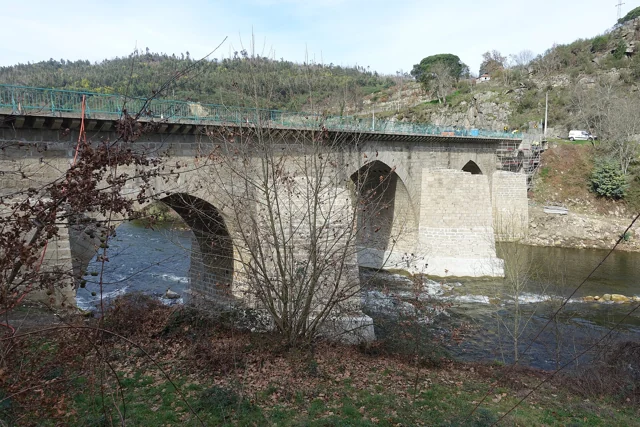
Local legend · Ponte de Cavez

The voice that had built above

Ponte de Cavez on the river Tâmega, with stone arches, board and wooded banks.
Ponte de Cavez on the Tâmega · the monument to which legend refers.© Joseolgonⓘ

Around the bridge, memory also invented paths.

Includes an activity to try →
Read here and view sources

The legend published by the Museum makes the masons try to build the bridge in Vila Franca and then by the Poço das Laranjeiras. In both places, a supernatural voice sent up the river. Tradition attributed it to Saint Bartholomew.

On the third attempt, the narrative places the work next to the chapel. It is a story about the memory of the place, not documentary proof of the choice of the site or an itinerary to look for the episodes.

In another passage of the tradition collected by the Museum, the food of the builders gains a miraculous explanation: there are sources of water, wine and olive oil and fish appear in the river. The narrative associates the effort of construction to religious protection. Reading it alongside the history of the works allows to know two different ways of telling the same place.

See Fact sheet: Ponte de Cavez See Fact sheet: Capela de São Bartolomeu de Cavez
Source and context

Land Museum of Basto — Ponte de Cavez, 27/02/2022

Accessed: . Editorial summary; the date of consultation is not the date of the facts.

Vila Nune · settlement described in 1758

A parish, many small places

Telling neighbors wasn't the same as counting people.

Includes an activity to try →Explore: Places, people and paths →
Read here and view sources

In May 1758, the vicar of Vila Nune registered 55 neighbors and 239 people. He numbered fourteen places, some with only one resident, and marked uninhabited houses in the place of Serra.

These numbers describe different categories of the document. They should not be added or confused with a current census. The small scale of the places helps imagine a scattered settlement, observed from the parish.

The enumeration allows to approach the look: Silva assigns eight neighbors; to Vale and Rossada, five to each. Fojães and Ribeira da Covilhã appear with one resident. The church was in Granja, near the Valley. The religious center was not confused, therefore, with the place called Vila Nune.

The vicar Domingos Leite de Andrade adds that there were unmarried women in poverty between neighbors and people from other parishes. It is the social description of an author and of a time, without allowing the life of each person to be reconstructed. By preserving the terms and date, the document allows different domestic conditions to be observed within the small places.

Source and context

Municipality — Parish Memoirs of Vila Nune, 23/05/1758

Accessed: . Editorial summary; the date of consultation is not the date of the facts.

YOUR LOCAL GUIDE

What would you like to discover?

Take a closer look.