Five arches, more than a while
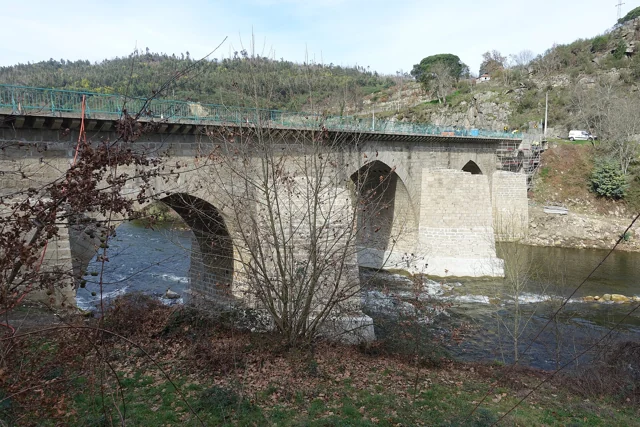

An old bridge didn't stop in history.
Explore this story
Your choice is saved only in this browser.
Three broken central arches and two perfect back, next to the banks: the Ponte de Cavez brings together different shapes and times. The Museum located the medieval construction in the second half of the 13th century, at the service of the road between Braga and Vila Pouca de Aguiar.
The source attributes the round arches to the works of Philip II's reign and mentions a landmark of 1599. In the 19th century, the road between Fafe and Vila Pouca de Aguiar brought the enlargement of the board. Watching the bridge is looking for changes to an ancient crossing.
According to the Museum, the stone bridge replaced a previous wooden, then degraded. The construction is attributed to Frei Lourenço Mendes, Dominican who gathered alms for the work; the museological text mentions testimonial legacies as support of this connection. The crossing thus involves materials, paths and ways to finance a collective work.
A crossing, several seasons
It opens every moment and discovers what the date represents.
Second half of the 13th century · Medieval construction
The stone bridge serves the link between Braga and Vila Pouca de Aguiar.
1599 · A milestone
The Museum associates this milestone with changes in the Filipino period.
1758 · The look of the vicar
The parochial memory praises Ponte Grande: it is a historical appreciation.
19th Century · Extend the passage
The board is extended with the road from Fafe to Vila Pouca de Aguiar.
1910 · National Monument
The bridge receives the classification referred to by the sources.
2018–2019 · Handle the structure
Intervention in foundations, board and drainage, completed according to the April news of 2019.
Source and context
Land Museum of Basto — Ponte de Cavez, 27/02/2022
Municipality of Cabeceiras de Basto — Parish memories of 1758: Cavez
Municipality — conclusion of rehabilitation of Ponte de Cavez, 30/04/2019
Accessed: . Editorial summary; the date of consultation is not the date of the facts.