Discover Cabeceiras de BastoFree independent guide
ViveCabeceirasYOUR GUIDE TO CABECEIRAS
ENEnglish
SearchSaved

Stories of Cabeceiras

Choose a story to start with. You can change the subject or fine tune the search.

29 leituras · Todos os temas · Cavez

The flavours of Cabeceiras

From the garden to the pot, from the oven to the table.

Escolher uma história · 7
Local gastronomic tradition

Beans

A winter dish with roots in rural life.

Explorar: Uma cozinha, diferentes momentos →Ver ingredientes e preparação →
Read here and consult sources

Cabeceiras chose beans for the Minho Gastronomic Reference. The description connects kale and yellow beans, also called miller, to the fireplace kitchen. At the fullest meals, the cooking water of pork and sausages enriched the dish. The Museum also retains a family version collected in February 2010: Maria da Conceição Gonçalves Mouta, a native of Cavez and resident in Pedraça, had learned the dish from her grandmother. In this preparation, the cabbages and potatoes used the cooking water of beans and meat; the olive oil was added to the table.

Source and context

Gastronomic Reference of Minho — Cabeceiras, pp. 214–215
Accessed:

Basto Land Museum — food collections, 2010 and 2011
Accessed:

Editorial summary; the date of consultation is not the date of the facts.
Oral memory · Cavez and Pedraça

Carnival also went to the pot

A recipe learned from Grandma of Cavez.

Explorar: O Carnaval e os sabores da família →Ver ingredientes e preparação →
Read here and consult sources

Orilheira, gruelos and potatoes composed the carnival meal remembered by Maria da Conceição in February 2011. It is a documented family memory, not a menu available all year round. Potatoes and grells cooked in the water of the meat; the earpiece returned to the container at the end, before serving with olive oil.

The collection allows us to follow the passage between generations: Maria da Conceição was born in Cavez and lived in Recovos, Pedraça; she had learned this dish from her grandmother. In 2011, the gas stove and stainless steel pots were already part of her kitchen, while the fireplace was present on special occasions. The testimony shows a tradition that coexists with changes in utensils.

Source and context

Museum of Lands of Basto — Golden Ear (17/03/2011), Maria da Conceição Gonçalves Mouta; collection of Mary of Fatima Magalhães in February 2011

Accessed: . Editorial summary; the date of consultation is not the date of the facts.
Moimenta, Cavez · landscape of the vineyard

The vineyard climbs the hillside

Before the wine reaches the table, there is a landscape to discover.

Inclui uma atividade para experimentar →Explorar: A vinha tem mais de uma história →
Read here and consult sources

In Moimenta, Cavez, the vineyards occupy terraces on the slopes of a sheltered valley. The municipal description connects this landscape to the production of green wine. Looking at the steps on the ground is another way to know the wine culture. The visits to Thursdays and the tastings depend on the conditions of each space.

The municipal guide presents the terraces as a dominant mark of the slopes and also highlights the Casa do Valle and Casa da Ponte. The vineyard does not appear isolated: it is part of a village with built heritage, agriculture and livestock. This framework helps to look beyond the bottle and recognize the work inscribed on the ground.

The landscape, however, does not reveal alone the variety of each plot. To continue, it compares the names of the grapes described in the other readings of Basto with the utensils used in the harvest. They are different clues to know the wine culture.

Getting to know the parish
Source and context

Municipality — Village Guide of Serra da Cabreira: landscape, work and heritage
Accessed:

Municipality — parish of Cavez and places of Moimenta
Accessed:

Editorial summary; the date of consultation is not the date of the facts.

Food memory · testimony of 2011

A snack with bread still warm

Wine soups are part of the food memory collected in Cavez and Pedraça.

Read here and consult sources

In a testimony collected in February, 2011 by Maria de Fátima Carvalho, Maria da Conceição Gonçalves Mouta recalls a winter meal made with bread, green wine and sugar. It was preferred the bread out of the oven; on other occasions, a slice was heated in the coals. It is a familiar memory published by the Museum of Lands of Basto.

The occasion is part of the story as well as the ingredients: the collection situated the lunch in the middle of the afternoon and associated it with the winter. The bread connected the meal to the rhythm of the oven or the use of embers. The learning came from the grandmother of Cavez; the report was recorded with the granddaughter resident in Recovos, showing a family transmission between places.

Source and context

Basto Land Museum — testimony of Maria da Conceição Gonçalves Mouta, collected by Maria de Fátima Carvalho in 2011

Accessed: . Editorial summary; the date of consultation is not the date of the facts.

Cavez and Pedraça · transmission of recipe, 2011

A recipe also has someone who teaches it

The kitchen connects people, generations and parishes.

Inclui uma atividade para experimentar →Explorar: Quem trouxe esta receita? →
Read here and consult sources

In the collections of the Museum, Maria da Conceição Gonçalves Mouta, a native of Cavez and resident in Recovos, Pedraça, identifies who transmitted the dishes. The cabbages with migas came from the grandmother, from Cavez; the broth of chestnuts, from the mother-in-law, from Pedraça. Maria de Fátima Carvalho recorded these testimonies in February 2011. Names help to realize that this memory belongs to a concrete family experience.

Source and context

Basto Land Museum — food and food: collections of February and March 2011

Accessed: . Editorial summary; the date of consultation is not the date of the facts.

Cavez · tasting in 2013

Cavacas and roschilos, by the hands of those who know

Nazaré Oliveira showed how she made her sweets at a local history meeting.

Inclui uma atividade para experimentar →
Read here and consult sources

In May 2013, the Land Museum of Basto led the participants of the Meeting Memoirs of the Territory to know local heritage and knowledge. In Arosa, Nazaré Oliveira, sweetener of Cavez, presented the confection of their cavacas and their rosquinhos, which visitors could prove. The account keeps the name of those who did and shared this knowledge. It documents that demonstration; it does not announce a workshop or a current selling point.

Source and context

Basto Land Museum — Memoirs of the Territory: 3st Local History Meeting, news of 24/05/2013

Accessed: . Editorial summary; the date of consultation is not the date of the facts.

Arosa, Cavez · May meeting 2013

After the dance, a welcome table

Hospitality was also recorded in the memory of Arosa.

Read here and consult sources

The local history meeting in May 2013 ended at the headquarters of the Folklorico Ranch The Peasants of Arosa. According to the Museum, they danced the elements of the ranch and the visitors. The reception included homemade bread, ham, olives, salt onion and allegory. This episode shows a table linked to the conviviality, in addition to the recipes: it is the record of a concrete occasion, without defining a permanent menu.

Source and context

Basto Land Museum — Memoirs of the Territory: 3st Local History Meeting, news of 24/05/2013

Accessed: . Editorial summary; the date of consultation is not the date of the facts.

The life you don't always see

Knowing animals begins by perceiving the territory and respecting the distance.

Escolher uma história · 10
Cavez · 2016–2017 monitoring

Six species under the surface

A sample shows a small portrait of the Tâmega in Cavez.

Inclui uma atividade para experimentar →Explorar: Conhece os seis peixes do levantamento →
Read here and consult sources

At station 22, the report of 2016–2017 registered barbo-common, Northern boga-do-north, northern scale, embroidery, gobium and sunroof. The chart places the station in Cavez. These results document that campaign: they are neither a current inventory nor an indication of places to fish.

The six names open six ways to look at the river. The barb leads to migration in fresh water; the boga, the differences between young and adults; the scale, the drawing of scales. The embroidery and the gobium help to explore the food. The sunbath introduces the question of geographical origin. It opens the cards to choose one of these clues and get to the explanation of the species.

Sampling and biological datasheets have different functions.The survey documents the fish registered in that place and period.The datasheets explain the general characteristics of the species, without demonstrating that all these behaviors were observed in Cavez.

Getting to know the parish
Source and context

Biosphere / Iberdrola, APA file — Monitoring of ichthyofauna 2016–2017, February 2018; pp. 5, 35 and 40, station record 22 on p. 175 PDF
Accessed:

Mora Fluviary — Barbo-common, biology of the species
Accessed:

Municipality of Santa Maria da Feira — Northern Boga, fauna catalogue
Accessed:

Arouca Geopark — Northern scale, Squalius carolitertii: description and biology
Accessed:

ICNF — embroidery, ecology and riverside vegetation, pp. 2–3 (bibliography up to 2005)
Accessed:

Gaia Biological Park — Gobio, Gobio lozanoi: habitat, food and size
Accessed:

Águeda River Interpretation Center — Sun Loss
Accessed:

Editorial summary; the date of consultation is not the date of the facts.

Species biology · trace recorded in Cavez

At nightfall, a bird looks like an insect

Not all birds are discovered with eyes in the sky.

Inclui uma atividade para experimentar →
Read here and consult sources

The noitibo-European feeds on insects and goes into activity at dusk and at night. Its continuous singing can remember the sound of a cicada. In Portugal it is a summer bird, mainly associated to the north and the transition between forest and open spaces. The Cavez record shows a sentence attributed to this species by the iNaturalist community. It is a trace: it is not a photograph of the entire bird, nor does it prove the existence of a nest at that point. Curiosity begins in a feather and continues in the sound landscape.

The long wings and tail can be perceived in silhouette, but the little light hides details. Aves de Portugal’s record explains that females do not show white spots on the wings of males; juveniles do not have them either. The absence of a brand alone does not solve age and sex.

The source describes a late arrival and the easiest corner to detect in May and June. It is a Portuguese standard, not an agenda of sightings in Cavez. The recorded penalty does not allow to know when the bird sang, where it nested or how long it remained in the zone.

In order to know travel, investigators need another type of registration. The BTO presents follow-up studies that have located an important winter area in grass and shrub landscapes south of the equatorial forest, especially in the Democratic Republic of Congo. It is information on birds accompanied by those studies, not the proven destination of the specimen associated with the sentence of Cavez. A penalty documents a trace in one place; the follow-up allows you to connect positions over time and study movements.

Source and context

Poultry of Portugal — Caprimulgus europaeus

British Trust for Ornithology — BirdFacts: Nightjar, Caprimulgus europaeus; follow-up and winter studies

Accessed: . Editorial summary; the date of consultation is not the date of the facts.

Cavez · 2016–2017 registration and general biology

A fish can migrate without going to sea

The common barbeque makes its journey into the river.

Explorar: O mesmo rio, diferentes maneiras de viver →
Read here and consult sources

The Mora Fluviary describes the breeding migration of the common barb, Luciobarbus bocagei, to shallow and well-oxygenated waters, on sand, gravel or gravel. It is a trip in fresh water. It feeds on small animals from the bottom, plant matter and debris. The barb was registered in Cavez in the 2016–2017 campaign; the description of its behavior is general biology, not a migration observed at this point.

The trip does not contradict the preference for areas of weaker current and moderate temperature. The place used to live and feed may differ from the one chosen for reproduction. The Fluviary file places the latter between May and June, as a general description of the species.

The barbo is omnivorous: besides the invertebrates of the bottom and vegetable matter, it can occasionally eat small fish. The same source says it can reach about one meter. It is a possible dimension of the species, not the size measured in the specimens of Cavez.

Palavras desta história: ver explicações →
Source and context

Mora Fluviary — Barbo-common, biology of the species
Accessed:

Biosphere / Iberdrola, APA file — Monitoring of ichthyofauna 2016–2017, February 2018; pp. 5, 35 and 40, station record 22 on p. 175 PDF
Accessed:

Editorial summary; the date of consultation is not the date of the facts.

Cavez · 2016–2017 registration and general biology

The preferred current changes with age

For a young boga, a quiet area can make a difference.

Explorar: O mesmo rio, diferentes maneiras de viver →
Read here and consult sources

The Northern boga, Pseudochondrostoma duriense, is a species of the Iberian Peninsula. Santa Maria da Feira's municipal record describes adults in sections of strong current and juveniles that prefer waters of lower current and thin backgrounds. It also refers to upstream movements before reproduction. The Cavez record of 2016–2017 confirms the species in that sample; it does not describe the age or behavior of the specimens.

There is a clue in the mouth: the lower lip is right and has a well developed corneal blade. The body may have small dark spots. These features complement the history of the habitat; they do not replace a careful identification of the fish.

The municipal source places migrations upstream between March and June and indicates an approximate longevity of six years. Amount means moving towards the spring. The calendar and life span describe the species in general, without dating a shift or determining the age of the fish sampled at Tâmega.

Palavras desta história: ver explicações →
Source and context

Municipality of Santa Maria da Feira — Northern Boga, fauna catalogue
Accessed:

Biosphere / Iberdrola, APA file — Monitoring of ichthyofauna 2016–2017, February 2018; pp. 5, 35 and 40, station record 22 on p. 175 PDF
Accessed:

Editorial summary; the date of consultation is not the date of the facts.

Cavez · 2016–2017 registration and general biology

Not all the fish from the river came from here.

Sunshine tells an introduction story.

Explorar: O mesmo rio, diferentes maneiras de viver →
Read here and consult sources

Sunshine, Lepomis gibbosus, is originally from North America. The Interpretation Center of the River of Águeda describes it as an exotic species, of high body and flattened laterally, which lives in still waters but also in rivers. In breeding season, males may hinder access by juveniles of native species to the shore shelters. It was registered in Cavez in 2016–2017; this record does not measure its local impact.

The bluish bands from the head to the flanks and a dark spot on the tip of the pearl are part of the description. In juveniles, the pattern is simpler, on a greenish or olivaceous background. Age also changes appearance.

The menu includes insects, crustaceans, sea snails, and fish larvae. This diversity helps to realize that food is not limited to a single prey. The chart also distinguishes lentic environments, such as albufeiras, from exotic environments, such as rivers and streams: the species can use both. The geographical origin, presence in a survey and the effect on other species are different information.

Palavras desta história: ver explicações →
Source and context

Águeda River Interpretation Center — Sun Loss
Accessed:

Biosphere / Iberdrola, APA file — Monitoring of ichthyofauna 2016–2017, February 2018; pp. 5, 35 and 40, station record 22 on p. 175 PDF
Accessed:

Editorial summary; the date of consultation is not the date of the facts.

Cavez · 2016–2017 registration and general biology

A fish's menu also has insects

Feeding connects life in and out of water.

Inclui uma atividade para experimentar →Explorar: Quem se alimenta de quê? →
Read here and consult sources

The chart of the ICNF describes the embroidery, complex Squalius alburnoids, as a consumer mainly of insect larvae. In summer and early autumn, it refers to higher consumption of terrestrial insects. It is a small link between the river and its margins. The embroidery appears in the study of Cavez of 2016–2017 under the name Iberocypris alburnoides; the local study did not analyze this seasonal change in feeding.

The same chart describes the use of rivers and streams with diverse characteristics, including small and shallow courses with emerging aquatic vegetation. The habitat is not only water: shelters, vegetation and alternation of zones with different current speeds enter history.

Therefore, a margin totally devoid of vegetation changes more than the view. The chart associates the loss of riverside vegetation with the reduction of shade, shelter and feeding sites. These general ecological relationships help to interpret the river; they are not a current evaluation of a section of Cavez. The local record of 2016–2017 and the biological explanation answer different questions: where the fish was documented and how it relates to the environment.

Source and context

ICNF — embroidery, ecology and riverside vegetation, pp. 2–3 (bibliography up to 2005)
Accessed:

Biosphere / Iberdrola, APA file — Monitoring of ichthyofauna 2016–2017, February 2018; pp. 5, 35 and 40, station record 22 on p. 175 PDF
Accessed:

Editorial summary; the date of consultation is not the date of the facts.

Cavez · 2016–2017 registration and general biology

A fish with a net of scales

On the northern scale, the dark margins of the scales draw a pattern.

Inclui uma atividade para experimentar →
Read here and consult sources

The record of Arouca Geopark describes Squalius carolitertii with elongated body, large and rounded head and scales of darker margins, which create a cross-linked appearance. It presents it as an Iberian endemism: its natural distribution belongs to the Iberian Peninsula, not only to Cabeceiras.

The description refers to mountain and plain rivers, remembering that a species can occupy different contexts along the river network. They are general characteristics, useful to know the fish; they are not enough to identify a specimen from a distance.

The local link comes from another source: the Northern scale is included in the Cavez sampling of 2016–2017. The report documents this survey without establishing current presence or abundance.

Geopark’s chart points to a maximum length of 25 cm and a breeding season between April and June. In the description of the fins, the dorsal has a straight profile and the anal, convex profile. These are details for comparison in an appropriate illustration or photograph, not dimensions or dates measured in the Cavez campaign. The fusiform body — wider in the central area and tapered at the ends — completes this small reading of the shape.

Palavras desta história: ver explicações →
Source and context

Arouca Geopark — Northern scale, Squalius carolitertii: description and biology
Accessed:

Biosphere / Iberdrola, APA file — Monitoring of ichthyofauna 2016–2017, February 2018; pp. 5, 35 and 40, station record 22 on p. 175 PDF
Accessed:

Editorial summary; the date of consultation is not the date of the facts.

Cavez · 2016–2017 registration and general biology

A small fish, many small prey

The gobium links the life of the river to the invertebrates.

Read here and consult sources

The Gaia Biological Park describes Gobio lozanoi as a freshwater river fish that feeds on small invertebrates and usually measures about 12 centimeters. It is a usual dimension indicated in this chart, not the size of all individuals nor a measure collected in Cabeceiras.

In the survey of Cavez of 2016–2017, the gobium is among the six registered species. Adding this evidence to the description of the feed helps to ask a question about the river: which small animals support the fish? The record does not identify the prey consumed at that point or prove a relationship with each insect presented on this site.

Source and context

Gaia Biological Park — Gobio, Gobio lozanoi: habitat, food and size
Accessed:

Biosphere / Iberdrola, APA file — Monitoring of ichthyofauna 2016–2017, February 2018; pp. 5, 35 and 40, station record 22 on p. 175 PDF
Accessed:

Editorial summary; the date of consultation is not the date of the facts.

Cavez · local register and general biology

A long tail by the water

The grey alveola leads to curiosity to the shore.

Inclui uma atividade para experimentar →Explorar: A margem tem várias histórias →
Read here and consult sources

In the photograph of David Matos, the bird is located next to the water and a rocky surface. The record of 12 August 2024 is located in Cavez, at the intersection of the public point with CAOP2025, and is identified as Motacilla cinerea. The long tail and yellow at the bottom are visible details in this image.

The BTO describes a species mainly linked to rapid watercourses, which also uses slower rivers and shores of lakes and ponds, looking for aquatic insects. The environment is more than a scenario: it can offer food. The local photograph does not show a capture, so it does not allow to say what this bird ate at that meeting.

Compare the watermelon: two birds linked to watercourses may have very different ways of looking for food.

Source and context

British Trust for Ornithology — Grey Wagtail

Accessed: . Editorial summary; the date of consultation is not the date of the facts.

Cavez · local register and general biology

A shell, lots of drawings

Not all snails of the same species wear the same pattern.

Inclui uma atividade para experimentar →
Read here and consult sources

João Lima photographed this snail in 15 May 2024. The record is identified as Cepaea nemoralis and the published point is in Cavez, at the intersection with the limits CAOP2025. In the image, the dark bands accompany the turns of the shell between wet leaves.

The Carnegie Museum of Natural History describes a shell that can have bands of different widths or not present bands. The edge of the opening is usually brown, but not always. The species can also be confused with Cepaea hortensis. Color, drawing and shape need to be seen together; a photograph that hides the opening leaves part of the clues out of sight.

Try to follow the spiral with your eyes.

Source and context

Carnegie Museum of Natural History — Cepaea nemoralis

Accessed: . Editorial summary; the date of consultation is not the date of the facts.

Read the landscape through the plants

Trees, forests, vineyards and fields reveal different ways of occupying the territory.

Escolher uma história · 1
Local register · Cavez · general botany

The thimble likes the banks of the forest

Not every plant in the woods is looking for its interior.

Inclui uma atividade para experimentar →Explorar: Olhar para a planta inteira →
Read here and consult sources

The Flora-On describes Digitalis purpurea subsp. purpurea on the shores and clearings of woods and shrubs, including some slopes and hedges. It prefers cool and dark places. It helps to understand how light and moisture create different environments even close to each other. The plant is toxic by ingestion: knowing it does not mean using it as food.

Flora-On separates two subspecies with different ecological descriptions. For the purpurea subspecies, it refers to general preference for silicious substrates. For amandiana, it highlights rocky environments and shallow soils, including escarpments, shallow outcrops and slopes of abandoned vineyards.

This difference avoids treating all thimbles as inhabitants of a single scenario. Finding a flower in a clearing is not enough to give it a subspecies: ecology guides questions, but does not replace botanical characteristics. The chart also records the possibility of parasitism by Orobanche amethystea, showing that a plant also participates in relationships with other plants.

The photograph of João Lima, registered in 2026-06-15, shows this species in Cavez. Opens the register to compare the visible details with the botanical description. The observation documents this encounter; does not indicate that the plant is always visible in the same place. The record identifies Digitalis purpurea, without confirming a subspecies.

Palavras desta história: ver explicações →
Source and context

Portuguese Society of Botany, Flora-On — Digitalis purpurea, ecology and toxicity

iNaturalist — Digitalis purpurea, João Lima observation in 2026-06-15

Accessed: . Editorial summary; the date of consultation is not the date of the facts.

Between rivers and mountains

Water and relief form the municipality. Choose a name and follow the landscape.

Escolher uma história · 1
Cavez · landscape described in 1758

A river that moved but did not water

The water nearby was not always accessible water.

Inclui uma atividade para experimentar →
Read here and consult sources

In 1758, the Tâmega was described in Cavez as a caudal river throughout the year, with a particularly strong current in winter. It had dams, canals and cereal mills. On the banks, the report pointed out cultivated areas, olive groves and trees that supported vineyards.

Despite this presence in agricultural life, the vicar said that the river did not water the fields of the parish: it ran too deep to allow levadas. It is an important difference between having water nearby and being able to lead it to a portion. The description shows how the relief conditioned the uses of water at that time; it does not characterize the current irrigation.

Getting to know the parish
Source and context

Municipality of Cabeceiras de Basto — Parish memories of 1758: Cavez

Accessed: . Editorial summary; the date of consultation is not the date of the facts.

Crafts and memories

In the hands, at the table and in the community: little stories of how one lives and what one transmits.

Escolher uma história · 4
Cavez · rural economy in 1758

The mountains also gave coal

In Cavez, the memory of 1758 connects forests to fuel.

Inclui uma atividade para experimentar →Explorar: A paisagem tinha vários trabalhos →
Read here and consult sources

The parish priest of Cavez refers to carqueja, heather and other wood in the mountains and marks the abundant production of coal. In the same portrait, he describes corn, rye and green wine, of which was made brandy. Fields and woods entered into different works and products.

The memory allows to link vegetation to an economic activity, but does not explain how coal trees were built, where they stayed or who worked there. It also does not allow to calculate production. Separate what the text tells of these open questions makes the portrait more faithful: abundance is the appreciation of the author of 1758.

Getting to know the parish
Source and context

Municipality of Cabeceiras de Basto — Parish memories of 1758: Cavez

Accessed: . Editorial summary; the date of consultation is not the date of the facts.

Cavez · inventoried object

The candy also had luggage

A metal box connected the work to the parties.

Inclui uma atividade para experimentar →
Read here and consult sources

The metal box L 104, of Joaquina Basto, of Arosa, Cavez, carried sweets for parties. Media 88 cm long, 45,5 height and 43,5 width.

The measurements help imagine the backstage of the party; the inventory does not identify the content of each trip or the weight charged.

The number L 104 allows you to recognize this box in the inventory and distinguish it from other containers. The chart associates a name, a location, a material and a function. Instead of showing only the ready candy, this object draws attention to the transport that the party required.

Compares its length to its height: the box was much longer than high. You can draw a scale rectangle to imagine the space occupied, without deducing how many sweets it took. The inventory records external dimensions, not a useful capacity or a weight.

Getting to know the parish
Source and context

Basto Land Museum — Latoaria, Teresa Soeiro text and inventory of pieces

Accessed: . Editorial summary; the date of consultation is not the date of the facts.

Cavez and Basto · material culture

The light fit into a small piece

The lamps tell another story about the house.

Inclui uma atividade para experimentar →
Read here and consult sources

Two candeias of the House of the Bridge, in Cavez, appear in the inventory with heights of 46 and 17 centimeters. The lamp of hanging oil L 53, of the Devesa, Basto, is of flandre leaf and measures 27 centimeters.

The common function was to illuminate, but the pieces did not all have the same size or configuration. The record allows you to compare them without assuming how they were placed in each house.

Getting to know the parish
Source and context

Basto Land Museum — Latoaria, Teresa Soeiro text and inventory of pieces

Accessed: . Editorial summary; the date of consultation is not the date of the facts.

Cavez · Rome account published in 1886

# To Rome with the punches in his hand #

Wearing shoes wasn't always wearing them.

Inclui uma atividade para experimentar →
Read here and consult sources

Teresa Soeiro recovers a description of José Augusto Vieira, published in 1886: among the romeiros of St. Bartholomew of Cavez, there were women who carried the shoes in hand. The episode gives a human detail to the journey and recalls habits of saving and convenience. It is a historical testimony, not a description of the current pilgrimage.

In the introduction to the study, Teresa Soeiro relates wooden footwear with rural paths and agricultural work in the Northwest. It refers to reinforcements on the floor with metal parts and, more recently, rubber reused from tires. They are described solutions to resist wear, without identifying the reinforcement used by the pilgrims of the 1886 episode.

The scene of the pilgrimage recalls that having an object does not mean using it throughout the course. Saving it for certain moments was also part of its use. To follow the story before walking, it opens the reading about the alder and the tools of the tamanqueiros: the footwear begins in the choice and transformation of the materials.

Getting to know the parish See Fact sheet: Capela de São Bartolomeu de Cavez
Source and context

Land Museum of Basto / Teresa Soeiro — In the country of Tamanco, introduction and inventory T10/T13/T16–T19

Accessed: . Editorial summary; the date of consultation is not the date of the facts.

Time travel

Documents, details and traditions: there is more to discover than a date on a stone.

Escolher uma história · 6
Cavez · Parish memories of 1758

A bridge that deserved praise

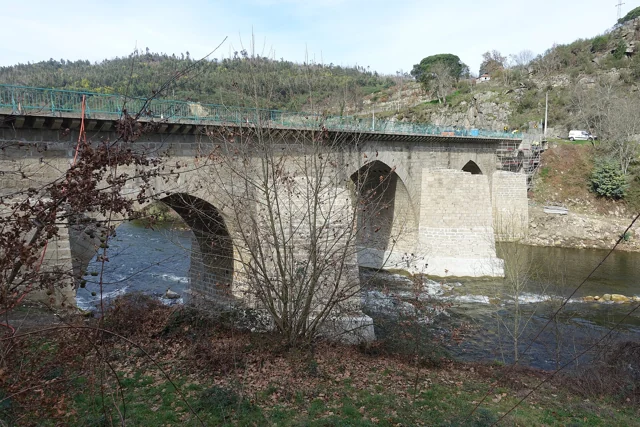
Ponte de Cavez on the river Tâmega, with stone arches, board and wooded banks.
Ponte de Cavez · crossing Tâmega© Joseolgonⓘ

In 1758, the Cavez Grand Bridge impressed the parish priest.

Explorar: Duas margens, várias histórias →
Read here and consult sources

In the parochial memory, the crossing of the Tâmega appears described as a great stone bridge, well worked. The author even considers it the best of that river. The praise belongs to the look of those who wrote: it reveals the importance it attributed to the construction, without functioning as a technical comparison between bridges.

In the same memory, the Tâmega appears as a strong current, especially in winter. The document distinguishes the crossing from the use of water: it describes mills and explains that the river was too deep to water the fields in that stretch. The bridge can be read in this set of relations between margins, displacements and work.

Notice the difference between observing a construction and evaluating it. The existence of the bridge is information; considering it the best is an appreciation. The two say something about the past, but answer different questions.

Getting to know the parish See Fact sheet: Ponte de Cavez
Source and context

Municipality of Cabeceiras de Basto — Parish memories of 1758: Cavez

Accessed: . Editorial summary; the date of consultation is not the date of the facts.

History of Ponte de Cavez

Five arches, more than a while

Ponte de Cavez on the river Tâmega, with stone arches, board and wooded banks.
Partial view of the Ponte de Cavez over the Tâmega.© Joseolgonⓘ

An old bridge didn't stop in history.

Inclui uma atividade para experimentar →Explorar: Uma travessia, várias épocas →
Read here and consult sources

Three broken central arches and two perfect back, next to the banks: the Ponte de Cavez brings together different shapes and times. The Museum located the medieval construction in the second half of the 13th century, at the service of the road between Braga and Vila Pouca de Aguiar.

The source attributes the round arches to the works of Philip II's reign and mentions a landmark of 1599. In the 19th century, the road between Fafe and Vila Pouca de Aguiar brought the enlargement of the board. Watching the bridge is looking for changes to an ancient crossing.

According to the Museum, the stone bridge replaced a previous wooden, then degraded. The construction is attributed to Frei Lourenço Mendes, Dominican who gathered alms for the work; the museological text mentions testimonial legacies as support of this connection. The crossing thus involves materials, paths and ways to finance a collective work.

Palavras desta história: ver explicações →See Fact sheet: Ponte de Cavez
Source and context

Land Museum of Basto — Ponte de Cavez, 27/02/2022

Municipality of Cabeceiras de Basto — Parish memories of 1758: Cavez

Municipality — conclusion of rehabilitation of Ponte de Cavez, 30/04/2019

Accessed: . Editorial summary; the date of consultation is not the date of the facts.

Local legend · Ponte de Cavez

The voice that had built above

Ponte de Cavez on the river Tâmega, with stone arches, board and wooded banks.
Ponte de Cavez on the Tâmega · the monument to which legend refers.© Joseolgonⓘ

Around the bridge, memory also invented paths.

Inclui uma atividade para experimentar →
Read here and consult sources

The legend published by the Museum makes the masons try to build the bridge in Vila Franca and then by the Poço das Laranjeiras. In both places, a supernatural voice sent up the river. Tradition attributed it to Saint Bartholomew.

On the third attempt, the narrative places the work next to the chapel. It is a story about the memory of the place, not documentary proof of the choice of the site or an itinerary to look for the episodes.

In another passage of the tradition collected by the Museum, the food of the builders gains a miraculous explanation: there are sources of water, wine and olive oil and fish appear in the river. The narrative associates the effort of construction to religious protection. Reading it alongside the history of the works allows to know two different ways of telling the same place.

See Fact sheet: Ponte de Cavez See Fact sheet: Capela de São Bartolomeu de Cavez
Source and context

Land Museum of Basto — Ponte de Cavez, 27/02/2022

Accessed: . Editorial summary; the date of consultation is not the date of the facts.

Cavez · heritage conservation, 2018–2019

Keeping a bridge is also making history

Ponte de Cavez on the river Tâmega, with stone arches, board and wooded banks.
Ponte de Cavez on Tâmega. Background photography, without attribution to the project of 2018–2019.© Joseolgonⓘ

Not all changes in a monument can be seen at first sight.

Read here and consult sources

In 30 April 2019, the Municipality announced the completion of the works at Ponte de Cavez initiated in October 2018 by the Infrastructures of Portugal. The intervention strengthened foundations of the pillars and treated the board: pavement, waterproofing, body guard and drainage. The bridge, classified as National Monument since 1910, thus continued to receive care long after its construction. This report documents that work; it does not evaluate the current state of the structure.

The announcement distinguishes two parts of an intervention: the support of the bridge, through the foundations of the pillars, and the surface of passage, with pavement, waterproofing and drainage. The painting of the bodyguards was only a portion of the works. A general photograph shows the bridge in the landscape, but not enough to document the reinforcement made in the foundations.

Compare this news with the chronology: the nineteenth century enlargement and the 2018–2019 undertaking are distinct interventions. Store a monument also produces new documentation, which must keep the date and scope of the work described.

See Fact sheet: Ponte de Cavez
Source and context

Municipality — conclusion of rehabilitation of Ponte de Cavez, 30/04/2019

Accessed: . Editorial summary; the date of consultation is not the date of the facts.

Cavez · settlement and devotion in 1758

Eight places and six chapels

In Cavez, an ancient list draws relations between villages, residents and monasteries.

Inclui uma atividade para experimentar →
Read here and consult sources

In 25 of May 1758, the vicar Manuel Pacheco da Cunha numbered eight places: Cavez, Vila Franca, Ponte, Arosa, Rabiçais, Moimenta, Revorça and Parada. He located the church in the middle of the parish and described six chapels. Names help to recognize a hammock; they are not a current list of administrative places.

São Gregório, in Vila Franca, São Mamede, in Arosa, and Santa Maria Magdalena, in Moimenta, were attributed to the abbot of Pombeiro, with its maintenance linked to the Benedictine congregation of Tibães. São Bartolomeu, on the Bridge, had as patron João Correia, of Guimarães. In São Caetano, in Raviceis at the passage of the chapels, and Santa Luzia, in Revorça, the charge was for the residents. The transcription itself uses the variants Rabiçais and Raviceais.

The report also describes five altars in the matrix and a brotherhood of the Souls. The parish appears as a space of worship and collective organization, with distinct responsibilities. The pilgrimage of São Bartolomeu is mentioned for 23 and 24 of August; they are dates of historical testimony, without functioning as current agenda.

The parish links went beyond the chapels. The vicar wrote that Cavez did not have their own mail and resorted to Raposeira, which was located to a league. He also indicated the absence of fair in the parish. They are clues to think where news arrived and where services were concentrated at that time; they do not describe the current offer nor allow automatically to convert the league into a road distance.

Getting to know the parish See Fact sheet: Capela de São Bartolomeu de Cavez See Fact sheet: Igreja de São João de Cavez e cruzeiro
Source and context

Municipality of Cabeceiras de Basto — Parish memories of 1758: Cavez

Accessed: . Editorial summary; the date of consultation is not the date of the facts.

Cavez · history of the bridge of Moimenta; current conditions not verified

Two seasons on the same bridge

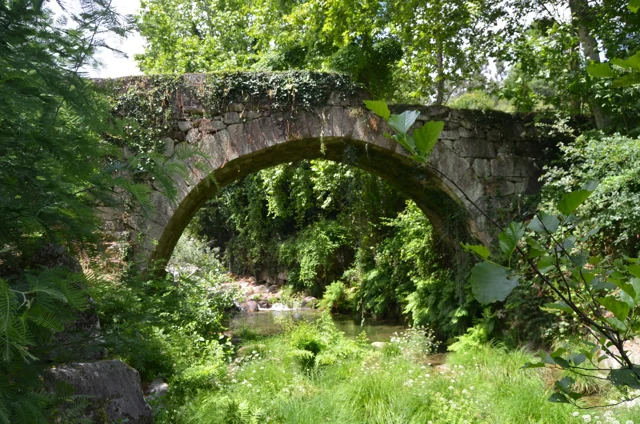
Ponte antiga de Moimenta in Cavez: stone arch over the river, surrounded by vegetation, photographed in June 2020.
Moimenta Bridge, photographed by Pedro at 11 June 2020. A crossing record other than Ponte de Cavez over Tâmega.© Pedroⓘ

In Moimenta, the ancient stone coexists with an intervention of 1990.

Read here and consult sources

An ancient bridge can continue to change. The municipality attributes medieval origin to the bridge of Moimenta in Cavez, and describes a single round arch.

In 1990, the passage was extended about one meter: it received a concrete structure on the downstream side and the guards were changed. The photograph allows to begin to observe the crossing; the date of the intervention comes from the documentary description.

Palavras desta história: ver explicações →See Fact sheet: Ponte antiga de Moimenta
Source and context

Municipality — Cultural heritage, bridges of Arco de Baúlhe and Moimenta

Accessed: . Editorial summary; the date of consultation is not the date of the facts.

YOUR LOCAL GUIDE

What would you like to discover?

Take a closer look.