Discover Cabeceiras de BastoFree independent guide
ViveCabeceirasYOUR GUIDE TO CABECEIRAS
ENEnglish
SearchSaved

Stories of Cabeceiras

Choose a story to start with. You can change the subject or fine tune the search.

9 stories · All themes · Search: oral

Time travel

Documents, details and traditions: there is more to discover than a date on a stone.

Choose a story · 2
Cunhas · heritage and legends in the municipal guide

A village between a manor and two legends

In Cunhas, the built heritage finds the oral tradition.

Includes an activity to try →
Read here and view sources

The municipal guide of the villages highlights in Cunhas a nucleus of concentrated old houses and the manor of Teixeiras Pereiras. It is a reference to the architecture of the village, without indication of access to the interior of the building.

The same guide tells two legends: one associates the name of Cunhas to a soldier called Cunha de Pau, linked to the fight against the Moors; another says that Santa Senhorinha had house in the locality. They are narratives of popular memory. The publication does not present them as proven events nor allows to locate a house of the saint.

Source and context

Municipality — Village Guide of Serra da Cabreira: landscape, work and heritage

Accessed: . Editorial summary; the date of consultation is not the date of the facts.
Rio Douro · archeology and oral tradition

The village that stayed in memory

The traces of the Old Village of Toninha count for another time.

Includes an activity to try →Explore: Other clues in the territory →
Read here and view sources

In the Old Village of Toninha, the municipal inventory proposes occupation between the 13th and 16th centuries. It compares the constructive remains with other serran settlements, including examples in Lindoso and the abandoned village of Juriz in Montalegre. Already the plague that would have caused the people to leave belongs to the popular tradition. They are different paths to know the place: comparing buildings and collecting memories.

There is a third clue: the Investigations of 1258. The inventory proposes that the village may correspond to one of the ten couples then assigned to Juguelhe. It is a probable identification presented by the author, not an equivalence demonstrated. Comparisons with other places help to formulate this interpretation.

Imagine three cards on the table: the buildings, the document of 1258 and the narrative of the plague. Each opens a different question. What forms are repeated in other villages? What places appear in the document? What explanation conveyed the tradition? The discovery begins by crossing these clues without confusing them.

Getting to know the parish
Source and context

Municipality — Old village of Toninha: proposed chronology, parallels and inquiries of 1258

Accessed: . Editorial summary; the date of consultation is not the date of the facts.

The flavours of Cabeceiras

From the garden to the pot, from the oven to the table.

Choose a story · 4
Cavez and Pedraça · transmission of recipe, 2011

A recipe also has someone who teaches it

The kitchen connects people, generations and parishes.

Includes an activity to try →Explore: Who brought this recipe? →
Read here and view sources

In the collections of the Museum, Maria da Conceição Gonçalves Mouta, a native of Cavez and resident in Recovos, Pedraça, identifies who transmitted the dishes. The cabbages with migas came from the grandmother, from Cavez; the broth of chestnuts, from the mother-in-law, from Pedraça. Maria de Fátima Carvalho recorded these testimonies in February 2011. Names help to realize that this memory belongs to a concrete family experience.

Source and context

Basto Land Museum — food and food: collections of February and March 2011

Accessed: . Editorial summary; the date of consultation is not the date of the facts.

Oral memory · March 2011

The bread kept the next batch

A small portion of mass attached one batch to the next.

Includes an activity to try →Explore: Three ways to look at the same dough →
Read here and view sources

In March 2011, Maria da Conceição recalls the bread cooked every eight days. A portion of the previous mass was in a bowl, with a little salt inside the wooden mass. On the eve of the new batch, warm water and flour were added. The testimony of Recovos, Pedraça, also describes an adaptation: when it started cooking less often, the yeast purchased in the bakery was used.

This change has a family history. Maria da Conceição was a native of Cavez and had learned from her grandmother to make cornbread. When she was interviewed, at the age of 69, she also made mix bread. The collection does not present an immobile tradition: it shows learning, choices and a routine that adapts.

The cooking schedule was also extended to the community. In the testimony of 2011, the batches are associated with the festivals of the year, the longing for homemade bread, the feast of Santa Marinha and the Christmas and defoliated initiatives of the Association D. Nuno Álvares, of Pedraça. Saving pasta for the following week made sense in a weekly routine; cooking only from time to time put other needs. These are remembered uses in this collection, not a current party program.

Words in this story: see explanations →
Source and context

Basto Land Museum — testimony of Maria da Conceição Gonçalves Mouta, collected by Maria de Fátima Carvalho in 2011

Accessed: . Editorial summary; the date of consultation is not the date of the facts.

Oral memory · Pedraça

Chestnuts in the spring?

The kitchen had the work schedule.

Includes an activity to try →Explore: From tree to working day →
Read here and view sources

Chestnuts in April and May? In the memory of Maria da Conceição Gonçalves Mouta, they were dried chestnuts that arrived at the table during the cultivation and sowing of corn. The broth, with beans, cabbage and potatoes, closed the first meal, by nine or nine and a half in the morning, after fried cod with bread.

The testimony was collected by Maria de Fátima Carvalho in February 2011, in Pedraça. Maria da Conceição had learned the preparation with her mother-in-law. The chestnuts were previously dried and aired; the baked potato was crushed and returned to the pot. Conservation, texture and working hours are found in this family memory.

Here there are two calendars: that of the fruit and that of the meal. The dried chestnut kept allowed to bring to the spring table a food associated with the harvest of another season. The memory does not only describe ingredients: it explains how the reserves of the house accompanied the time of tilling and sowing. The time of the “lunch” also surprises those who today use this word for the midday meal.

It is a story with voice and place, not a rule for all the houses of Cabeceiras. When talking about a family recipe, it is worth keeping these differences: who taught it, when it was prepared and what changed between the fireplace and the stove. Thus, a list of ingredients becomes a small history of work, learning and domestic life.

Source and context

Basto Land Museum — testimony of Maria da Conceição Gonçalves Mouta, collected by Maria de Fátima Carvalho in 2011

Accessed: . Editorial summary; the date of consultation is not the date of the facts.

Oral memory · Cavez and Pedraça

Carnival also went to the pot

A recipe learned from Grandma of Cavez.

Explore: Carnival and the flavors of the family →View ingredients and preparation →
Read here and view sources

Orilheira, gruelos and potatoes composed the carnival meal remembered by Maria da Conceição in February 2011. It is a documented family memory, not a menu available all year round. Potatoes and grells cooked in the water of the meat; the earpiece returned to the container at the end, before serving with olive oil.

The collection allows us to follow the passage between generations: Maria da Conceição was born in Cavez and lived in Recovos, Pedraça; she had learned this dish from her grandmother. In 2011, the gas stove and stainless steel pots were already part of her kitchen, while the fireplace was present on special occasions. The testimony shows a tradition that coexists with changes in utensils.

Source and context

Museum of Lands of Basto — Golden Ear (17/03/2011), Maria da Conceição Gonçalves Mouta; collection of Mary of Fatima Magalhães in February 2011

Accessed: . Editorial summary; the date of consultation is not the date of the facts.

Crafts and memories

In the hands, at the table and in the community: little stories of how one lives and what one transmits.

Choose a story · 2
Bucos · testimony collected in 2020

Whoever left also took the memory of the game

Emigration appears in the testimony of the players.

Includes an activity to try →Explore: A tradition goes from hand to hand →
Read here and view sources

Fernando Lima told, in Vila Boa from Bucos, to 23 October 2020, which emigrated after the military service. The match interrupted the practice of the game of the cock, but still liked to watch the cousin and the children of it. Before emigrating, he found other shepherds in the mountains: playing was also a way to live and make the day with the flock less long.

The National Inventory card contains another link to emigration: Custódio Bastos, from Bucos, who left for France, kept his lodon stick as a souvenir. The learning had passed by the father, Manuel Henriques Bastos, and Mestre Calado son.

There are still stories of return. In a testimony collected in October 2020, Fernando Oliveira recalls Ernesto Santos, who worked in Leiria and, after the reform, returned to Bucos and taught new generations. Leaving, keeping a memory and teaching again are different experiences within the same tradition. They are memories collected by the investigation, not an updated portrait of the participants or the trainings.

Source and context

MatrixPCI — Cabeceiras de Basto Stick Game, INPCI_2023_016

Accessed: . Editorial summary; the date of consultation is not the date of the facts.

Holy Lady · objects and memory of devotion

Devotion also fit a candle

Small objects help to get to know the people of other times.

Explore: Objects, words and memory →
Read here and view sources

In the study of Odília Alves Gameiro, the offerings mentioned in the reports of Santa Senhorinha include wax, candles, cirios and candeias. The author interprets its low cost as a sign of a cult accessible to different social groups. The doubling of bells and oral transmission also appear in the dissemination of the narrated miracles. They are elements of the history of devotion, not proof of the supernatural events described.

The study distinguishes the offering that accompanies a request from that which thanks a grace received. The same object could thus participate in different moments of devotion. Its interpretation depends on the context narrated, and not just on the material of which it was made.

Source and context

Odília Alves Gameiro — The nobiliarchic appropriation of a rural cult: the hagiography of Santa Senhorinha of Basto, Archipelago · History, 2001, pp. 561–562 and 571–572

Accessed: . Editorial summary; the date of consultation is not the date of the facts.

Between rivers and mountains

Water and relief form the municipality. Choose a name and follow the landscape.

Choose a story · 1
Landscape · Abadim

Follow the path of the water

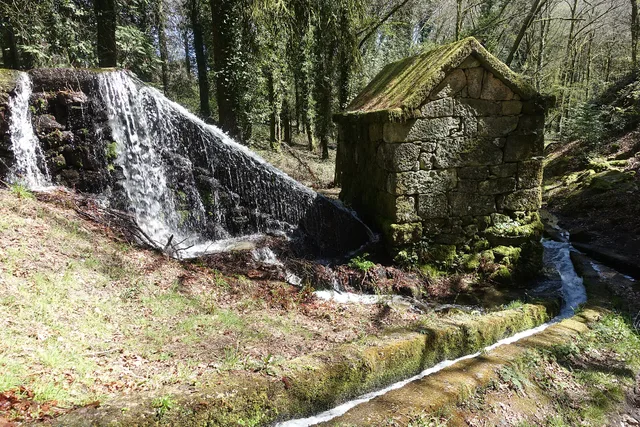
Granite mill served by Levada de Víbora, in all Moinhos de Rei, with waterfall and canal in the wooded surroundings. Register 2025.
A mill and the water channel at Moinhos de Rei.© Joseolgonⓘ

The Levada de Víbora approaches nature and human labor.

Includes an activity to try →
Read here and view sources

The Levada de Víbora allows you to relate the water path to the grinding work. The municipal presentation of the PR1 BCC connects the beginning to the Oral Dam, in Abadim, to the Moinhos de Rei, to woods and small watercourses. It also highlights the village and viewpoint of Porto d’Olho and Leisure Park of Víbora. Interest is not only in the destination: the channel helps to understand how the water was conducted and used. To choose the walk, see the track record and compare distance and difficulty; this reading does not replace the current conditions of the route.

Words in this story: see explanations →Compare the walks See Fact sheet: Moinhos de Rei See Fact sheet: Trilho da Levada de Víbora See Fact sheet: Área de Lazer do Oural See Fact sheet: Área de Lazer de Víbora
Source and context

Municipality — Trilho da Levada de Víbora, PR1 BCC

Accessed: . Editorial summary; the date of consultation is not the date of the facts.

YOUR LOCAL GUIDE

What would you like to discover?

Take a closer look.