Discover Cabeceiras de BastoFree independent guide
ViveCabeceirasYOUR GUIDE TO CABECEIRAS
ENEnglish
SearchSaved

Stories of Cabeceiras

Choose a story to start with. You can change the subject or fine tune the search.

40 leituras · Todos os temas · Refojos de Basto

The flavours of Cabeceiras

From the garden to the pot, from the oven to the table.

Escolher uma história · 6
Refojos · painting of 1703, studied in 2011

A table painted over three centuries ago

Dishes, cutlery and napkins also tell stories.

Inclui uma atividade para experimentar →
Read here and consult sources

The painting Supper of St. Benedict and the Raven, of 1703, is attributed by the Land Museum of Basto to Father Manuel Correia de Sousa and comes from the Monastery of Refojos. In an article of 2011, Isabel Maria Fernandes draws attention to individual dishes, salt shakers, cutlery and napkins represented. The work opens a window for the material culture of the table. However, it is not a record of a concrete meal of the monks of Refojos. The location in the Municipal Session Room is indicated in that publication, without confirmation of current exposure or access.

Source and context

Land Museum of Basto — Isabel Maria Fernandes, eat in conventual context, 21/02/2011

Accessed: . Editorial summary; the date of consultation is not the date of the facts.
Refojos · family memory published in 2020

A recipe that has crossed continents

The lemon cookies came with a family story.

Inclui uma atividade para experimentar →Explorar: Três doces, uma memória de família →Ver ingredientes e preparação →
Read here and consult sources

Alcina Teixeira found recipes of Cabeceiras in a Portuguese magazine during the years in Mozambique. Cookies arrived at the Museum through the son Mário, resident in Refojos, and were published in 2020.

The family also kept the honey cake and the Cassians. Compare these recipes allows you to follow the journey of a knowledge between a magazine, family cuisine and public disclosure.

Source and context

Basto Land Museum — Lemon biscuits Cabeceiras (2020)

Accessed: . Editorial summary; the date of consultation is not the date of the facts.
Refojos · February 2016 collection

Honey finds cinnamon and fennel

A recipe has ingredients and has a voice.

Explorar: Uma memória, vários doces →Ver ingredientes e preparação →
Read here and consult sources

Alcina Teixeira, residing in Refojos, shared this cake in 2016. I remembered meeting him in a magazine by Maria Odette Cortes Valente, about 1966, when I lived in Mozambique.

Honey, cinnamon and fennel are found in this family memory.

The collection identifies a family practice: Alcina made cakes for parties and sought recipes in magazines. The cake combines honey with sugar and brings olive oil, milk, nuts and spices. The chimney shape belongs to the registered preparation. These details allow us to recognize this version, without presenting it as the only way to make honey cake in Cabeceiras.

Source and context

Basto Land Museum — Honey cake Cabeceiras de Basto (2016)

Accessed: . Editorial summary; the date of consultation is not the date of the facts.
Refojos · kitchen memory collected by the Museum

The hanger was held on Sunday

A recipe of Refojos also holds a weekly habit.

Inclui uma atividade para experimentar →Explorar: À mesa de quem contou a receita →Ver ingredientes e preparação →
Read here and consult sources

On Sunday, the cabidela took place in the kitchen described by Isabel Sousa, a natural and resident in Refojos. In the version she shared, the chicken accompanies the rice; onion, garlic, blonde and parsley enter the seasoning, along with white wine, blood and vinegar. The publication also keeps words of preparation, such as the strut and testus.

Conceição Magalhães collected the recipe in 2013, and the Museum published it in October 2014. The indication of Sunday gives the dish a place in the family calendar, but does not establish a rule for the whole municipality. It is the voice of an identified cook, with an occasion and a way of telling what he was doing.

Palavras desta história: ver explicações →
Source and context

Basto Land Museum — The hanger was held on Sunday, publication of 10/10/2014

Accessed: . Editorial summary; the date of consultation is not the date of the facts.
Refojos · kitchen memory collected by the Museum

A recipe learned at parties

Shroud popes also tell how knowledge circulates.

Inclui uma atividade para experimentar →Explorar: A palavra papas guarda diferenças →Ver ingredientes e preparação →
Read here and consult sources

Maria Helena da Mota Lopes da Silva Almeida, resident in Refojos since childhood, told that she had learned these popes in the early 21st century. The master was a cook from Porto who came to Cabeceiras to work in baptisms and marriages. The parties were also places where techniques and recipes were learned.

The version collected in June 2011 combines different meats, cornmeal, cooked pig blood, red wine and cumin. The report situates the preparation in winter until the end of March. The publication, July of that year, documents the transmission of a knowledge and its usual time; it does not indicate a menu available today.

Source and context

Basto Land Museum — A recipe learned at parties, publication of 06/07/2011

Accessed: . Editorial summary; the date of consultation is not the date of the facts.

Refojos · family memory published in 2020

Cassians: small shapes, a long journey

Another Cabeceiras candy stored in Alcina's memory.

Inclui uma atividade para experimentar →Explorar: Uma receita atravessa lugares e gerações →Ver ingredientes e preparação →
Read here and consult sources

Alcina Teixeira shared these small cakes through Mário Teixeira, residing in Refojos. The publication of the Museum, of 2020, links them to the recipes found in a Portuguese magazine during the years in Mozambique.

The Cassians belong to the same set of memories of lemon cookies and honey cake. The source describes the shape in polka dots, but does not explain the origin of the name.

The report identifies a family trip: Alcina, born in Penafiel, went to Vila de Manica, Mozambique, at the age of fifteen. There he met Alexandre Teixeira of Cavez, who worked on the railways. Alcina had a corn mill and a commercial establishment, and made cakes for family parties. The magazine where he found the recipes connected it to the flavors of Cabeceiras before the family came to live for the municipality. History follows the transmission of recipe; it does not establish who created it.

Source and context

Basto Land Museum — Cassians Cabeceiras, 11/12/2020

Accessed: . Editorial summary; the date of consultation is not the date of the facts.

The life you don't always see

Knowing animals begins by perceiving the territory and respecting the distance.

Escolher uma história · 1
Refojos de Basto · local register and general biology

A rapture with a varied menu

The common-buthium seeks food in the landscape sky and also on the ground.

Inclui uma atividade para experimentar →Explorar: Do poiso à paisagem →
Read here and consult sources

The photograph of ecovore shows Buteo buteo landed among branches, in a record of 1 July 2025. The published point, crossed with CAOP2025, is located in the parish of Refojos de Basto. The image allows to observe the inn bird; it does not show a hunt.

Also called eagle-d’asa-round, this prey may show marked differences in the amount of white and brown plumage. The University of Évora describes a species resident in mainland Portugal, with reinforcement of winter birds from northern Europe. Color alone does not solve all identifications.

The BTO describes a feed that takes advantage of available prey: rabbits and small mammals, but also birds, amphibians, large insects and earthworms. The search for food can take you to the ground. Compared with the hunting tartaranion helps you realize that two prey can share some food without having the same way of life.

Source and context

University of Évora — Buteo buteo: plumage and distribution

British Trust for Ornithology — BirdFacts: Buzzard

Accessed: . Editorial summary; the date of consultation is not the date of the facts.

Read the landscape through the plants

Trees, forests, vineyards and fields reveal different ways of occupying the territory.

Escolher uma história · 2
Refojos · monastic landscape

Beyond the church, a cultivated land

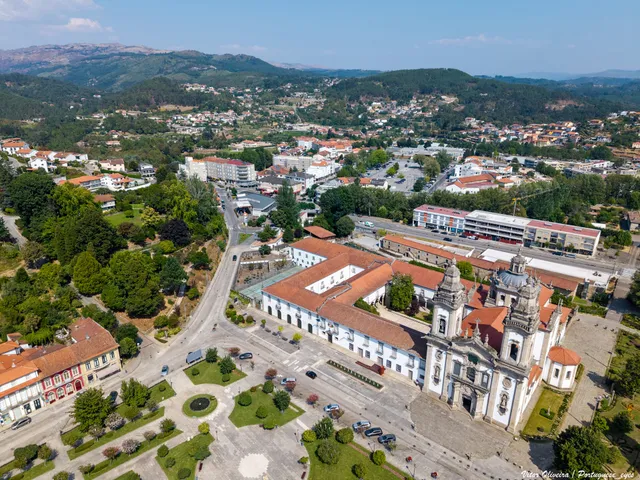
Air view of the Monastery of São Miguel and the Republic Square in Refojos
View of the Monastery of Refojos and the urban surroundings. It is a context image, not a reconstruction of the cultivated fence.© Vitor Oliveira from Torres Vedras, PORTUGALⓘ

Vegetables, orchards and medicinal plants were part of the fence.

Inclui uma atividade para experimentar →Explorar: A cerca continua noutras histórias →
Read here and consult sources

Hortes, orchards, medicinal plants, fields and forests composed the ancient surrounding monastery of Refojos, according to the municipal description of 2021. The botica supplied other Benedictine monasteries, including Tibães. Beyond the church, there was land to cultivate and medicines to prepare. It is a historical portrait of the fence, not an inventory of the current plants.

The same description situates the riverside of Penoutas next to and in the back of the Monastery, next to buildings of agricultural origin however musealized. Water and work buildings help to broaden the look: the history of the set is also told outside the cult space.

The ancient fence is not read today as a single garden intact. The fountain draws attention to scattered traces. Distinguishing what the document describes from what a photograph allows to see is part of the discovery: a view of the square does not reconstitute missing gardens, orchards or medicinal plants.

Palavras desta história: ver explicações →Getting to know the parish See Fact sheet: Mosteiro de São Miguel de Refojos
Source and context

Municipality — historical gardens, news of 21/05/2021

Accessed: . Editorial summary; the date of consultation is not the date of the facts.

Refojos de Basto · history and mission of educational equipment

A green space can also teach

In Vinha de Mouros, leisure meets environmental education.

Inclui uma atividade para experimentar →Explorar: Escolhe o que queres observar →
Read here and consult sources

The Centro de Educação Ambiental of Vinha de Mouros was inaugurated in 10 August 2001. In the municipal presentation, preserving and valuing the local flora and fauna is part of its mission, together with the educational work with the schools. The space was designed to bring together different public heritage of the municipality.

The same presentation brings together different functions: lunch park, play areas, mini golf, maintenance circuit and support the pedagogical program. Therefore, a visit can start with a pause and continue with questions about the landscape. The practical form distinguishes the equipment and conditions of use; this story does not announce a guided activity marked.

A useful question is to separate what one sees from what one interprets. The park’s photograph shows trees and tables, but it does not identify all plants nor shows that an animal species lives there in freedom. The following readings help to look at leaves, soil and relationships between living beings, without turning examples of general biology into an inventory of Vinha de Mouros.

See Fact sheet: Vinha de Mouros
Source and context

Municipality — Centro de Educação Ambiental of Vinha de Mouros: origin and objectives

Accessed: . Editorial summary; the date of consultation is not the date of the facts.

Between rivers and mountains

Water and relief form the municipality. Choose a name and follow the landscape.

Escolher uma história · 2
Refojos · opening in 2013 and urban transformation

A stream in the history of Casa do Tempo

The renovation of the village centre also passed through the water.

Inclui uma atividade para experimentar →Explorar: Memória, edifícios e água →
Read here and consult sources

The Casa do Tempo opened in 2 August 2013 next to the Monastery of Refojos. In the municipal description, the recovery of old housekeeping houses is part of a broader transformation: connecting the Republic Square to the new areas of the village, creating green spaces and treating the banks of the riverside of Penoutas. The interpretive center thus allows to tell two stories together: the memory of Cabeceiras and the change of its urban landscape.

The Municipality describes the acquisition of part of the returned houses and the negotiations that preceded the intervention. Reutilizing the buildings and transforming their surroundings appear as parts of the same project, rather than separate stories.

The multimedia component of the center was presented as a way to know territory, people, nature, uses and customs. Thus, the stream does not appear only as a scenario: it integrates the history of how that village space gained new functions. To plan a visit, the site's file gathers the practical information available.

See Fact sheet: Casa do Tempo
Source and context

Municipality — Casa do Tempo: opening in 2013 and requalification of the surroundings

Accessed: . Editorial summary; the date of consultation is not the date of the facts.

Refojos and São Nicolau · uses described in 2025

Water also reaches the light and fields

The same landscape brings together different uses.

Explorar: Da água em movimento à eletricidade →
Read here and consult sources

The environmental report of 2025 relates water resources to electricity production and irrigation. It identifies the Cefra Hydropower Plant in Refojos, and the São Nicolau mini-hydric. They are documentary references to water use, without confirmation of public access or current operation. Add to them the stories of mills and levadas: the relationship between water and work goes through different times.

How does it go from current to electricity? Water runs a turbine connected to a generator. Flow and downgrade influence the available energy, explains the Department of Energy. It is the general principle that the scheme allows you to explore; it does not describe the specific equipment of the two local facilities. Thus, watering fields, grinding cereal and producing electricity are different uses of a resource connected to the landscape.

Palavras desta história: ver explicações →
Source and context

Municipality — Environmental Report of the PDM review, February 2025, pp. 56–58: water network and resources

U.S. Department of Energy — How Hydropower Works: turbine, generator, flow and downgrade

Accessed: . Editorial summary; the date of consultation is not the date of the facts.

Crafts and memories

In the hands, at the table and in the community: little stories of how one lives and what one transmits.

Escolher uma história · 12
crafts · Faia, Basto and Refojos

The wood also keeps the wine

Pipes, barrels and barrels tell a business story.

Inclui uma atividade para experimentar →
Read here and consult sources

The municipality associates these works to Faia and also refers to tannaria in Basto and Refojos. The container is part of the wine culture as much as the vineyard. In the Ethnographic Court of 24 September 2023, dedicated to the arts and crafts, Faia introduced the oil tankers. The municipal news shows how this knowledge was also chosen to represent the parish at a collective party. The episode does not confirm the existence of a visitable workshop today. The presentation of the parish adds the manual manufacture of footwear to its craft traditions. The wood of wine containers is thus part of a more varied working memory, without identifying today's artisans or workshops here.

To understand how a container is built, it is worth knowing two words of the craft. The Lourinhã Museum identifies the trims and rims as central elements: wooden pieces form the body, while the rims involve them. The description highlights the work of the curvature and thickness of the trims. It is a general explanation of the tannaria, used here to read the objects; it does not document the sequence of manufacture of a workshop of Faia.

When looking at a pipe, look for the vertical lines between pieces and the rims that cross the set. Compare later with the wooden base of a punch: a material can be cluttered to support a foot or worked on several pieces to form a volume. The finished object holds shape, fit and use decisions.

Palavras desta história: ver explicações →Getting to know the parish
Source and context

Municipality — crafts and services of the parishes

Municipality — Arts and Crafts in the Ethnographic Court, news of 25/09/2023

Municipality — presentation of Faia: settlement and traditional activities

Lourinhã Museum — Tanoeiro, elements and work of the plasters; general technical context

Accessed: . Editorial summary; the date of consultation is not the date of the facts.

Arco de Baúlhe and Refojos · history of trade

When the metal sheet was forming

From the workshop came objects to the house, the countryside and the fair.

Explorar: Para que servia o metal? →
Read here and consult sources

João Pacheco, no Arco de Baúlhe, and Luziário Pereira de Magalhães, with their son António, in Refojos, are protagonists in the investigation of the Museum on lattice. The workshop of Luziário and António was in the Beco dos Ofícios; the nearby fair was the main point of sale. Teresa Soeiro relates the decline of craft with the diffusion of aluminum and plastic.

The inventory brings this work closer to everyday gestures: the MTB 241 copper mug served to make coffee, the MTB 240 cantara contained water and the lamps lit. The functions are documented for identified pieces. Knowing the objects helps to understand the workshop, but the collection does not confirm that these craftsmen or establishments continue in activity.

Teresa Soeiro's investigation gave rise to the exhibition The Art of lattice in Cabeceiras de Basto, in the Museum's facilities in Arco de Baúlhe. The work retreated to the artisans who began using white iron, or flander leaf, at the beginning of the Modern Era. The collection of the last professional routes was thus linked to a longer history of materials.

The objects reveal the variety of tasks: lighting a house, transporting wine, watering plants or storing oil for a locomotive. The craft passed through the house, field and transport. Comparing these functions helps to discover metallurgical work in gestures that seem to belong to separate worlds.

Palavras desta história: ver explicações →Getting to know the parish
Source and context

Basto Land Museum — Latoaria, Teresa Soeiro text and inventory of pieces

Accessed: . Editorial summary; the date of consultation is not the date of the facts.

Outeiro and Refojos · 2012 initiative

When the images came out of the church

A work can also open a discovery.

Inclui uma atividade para experimentar →Explorar: Uma peça, vários contextos →
Read here and consult sources

A work in the church opened an opportunity to know its sculptures. In October 2012, the Municipality announced the deposit and temporary exhibition of twelve pieces of Outeiro in Núcleo de Arte Sacra, installed in the former sacristy of Refojos. They represented the Virgin and other saints, from medieval to twentieth century. The partnership between parish and municipality thus brought together objects from different times and a concrete need for conservation during the preparation of the works. The news documents that initiative, not a current exhibition.

The reason for the displacement was concrete: the church prepared remodeling and expansion works. According to the news, the parish priest Francisco Marcelino Esteves decided to deposit the images in the museum core. The meeting of the pieces in an exhibition space resulted, therefore, from a temporary guard decision linked to the life of the building of origin.

Among the twelve sculptures, the medieval image of Santa Maria received special prominence. The news describes the wood worn by time and recalls the role of the parishioners who had taken it to the church. The history of the collection involves more than authors and dates: it includes those who found, saved, transferred and made known the pieces.

The October 2012 document also announced the intention of developing similar partnerships with other parishes. This intention helps to know the museum project at that time; it does not demonstrate that all these collaborations took place.

Palavras desta história: ver explicações →See Fact sheet: Núcleo de Arte Sacra See Fact sheet: Igreja de Santa Maria Maior de Outeiro
Source and context

Municipality — Parish of Outeiro exposes acquis No Núcleo de Arte Sacra, 09/10/2012

Accessed: . Editorial summary; the date of consultation is not the date of the facts.

Refojos · devotional memory of unknown date

A little pagela kept a collective concern

Devotion also left marks on paper.

Inclui uma atividade para experimentar →Explorar: O papel, o lugar e quem partiu →
Read here and consult sources

A small devotional image can keep concerns of an entire community. The Land Museum of Basto released a pagela prepared for the feast of São Miguel of Refojos with this message: «S. Miguel protect and defend the soldiers, migrants and people of Cabeceiras.»

The reference to soldiers and emigrants allows to read the object also from the absence: prayer includes those who were far away, along with the population of Cabeceiras. It is a proposal to read the message, without assigning to the piece a war or a vague migration that the source does not identify.

There are two dates that we should not confuse. The Museum published the play in 24 September 2026; declared not having been able to identify the date of the pagela itself. The object belongs to the memory of the party, but the year it was produced remains open.

Source and context

Basto Land Museum — Pagela de S. Miguel Archangel, 24/09/2026

Accessed: . Editorial summary; the date of consultation is not the date of the facts.

Outeiro and Refojos · trade in the mid-20th century

Two ox cars full of shoes

The São Miguel fair began months earlier, inside the workshop.

Read here and consult sources

Teresa Soeiro reports that, in the middle of the 20th century, the tamanqueiros of Outeiro even took two cars of oxen loaded with punches and cocks to the São Miguel fair in Refojos. They accumulated production for months and kept the merchandise in wooden tents, in candlelight. The fair brought together artisans and dealers: the shoes followed for other customers.

Source and context

Teresa Soeiro — Soqueiros e Tamanqueiros, municipal edition of 2017, p. 96 (viewer page 98)

Accessed: . Editorial summary; the date of consultation is not the date of the facts.

Refojos · journalistic report of 1977

São Miguel in the harvest calendar

The party also marked the rhythm of the fields.

Explorar: Três datas, dois testemunhos e uma publicação →
Read here and consult sources

In a text of 1977 recovered by the Museum, São Miguel appears linked to the harvest of beans and corn on the driest slopes. The harvest completed this cycle. It is a memory in which agricultural work helps explain the time of the feast.

The relationship between corn, beans and harvest places the celebration at the end of an agricultural cycle, as the chronicler described it. It is a way to read the calendar through the works, and not just the festive days.

The two years of the newspapers should be separated: the portrait of the arrival and table belongs to 1956; the reference to the harvests comes from 1977. The Museum gathered these testimonies in 2024. The digital publication date does not make the memories a description of the current feast.

Source and context

Basto Land Museum — St Michael of other times, 26/09/2024; excerpts from The Journal of Cabeceiras of 16/09/1956 and 08/09/1977

Basto Land Museum — archive, page 4: Saint Michael of old, publication of 26/09/2024

Accessed: . Editorial summary; the date of consultation is not the date of the facts.

Refojos · journalistic report of 1956

The paths filled for the fair

The trip was part of the meeting.

Explorar: Chegar à feira e seguir as histórias →
Read here and consult sources

The report of 1956 describes people arriving on the roads, on buses and trains. Alameda do Seco and the garden of Praça da República concentrated the movement. Barroso products and blankets joined the fair: the meeting connected territories and transports.

In the excerpts gathered by the Museum, the fair is also an occasion to present animals and debut clothes. The text evokes joints of ox ornamented with flowers on the way to the livestock contest and lists aprons, handkerchiefs, skirts, blouses and slippers. The party gathered work, trade and public presentation.

It is a journalistic description, with expressive language and a proper look at people. It helps to imagine the environment, but it does not measure how many visitors arrived or allows to treat all habits described as universal.

Source and context

Basto Land Museum — St Michael of other times, 26/09/2024; excerpts from The Journal of Cabeceiras of 16/09/1956 and 08/09/1977

Basto Land Museum — archive, page 4: Saint Michael of old, publication of 26/09/2024

Accessed: . Editorial summary; the date of consultation is not the date of the facts.

Refojos · flavours described in 1956

New chestnuts and clay mugs

The memory of the party also has flavors.

Inclui uma atividade para experimentar →
Read here and consult sources

In the description of 1956 published by the Museum, the food establishments and tents were filled. Regional wine accompanied new lunches or chestnuts, served in glassy white clay mugs. They are details of a chronicle that brings the fair closer to its daily gestures.

The table appears in the middle of a moving fair. The chronicle evokes groups crossing paths, buses and trains, blankets coming from Barroso and the arrival of people in the Alameda do Seco and the Praça da República. Eating and drinking were part of this meeting, alongside the trade, the religious festival and the livestock contest.

There are two dates to be kept: the quoted text came out in the newspaper in 16 September 1956; the Museum re-disclosed it in 26 September 2024. The excerpt has the expressive language of a chronicle, does not present visitor counts or meals sold. By comparing it with the memory of dried nuts in crops, we discover the same fruit in different occasions and forms of conservation.

Source and context

Basto Land Museum — St Michael of other times, 26/09/2024; excerpts from The Journal of Cabeceiras of 16/09/1956 and 08/09/1977

Accessed: . Editorial summary; the date of consultation is not the date of the facts.

Pereiras, Refojos · memory of the decade 1960

A street also guards trades

School, trade, and work made the living of the place.

Inclui uma atividade para experimentar →
Read here and consult sources

The Museum recalls that, in the decade of 1960, the Pereiras had primary school, tailoring, blacksmith and cereal store. These examples show a place where to learn, buy and work crossed paths. They are memories of activities of that time, not a list of services that are still open.

The memory gains another dimension when we join it at the fairs of the place. The Museum's article describes, for the first half of the 20th century, the Fair of the Thirty and the Fair of the Onions, also known as the Fair of Saint Antonino. Trade was not limited to shops: it included periodic meetings, especially cattle.

The same place also brought together the old chain and football field opened in 1925. By linking these stories, the street is no longer just an alignment of buildings: learning, work, administration and leisure appear. References belong to different moments; they are not a photograph of everything working on the same day.

Source and context

Basto Land Museum — The place of the Pereiras of Refojos de Basto, 28/07/2024

Accessed: . Editorial summary; the date of consultation is not the date of the facts.

Refojos · fairs in the first half of the 20th century

The Thirty Fair had a date day

The name didn't say the day of the month.

Read here and consult sources

According to the Museum, in the first half of the 20th century the Fair of the Thirty was held in Pereiras on the last Sunday of each month. The locality also welcomed the annual Onion Fair, or Santo Antonino, at the end of August or early September. Both were known for selling cattle. This calendar belongs to the historical account, does not announce current fairs.

Source and context

Museum of Lands of Basto — The place of the Pereiras Refojos de Basto (28/07/2024)

Accessed: . Editorial summary; the date of consultation is not the date of the facts.

Saint Lady and Refojos · mail described in 1758

To receive news, it was necessary to count on Fox

The letters linked parishes before they got further.

Inclui uma atividade para experimentar →Explorar: Quatro maneiras de esperar notícias →
Read here and consult sources

In 1758, receiving news in Santa Senhorinha depended on the post office of Raposeira, in Refojos. The memory indicates a quarter of league distance and a connection to Porto: departure on Thursday and arrival on Tuesday.

These two days allow us to imagine a weekly pace of news. They do not allow us to calculate how long a concrete letter took: the text does not describe its entire path. Raposeira also appears in the memories of other parishes, showing how a service connected different communities.

The response of Vila Nune does not coincide on the day of arrival: it mentions Monday for the post office of Raposeira and Mondim. This difference deserves to be visible. Compare sources is also to realize where they do not agree, instead of turning separate accounts into a unique calendar.

Source and context

Municipality — Memória de Santa Senhorinha, 23/05/1758, replies 15, 19 and 20; transcription of José Viriato Capela (2003)

Municipality — Parish Memoirs of Vila Nune, 23/05/1758

Accessed: . Editorial summary; the date of consultation is not the date of the facts.

Refojos · scheduled assets

The olive oil also had a table piece

From the transport bag to the gallet, the container changes with the task.

Inclui uma atividade para experimentar →Explorar: O mesmo produto, três tarefas →
Read here and consult sources

The MSRM88 gallet, registered as the property of the São Miguel Church of Refojos, is described by the Museum as a metal piece to serve olive oil at the table. The 2016 record distinguishes this function from transporting or measuring. It is an inventory description: it does not confirm the current exhibition of the piece nor allows to reconstruct a concrete meal.

One way to explore the collection is to follow the same product by different tasks: measuring, transporting and serving. The gallet occupies the time to serve; the measures and the bag of olive oil allow to continue the comparison.

Source and context

Basto Land Museum — Latoaria in Cabeceiras de Basto V (18/01/2016), L63, L18 and MSRM88

Accessed: . Editorial summary; the date of consultation is not the date of the facts.

Time travel

Documents, details and traditions: there is more to discover than a date on a stone.

Escolher uma história · 17
Refojos · medieval origins

A monastery older than certainty

Air view of the Monastery of São Miguel and the Republic Square in Refojos
The Monastery of Refojos and the square, in a current view.© Vitor Oliveira from Torres Vedras, PORTUGALⓘ

Not all stories begin with an exact date.

Explorar: Um mosteiro, várias histórias →
Read here and consult sources

The Monastery of Refojos already existed in the early 12th century, but the municipal review does not fix the foundation. It questions the traditional assignments to Hermínio Fafes and Gomes Soeiro.

The source links the medieval patronate to noble families in the region. Separate two questions: when we know the monastery existed and when it was founded. A documented date of existence does not solve the second question by itself.

See Fact sheet: Mosteiro de São Miguel de Refojos
Source and context

Municipality — history and art of Mosteiro de São Miguel de Refojos

Accessed: . Editorial summary; the date of consultation is not the date of the facts.

Refojos · art and architecture

Two organs, one of them mute

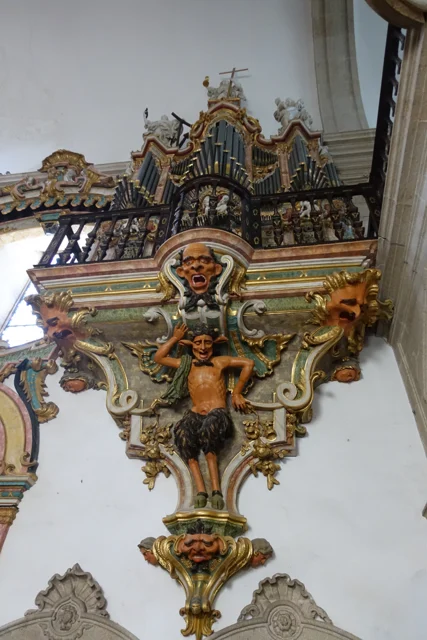
Organ with tubes and golden cut, on carved figures and decorative faces.
View of the organ and the decoration that sustains it, photographed in 2016. The image does not determine which of the two organs is the mute.
Photography: Joseolgon · CC BY-SA 4.0
About this photograph

Date given at source: . Source consulted in 2026-11-07. EXIF orientation, proportional resizing and WebP conversion; no retouching or clipping of the file.

Request withdrawal or correct authorship

See more 2 photos and details
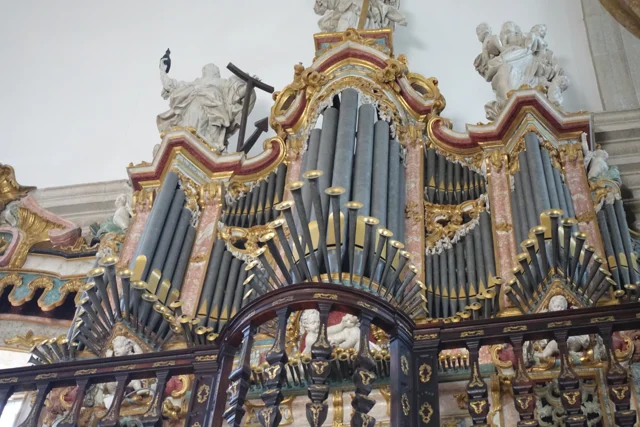
Organ tubes at different heights, surrounded by golden cut and light sculptures.
Details of the tubes, cut and sculptures of the organ in 2016.
Photography: Joseolgon · CC BY-SA 4.0
About this photograph

Date given at source: . Source consulted in 2026-11-07. EXIF orientation, proportional resizing and WebP conversion; no retouching or clipping of the file.

Request withdrawal or correct authorship

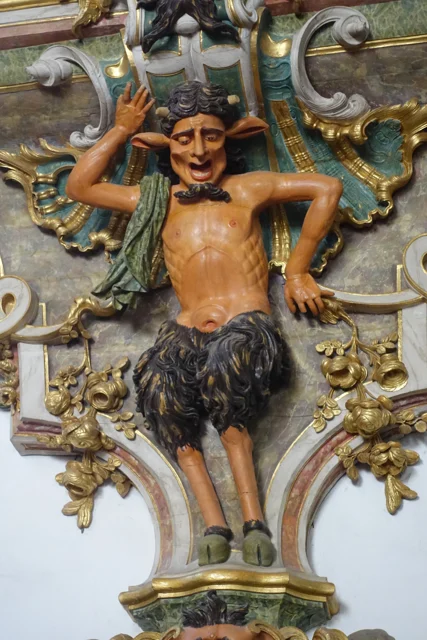
A figure carved with horns, pointed ears and fur-covered legs between golden elements.
Details of a figure carved under the organ in 2016.
Photography: Joseolgon · CC BY-SA 4.0
About this photograph

Date given at source: . Source consulted in 2026-11-07. EXIF orientation, proportional resizing and WebP conversion; no retouching or clipping of the file.

Request withdrawal or correct authorship

An invitation to look beyond the facade.

Inclui uma atividade para experimentar →Explorar: Os púlpitos tiveram mais de uma etapa →
Read here and consult sources

The municipal description identifies two lateral organs, being a mute. The visual symmetry of the church does not correspond, therefore, to two sound instruments. Next to the entrance appear frowns; later, the wood creates another surprise effect.

The two pulpits are painted brown to imitate marble and partially golden. The fountain places the execution in 1777–1780 and the painting and browning in 1786–1789. Shape, material and finishing count different stages of the same work. This patrimonial description does not confirm the current functioning of the organ.

The choir adds another reading of the wood: the Municipality describes a brown chair, of 1767–1770, organized in two levels and in the shape of U. São 45 seats, with the place of the abbot to the center. The disposition helps imagine a community gathered, instead of looking at each chair separately.

At the top, the circular zimbarium is accompanied by interior and exterior balconies. The description identifies the twelve apostles and, on the top, St. Michael. From furniture to silhouette, they change the scale and the observation point. The photographs of this reading show details of the organ; they do not document all these elements.

Palavras desta história: ver explicações →See Fact sheet: Mosteiro de São Miguel de Refojos
Source and context

Municipality — history and art of Mosteiro de São Miguel de Refojos

Accessed: . Editorial summary; the date of consultation is not the date of the facts.

Refojos · furniture of the sacristy

Wood inside, glow outside

The furniture of the sacristy brings together materials with different functions.

Inclui uma atividade para experimentar →Explorar: Materiais, aparência e conservação →
Read here and consult sources

The municipal news about the restoration of 2014 describes two arches and two counters with brown structure, jacaranda coating and cut brass decoration. The municipality identifies Agostinho Marques, notchmaker of Braga, as the author of this work of the early 18th century. The contrast between wood and metal is a clue to look at these furniture more closely.

In 2014, the restoration separated materials and tasks: the brass elements were removed for treatment, while the wood received intervention against insects and structural corrections. After cleaning and protecting, the metallic decoration returned to the furniture. The visible brightness results from a set of care, not just adding gold. It is the report of a professional intervention, not a proposal for home treatment.

Getting to know the parish See Fact sheet: Núcleo de Arte Sacra
Source and context

Municipality — Restoration of tokers and furniture, 14/11/2014

Accessed: . Editorial summary; the date of consultation is not the date of the facts.

Refojos · carving and artistic assignment

Three faces for a little sculpture

Major altar tokers deserve a long look.

Read here and consult sources

In the announcement of the restoration of six tocheiros, in 2014, the Municipality describes pyramidal structures with three decorated faces, gold leaf, floral motifs and heads of angels. It proposes a probable assignment to Frei José Vilaça and a conclusion between 1764 and 1767. The source presents this authorship as hypothesis, distinct from the confirmed assignment of the furniture of the sacristy.

The news also included the cross of the main altar between the pieces under treatment at the Santa Bárbara Workshops in Porto. The intervention was financed by a patron. This episode links the conservation of the heritage to the specialized work and the support of those who assume its costs.

Getting to know the parish See Fact sheet: Mosteiro de São Miguel de Refojos
Source and context

Municipality — Restoration of tokers and furniture, 14/11/2014

Accessed: . Editorial summary; the date of consultation is not the date of the facts.

Refojos · painting and restoration documented in 2013

What the frame was hiding

Restoring a painting can reveal more than new colors.

Read here and consult sources

The conservation report of the Adoration of Pastors, published by the museum in 2013, says that the frame hid parts of the composition. The intervention recovered these areas and adjusted the frame and support structure. The description of the scene also highlights a musician with bagpipes among the figures: a detail to look for in reading this painting, whose history also includes the conservation work.

The work included the recovery of nine paintings on canvas, including two double-sided procedural flags, awarded in 2012 to the Santa Barbara Workshops. The report also describes aged varnishes that altered the reading of colors, showing that preserving requires studying both the image and its materials.

Getting to know the parish See Fact sheet: Núcleo de Arte Sacra
Source and context

Basto Land Museum / Santa Barbara Workshops — Restoration of the Adoration of Pastors, 19/06/2013
Consultations: ,

Editorial summary; the date of consultation is not the date of the facts.

Refojos · history of assistance since 1877

Care is also part of the story

Mercy was born of a local initiative in the 19th century.

Read here and consult sources

The review of Santa Casa places its constitution in September 1877, with the purpose of supporting poor people who needed health care. The first statutes were approved in January 1879. In 1896 opened a hospital, replaced in the years 1950 by the Hospital Professor Julio Henriques. The institution highlights the contribution of the population to this new unit. These dates help follow a history of assistance and cooperation; they do not describe the health services available today.

Source and context

Santa Casa da Misericórdia of Cabeceiras de Basto — historical review of the institution

Accessed: . Editorial summary; the date of consultation is not the date of the facts.

Refojos de Basto · photography and biography

From Cancela to portraits of Brazil

A photographer from Refojos left a mark across the Atlantic.

Inclui uma atividade para experimentar →
Read here and consult sources

Joaquim Insley Pacheco was born in the place of Cancela, in Refojos de Basto, according to the Museum of Lands of Basto. Photographer and painter, became one of Brazil's outstanding portraitists. The Brazilian National Library documents his appointment as Photographer of the Imperial House in 1855. History thus links a place of the municipality to the early days of photography in Brazil.

The exhibition of the National Library adds a learning link: Pacheco was a student of Frederick Walter, who arrived in Fortaleza in 1847 with daguerreotype equipment and also acted as a magician. Photography, teaching and show intersect in this story of the first professionals.

The recognition of 1855 places Pacheco in Rio de Janeiro and in the court of D. Pedro II. It is three points to follow the biography: the place of origin, learning and professional recognition. The relationship between them helps to discover how a history of Refojos participates in a broader history of the image.

Do you want to move from biography to image? The presentation of 2016 on the official blog of the National Library shows a portrait of D. Pedro II, dated 1883 and attributed to Pacheco, from the collection of the institution. The legend allows to connect an author name, a person portrayed, a date and a collection. It is a concrete example to observe at the source and compare with the photographer's history.

Source and context

Basto Land Museum — Joaquim Insley Pacheco, 27/03/2026

National Library of Brazil Foundation — a photographer, an editor and a zoologist

National Library Foundation — presentation by Joaquim Insley Pacheco and portrait by Pedro II (14/10/2016)

Accessed: . Editorial summary; the date of consultation is not the date of the facts.

Refojos · teaching and monastic life in the 16th century

Between a monastery and a university

Air view of the Monastery of São Miguel and the Republic Square in Refojos
Mosteiro de São Miguel de Refojos: the place connected to the abbot Frei Diogo de Murça. Photograph of the set, not of the reported season.© Vitor Oliveira from Torres Vedras, PORTUGALⓘ

Frei Diogo de Murça links Refojos to the academic life of Coimbra.

Explorar: Um plano reconsiderado →
Read here and consult sources

Abbot of Refojos and rector of the University of Coimbra, Frei Diogo de Murça wanted to apply the rents of the Monastery to the foundation of two colleges in Coimbra: São Bento and São Jerónimo. The plan meant to extinguish the monastery. The municipal documentation reports the opposition of the religious and the subsequent reconsideration of the Abbot himself. This link shows how decisions on Refojos participated in a broader history of teaching and religious institutions.

The municipal review is in 1555 the acceptance of the new request by Paul IV: keep the Monastery with twelve religious and a prior, rather than follow the first plan of extinction. The same source records the death of Frei Diogo in Refojos, in 1570, and his grave in the Monastery.

See Fact sheet: Mosteiro de São Miguel de Refojos
Source and context

Municipality — proposal for a heritage registration of the Monastery, pp. 9 and 11; later uses in p. 11 (candidature document, not a UNESCO classification)

Municipality — History of the Monastery: Frei Diogo de Murça and the colleges of Coimbra

Accessed: . Editorial summary; the date of consultation is not the date of the facts.

Refojos · 19th and 20th century transformations

After the monks, other lives

Air view of the Monastery of São Miguel and the Republic Square in Refojos
Current view of the Monastery of Refojos and the square; it is not an image of the nineteenth-century uses.© Vitor Oliveira from Torres Vedras, PORTUGALⓘ

Camera and school are also part of the history of the building.

Explorar: O edifício mudou de vida por etapas →
Read here and consult sources

The extinction of religious orders, in 1834, changed the fate of the set of Refojos, keeping the church in the religious function. According to the municipal proposal of patrimonial candidacy, João António Fernandes Basto acquired the Monastery in public haste between 1838 and 1842. In the nineteenth century, the assembly also welcomed municipal services; in 1944, another part received a college with boarding school. Looking at the whole is also to discover how ancient buildings were adapted to administration and teaching.

The document places around 1855 the installation of the city services in the part of the cloisters. For the school area, it registers a new change of ownership in 1959, for the Conciliar Seminary of Braga. The group therefore did not have a single destination after 1834: different parts followed their own stories. The heritage proposal is here a historical source; it does not demonstrate a UNESCO classification nor confirms the current uses of each space.

Palavras desta história: ver explicações →See Fact sheet: Mosteiro de São Miguel de Refojos
Source and context

Municipality — proposal for a heritage registration of the Monastery, pp. 9 and 11; later uses in p. 11 (candidature document, not a UNESCO classification)

Basto Land Museum — The place of the Pereiras of Refojos de Basto, 28/07/2024

Accessed: . Editorial summary; the date of consultation is not the date of the facts.

Refojos · municipal toponymy decision, 2020

A street sign can open a story

The names chosen in 2020 resemble people connected to Refojos.

Read here and consult sources

In June 2020, the Municipality announced the assignment of names to ruins of the village to remember figures of the history of the Monastery. Among them were the Abbot Diogo of Murça, the notchmaker Vilaça and Gueda Mendes, associated with the offer of the medieval chalice. The same decision recovered ancient toponyms from places of Refojos. The toponym thus approximates two memories: people who marked the heritage and names that the inhabitants used to recognize their places.

Source and context

Municipality — deliberations of June 2020 and toponymy of Refojos

Accessed: . Editorial summary; the date of consultation is not the date of the facts.

Pereiras, Refojos · old uses of the House

From jail to music

A building can change paper in the community.

Explorar: As Pereiras para lá de um edifício →
Read here and consult sources

In the Pereiras, the building of the former House of the House continued to serve as a chain until 1972, according to the Museum of Lands of Basto. After recovered, received Casa da Música. A municipal news of July 2010 already included it among the spaces proposed to know the municipality. The Museum article needs the change from the House to the Monastery in 1835 and the inauguration of the Casa da Música in 2003: the building continued to change its function after not receiving the municipal administration.

The story of the building begins before the chain that remained in memory. The article of the Museum assigns the editor João Gil de Abreu Castelo Branco the order to build the House of the House in 1586. It then admits a reconstruction in the 18th century, in place of the previous building.

The two floors shared functions: jail in the first, Chamber and hearings in the second. This organization gathered administration and justice in the same space. When the House left, the prison remained; when it closed, the building did not disappear. The inauguration as Casa da Música, in 2003, added another use to a construction with several chapters.

Source and context

Basto Land Museum — The place of the Pereiras of Refojos de Basto, 28/07/2024

Municipality — visits to see the municipality, news of 29/07/2010

Accessed: . Editorial summary; the date of consultation is not the date of the facts.

Pereiras, Refojos · football in the 20th century

When football won the field

The Pereiras are also part of sports memory.

Inclui uma atividade para experimentar →Explorar: As Pereiras tinham várias vidas →
Read here and consult sources

In Pereiras, the memory of the municipality also passes through football. The Basto Land Museum identifies the field inaugurated in 1925 as the first of Cabeceiras de Basto. It served from home to different sports communities, linking the place to the practice of the game and the meetings of those who accompanied it.

In 1982, the construction of the National Road 311 led to the move of the countryside to another location. A sports equipment can thus help count the transformation of a settlement: space changes, but memory preserves the connection to the previous place.

The Museum article, published in July 2024, places the field in a place that had trade, school and fairs. The bibliography includes The Journal of Cabeceiras, of 20 September 1925, and Ecos of Cabeceiras, of 15 August of that year. They are references indicated by the Museum, without reproducing here the contents of these newspapers.

Source and context

Basto Land Museum — The place of the Pereiras of Refojos de Basto, 28/07/2024

Accessed: . Editorial summary; the date of consultation is not the date of the facts.

Refojos · Núcleo de Arte Sacra collection

A painting is part of a bigger story

The Incredulity of São Tomé belongs to a set of five works.

Inclui uma atividade para experimentar →
Read here and consult sources

In March 2026, the Basto Museum of Land presented an iconographic study of the Incredulity of São Tomé, sung by Saint Thomas Aquinas. It identifies it as oil painting on canvas, integrated into a retabular set of five late-mannerist works of the early 17th century. Looking at a painting together with the others helps to realize that a collection can keep relationships between images. The news documents the work, without confirming current conditions of visit.

See Fact sheet: Núcleo de Arte Sacra
Source and context

Basto Land Museum — Painting of Núcleo de Arte Sacra, 2026-03-13

Accessed: . Editorial summary; the date of consultation is not the date of the facts.

Refojos · documented object 2011

A dish that passed through centuries

The heritage also fits into a brass object.

Read here and consult sources

A municipal publication of 2011 presented a plate of offerings in brass then exhibited in the Museological Center of the Bass Tâmega. Its production was located, with reservation, between the 15th and 16th centuries. This uncertainty is part of the story of the piece: knowing an object does not always allow setting a year. The reference to the exhibition belongs to 2011 and does not confirm that the piece is currently visible to the public.

See Fact sheet: Núcleo de Arte Sacra
Source and context

Municipality — publication of 2011, page 14, Offer dish

Accessed: . Editorial summary; the date of consultation is not the date of the facts.

Refojos · provenance of a piece preserved in Coimbra

A cup full of characters

A small piece of gold silver holds a medieval connection to Refojos.

Read here and consult sources

The Machado de Castro National Museum identifies this 12th century chalice as an offer by D. Gueda Mendes to Mosteiro de São Miguel de Refojos. The decoration invites to look at parts: in the cup are Christ and the Apostles, under round arches; at the base appear the symbols of the four evangelists. The form indicates unknown authorship and locates the piece in Coimbra. Knowing its provenance allows discovering heritage linked to Cabeceiras which is outside the municipality.

See Fact sheet: Mosteiro de São Miguel de Refojos
Source and context

Museu Nacional de Machado de Castro — Cálice, ficha da coleção no Google Arts & Culture

Accessed: . Editorial summary; the date of consultation is not the date of the facts.

Refojos · historical interpretation of medieval donation

Who offers is not necessarily who does

An inscription can also give work to historians.

Read here and consult sources

The study published in Portvgalia magazine in 1995 explains an old confusion: D. Gueda Mendes was taken by goldsmiths, when the inscription should be understood as a reference to who ordered the play. The chalice is associated with 1152, but the study does not confirm whether the donor still lived on that date or whether the order fulfilled a testamentary disposition. The story of the object therefore includes certainties and open questions.

See Fact sheet: Mosteiro de São Miguel de Refojos
Source and context

Portvgalia, new series, volume XVI (1995) — study of medieval goldsmithry, analysis of the cup of Refojos

Museu Nacional de Machado de Castro — Cálice, ficha da coleção no Google Arts & Culture

Accessed: . Editorial summary; the date of consultation is not the date of the facts.

Refojos and Coimbra · historical route of the chalice

From Refojos to Coimbra, a history in motion

Objects also go through changes in institutions.

Inclui uma atividade para experimentar →
Read here and consult sources

According to the study of 1995, the chalice remained in Refojos until the mid-16th century and went to the College of São Bento de Coimbra, in the context of the work of Frei Diogo de Murça. After the extinction of religious orders in 1834, he passed to the Treasure of the Sé de Coimbra. The record of the Machado de Castro Museum documents its current connection to the collection. This journey adds a material history to the relationship between Refojos and Coimbra.

See Fact sheet: Mosteiro de São Miguel de Refojos
Source and context

Portvgalia, new series, volume XVI (1995) — study of medieval goldsmithry, analysis of the cup of Refojos

Museu Nacional de Machado de Castro — Cálice, ficha da coleção no Google Arts & Culture

Accessed: . Editorial summary; the date of consultation is not the date of the facts.

YOUR LOCAL GUIDE

What would you like to discover?

Take a closer look.