Heritage
ⓘPonte de Cavez
Five arches over the Tâmega and centuries of change on a medieval bridge.
Cavez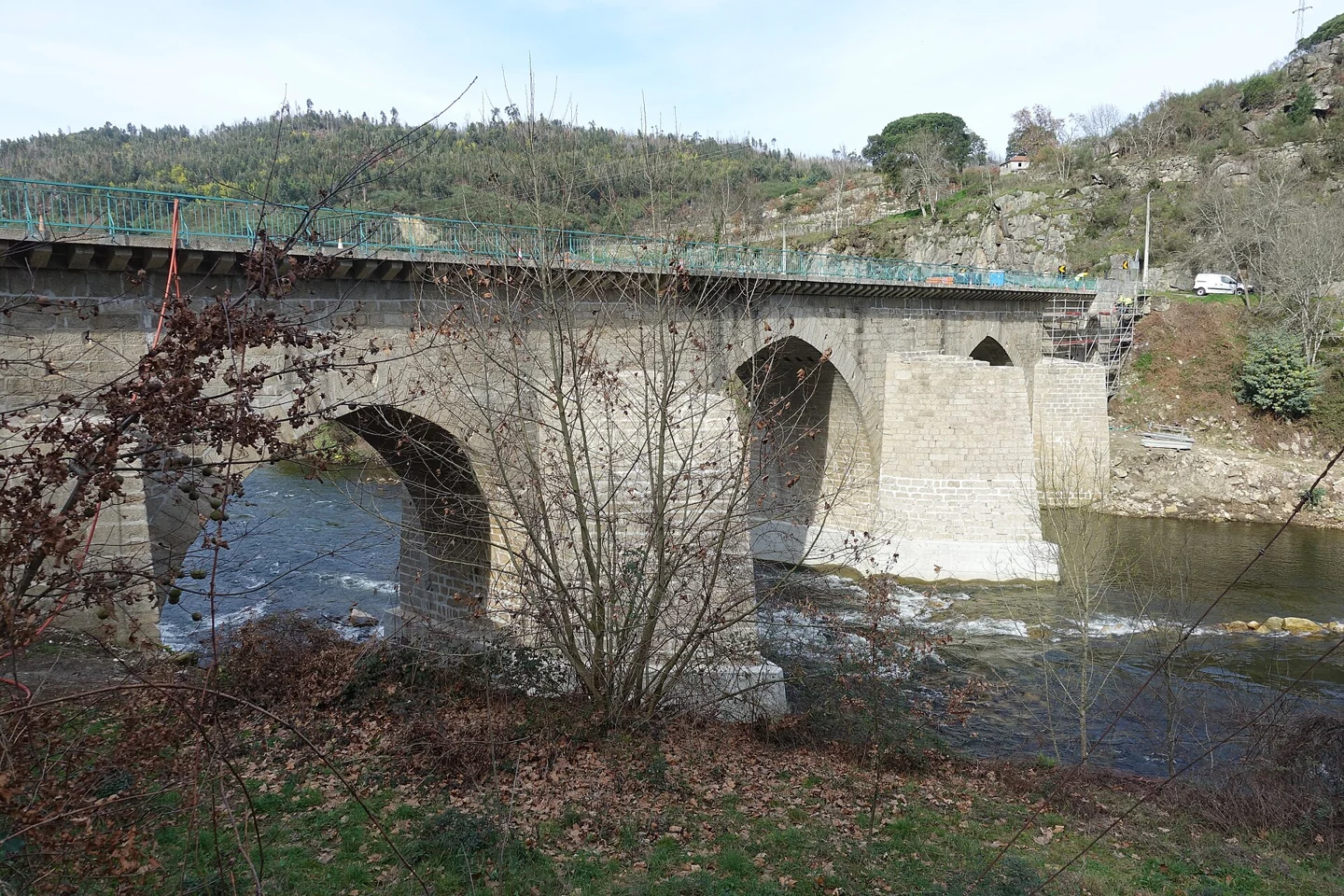
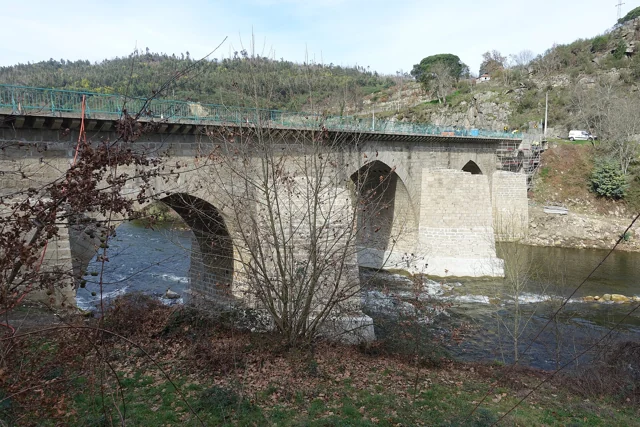
View of the Cavez bridge over the river Tâmega, with stone arches and wooded banks.
ⓘA bridge over the Tâmega, a pilgrimage and many stories to take with you.
Administrative name: Cavez
A selection of what is documented in the guide. Confirm visiting conditions in the charts.
Slide to see more places →
Five arches over the Tâmega and centuries of change on a medieval bridge.
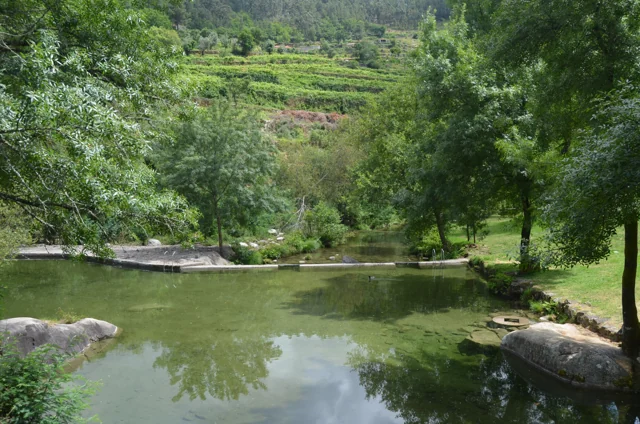
CavezA leisure area at the mouth of the Moimenta stream, on the right bank of the Tâmega in Cavez.
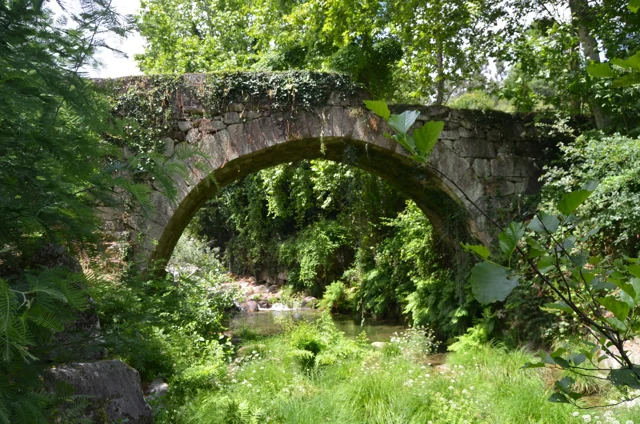
CavezAn ancient arch and an enlargement of 1990: two seasons in the crossing of Moimenta.
CavezThe medieval bridge of Cavez tells a story of links between banks and territories.
The tradition attributes the construction of the bridge to Frei Lourenço Mendes and associates a narrative about the completion of the work and the death of the builder.
The parish relationship of São João of Cavez lists eight places, including Ponte, Vila Franca, Arosa and Moimenta.
Knowledge, landscapes and memories linked to this parish.
Choose from 18 activities here →
2 guides with stories from here → · To follow a story by chapters.
In Moimenta, the ancient stone coexists with an intervention of 1990.
A winter dish with roots in rural life.
A sample shows a small portrait of the Tâmega in Cavez.
A recipe learned from Grandma of Cavez.
Before the wine reaches the table, there is a landscape to discover.
Wine soups are part of the food memory collected in Cavez and Pedraça.
The kitchen connects people, generations and parishes.
Nazaré Oliveira showed how she made her sweets at a local history meeting.
Hospitality was also recorded in the memory of Arosa.
Not all birds are discovered with eyes in the sky.
The common barbeque makes its journey into the river.
For a young boga, a quiet area can make a difference.
Sunshine tells an introduction story.
Feeding connects life in and out of water.
On the northern scale, the dark margins of the scales draw a pattern.
The gobium links the life of the river to the invertebrates.
The grey alveola leads to curiosity to the shore.
Not all snails of the same species wear the same pattern.
Not every plant in the woods is looking for its interior.
The water nearby was not always accessible water.
In Cavez, the memory of 1758 connects forests to fuel.
A metal box connected the work to the parties.
The lamps tell another story about the house.
Wearing shoes wasn't always wearing them.
In 1758, the Cavez Grand Bridge impressed the parish priest.
An old bridge didn't stop in history.
Around the bridge, memory also invented paths.
Not all changes in a monument can be seen at first sight.
In Cavez, an ancient list draws relations between villages, residents and monasteries.
Observations of citizen science with location published in this parish, crossed with the limits CAOP2025. They are not visiting points or independent confirmation in the field.
Leaves that deserve a second look
See observation Birds · 25/06/2024A feather also leaves a clue
See observation Birds · 12/08/2024A bird by the water
See observation Molluscs · 15/05/2024A spiral between the leaves
See observation Plants · 15/06/2026Bell-shaped flowers
See observationWe don't have any revised events here yet. Go back to the schedule to find out the schedule available.
A bridge over the Tâmega, a pilgrimage and many stories to take with you. The medieval bridge of Cavez is National Monument; Saint Bartholomew connects the chapel to the traditions of the sulfuous waters. Moimenta, the farms and the agricultural landscape open other paths of discovery by the parish.
The medieval bridge of Cavez tells a story of links between banks and territories. Around it, the valley of the Tâmega gathers farms, manor houses and places such as Moimenta, Arosa, Rabiçais and Vila Franca. There is another crossing to know: the bridge of Moimenta, distinct from the bridge of Cavez.
The tradition attributes the construction of the bridge to Frei Lourenço Mendes and associates it with a narrative about the completion of the work and the death of the builder. The report is part of the local memory; it is not used as a documentary biography. The pilgrimage of São Bartolomeu relates the chapel, the bridge and the sulphur waters. Beliefs about these waters are described as tradition, without assigning them therapeutic efficacy.
The parish relationship of São João of Cavez lists eight places, including Ponte, Vila Franca, Arosa and Moimenta. It also records the existence of a hearing, judge and jail in the context of the local organization. The document helps to recognize the importance of the parish and the places in the life of the 18th century, without equating these institutions to the current competences of local authorities.
The municipal presentation describes the arches of unequal forms and the talhamares of the bridge of Cavez. Associates the pilgrimage of St. Bartholomew to the tale of Camilo Castelo Branco How she loved him. Reading the place can add architecture, literature and oral tradition, preserving the distinction between these sources. The bridge of Moimenta remains a different reference; its popular name is not enough to determine the date of construction.
The houses of Ponte, Souto and the Church and the distinct references to the Valley of Moimenta and the Vale de Arosa show the diversity of the housing heritage of the parish. The municipality also mentions ranches linked to São João Baptista, Arosa and the village of Cavez. These references document the presence of collective expressions in the local characterization, without confirming the current activities or activities of each group.
Cavez · Moimenta · Arosa · Ribs · Vila Franca
This list preserves the places referred to in the selected documentation, without constituting a complete census.
Getting to know the history of the municipality
Main source consulted in 04/11/2026.
Publication at that source: Unidentified. Registered documentary verification: 2026-11-04.
Method recorded in that review: Documental review in 04/11/2026 of the municipal pages, historical transcripts and references indicated. Uncollated manuscripts. Archivistic descriptions, studies of oral tradition and dated observations are identified. Visually revised photographs from the Commons file consulted in 03/11/2026; camera position does not equal the survey of the object.
Editorial review: 2026-11-06. The editorial review is neither a visit to the site nor a real-time update. Additional times and sources may have their own consultation dates, indicated in the form.
Did you find any different information? Suggest correction