Discover Cabeceiras de BastoFree independent guide
ViveCabeceirasYOUR GUIDE TO CABECEIRAS
ENEnglish
SearchSaved

Stories of Cabeceiras

Choose a story to start with. You can change the subject or fine tune the search.

20 leituras · Todos os temas · Pesquisa: castanhas

The flavours of Cabeceiras

From the garden to the pot, from the oven to the table.

Escolher uma história · 10
Oral memory · Pedraça

Chestnuts in the spring?

The kitchen had the work schedule.

Inclui uma atividade para experimentar →Explorar: Da árvore ao dia de trabalho →
Read here and consult sources

Chestnuts in April and May? In the memory of Maria da Conceição Gonçalves Mouta, they were dried chestnuts that arrived at the table during the cultivation and sowing of corn. The broth, with beans, cabbage and potatoes, closed the first meal, by nine or nine and a half in the morning, after fried cod with bread.

The testimony was collected by Maria de Fátima Carvalho in February 2011, in Pedraça. Maria da Conceição had learned the preparation with her mother-in-law. The chestnuts were previously dried and aired; the baked potato was crushed and returned to the pot. Conservation, texture and working hours are found in this family memory.

Here there are two calendars: that of the fruit and that of the meal. The dried chestnut kept allowed to bring to the spring table a food associated with the harvest of another season. The memory does not only describe ingredients: it explains how the reserves of the house accompanied the time of tilling and sowing. The time of the “lunch” also surprises those who today use this word for the midday meal.

It is a story with voice and place, not a rule for all the houses of Cabeceiras. When talking about a family recipe, it is worth keeping these differences: who taught it, when it was prepared and what changed between the fireplace and the stove. Thus, a list of ingredients becomes a small history of work, learning and domestic life.

Source and context

Basto Land Museum — testimony of Maria da Conceição Gonçalves Mouta, collected by Maria de Fátima Carvalho in 2011

Accessed: . Editorial summary; the date of consultation is not the date of the facts.
Vila Nune · feed in 1758

There was wine, but you bought bread

A small difference reveals how the table was supplied.

Inclui uma atividade para experimentar →Explorar: Produzir, comprar, transformar →
Read here and consult sources

In 1758, the vicar of Vila Nune pointed the wine as the most abundant production, but said that almost all the residents bought bread. Olive oil arrived for the population and there was little chestnut left. The table therefore depended on both the crops and the purchases.

In the same memory, the parish priest described a land situated in a small valley and on the descent of mountains. The abundance of a product did not mean producing everything that was eaten. The document allows making this comparison, but does not say where the bread was bought or how much it cost.

Getting to know the parish
Source and context

Municipality — Parish Memoirs of Vila Nune, 23/05/1758

Accessed: . Editorial summary; the date of consultation is not the date of the facts.
Saint Nicholas · agriculture described in 1758

Not all the cereal was the same

Rye, target corn and million appear side by side in the old account.

Inclui uma atividade para experimentar →Explorar: O que sustentava a mesa? →
Read here and consult sources

In 1758, the parish priest of São Nicolau distinguishes rye, target corn and million among the crops. He adds wine, olive oil, chestnuts and other fruits, describing a production to support the growers. In speaking of the fields on the hills, he highlights mainly rye. The variety of words invites to read the agriculture of the past without reducing all the cereals to a single crop.

The report places the fields in the low areas, among mountains that separated the places. The water entered this organization: mentions mills, dams and levadas that served fields and farms. Cultivating was not only choosing a seed; it also depended on the land and access to water.

For the animals of labor, the farmers turned to the hills for part of the year, for lack of pasture in the fields, collecting them at night. Read together, these passages show fields, mountains, animals and water as parts of the same rural life. They are observations of the parish priest in 1758, not quantities of production or current agricultural rules.

Source and context

Basto Land Museum — St Nicholas Parish Memories (1758)

Accessed: . Editorial summary; the date of consultation is not the date of the facts.

Rio Douro · agriculture in 1758

From valley to hill, the harvest changed

The landscape also chose the pantry.

Inclui uma atividade para experimentar →Explorar: Segue a paisagem até à despensa →
Read here and consult sources

In Rio Douro, the report of 1758 distinguishes the production of the places by the rivers from the places of mount. To the first associates millions, wine, chestnut and acorn; to the second, rye. The landscape also helps to read the pantry.

In describing the shores, the parish priest refers to fields with oaks and vines and, where there were no fields, woods of heather. The same document depicts cold, windy mountains and with snow in winter. They are historical descriptions that allow to relate cultivation and land, without constituting a current agricultural or climatic survey.

Getting to know the parish
Source and context

Municipality of Cabeceiras de Basto — Parish memories of 1758: Rio Douro

Accessed: . Editorial summary; the date of consultation is not the date of the facts.

Pedraça · 2011 food memory

The bread also entered the cabbages

The cabbages with migas used the tender leaves of spring.

Explorar: Uma cozinha ao longo do ano →Ver ingredientes e preparação →
Read here and consult sources

Maria da Conceição added broa, beans and sausage to the cabbages. The collection of February 2011 associates the dish to April and May. It is a family testimony, distinct from the cabbages with beans. After the preparation, the broa, garlic and olive oil were added together in an alguidar. The same container went to the table.

The dish accompanies the calendar of the garden: in the memory of Maria da Conceição, April and May brought new and tender cabbages. The recipe also holds gestures — thin cutting, running, involving — and an object of service, the alguidar. Ingredients, time and utensils count different parts of the same memory.

Getting to know the parish
Source and context

Basto Land Museum — testimony of Maria da Conceição Gonçalves Mouta, collected by Maria de Fátima Carvalho in 2011

Accessed: . Editorial summary; the date of consultation is not the date of the facts.

Pedraça · crop memory

Lunch at 9:00 in the morning?

Meal names also save other rhythms.

Read here and consult sources

In the crops remembered by Maria da Conceição, the first meal was called lunch and arrived at nine or nine and a half. Fried cod was served with bread, followed by chestnuts broth.

The testimony associates this rhythm to April and May, when tilling and sowing corn. The words of the meals also guard ways of organizing the work. It is the memory collected in this family, not a general time of the municipality.

In this case, the learning of broth came from the mother-in-law, born in Pedraça. The testimony thus distinguishes different people in the transmission of the recipes. The preparation used dried chestnuts, approaching an autumn harvest of spring labor from the fields. The meal recalled gathered preserved food, bread and a concrete agricultural task: to till and sow corn.

Getting to know the parish
Source and context

Basto Land Museum — testimony of Maria da Conceição Gonçalves Mouta, collected by Maria de Fátima Carvalho in 2011

Accessed: . Editorial summary; the date of consultation is not the date of the facts.

Bucos · testimony of 1758

Three cereals in the same landscape

The storeroom of Bucos did not depend on one grain.

Inclui uma atividade para experimentar →Explorar: Do grão ao moinho →
Read here and consult sources

The parish priest of 1758 lists target corn, million and rye, saying that they were produced in similar proportions. He also mentions some wine and little chestnut. It is the agricultural portrait he left in writing, not a description of the current crops.

And where were the grains transformed? In the same memory, António Alves Teixeira describes mills in the two water courses of the parish and farmers that carried the cereal there. The document allows to link the list of crops to the milling, although not detail recipes nor the division of each cereal between food and other uses. The date, 22 May 1758, marks the moment of the report: the proportions mentioned are an appreciation of the vicar, not a weighing of a harvest.

Getting to know the parish
Source and context

Municipality — Parish memories of Bucos (1758)

Accessed: . Editorial summary; the date of consultation is not the date of the facts.

Alvite · written memory in 1758

In the fields, there was more than corn

A crop list opens the landscape of 1758.

Inclui uma atividade para experimentar →Explorar: Segue o cereal, muda de fonte →
Read here and consult sources

The million appears as the most abundant cereal in Alvite’s memory of 1758. But the list continues with rye, target corn, millet, wheat and barley. The parish priest adds beans, hanged wine, olive oil, chestnut, land and fruit.

The enumeration shows a diverse agriculture; it does not give quantities of each harvest. Compare it to Bucos, where the report describes another relationship between cereals. The documents allow to recognize differences without turning impressions of the parish priests into modern statistics.

The same report places part of the parish on the slopes of Senhora da Orada and another part in a more flat zone, accompanying a small course of water. The list of products thus gains a scenario: fields distributed by different positions in the relief. The text does not, however, relate each culture with a concrete portion.

There is also a difference between harvest and meal. Knowing that cereals, beans, wine or olive oil were produced does not reveal the recipe served in a given house. To get to the kitchen, other sources, such as family memories and preparations documented on the site, must be added.

Source and context

Municipality — Memory of Alvite, 23/05/1758; transcription of José Viriato Chapel (2003)

Accessed: . Editorial summary; the date of consultation is not the date of the facts.

Cavez and Pedraça · transmission of recipe, 2011

A recipe also has someone who teaches it

The kitchen connects people, generations and parishes.

Inclui uma atividade para experimentar →Explorar: Quem trouxe esta receita? →
Read here and consult sources

In the collections of the Museum, Maria da Conceição Gonçalves Mouta, a native of Cavez and resident in Recovos, Pedraça, identifies who transmitted the dishes. The cabbages with migas came from the grandmother, from Cavez; the broth of chestnuts, from the mother-in-law, from Pedraça. Maria de Fátima Carvalho recorded these testimonies in February 2011. Names help to realize that this memory belongs to a concrete family experience.

Source and context

Basto Land Museum — food and food: collections of February and March 2011

Accessed: . Editorial summary; the date of consultation is not the date of the facts.

Abadim · agriculture described in 1758

In the same parish, the harvest changed

In 1758, the cold separated two agricultural landscapes.

Inclui uma atividade para experimentar →
Read here and consult sources

In the memory of Abadim, José Antunes distinguishes the fields of the Village of the Tower and Santo António from those of Travassô, Porto d’Olho and Torrinheiras. In the first two places, it lists corn, millet and rye, as well as wine, olive oil, chestnut and oak acorn.

In the three places that he describes as colder, he highlights rye and little corn. The document approaches climate, relief and food: what was harvested was not the same in the whole parish. It does not present harvest weights nor allows to calculate the production per inhabitant.

The author also places Torrinheiras at the top of the hill and Porto d’Olho and Travassô at half a hillside. Its description helps to relate the names to positions in the landscape, without providing measured altitudes. In the mountain grounds it mentions heather, carquejas, tojos, and some pasture. The agricultural portrait therefore includes cultures and forest spaces: the parish does not appear as a single uniform field.

Source and context

Municipality — Parish memories of Abadim, José Antunes, 22/05/1758

Accessed: . Editorial summary; the date of consultation is not the date of the facts.

Crafts and memories

In the hands, at the table and in the community: little stories of how one lives and what one transmits.

Escolher uma história · 2
Refojos · flavours described in 1956

New chestnuts and clay mugs

The memory of the party also has flavors.

Inclui uma atividade para experimentar →
Read here and consult sources

In the description of 1956 published by the Museum, the food establishments and tents were filled. Regional wine accompanied new lunches or chestnuts, served in glassy white clay mugs. They are details of a chronicle that brings the fair closer to its daily gestures.

The table appears in the middle of a moving fair. The chronicle evokes groups crossing paths, buses and trains, blankets coming from Barroso and the arrival of people in the Alameda do Seco and the Praça da República. Eating and drinking were part of this meeting, alongside the trade, the religious festival and the livestock contest.

There are two dates to be kept: the quoted text came out in the newspaper in 16 September 1956; the Museum re-disclosed it in 26 September 2024. The excerpt has the expressive language of a chronicle, does not present visitor counts or meals sold. By comparing it with the memory of dried nuts in crops, we discover the same fruit in different occasions and forms of conservation.

Source and context

Basto Land Museum — St Michael of other times, 26/09/2024; excerpts from The Journal of Cabeceiras of 16/09/1956 and 08/09/1977

Accessed: . Editorial summary; the date of consultation is not the date of the facts.

Pedraça · inventoried object 2015

One almude, two colors in memory

The inventory records more than the form of an object.

Inclui uma atividade para experimentar →
Read here and consult sources

The Almude L023, associated with the Casa de Passo de Vides, in Pedraça, served to transport and measure wine. The plug of 2015 gives it 28 liters and describes zinc plate painted brown, with paint to peel; the original color was blue. The capacity belongs to this invented piece, not to all almudes. Even a layer of paint helps to tell the life of an object.

The record indicates 55 cm tall and 28 in diameter and identifies Jacqueline Vilela Passos as owner. External measurement, capacity and property are distinct information: joints make the description more useful than the name of the object alone.

The brown painting and the traces of blue also show that a piece may have been transformed throughout use. The inventory does not give the date of repainting. The observation of the ink allows to count a change, but does not reconstruct all the episodes of the almude's life.

Source and context

Basto Land Museum — Latoaria in Cabeceiras de Basto (05/11/2015), L023

Accessed: . Editorial summary; the date of consultation is not the date of the facts.

Read the landscape through the plants

Trees, forests, vineyards and fields reveal different ways of occupying the territory.

Escolher uma história · 3
Botanic · general characteristics

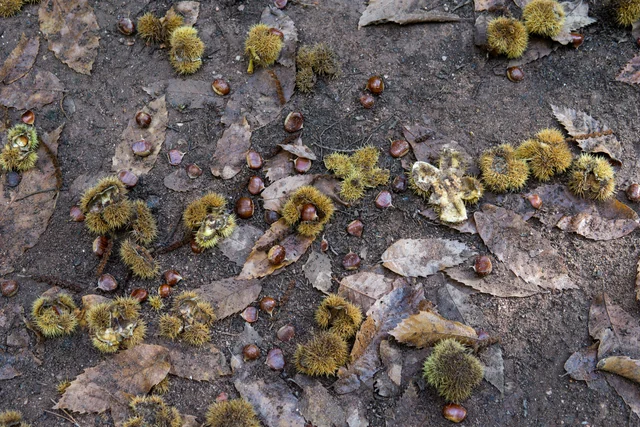
What's hidden in the hedgehog?

Open urchins and bright chestnuts between fallen leaves.
Chestnuts and hedgehogs on the ground in Guirbaden, Mollkirch, France, in 2020. Botany illustration; not a record of Cabeceiras.
Photography: AudreyMuratet · CC BY-SA 4.0
About this photograph

Date given at source: . Source consulted in 2026-11-07. EXIF orientation, proportional resizing and WebP conversion; no retouching or clipping of the file.

Request withdrawal or correct authorship

The chestnut is the fruit; the hedgehog involves the whole.

Inclui uma atividade para experimentar →Explorar: Do ouriço à semente →
Read here and consult sources

Castanea sativa loses the leaves at the unfavorable time and can reach large size. The form of the Polytechnic Institute of Castelo Branco describes narrow and yellow flowers in long and pendant ears. Later, the chestnuts are grouped within the hedgehog: the chestnut is the fruit, while the hedgehog involves the set.

Notice the layers: the brown and shiny cover belongs to the fruit; inside there is usually a seed, with a yellowish film. The tree also took place in the workshops: the source refers to wood used in carpentry, woodworking, basketry and turnery. They are general characteristics and uses, without assigning a workshop or exemplary to the municipality.

Before the hedgehog there are flowers. UTAD Digital Flora indicates May and June as the flowering season of the species. It is a general botanical reference, not a prediction for a tree of Cabeceiras: to know its rhythm, compare photographs of the same specimen on different dates. A tree without chestnuts on a spring visit does not tell the same story as an open hedgehog in autumn.

The chestnut belongs to the family Fagaceae, the same large botanical family of oaks. Compare the fruits helps to realize that kinship does not mean equal appearance: go back to the reading of the oak and look for what involves the acorn, then return to the scheme of the layers of the chestnut.

Palavras desta história: ver explicações →See the plants photographed in the municipality
Source and context

Polytechnic Institute of Castelo Branco — botanical record of Castanea sativa

UTAD Botanical Garden — Castanea sativa, Flora Digital de Portugal

Accessed: . Editorial summary; the date of consultation is not the date of the facts.

Vegetation described for the territory

The forest also has a history

Names that are part of the mountain memory.

Inclui uma atividade para experimentar →Explorar: Ler uma árvore por partes →
Read here and consult sources

Carvalhos and chestnut trees are part of the mountain vegetation described by the municipality. The same source counts the partial replacement of this vegetation by pine-bravo. Therefore, a wooded slope also keeps planting choices and changes in land use. Looking only at the green does not arrive: it is worth noticing the species, spots and spaces between trees. This municipal description is not a current survey of each forest.

The publication Forests do Alto Minho distinguishes soutos, oriented to the production of chestnut, candlesticks, for the production of sticks. They are uses of chestnut, not two species of tree. This regional comparison helps to ask questions about the landscape of Cabeceiras; it does not identify the function of a concrete portion of the municipality.

There is still a forest below the canopy. The sub-basket gathers plants that grow under the trees; dead wood can also sustain insects that feed on it and fungi. A forest landscape is not, therefore, limited to the number of living trunks. To observe it, look for different layers — canopy, low vegetation and fallen wood — without concluding that the species cited for another region are present in that area.

Palavras desta história: ver explicações →
Source and context

Municipality — landscape and vegetation

High CIM Minho — High Forests Minho, sours and candlesticks (habitat 9260)

Accessed: . Editorial summary; the date of consultation is not the date of the facts.

Botanic · general characteristics

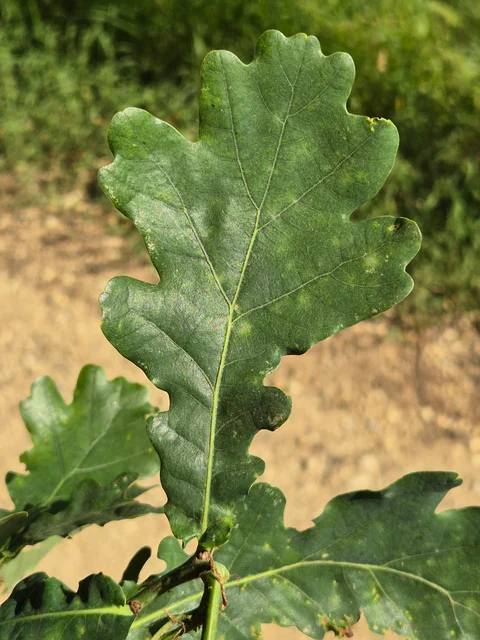
A leaf drawn in waves

Oak green leaf with margin cut into visible wolves and ribs, still connected to the branch.
Leaf of Quercus robur photographed near Hollenstein, in the forest of Hollabrunn, Austria, in 2025. Illustration of the species; it is not a record of Cabeceiras nor identifies the broteroan subspecies.
Photography: Stefan.lefnaer · CC BY-SA 4.0
About this photograph

Date given at source: . Source consulted in 2026-11-07. EXIF orientation, proportional resizing and WebP conversion; no retouching or clipping of the file.

Request withdrawal or correct authorship

In the oak, notice the contour and the foot of the leaf.

Inclui uma atividade para experimentar →Explorar: A bolota entre a árvore e a história →
Read here and consult sources

The outline of the leaf has broad and unequal lobes: curves that resemble small waves. The description of the University of Évora adds a short petiole, with less than five millimeters, and secondary ribs curves that are not parallel. Instead of just looking at the silhouette, compare contour, ribs and link to the branch.

The fruits appear supported by peduncles and have a dome of brownish scales. The name used by the source is Quercus robur subsp. broteroana. These characteristics help to understand the botanical description; they do not identify the subspecies in the photographs or places of this guide.

The description presents deciduous leaves to marcescents. In the first case, they fall seasonally; in the marcescence, dried leaves may remain trapped for some time. A brown leaf in the branch is therefore not necessarily a living leaf.

The chart associates this oak to humid environments and refers to intolerance to summer drought. The leaf outline describes a structure; moisture and response to drought describe relationships with the environment. They are complementary clues to read the plant and landscape.

Palavras desta história: ver explicações →See the plants photographed in the municipality
Source and context

University of Évora — Quercus robur subsp. broteroana, description by Carlos Vila-Viçosa

Accessed: . Editorial summary; the date of consultation is not the date of the facts.

A world under the leaves

A first look at the fungi. Continue in the gallery to see the local records already documented.

Escolher uma história · 2
General ecology · wood and biodiversity

A log can be a small house

Decomposing wood is still full of relationships.

Inclui uma atividade para experimentar →Explorar: Um tronco abre várias histórias →
Read here and consult sources

A fallen log is still part of the forest life. Fungus decomposes wood, which also sustains other organisms, including insect larvae. The researcher Susana Gonçalves explains that certain tree cavities result from fungal activity and can then serve as an animal shelter. A tree with cavities and a trunk on the ground offer different situations to observe. In green spaces, conserving old trees requires assessing and monitoring the risk of falling. This ecological explanation does not confirm an association between the beetle photographed in Cabeceiras and a specific tree.

But the wood does not always break down in the same way. In white rot, the fungi degrade lignin and cellulose; the wood can become clear, fibrous or spongy. In brown rot, the degradation reaches mainly cellulose and hemicellulose, becoming a brownish residue rich in lignin. The wood can become fragile and fragmented into small blocks. The University of California distinguishes these processes by the effect on the components of the wood.

White and chestnut describe decomposition, not the color of a mushroom hat. Nor are species names. A reproductive structure visible in the trunk shows only part of the story: decomposition can extend up or down and remain hidden. A photograph does not allow to measure this extension or evaluate the stability of the tree.

Palavras desta história: ver explicações →See local fungal records
Source and context

Gulbenkian Garden — ecology of fungi, with Susana Gonçalves (17/04/2023)

University of California — Wood Decay Fungi in Landscape Trees (revised August 2019)

Accessed: . Editorial summary; the date of consultation is not the date of the facts.

General biology · example of Laetiporus sulphureus

Shears that grow in a log

The reproductive form can project itself to the side.

Read here and consult sources

In Laetiporus sulphureus, Kew describes yellow reproductive structures that are available as shelves on trees. The fungus acts on the dead wood of the interior of larger trunks and branches, contributing to their decomposition. The description explains a form of growth; it does not confirm the presence of this species in Cabeceiras nor allows to recognize other fungi only by color.

Yellow belongs to the structure that is seen outside; the activity of the fungus extends to wood. Kew describes a decomposition that makes it brown and can leave cavities inside. Looking only at the shelves is therefore looking at a part of the process. The presence in a tree does not mean that all its parts are dead: the text refers to dead wood inside trunks and branches. This description does not evaluate the stability of concrete trees.

Source and context

Royal Botanic Gardens, Kew — In pictures: Fungi spotting season at Kew, Grace Brewer, 24/10/2019

Accessed: . Editorial summary; the date of consultation is not the date of the facts.

The life you don't always see

Knowing animals begins by perceiving the territory and respecting the distance.

Escolher uma história · 3
Serra da Cabreira · regional reference and biology of the species

A discreet bird that reveals itself in the corner

In the fig tree, listening can be as interesting as looking.

Explorar: Três pistas para conhecer uma ave →
Read here and consult sources

Sylvia borin has relatively uniform chestnut plumage and clear lower parts. The British Trust for Ornithology chart highlights the song rich in whistling notes and the connection to dense shrub vegetation and wood edges. Vieira tourist portal of Minho refers to figueira-fellosa for the Cabreira. They are clues to know the species and its habitat, without identifying nests or ensuring sightings in the municipality.

The whole year doesn't happen in the same scenario. BTO describes the winter south of Sara. In the UK, the species is a summer visitor and becomes harder to detect when it stops singing. This helps to perceive an important difference in one observation: hearing less does not necessarily mean that all birds have left. British dates do not serve as the arrival schedule for Cabreira.

In reproduction, the BTO record indicates a typical posture of four to five eggs and incubation shared by the male and female, usually for 10–12 days. After hatching, the cubs still develop in the nest. Compared with the gift-faf, it is possible to find that birds with similar size postures can differently share the care of the eggs.

Palavras desta história: ver explicações →
Source and context

British Trust for Ornithology — BirdFacts: Garden Warbler, Sylvia borin

Vieira Tourism of Minho — fauna of Serra da Cabreira, regional reference

Accessed: . Editorial summary; the date of consultation is not the date of the facts.

Cabeceiras and Serra da Cabreira · documented distribution of the breed

Little horse, mountain pass

Garrano is part of the Northwest's living heritage.

Read here and consult sources

The DGAV catalogue includes Cabeceiras de Basto in the Garrana breed breeding area and refers to its presence in Serra da Cabreira. It describes brown horses, sometimes dark, with an adult height of less than 1,35 meters to the garrote. Its movements adapt to the mountain paths. Even when created in freedom, Garrano is a domestic horse. The documented distribution links the breed to the territory, without guaranteeing meetings on a rail or identifying a concrete herd.

The race pattern describes a compact body, short and strong limbs, black manes and tail. Fitness is not limited to saddle: it includes cargo transportation, traction and agricultural work. Horses are part of a landscape also worked by people, where walking mode is of practical importance.

The catalogue distinguishes locked step and walking. In the first describes four beats; in the walk, members on the same side raise and land together, producing two beats per past. They are descriptions of movements, not two names for the same movement. Reading this detail helps to understand why the heritage of a race includes more than appearance.

Palavras desta história: ver explicações →
Source and context

DGAV — Garrana, distribution and pattern of race, p.2

Accessed: . Editorial summary; the date of consultation is not the date of the facts.

Refojos de Basto · local register and general biology

A rapture with a varied menu

The common-buthium seeks food in the landscape sky and also on the ground.

Inclui uma atividade para experimentar →Explorar: Do poiso à paisagem →
Read here and consult sources

The photograph of ecovore shows Buteo buteo landed among branches, in a record of 1 July 2025. The published point, crossed with CAOP2025, is located in the parish of Refojos de Basto. The image allows to observe the inn bird; it does not show a hunt.

Also called eagle-d’asa-round, this prey may show marked differences in the amount of white and brown plumage. The University of Évora describes a species resident in mainland Portugal, with reinforcement of winter birds from northern Europe. Color alone does not solve all identifications.

The BTO describes a feed that takes advantage of available prey: rabbits and small mammals, but also birds, amphibians, large insects and earthworms. The search for food can take you to the ground. Compared with the hunting tartaranion helps you realize that two prey can share some food without having the same way of life.

Source and context

University of Évora — Buteo buteo: plumage and distribution

British Trust for Ornithology — BirdFacts: Buzzard

Accessed: . Editorial summary; the date of consultation is not the date of the facts.

YOUR LOCAL GUIDE

What would you like to discover?

Take a closer look.