Discover Cabeceiras de BastoFree independent guide
ViveCabeceirasYOUR GUIDE TO CABECEIRAS
ENEnglish
SearchSaved

Story

Choose a story to start with. You can change the subject or fine tune the search.

8 stories · Travel through time · Search: água

Travel through time

Documents, details and traditions: there is more to discover than a date on a stone.

Choose a story · 8
Arco de Baúlhe and Vila Nune · municipal heritage description

The triangle facing the water

A detail of the Ponte Velha reveals which way the river comes from.

Read here and view sources

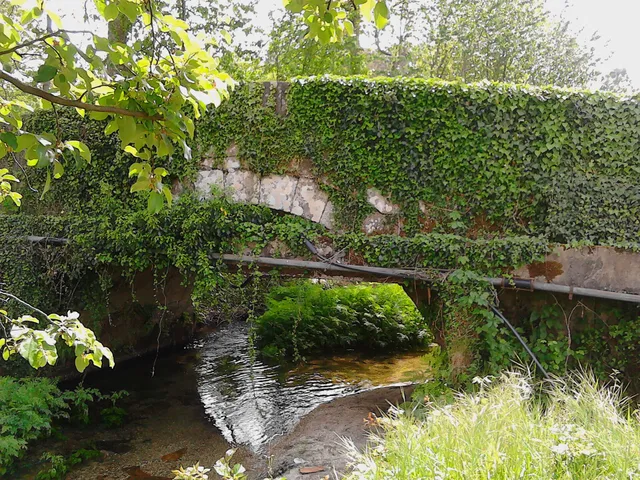
At the Ponte Velha in Arco de Baúlhe, a semicircular arch supports the deck over the Ouro River. The municipal description dates construction to the 18th century.

The triangular cutwater stands upstream, facing the incoming water. This detail allows us to read the bridge beyond its outline. The shape of the arch alone does not prove Roman origins.

Words in this story: see explanations →See Fact sheet: Ponte Velha de Arco de Baúlhe
Source and context

Municipality — Cultural heritage, bridges of Arco de Baúlhe and Moimenta

Accessed: . Editorial summary; the date of consultation is not the date of the facts.
Abadim · milling history

Flour brought revenue to the king too

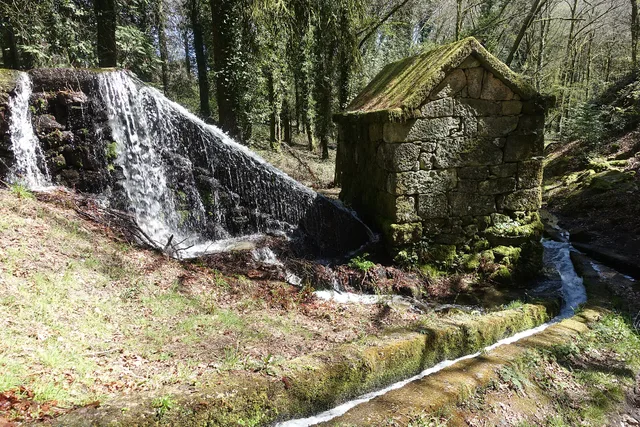
Granite mill supplied by the Levada de Víbora at Moinhos de Rei, with a waterfall and channel in wooded surroundings. Photograph from 2025.
Moinhos de Rei · the place of grinding© Joseolgonⓘ

Moinhos de Rei preserves a story of water, grain and income.

Read here and view sources

In the historical narrative published by the municipality, these communal mills belonged to the Crown and half their income was assigned to the king. The same description mentions a later change to a symbolic tax. The place name thus opens a window onto the economic organisation of milling.

The income mentioned concerns the mill’s economic activity. Without more information, it should not be converted into a rule that each person handed half a sack of grain to the king. The introduction gives no accounts, quantities ground or date for the change to a symbolic tax.

Exploring the history of Moinhos de Rei, you can ask two different questions: how did water reach the machinery, and how were the benefits of milling distributed? The levada helps follow the first; the reference to the Crown opens the second. Technology, organisation and income belong to the same working landscape.

See Fact sheet: Moinhos de Rei
Source and context

Municipality — Moinhos de Rei, historical account of milling and the Crown

Accessed: . Editorial summary; the date of consultation is not the date of the facts.

Bucos · transport in 1758

A small bridge on a long route

Casares lay on many people’s route.

Includes an activity to try →Explore: Paths that served the life of the village →
Read here and view sources

At Casares, a wooden bridge formed part of the royal road to Braga and the connections with Trás-os-Montes, according to the 1758 account. Given the traffic, the vicar argued for rebuilding it in stone. This was a request, not confirmation of completed work.

The source distinguishes that crossing from small pedestrian footbridges made with a wooden beam. Different crossings answered different needs.

The crossing did not serve only the village. The vicar describes a busy public road connecting Braga with the jurisdiction of Basto and Trás-os-Montes. The bridge therefore appears as a local point in a larger network. His recommendation to replace it with dressed stone shows the author assessing a need as well as recording what existed.

In the same rivers, water drove mills and was used by farmers in their fields. Crossing, milling and irrigation appear in the same portrait of the territory. A bridge can be read through what it makes possible: reaching another place, maintaining a connection or bringing work on opposite sides of the water closer together.

Words in this story: see explanations →Getting to know the parish
Source and context

Municipality — Parish memories of Bucos (1758)

Accessed: . Editorial summary; the date of consultation is not the date of the facts.

Cavez · Parish Memories of 1758

A bridge that earned praise

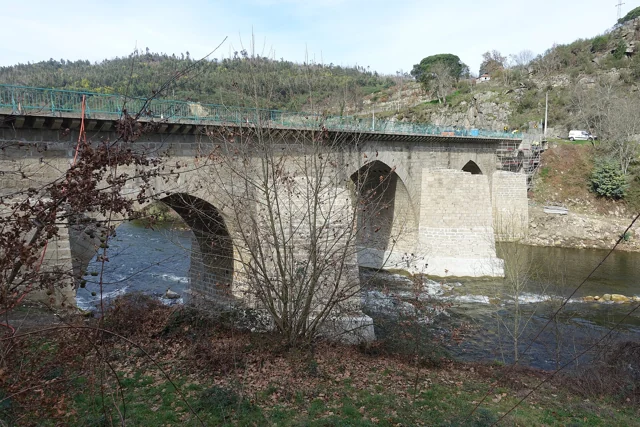
Cavez Bridge over the Tâmega River, with stone arches, a deck and tree-lined banks.
Ponte de Cavez · crossing Tâmega© Joseolgonⓘ

In 1758, Cavez’s Ponte Grande impressed the parish priest.

Explore: Two shores, several stories →
Read here and view sources

In the parish account, the Tâmega crossing is described as a large, well-worked stone bridge. The author even calls it the best on that river. The praise belongs to the writer’s viewpoint: it reveals the importance he gave the structure, without serving as a technical comparison of bridges.

In the same account, the Tâmega appears as a strong current, especially in winter. The document distinguishes crossing the water from using it: it describes mills and explains that the river ran too deep to irrigate the fields along that stretch. The bridge can be read within these relationships among banks, movement and work.

Notice the difference between observing a structure and judging it. The bridge’s existence is information; calling it the best is an assessment. Both tell us about the past, but answer different questions.

Getting to know the parish See Fact sheet: Ponte de Cavez
Source and context

Municipality of Cabeceiras de Basto — Parish memories of 1758: Cavez

Accessed: . Editorial summary; the date of consultation is not the date of the facts.

Local legend · Cavez Bridge

The voice that said to build further upstream

Cavez Bridge over the Tâmega River, with stone arches, a deck and tree-lined banks.
Ponte de Cavez on the Tâmega · the monument to which legend refers.© Joseolgonⓘ

Around the bridge, memory imagined its own paths.

Includes an activity to try →
Read here and view sources

The legend shared by the Museum has masons try to build the bridge at Vila Franca and then beside Poço das Laranjeiras. In both places, a supernatural voice told them to move upstream. Tradition attributed it to Saint Bartholomew.

On the third attempt, the narrative places construction beside the chapel. This is a story about the memory of a place, not documentary proof of site selection or an itinerary for finding the episodes.

In another part of the tradition collected by the Museum, feeding the builders receives a miraculous explanation: springs of water, wine and olive oil emerge, and fish appear in the river. The narrative connects building effort with religious protection. Reading it beside the history of the works reveals two different ways of telling the same place.

See Fact sheet: Ponte de Cavez See Fact sheet: Capela de São Bartolomeu de Cavez
Source and context

Land Museum of Basto — Ponte de Cavez, 27/02/2022

Accessed: . Editorial summary; the date of consultation is not the date of the facts.

Pedraça · residential heritage

Pedraça can be told through its houses too

Beyond the church lies a landscape of homes.

Includes an activity to try →Explore: Houses, persons and work in Pedraça →
Read here and view sources

Pedraça’s history can also be read through its houses. The municipal presentation highlights Casa do Paço, Casa de Parada and the houses of the Baron of Basto and Paço de Vila. It describes Parada as Brazilian in style, while drawing attention to the place name for Casa do Paço. These are different clues: one points to architecture, the other to place naming.

The houses belong to a parish the municipality describes as fertile and rich in water, connected with agriculture and flax growing. Bringing housing together with the working landscape helps us look at heritage beyond religious buildings.

The municipal description gives no construction dates for this group and does not identify who was responsible for each building. The reference to Brazilian taste is also insufficient to reconstruct an owner’s biography. The houses are starting points for learning about the parish; inclusion here does not imply public access.

Words in this story: see explanations →
Source and context

Municipality — parish presentation of Pedraça

Accessed: . Editorial summary; the date of consultation is not the date of the facts.

Painzela · heritage identification, without an established chronology

A bridge, a name and a question

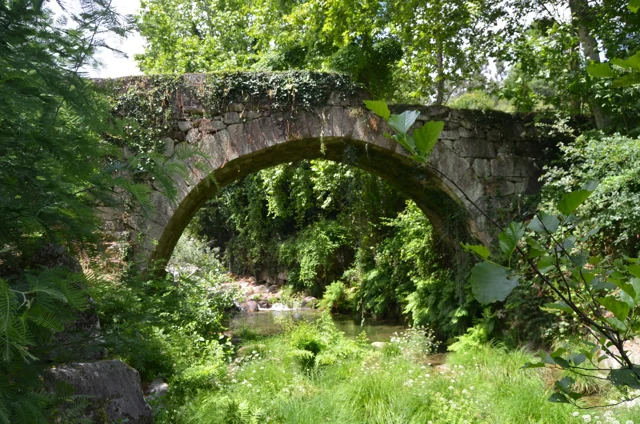
Painzela’s stone bridge over a watercourse, surrounded by vegetation
Ponte de Painzela, photographed by Tommasoandrea. The image allows observing the arch and the water line; it does not determine the time of construction.© Tommasoandreaⓘ

Calling it Roman does not settle its age.

Includes an activity to try →
Read here and view sources

The municipal presentation of Painzela includes a photograph labelled Ponte de Painzela and lists a Roman Bridge among the parish’s heritage. That name alone does not establish when the bridge was built. The name helps locate the place; dating would require documents or a study of the structure. It is a useful question to bring to heritage: what do we know from the identification, and what do we still need to investigate?

See Fact sheet: Ponte de Painzela
Source and context

Municipality — parish presentation of Painzela and bridge identification

Accessed: . Editorial summary; the date of consultation is not the date of the facts.

Cavez · history of Moimenta Bridge; current conditions unverified

Two eras in the same bridge

Moimenta’s old bridge in Cavez: a stone arch over the river, surrounded by vegetation, photographed in June 2020.
Moimenta Bridge, photographed by Pedro at 11 June 2020. A crossing record other than Ponte de Cavez over Tâmega.© Pedroⓘ

In Moimenta, old stone meets work carried out in 1990.

Read here and view sources

An old bridge can keep changing. The municipality attributes medieval origins to Moimenta Bridge in Cavez and describes a single rounded arch.

In 1990, the crossing was widened by around one metre: a concrete structure was added on the downstream side and the parapets were altered. The photograph offers a starting point for observing the crossing; the date of the work comes from the documentary description.

Words in this story: see explanations →See Fact sheet: Ponte antiga de Moimenta
Source and context

Municipality — Cultural heritage, bridges of Arco de Baúlhe and Moimenta

Accessed: . Editorial summary; the date of consultation is not the date of the facts.
YOUR LOCAL GUIDE

What would you like to discover?

Take a closer look.