Discover Cabeceiras de BastoFree independent guide
ViveCabeceirasYOUR GUIDE TO CABECEIRAS
ENEnglish
SearchSaved

Story

Choose a story to start with. You can change the subject or fine tune the search.

6 stories · Time travel · Search: pelas

Time travel

Documents, details and traditions: there is more to discover than a date on a stone.

Choose a story · 6
Pedraça · housing

Pedraça is also counted by houses

Beyond the church, there is a housing landscape.

Includes an activity to try →Explore: Houses, persons and work in Pedraça →
Read here and view sources

The history of Pedraça is also read in the houses. The municipal presentation highlights Casa do Paço, Casa de Parada and the houses of the Baron of Basto and Paço de Vila. For Parada, it uses the expression Brazilian taste; for Casa do Paço, it draws attention to the name of the place. They are different clues: one points to architecture, another to the toponymy.

These houses are part of a parish that the Municipality describes as fertile and abundant in water, linked to agriculture and the cultivation of flax. Approaching the housing of the work landscape helps to look at the heritage beyond religious buildings.

The municipal description does not provide construction dates for this set nor identifies those responsible for each work. Nor does the reference to Brazilian taste enough to reconstruct the biography of a owner. The houses are here starting points to know the parish; their inclusion does not presuppose public access.

Words in this story: see explanations →
Source and context

Municipality — parish presentation of Pedraça

Accessed: . Editorial summary; the date of consultation is not the date of the facts.
Saint Lady · celebrations at 1758

When the parishes met

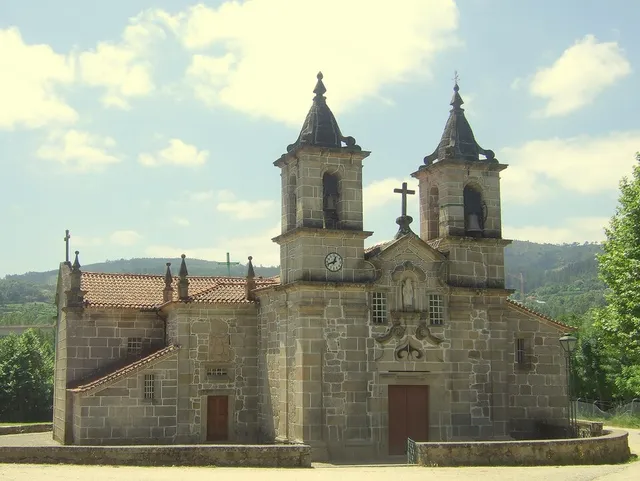
Facade of Igreja de Santa Senhorinha of Basto, with its two towers
Igreja de Santa Senhorinha · heritage context of the parish, not a record of the 1758 celebration© Bocacheteⓘ

A celebration also gathered the territory.

Explore: What made a community meet? →
Read here and view sources

In 1758, the procession of the Body of God gathered in Santa Senhorinha the Chamber and representatives of the nearby parishes, with crosses and ecclesiastics. The memory mentions expenses with wax and sermon: behind the celebration there was preparation, objects and work.

The Abbot also describes separately the triduum of the forty hours, with music and sermons for three days. Distinguishing the two references helps to realize the religious calendar of that time. The document is a testimony of 1758, not the agenda of the current feasts.

Words in this story: see explanations →Getting to know the parish
Source and context

Municipality — Parish Memoirs of Santa Senhorinha (1758)

Accessed: . Editorial summary; the date of consultation is not the date of the facts.
History of Ponte de Cavez

Five arches, more than a while

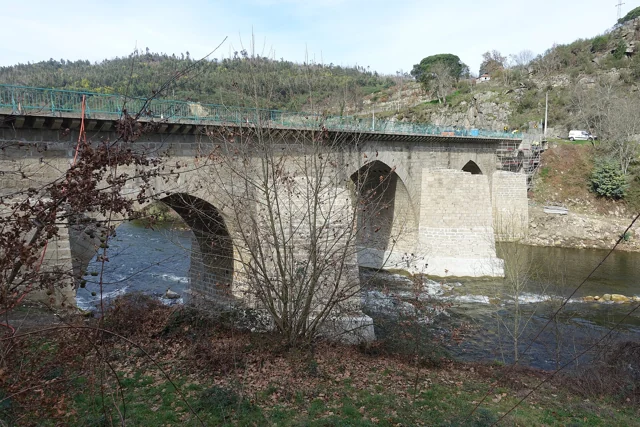
Ponte de Cavez on the river Tâmega, with stone arches, board and wooded banks.
Partial view of the Ponte de Cavez over the Tâmega.© Joseolgonⓘ

An old bridge didn't stop in history.

Includes an activity to try →Explore: A crossing, several seasons →
Read here and view sources

Three broken central arches and two perfect back, next to the banks: the Ponte de Cavez brings together different shapes and times. The Museum located the medieval construction in the second half of the 13th century, at the service of the road between Braga and Vila Pouca de Aguiar.

The source attributes the round arches to the works of Philip II's reign and mentions a landmark of 1599. In the 19th century, the road between Fafe and Vila Pouca de Aguiar brought the enlargement of the board. Watching the bridge is looking for changes to an ancient crossing.

According to the Museum, the stone bridge replaced a previous wooden, then degraded. The construction is attributed to Frei Lourenço Mendes, Dominican who gathered alms for the work; the museological text mentions testimonial legacies as support of this connection. The crossing thus involves materials, paths and ways to finance a collective work.

Words in this story: see explanations →See Fact sheet: Ponte de Cavez
Source and context

Land Museum of Basto — Ponte de Cavez, 27/02/2022

Municipality of Cabeceiras de Basto — Parish memories of 1758: Cavez

Municipality — conclusion of rehabilitation of Ponte de Cavez, 30/04/2019

Accessed: . Editorial summary; the date of consultation is not the date of the facts.

Holy Lady · memory of 1758

A Church Counted in Images

Before the screens, you looked at the panels.

Includes an activity to try →
Read here and view sources

In the memory of 1758, the church of Santa Senhorinha had two ships with programs of different images. One presented panels on the Creation of the World; the third Franciscan showed saints of this order.

The abbot also described a vaulted chapel, closed with iron railings. Painting, spaces and architectural elements composed a written portrait of the interior. The source allows to study this description, without ensuring that the pieces or layout are preserved today.

The description continues by the tombs, which the Abbot presents decorated with painting and golden letters, and by a particular chapel dedicated to Our Lady of the Pilar. The interior appears as a set of spaces, images and inscriptions, each with its function in the account.

This allows a layer reading: first the organization of the ships, then the painted themes and, finally, the elements that marked memory and devotion. It is not necessary to imagine a single undifferentiated hall; the document itself distinguishes various environments.

Words in this story: see explanations →See Fact sheet: Igreja de Santa Senhorinha
Source and context

Municipality — Memória de Santa Senhorinha, 23/05/1758; transcript of José Viriato Chapel (2003)

Accessed: . Editorial summary; the date of consultation is not the date of the facts.

Faia · communications in 1758

The letters had days of arrival

Before instant messages, the week was also organized in the mail.

Read here and view sources

In the reply of 1758, the abbot of Faia notes that the mail arrived on Tuesday and left on Thursday. A brief information reveals the pace of communications in a rural community. The document does not identify here the building where the letters were received; these days belong to the old account, not to the current postal services. The abbot placed Braga at eight leagues and Lisbon at sixty. The recorded distances, without conversion to current kilometers, add scale waiting for the news.

The answer is inserted in a questionnaire that also asked for distances, fairs and aspects of local life. In the same memory, the abbot distinguishes the São Miguel fair from the Olela fairs and the monthly fair in the head of the municipality. Mail and fair are two examples of rhythms that help to perceive a community; the text does not say that the letters were delivered in these markets.

Source and context

Municipality — Memory of Faia, 23/05/1758; transcript of José Viriato Chapel (2003)

Accessed: . Editorial summary; the date of consultation is not the date of the facts.

Vila Nune · settlement described in 1758

A parish, many small places

Telling neighbors wasn't the same as counting people.

Includes an activity to try →Explore: Places, people and paths →
Read here and view sources

In May 1758, the vicar of Vila Nune registered 55 neighbors and 239 people. He numbered fourteen places, some with only one resident, and marked uninhabited houses in the place of Serra.

These numbers describe different categories of the document. They should not be added or confused with a current census. The small scale of the places helps imagine a scattered settlement, observed from the parish.

The enumeration allows to approach the look: Silva assigns eight neighbors; to Vale and Rossada, five to each. Fojães and Ribeira da Covilhã appear with one resident. The church was in Granja, near the Valley. The religious center was not confused, therefore, with the place called Vila Nune.

The vicar Domingos Leite de Andrade adds that there were unmarried women in poverty between neighbors and people from other parishes. It is the social description of an author and of a time, without allowing the life of each person to be reconstructed. By preserving the terms and date, the document allows different domestic conditions to be observed within the small places.

Source and context

Municipality — Parish Memoirs of Vila Nune, 23/05/1758

Accessed: . Editorial summary; the date of consultation is not the date of the facts.

YOUR LOCAL GUIDE

What would you like to discover?

Take a closer look.