Discover Cabeceiras de BastoFree independent guide
ViveCabeceirasYOUR GUIDE TO CABECEIRAS
ENEnglish
SearchSaved

Stories of Cabeceiras

Choose a story to start with. You can change the subject or fine tune the search.

17 leituras · Todos os temas · Pesquisa: lobo

The life you don't always see

Knowing animals begins by perceiving the territory and respecting the distance.

Escolher uma história · 6
The occurrence referred to in the environmental document

Iberian wolf

A documented presence in the landscape of the municipality.

Inclui uma atividade para experimentar →Explorar: Conhecer o lobo através da paisagem →
Read here and consult sources

The environmental assessment of the PDM marks a pack in the territory, based on information from the ICNF. It is a reference to the ecological importance of Cabeceiras, not a promise of sighting. Knowing this presence does not require looking for animals or disseminating shelter sites. The national platform relates the scarcity of wild prey to livestock consumption and conflict with pastoral communities. It points to the protection of herds and the recovery of natural prey as complementary parts of conservation.

A pack is also a changing family. The platform describes a breeding couple, descendants of different years and sometimes other related adults. The group defends a territory, but its composition changes with births, growth and dispersion.

In the general cycle presented to Portugal, the cubs are born at the end of April or in May. During the summer, the meeting places become centers of family activity; in the autumn, the young begin to accompany the adults in travel and hunting. It is not an observation calendar for a concrete pack.

When growing up, some youths leave the group of origin to search for territory, partner or other pack. Others remain longer when there is enough food. Therefore, a count at one time does not describe an immutable family: social life accompanies the annual cycle and landscape opportunities.

Source and context

PDM — Environmental Assessment, p. 50
Accessed:

Lobo-Iberico platform in Portugal — wolf prey; registration of Cabreira without date indicated
Accessed:

Lobo-Iberico Platform in Portugal — Life in pack
Accessed:

Editorial summary; the date of consultation is not the date of the facts.
Wolf Ecology · Portuguese context and document reference to Cabreira

A landscape is also food

The wolf is part of a network of relationships.

Explorar: Quem vive na paisagem? →
Read here and consult sources

Javali, deer, deer and mountain goat are the main natural prey of the wolf presented by the platform for Portugal. This national list does not mean that all occur in Cabeceiras. Knowing a predator implies also understanding its prey. The platform explains that the recovery of wild prey depends on both natural expansion and reintroductions. These stories have different scales and origins: recovering one species in one region does not demonstrate its presence in another.

The page includes a photograph whose legend identifies a wild boar predatored by wolves in Serra da Cabreira, in Cabeceiras de Basto, with credit to Ismael Cunha. The legend establishes a local link, but does not indicate the date or allows calculating the frequency of predation. The photograph was not reproduced here.

There is another useful distinction when looking at animals in the mountains: a domestic breed created in freedom, like Garrano, does not become a wild species. The landscape can gather animals with different stories. This comparison does not show that a concrete animal is trapped from the wolf or that all the species mentioned share the same mountain section.

Source and context

Lobo-Iberico platform in Portugal — wolf prey; registration of Cabreira without date indicated

Accessed: . Editorial summary; the date of consultation is not the date of the facts.

Rio Douro · animals mentioned in 1758

The animals that remained in the memory of the mountains

A list of 1758 mixes encounters, abundances and passages.

Read here and consult sources

The vicar of Rio Douro names rabbits, hares, partridges, wolves, foxes and badgers when describing the mountains in 1758. Adds mountain pigs of passage and places the partridges only in some parts. These language differences are part of the testimony and deserve to be preserved.

The report describes cold, windy and snowy mountains in winter. It brings animals and landscape closer, but does not present counts, observation methods or a scientific inventory. It does not allow to conclude that all the mentioned species continue in the same places today.

Source and context

Municipality — Parish Memoirs of Rio Douro, António Carneiro da Costa, 22/05/1758

Accessed: . Editorial summary; the date of consultation is not the date of the facts.

Interpretation equipment

A first meeting in Moinhos de Rei

Learn about the Cabreira before going out to the field.

Explorar: Da interpretação à descoberta →
Read here and consult sources

The Núcleo Interpretativo de Vida Selvagem was inaugurated in 31 August 2013, in Abadim. The municipal presentation explains its connection to the fauna and flora of Serra da Cabreira and to the awareness of the forest. See the site chart to prepare the visit.

The building also has a history: the municipal presentation places the core in a small annex previously used by Social Services. The change of function has added the dissemination of animals and plants to the valorization of the forest and local customs and uses.

It is a starting point to ask questions about the landscape: what relations exist between forests, trees and animals? The following readings allow you to continue this discovery at home. Knowing a species or an environment does not guarantee a sighting on a visit.

See Fact sheet: Núcleo Interpretativo de Vida Selvagem
Source and context

Municipality — Núcleo Interpretativo de Vida Selvagem

Accessed: . Editorial summary; the date of consultation is not the date of the facts.

Mammals · local habits and reference

The boar comes out when the light goes down

A long snout and a very varied diet.

Inclui uma atividade para experimentar →
Read here and consult sources

The wild boar, Sus scrofa, is omnivorous and has mainly crepuscular and nocturnal habits. During the day it can shelter in dense woods. The Lobo-Iberic Platform documents a wild boar predatored by wolves in Serra da Cabreira, in Cabeceiras, without indicating the date of that record. The elongated snout and abundant fur distinguish it from the domestic pig. Although omnivorous, the source describes a mainly vegetable feed. The food flexibility helps to understand its adaptation to different landscapes.

The platform presents it as a pig-bravo and refers to marked differences between the sexes. It also describes the expansion of the species in Portugal, including areas close to urban centers. This national framework does not allow to calculate how many boars live in Cabeceiras.

The Cabreira register and the description of habits answer different questions: one document a meeting between predator and prey; the other helps to understand the life of the species. We do not know, from this isolated reference, the frequency of predation or the size of local populations.

Source and context

Lobo-Iberico platform in Portugal — wolf prey; registration of Cabreira without date indicated

Accessed: . Editorial summary; the date of consultation is not the date of the facts.

Bucos · memory 1758

The animals of an ancient portrait

An account of the mountains, written in 1758.

Inclui uma atividade para experimentar →
Read here and consult sources

The vicar of Bucos mentions partridges, rabbits, wolves, foxes and wild boars, which he describes as sparsely plentiful. He points out carqueja, heather and tojo on the hills. It is the landscape that recorded at that time, not a current inventory nor a promise to spot these animals.

The memory also mentions goats as the most abundant cattle and some large cattle. Thus, the same document gathers farm animals and fauna that the vicar describes as hunting. Separating the two groups helps to read the rural life of the period.

The expression of little abundance is an appreciation of the author, without method of counting presented. It does not allow directly to compare 1758 with a census of current fauna. The interest of the report is also in what you choose to observe: animals, forests, terrain and uses of the mountains appear together.

Source and context

Municipality — Parish memories of Bucos (1758)

Accessed: . Editorial summary; the date of consultation is not the date of the facts.

Time travel

Documents, details and traditions: there is more to discover than a date on a stone.

Escolher uma história · 4
Vilar de Cunhas · pastoral heritage

Two walls and a story of wolves

The fire of Uz witnesses ancient forms of defensive hunting.

Read here and consult sources

The inventory identifies a V-wall trap in Vilar de Cunhas. The date of construction remains uncertain: it discusses hypotheses between the Modern Era and the 19th century. One detail distinguishes it from other fires: one of the walls rises towards the well. The reading of digits on a slab is also uncertain, between 1668 and 1868. Doubt helps to understand why inventory does not set a single date.

Getting to know the parish
Source and context

Municipality — archaeological inventory, interpretations and chronologies

Accessed: . Editorial summary; the date of consultation is not the date of the facts.

Holy Lady · memory of 1758

Not all bridges were stone

The wood also united the banks.

Read here and consult sources

The memory of 1758 lists three wooden bridges in the parish: Vagalhafos, in Quinta de Vila de Lobos; Santa Senhorinha, near the church; and Olela. Names approach the crossings of the farms, the place of worship and the inhabited places.

The same report mentions singing bridges in São Clemente and São Martinho do Arco de Baúlhe. Wood and stone appear, thus, in a single description of the river. The enumeration does not provide construction dates nor proves the survival of structures.

Palavras desta história: ver explicações →
Source and context

Municipality — Memória de Santa Senhorinha, 23/05/1758; transcript of José Viriato Chapel (2003)

Accessed: . Editorial summary; the date of consultation is not the date of the facts.

Faia · settlement described in 1758

A parish told by sixteen places

In 1758, the Faia appears as a network of small places.

Inclui uma atividade para experimentar →Explorar: Uma freguesia distribuída por lugares →
Read here and consult sources

In memory of 23 May 1758, the abbot João de Lima Lobo de Noronha enumerates sixteen places. The enumeration includes Covilhã, Augueiros, Presas, Nogueira, Candedo, Ribeiro, Outeiro, Porcarice, Faia, Togais, Souto, Ribeira, Tuesdays, Breia, Casa Nova and Joio. Situa the church out of place and describes the parish on a northern slope.

The list helps to think of a territory distributed by small cores, and not just around the matrix. Names belong to historical transcription; they are not a current administrative list or allow to draw the boundaries of each place by themselves.

The same testimony presents two counts: 99 neighbors and 418 people. The document separates them; they should not add or read “neighbours” as another total of inhabitants. It also distinguishes scales: when speaking of the municipality, the abbot refers to eighteen parishes, but declares not knowing the number of its neighbors. Knowing what the author did not tell is as useful as knowing the numbers he left.

Ribeiro and Ribeira appear as different entries. Outeiro is here in the list of places of Faia: the coincidence with the name of another parish does not authorize to shift this reference on the map. The complete list allows to compare names, while chapels help to perceive some relations between places and houses.

Source and context

Municipality — Memory of Faia, 23/05/1758; transcript of José Viriato Chapel (2003)

Accessed: . Editorial summary; the date of consultation is not the date of the facts.

Faia · parochial memory 1758

At Faia, the abbot recorded no ruins

The same event left different accounts in the parishes.

Read here and consult sources

In the memory signed in 23 May 1758, the Abbot of Faia declared that there was no ruin caused by the earthquake. It is a counterpoint to the testimony of Alvite, who described damage to the crosses of a chapel. The absence of ruins in the account does not demonstrate that the earthquake was not felt: it shows what was recorded in that answer. Reading the two documents brings the general history of local experiences closer.

It is useful to notice who writes and when: the answer is from João de Lima Lobo de Noronha, abbot of Faia, and arises in a set of questions that also covers places, crops, fairs and mail. The earthquake is one of the subjects of this local portrait. The signature of 1758 dates the testimony, not the event that he recalls.

Source and context

Municipality — transcription of the Parish Memories of Faia, 23/05/1758

Accessed: . Editorial summary; the date of consultation is not the date of the facts.

Read the landscape through the plants

Trees, forests, vineyards and fields reveal different ways of occupying the territory.

Escolher uma história · 4
Botanic · general characteristics

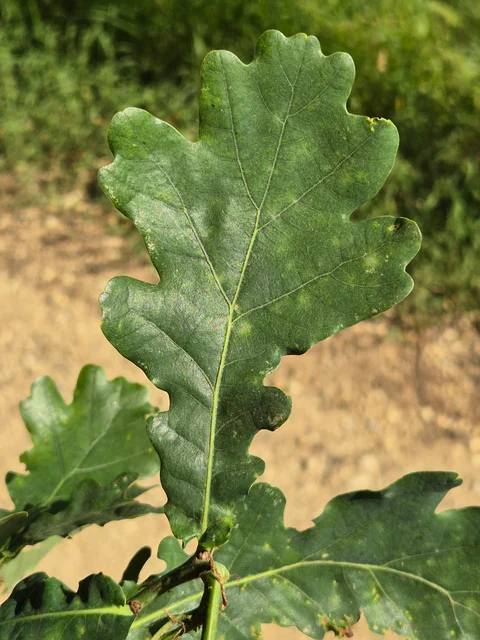
A leaf drawn in waves

Oak green leaf with margin cut into visible wolves and ribs, still connected to the branch.
Leaf of Quercus robur photographed near Hollenstein, in the forest of Hollabrunn, Austria, in 2025. Illustration of the species; it is not a record of Cabeceiras nor identifies the broteroan subspecies.
Photography: Stefan.lefnaer · CC BY-SA 4.0
About this photograph

Date given at source: . Source consulted in 2026-11-07. EXIF orientation, proportional resizing and WebP conversion; no retouching or clipping of the file.

Request withdrawal or correct authorship

In the oak, notice the contour and the foot of the leaf.

Inclui uma atividade para experimentar →Explorar: A bolota entre a árvore e a história →
Read here and consult sources

The outline of the leaf has broad and unequal lobes: curves that resemble small waves. The description of the University of Évora adds a short petiole, with less than five millimeters, and secondary ribs curves that are not parallel. Instead of just looking at the silhouette, compare contour, ribs and link to the branch.

The fruits appear supported by peduncles and have a dome of brownish scales. The name used by the source is Quercus robur subsp. broteroana. These characteristics help to understand the botanical description; they do not identify the subspecies in the photographs or places of this guide.

The description presents deciduous leaves to marcescents. In the first case, they fall seasonally; in the marcescence, dried leaves may remain trapped for some time. A brown leaf in the branch is therefore not necessarily a living leaf.

The chart associates this oak to humid environments and refers to intolerance to summer drought. The leaf outline describes a structure; moisture and response to drought describe relationships with the environment. They are complementary clues to read the plant and landscape.

Palavras desta história: ver explicações →See the plants photographed in the municipality
Source and context

University of Évora — Quercus robur subsp. broteroana, description by Carlos Vila-Viçosa

Accessed: . Editorial summary; the date of consultation is not the date of the facts.

Vegetation described for the territory

The forest also has a history

Names that are part of the mountain memory.

Inclui uma atividade para experimentar →Explorar: Ler uma árvore por partes →
Read here and consult sources

Carvalhos and chestnut trees are part of the mountain vegetation described by the municipality. The same source counts the partial replacement of this vegetation by pine-bravo. Therefore, a wooded slope also keeps planting choices and changes in land use. Looking only at the green does not arrive: it is worth noticing the species, spots and spaces between trees. This municipal description is not a current survey of each forest.

The publication Forests do Alto Minho distinguishes soutos, oriented to the production of chestnut, candlesticks, for the production of sticks. They are uses of chestnut, not two species of tree. This regional comparison helps to ask questions about the landscape of Cabeceiras; it does not identify the function of a concrete portion of the municipality.

There is still a forest below the canopy. The sub-basket gathers plants that grow under the trees; dead wood can also sustain insects that feed on it and fungi. A forest landscape is not, therefore, limited to the number of living trunks. To observe it, look for different layers — canopy, low vegetation and fallen wood — without concluding that the species cited for another region are present in that area.

Palavras desta história: ver explicações →
Source and context

Municipality — landscape and vegetation

High CIM Minho — High Forests Minho, sours and candlesticks (habitat 9260)

Accessed: . Editorial summary; the date of consultation is not the date of the facts.

Environmental history · testimony of 1758

A landscape told in 1758

Urches, carquejas, oaks and animals in the words of the parish priest.

Read here and consult sources

The memory of St Nicholas describes differences between mountains: some covered with heather and carqueja, others with tojo and oaks. It also refers to rabbits, partridges, hares, wolves, boars and foxes. This testimony shows how nature was described in the 18th century; it is not a current inventory of species. The author also compares the land: distinguishes finer grain stones to the north and spring from the big penedos to the west and south.

Getting to know the parish
Source and context

Municipality — Parish memories of St Nicholas, 22/05/1758
Accessed:

Basto Land Museum — St Nicholas Parish Memories, 22 May 1758
Accessed:

Editorial summary; the date of consultation is not the date of the facts.

Botanic of the species · with local registration

White flowers, small red fruits

The woodwork changes appearance throughout the reproductive cycle.

Inclui uma atividade para experimentar →Explorar: Uma folha simples ou um conjunto de folíolos? →
Read here and consult sources

The pine tree, Crataegus monogyna, is a shrub or small deciduous leaf tree. The leaves are simple, alternating and lobulated; the thorns explain the name white thorn. In the description of the Museum of Natural History and Science of the University of Porto, the white flowers have five petals.

The small red fruits are pomos and the fiche refers to a seed in each fruit. Leaves, flowers and fruits allow comparing different moments of the plant. The local photographic record linked to this history documents an observation, not all phases of the cycle or the distribution of the species by the municipality.

The botanical family also helps to make comparisons: the wood and silva belong to the Rosaceae, although they have different leaves and fruits. In the forest, a simple leaf has limbo cut into wolves; in silva, a composite leaf is divided into folioli. Being in the same family does not mean having the same shape.

The collection of the University of Porto associates the Piliteiro to the sub-basket and the forests in well drained soils. The distribution presented extends through Europe, Asia and North Africa. This framework is broader than the local record: a photograph of Cabeceiras documents a meeting, while the botanical record describes the species.

Palavras desta história: ver explicações →
Source and context

University of Porto — living botanical collection, Crataegus monogyna

University of Évora — Rubus ulmifolius, leaves and fruits

Accessed: . Editorial summary; the date of consultation is not the date of the facts.

Between rivers and mountains

Water and relief form the municipality. Choose a name and follow the landscape.

Escolher uma história · 1
Holy Lady · memory of 1758

The river entered the life of the fields

A cultivated margin also tells history.

Inclui uma atividade para experimentar →Explorar: Um rio, quatro histórias →
Read here and consult sources

The memory of 1758 describes the river of Santa Senhorinha running all year round, but with little water in summer. The memory describes cultivated shores, fruit trees and wild grove, linking water to irrigation and rural work.

Vila de Lobos and Cainhos had olive oil mills; the mills are referred to in Vila de Lobos and Sestelo. The same description allows following various uses of the river: to cultivate, grind and transform the olive. It does not confirm which of these equipment survive or operate today.

Unlike the precipitated currents described in São Nicolau, the abbot characterizes this river as quiet and oriented from sunset to spring. He begins his journey in Aboim and lists the passage by Várzea Cova, Passos and St Clemente before arriving in Santa Senhorinha. It is the geography reported in the document, not a current demarcation of the course.

The use of water for the fields is presented as free for residents. The relationship was signed on 23 May 1758. This detail is important: the indication of little water in the summer describes a pattern known to the author, not an observation made in the summer of this year.

Palavras desta história: ver explicações →
Source and context

Municipality — Memória de Santa Senhorinha, 23/05/1758; transcript of José Viriato Chapel (2003)

Accessed: . Editorial summary; the date of consultation is not the date of the facts.

A world under the leaves

A first look at the fungi. Continue in the gallery to see the local records already documented.

Escolher uma história · 1
Abadim · local register and general biology

A small landscape on the stone

The protrusions of a lichen give relief to the rock.

Inclui uma atividade para experimentar →Explorar: Continua pelo mundo pequeno →
Read here and consult sources

In the photograph of Pedro Andrade, of 31 January 2025, a brown-gray lichen has rounded protrusions over rock. The record is identified as Lasallia pustulata and located in Abadim by crossing the public point with CAOP2025.

The University of Évora describes this species as Saxon, that is, linked to rocks. The stem is umbilicalized: it is attached to the support only by the central zone. The protrusions of the upper face are another detail described by the source.

The photograph allows you to observe the relief, but does not show the fixture point hidden below. Compare what you see with what the description explains is a way to learn without lifting or highlighting the lichen.

The record of Évora describes a single wolf, which can reach ten centimeters, and small structures branched on the margins, the isids. The surface can present a whitish coating, called pruin. Edge, margin and relief are three different observations; no measurements of the photograph should be estimated without a known scale.

Palavras desta história: ver explicações →
Source and context

University of Évora — Biodiversity of Mitra, Lasallia pustulata

Accessed: . Editorial summary; the date of consultation is not the date of the facts.

Crafts and memories

In the hands, at the table and in the community: little stories of how one lives and what one transmits.

Escolher uma história · 1
Alvite · testimony of 1758

When the winepress walked with the animals

Not all force came from the water.

Explorar: De onde vinha a força? →
Read here and consult sources

In 1758, the vicar João Lobo de Sousa described two olive oil mills powered by oxen and beasts. The parish was particularly dry in the summer and had no mills or pisões. Many residents resorted to neighboring parishes to grind cereal and make olive oil.

The same memory refers to small waters coming from the Orada, held in prey to benefit the fields. Watering and grinding did not necessarily depend on the same solution: here, storing water to cultivate coexisted with resorting to the force of the animals in the mill. It is the portrait of a work organization in 1758, not an inventory of current equipment.

Getting to know the parish
Source and context

Basto Land Museum — Parish Memories of 1758: Alvite

Accessed: . Editorial summary; the date of consultation is not the date of the facts.

YOUR LOCAL GUIDE

What would you like to discover?

Take a closer look.