Discover Cabeceiras de BastoFree independent guide
ViveCabeceirasYOUR GUIDE TO CABECEIRAS
ENEnglish
SearchSaved

Stories of Cabeceiras

Choose a story to start with. You can change the subject or fine tune the search.

23 leituras · Todos os temas · Abadim

The flavours of Cabeceiras

From the garden to the pot, from the oven to the table.

Escolher uma história · 2
Abadim · bread heritage

Before the bread, there was a field

At Casa do Pão, cereal is the beginning of the story.

Inclui uma atividade para experimentar →Explorar: Do campo à próxima fornada →
Read here and consult sources

The bread comes to the table after a lot of work. At Casa do Pão, in Moinhos de Rei, Abadim, agricultural utensils and tailors help to reconstitute the bread cycle and the production of corn and rye. The municipal presentation connects the objects to baking and bread-proof. It is an entrance to understand the path between field, processing of the cereal and oven. Consult the contacts and the conditions of visit in the form before planning a demonstration.

Palavras desta história: ver explicações →Getting to know the parish See Fact sheet: Casa do Pão
Source and context

Visit Cabeceiras — Casa do Pão, Moinhos de Rei

Accessed: . Editorial summary; the date of consultation is not the date of the facts.
Abadim · agriculture described in 1758

In the same parish, the harvest changed

In 1758, the cold separated two agricultural landscapes.

Inclui uma atividade para experimentar →
Read here and consult sources

In the memory of Abadim, José Antunes distinguishes the fields of the Village of the Tower and Santo António from those of Travassô, Porto d’Olho and Torrinheiras. In the first two places, it lists corn, millet and rye, as well as wine, olive oil, chestnut and oak acorn.

In the three places that he describes as colder, he highlights rye and little corn. The document approaches climate, relief and food: what was harvested was not the same in the whole parish. It does not present harvest weights nor allows to calculate the production per inhabitant.

The author also places Torrinheiras at the top of the hill and Porto d’Olho and Travassô at half a hillside. Its description helps to relate the names to positions in the landscape, without providing measured altitudes. In the mountain grounds it mentions heather, carquejas, tojos, and some pasture. The agricultural portrait therefore includes cultures and forest spaces: the parish does not appear as a single uniform field.

Source and context

Municipality — Parish memories of Abadim, José Antunes, 22/05/1758

Accessed: . Editorial summary; the date of consultation is not the date of the facts.
The life you don't always see

Knowing animals begins by perceiving the territory and respecting the distance.

Escolher uma história · 2
Interpretation equipment

A first meeting in Moinhos de Rei

Learn about the Cabreira before going out to the field.

Explorar: Da interpretação à descoberta →
Read here and consult sources

The Núcleo Interpretativo de Vida Selvagem was inaugurated in 31 August 2013, in Abadim. The municipal presentation explains its connection to the fauna and flora of Serra da Cabreira and to the awareness of the forest. See the site chart to prepare the visit.

The building also has a history: the municipal presentation places the core in a small annex previously used by Social Services. The change of function has added the dissemination of animals and plants to the valorization of the forest and local customs and uses.

It is a starting point to ask questions about the landscape: what relations exist between forests, trees and animals? The following readings allow you to continue this discovery at home. Knowing a species or an environment does not guarantee a sighting on a visit.

See Fact sheet: Núcleo Interpretativo de Vida Selvagem
Source and context

Municipality — Núcleo Interpretativo de Vida Selvagem

Accessed: . Editorial summary; the date of consultation is not the date of the facts.
Abadim · local register and general biology

The wings give a clue to the finch

Males and females have different colors, but share marks on their wings.

Inclui uma atividade para experimentar →Explorar: Cores, estações e alimento →
Read here and consult sources

The common finch, Fringilla coelebs, appears in a record of naturpel of 6 February 2022, located in Abadim by crossing the public point with CAOP2025. The image allows you to look for the contrast of the clear marks on the wings and tones of the chest, although the movement reduces the sharpness.

Birds of Portugal describe the males with bluish barrette and chest and reddish faces. The females have more discrete shades, brown and gray, but retain a contrasting pattern on the wings. The beak is conical and robust. Compare various features is more useful than looking for a single color.

The species is resident in Portugal and receives winter birds in autumn. At that time there may be more individuals, but behave more discreetly than in spring. This general description does not allow determining whether the bird photographed in February was born in the region or arrived from another territory.

Source and context

Birds of Portugal — Common finch

Accessed: . Editorial summary; the date of consultation is not the date of the facts.

Between rivers and mountains

Water and relief form the municipality. Choose a name and follow the landscape.

Escolher uma história · 5
Water memory · lifting of 2008

The water had its turn

Sundown to sunset, community rule.

Inclui uma atividade para experimentar →
Read here and consult sources

The survey of 4 March 2008 describes the water of Levada de Víbora divided into eleven shifts of 24 hours, called couples. Each shift began at sunset and ended at sunset. The initial order changed from year to year.

The names came from houses of Abadim: six couples were associated with the Village of the Tower and five to Santo António. The granite gutter led water from the stream of Busteliberne for irrigation and grinding. Thus, the levada had a visible construction and an equally important time organization. These data belong to the inventory of 2008, not to a current watering scale.

Source and context

Municipality — inventory of taken, L1 and L18 forms (uplifts of 2008)

Accessed: . Editorial summary; the date of consultation is not the date of the facts.

Landscape · Abadim

Follow the path of the water

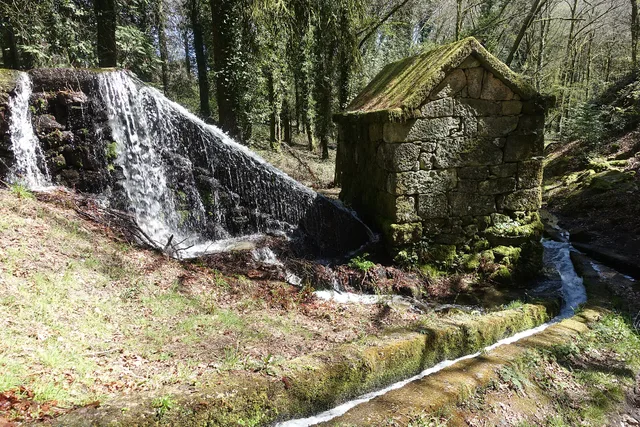
Granite mill served by Levada de Víbora, in all Moinhos de Rei, with waterfall and canal in the wooded surroundings. Register 2025.
A mill and the water channel at Moinhos de Rei.© Joseolgonⓘ

The Levada de Víbora approaches nature and human labor.

Inclui uma atividade para experimentar →
Read here and consult sources

The Levada de Víbora allows you to relate the water path to the grinding work. The municipal presentation of the PR1 BCC connects the beginning to the Oral Dam, in Abadim, to the Moinhos de Rei, to woods and small watercourses. It also highlights the village and viewpoint of Porto d’Olho and Leisure Park of Víbora. Interest is not only in the destination: the channel helps to understand how the water was conducted and used. To choose the walk, see the track record and compare distance and difficulty; this reading does not replace the current conditions of the route.

Palavras desta história: ver explicações →Compare the walks See Fact sheet: Moinhos de Rei See Fact sheet: Trilho da Levada de Víbora See Fact sheet: Área de Lazer do Oural See Fact sheet: Área de Lazer de Víbora
Source and context

Municipality — Trilho da Levada de Víbora, PR1 BCC

Accessed: . Editorial summary; the date of consultation is not the date of the facts.

Toasters · Abadim

A village over a thousand meters

In Torrinheiras, the landscape begins at altitude.

Inclui uma atividade para experimentar →
Read here and consult sources

Torrinheiras, in Abadim, is presented by the Municipality as the highest settlement in the municipality, about 1020 meters. The track climbs the hill and reaches 1159 meters. They are two distinct altitude references: that of the village and that of a point of the route, not a measure of the accumulated climb of the walk.

The description of the panorama names Gerês, Alvão, Marão and Barroso. Further down, it mentions the brook of Busteliberne, Porto d’Olho and, on the return, mills and grazing of barrosan and maronese cattle. Thus, the mountain tells a story of distances and views, but also of water, villages and work. The visibility and state of the track should be evaluated during the visit.

Getting to know the parish See Fact sheet: Trilho de Torrinheiras
Source and context

Municipality — Trilho de Torrinheiras, altitude, landmarks and landscape

Accessed: . Editorial summary; the date of consultation is not the date of the facts.

Abadim · intervention in Peio in 2017

Wood, stone and coconut on the shores of Peio

In Ranha, recovering the river also went by choosing the materials.

Inclui uma atividade para experimentar →Explorar: Cuidar das margens, de várias maneiras →
Read here and consult sources

In Ranha, the margin also tells a history of construction. The intervention inaugurated in 17 June 2017 combined stone, wood, coconut fiber and autochthonous plants. According to the municipal news, sought to stabilize the banks of Peio, recover the riverside vegetation and ecologically rehabilitate the leisure area in Abadim.

The work extended to the support spaces: parking, building and sanitary facilities, bridge and support wall of the road. The intervention in the river was part of a set that articulated the landscape and public use of the place.

The Municipality has framed the project in the compensation and minimization measures associated with the dam of Davões, with financial support from Iberdrola. This link helps to understand the context of the work, in addition to the visible materials. The news documents 2017; it does not prove the current operation of the equipment or the quality of the water for bathing. Consult the practical information in the form of Ranha.

See Fact sheet: Zona de Banhos da Ranha
Source and context

Municipality — inauguration of the renaturalization of Peio margins, news of 20/06/2017

Accessed: . Editorial summary; the date of consultation is not the date of the facts.

Abadim · water and grinding in memory 1758

Two streams worked six mills

Few water could also keep a landscape moving.

Inclui uma atividade para experimentar →Explorar: Da água ao alimento →
Read here and consult sources

In 1758, the abbot of Abadim described two streams that went down south, were near Ponte de Pé and went to Tâmega. The water was small, but ran all year round. The report mentions trouts and bogs, without identifying species with scientific names.

In the regato a poente, marks the bridge of cantaria da Ranha. Of the several mills existing on the two water lines, six belonged to the parish. This count does not identify the current buildings nor allows to conclude that they were the same as the assembly today called Moinhos de Rei.

The Abbot describes rapid currents and free use of the waters by neighboring peoples. Thus, little water and movement were not incompatible ideas in his portrait. Reading gains another dimension when approaching the fields: the same document distinguishes the cereals produced in the various places. The regattos belonged to a landscape of cultivation and transformation, although memory does not tell which mill received the cereal from each village.

Palavras desta história: ver explicações →
Source and context

Municipality — Parish memories of Abadim, José Antunes, 22/05/1758

Accessed: . Editorial summary; the date of consultation is not the date of the facts.

A world under the leaves

A first look at the fungi. Continue in the gallery to see the local records already documented.

Escolher uma história · 4
Abadim · photographed record and general biology

The stains of a hat also change

A photograph fixes only one moment of the mushroom.

Explorar: Do chapéu à vida escondida →
Read here and consult sources

Naturalis describes Amanita muscaria with white spots that can disappear and a hat whose red can pass to lighter shades, orange or yellowish. Therefore, the appearance is not always the same. The record photographed in Abadim shows light spots in a red hat; it does not follow the evolution of the same specimen. These details serve to understand the species, not to identify mushrooms for consumption.

The shape also changes: Naturalis describes an initially globoso hat that expands until flat. The blades are white. Color, stains and shape belong to a developing organism, so an image should not be treated as an unchanging mold of the species.

There is also a story under the ground. The source indicates that Amanita muscaria forms ectomycorrizas, associations with tree roots. It refers to environments with broad and coniferous leaf trees, in sandy or peat soils. The record of Abadim documents the mushroom photographed; it does not identify the partner tree nor demonstrates that underground link at that point.

Source and context

Naturalis Biodiversity Center — Amanita muscaria

Accessed: . Editorial summary; the date of consultation is not the date of the facts.

Abadim · local register and general biology

Small fans, a life in wood

The top and bottom tell different stories.

Inclui uma atividade para experimentar →
Read here and consult sources

Pedro Andrade photographed these small white fans in 31 January 2025. The record is identified as Schizophyllum commune and the published point was crossed with CAOP2025, placing it in Abadim. In the image, the structures exit laterally from a branch and have a pilous surface.

The Naturalis guide describes an inferior face with radial folds divided longitudinally. It is an important detail that this photograph from above does not reveal. Community identification belongs to the complete record, which includes other images.

The source describes the fungus as saprophyte, linked to trunks and branches: it obtains food from dead organic matter. Small fans are reproductive structures, not the whole set of life of the fungus in wood.

Palavras desta história: ver explicações →
Source and context

Naturalis — Interactive Guide to Mushrooms and other fungi, Schizophyllum commune

Accessed: . Editorial summary; the date of consultation is not the date of the facts.

Abadim · local register and general biology

Looks like a leaf, but it's a partnership.

Among mosses, there's a lichen that deserves a second look.

Inclui uma atividade para experimentar →Explorar: Continua pelo mundo pequeno →
Read here and consult sources

The Pedro Andrade record of 31 January 2025, shows Lobarina scrobiculata in Abadim, according to the crossing of the published point with CAOP2025. Light lobes and surface depressions stand out among green mosses.

The ITALIC portal of the University of Trieste describes a foliaceous stalk and an association with cyanobacteria of the genus Nostoc. The leafy appearance does not make it a plant: this lichen results from an association between partners.

The source describes color differences between the dry and wet stalk. An isolated image does not show this change over time. It is worth comparing visible shapes and reliefs without watering or removing the lichen to try.

The description of ITALIC places the species in ancient caducifoli trees and rocks with mosses, in wet and open forests. It also refers to a reproduction mainly asexual, through sorédios. They are general characteristics of the species; the record of Abadim documents the published photography and location, not a study of all these processes on site.

The wide, rounded lobes contrast with the lichen Lasallia pustulata, also photographed in Abadim. Compare the two helps to realize that having a leafy appearance does not mean having the same shape or the same fixation mode.

Palavras desta história: ver explicações →
Source and context

University of Trieste — ITALIC 8.0, Lobarina scrobiculata

Accessed: . Editorial summary; the date of consultation is not the date of the facts.

Abadim · local register and general biology

A small landscape on the stone

The protrusions of a lichen give relief to the rock.

Inclui uma atividade para experimentar →Explorar: Continua pelo mundo pequeno →
Read here and consult sources

In the photograph of Pedro Andrade, of 31 January 2025, a brown-gray lichen has rounded protrusions over rock. The record is identified as Lasallia pustulata and located in Abadim by crossing the public point with CAOP2025.

The University of Évora describes this species as Saxon, that is, linked to rocks. The stem is umbilicalized: it is attached to the support only by the central zone. The protrusions of the upper face are another detail described by the source.

The photograph allows you to observe the relief, but does not show the fixture point hidden below. Compare what you see with what the description explains is a way to learn without lifting or highlighting the lichen.

The record of Évora describes a single wolf, which can reach ten centimeters, and small structures branched on the margins, the isids. The surface can present a whitish coating, called pruin. Edge, margin and relief are three different observations; no measurements of the photograph should be estimated without a known scale.

Palavras desta história: ver explicações →
Source and context

University of Évora — Biodiversity of Mitra, Lasallia pustulata

Accessed: . Editorial summary; the date of consultation is not the date of the facts.

Crafts and memories

In the hands, at the table and in the community: little stories of how one lives and what one transmits.

Escolher uma história · 2
crafts · Pedraça and Abadim

From linen to house

Panos and quilts are also heritage.

Read here and consult sources

Pedraça and Abadim are referred to by the municipality by the weaving of flax. Fabrics take handmade work into the house and to the memory of families.

On 6 July 2024, the Soutinho field, in Pedraça, received an activity of the Lining Cycle: manual plucked from the Galician linen, ripped and wet. The municipal news records the collaboration of the Junta, ANAP and Cultilinho — Fátima Mota. It is an example of sharing this knowledge, not an announcement of future activities.

Before reaching the loom, the plant passes through several hands and operations. The municipal explanation of the cycle distinguishes the removal of the baghan, the passage through the water, the drying and the work that prepares the fiber. The spade and the seireiro help in this transformation. Only then do the spinning: a cloth begins long before there is a thread.

Palavras desta história: ver explicações →
Source and context

Municipality — crafts and services of the parishes

Municipality — Linen Cycle in Pedraça, news of 08/07/2024

Municipality — Linen Cycle in Pedraça, news of 03/04/2024

Accessed: . Editorial summary; the date of consultation is not the date of the facts.

Immaterial cultural heritage · Bucos and Abadim

A knowledge that passes from hand to hand

In Bucos and Abadim, the game of the stick is also heritage.

Read here and consult sources

The record of the National Inventory of Immaterial Cultural Heritage identifies the schools of Bucos and Abadim and the associations that support them. It describes the passage from an old practice of defense to a presentation game, transmitted between generations and demanding in training and dexterity. Registration INPCI_2023_016 helps to know this tradition; it is not a calendar of lessons or exhibitions.

Getting to know the parish
Source and context

MatrixPCI — Cabeceiras de Basto Stick Game, INPCI_2023_016

Accessed: . Editorial summary; the date of consultation is not the date of the facts.

Time travel

Documents, details and traditions: there is more to discover than a date on a stone.

Escolher uma história · 8
Documented history · 1514

Two outcasts, seven days

October 1514 left two marks on the territory.

Inclui uma atividade para experimentar →Explorar: Abadim: documentos e marcas no lugar →
Read here and consult sources

Manuel I granted the foral of Cabeceiras in 5 October 1514 and that of Vadym, today Abadim, in 12 October. Seven days separate the documents: the administrative history of the territory goes through more than one place.

But what was the point of reviewing the outsiders? The Tombo Tower exhibition explains the general context: there were complaints about outdated charges, coins and weights and old texts difficult to interpret. Manueline reform sought to review these documents. Local dates of 1514 belong to this broader movement; it does not mean that the settlements began to exist that year.

The work also required registration and preservation. The same exhibition describes the preparation in triplicate: one copy for the chamber, one for the landlord of the rights and another for the Tower of the Tombo. This general explanation helps to understand why an administrative document could have several copies. It does not identify here the whereabouts of each copy of the two local forals.

In 5 October 2024, Casa do Tempo received a tertulia over the 510 years of the foral, with José Viriato Chapel and Porfirio Correia. The municipal news recalls the two documents and their importance for the administrative organization. The celebration is a gateway to history; it does not replace the reading of the forals themselves.

Palavras desta história: ver explicações →
Source and context

Municipality — celebration of fora, published in 07/10/2024

DGLAB / Torre do Tombo and Casa de Bragança Foundation — O Foral Novo: records that tell stories, pp. 2 and 4 PDF

Accessed: . Editorial summary; the date of consultation is not the date of the facts.

Abadim · old occupation

From village to farm couple

The occupation of the land also changed with Rome.

Read here and consult sources

With the Romanization, the Archaeological Charter describes changes in the distribution of populations between mountain and valley and the agricultural occupation of lower lands. In Abadim, it refers to an open agrarian settlement of the couple type. The text suggests that there could have lived people linked to the mentioned honorific inscriptions. The existence of the occupation and the identity proposed for the inhabitants do not have the same degree of certainty: the second remains a hypothesis.

Palavras desta história: ver explicações →Getting to know the parish
Source and context

Archaeological Letter of Cabeceiras de Basto — Protohistory and Romanization

Accessed: . Editorial summary; the date of consultation is not the date of the facts.

Abadim · prehistory

The stone also kept drawings

Marmoirals gather ancient tombs and engravings.

Inclui uma atividade para experimentar →
Read here and consult sources

In Marmoirais, Abadim, mammoths and granite outcrops with engravings form an archaeological set. The inventory proposes the second or first millennium before Christ, comparing ceramics, engraved motifs and similar sets of the Northwest. Dating results from this interpretation. The name Marmoirais is also related in the source with the tumular memory of the place: the landscape can keep clues in the vestiges and names.

The inventory distinguishes conservation and interpretation: it describes the whole as poorly preserved and admits that the Mamoa 5 can remain intact. It proposes cyst-type funeral structures, without presenting this hypothesis as a confirmed excavation.

The tombs and engravings are different traces, gathered in the same landscape. Reading ceramic materials and comparison with other sets help to propose chronology, but do not automatically reveal the meaning of each recorded motif.

Palavras desta história: ver explicações →Getting to know the parish
Source and context

Municipality — archaeological inventory, interpretations and chronologies

Accessed: . Editorial summary; the date of consultation is not the date of the facts.

Abadim · history of grinding

The flour also yielded to the king

Granite mill served by Levada de Víbora, in all Moinhos de Rei, with waterfall and canal in the wooded surroundings. Register 2025.
Moinhos de Rei · the place of grinding© Joseolgonⓘ

Moinhos de Rei keeps a history of water, cereal and income.

Read here and consult sources

In the historical narrative published by the Municipality, these community mills belonged to the Crown and half of the income was destined to the King. The same description refers to the later passage to a symbolic tax. The name of the place thus opens a window on the economic organization of the milling.

The income mentioned concerns the economic activity of the mill. It should not be converted, without further information, into a rule according to which each person delivers half of the cereal bag to the king. The presentation does not indicate accounts, milled quantities or the date of transition to symbolic tax.

When visiting the history of the Moinhos de Rei, you can ask two different questions: how did water reach the mill and how were the benefits of grinding distributed? The lead helps to follow the first; the reference to the Crown opens the second. Technique, organization and income are part of the same work landscape.

See Fact sheet: Moinhos de Rei
Source and context

Municipality — Moinhos de Rei, historical account of milling and the Crown

Accessed: . Editorial summary; the date of consultation is not the date of the facts.

Torinheiras · reading of the territory

Rocks that mark a division

Bull's Marks help you read the boundaries of the territory.

Read here and consult sources

In the description of the trail, the Municipality presents these ancient landmarks as testimonies of the division between Cabeceiras de Basto and Montalegre, and between Minho and Trás-os-Montes. They are a concrete way to find in the landscape a border that we usually see only drawn on the map.

Getting to know the parish See Fact sheet: Trilho de Torrinheiras
Source and context

Municipality — Trilho de Torrinheiras, altitude, landmarks and landscape

Accessed: . Editorial summary; the date of consultation is not the date of the facts.

Heritage of Abadim

A tower to look slowly

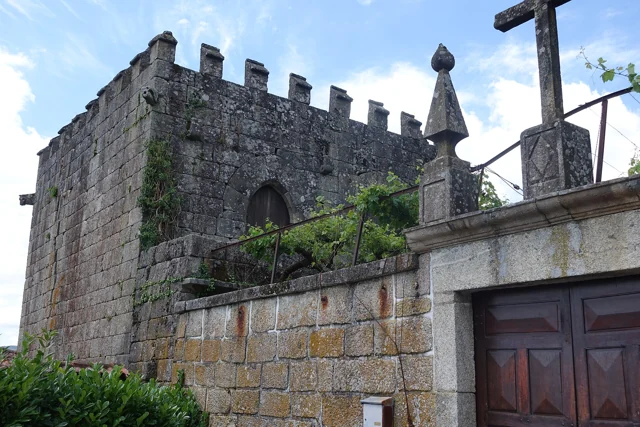
Tower of Abadim, with yellow crowning and stone constructions around.
Tower of Abadim · yellow crowning and surrounding constructions.© Joseolgonⓘ

History is also read in windows and corners.

Explorar: Lê as marcas do poder e do tempo →
Read here and consult sources

The Tower of Abadim has battlements at the top and gargoyles with animal shapes in the corners. António P. Dinis highlights the settery, the broken arch doors and, inside, conversationals next to the windows. It proposes a construction of the sixteenth century, perhaps from the foral period, without setting an exact date.

The memory of 1758 places the tower in the middle of the Village of the Tower and states that it did not suffer ruin in the earthquake of 1755. The same document describes Abadim with ordinary judge and Chamber, in an organization proper to the former Couto. Reading architecture and administration together helps to understand the importance of the building; the interior description does not confirm current access.

The text of António P. Dinis distinguishes the probable place of the medieval manor from the quintentist construction described today. It is not necessarily the same building preserved without change. The designation Casa do Tronco accompanies the hypothesis that here the justice and the chain of trust functioned.

In the memory of 1758, the election of the ordinary judge and of the House was presided over by the donate. The document also refers to the intervention of the Guimarães magistrate in correction or new scope. Thus, the existence of own organs should not be confused with an administration without relations with other authorities.

Palavras desta história: ver explicações →See Fact sheet: Torre de Abadim / Casa do Tronco
Source and context

Basto Land Museum / António P. Dinis — Tower of Abadim, 17/01/2018

Municipality — Parish memories of Abadim, José Antunes, 22/05/1758

Accessed: . Editorial summary; the date of consultation is not the date of the facts.

Heritage of Abadim

A star in the pillory

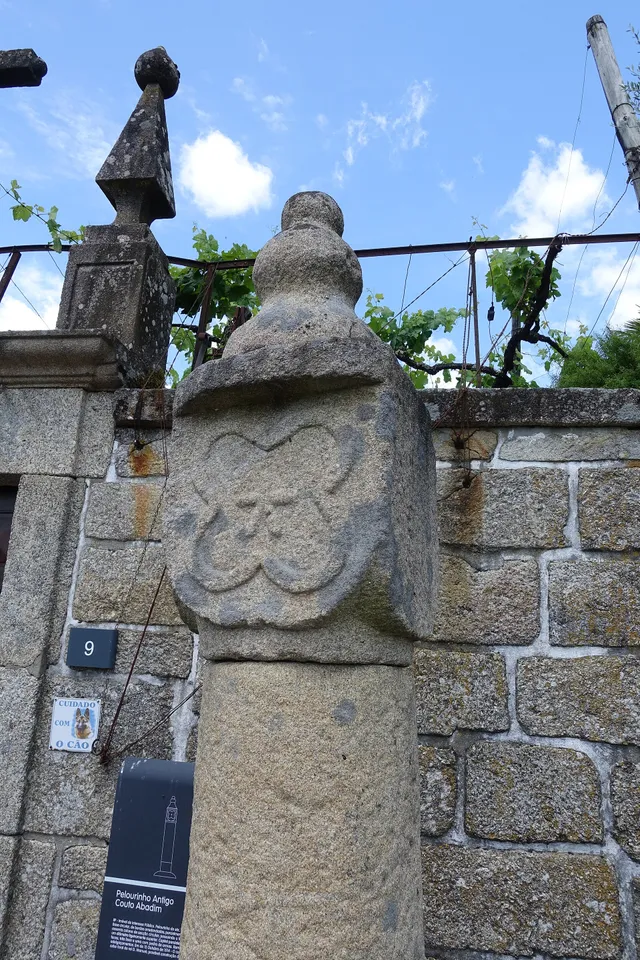
Details of the Pelourinho de Abadim in granite
Details of Pelourinho de Abadim. The star described in the text is not visible on this face.© Joseolgonⓘ

A small monument holds a history of autonomy.

Read here and consult sources

The pillory of Abadim seems simple at first glance: a smooth column of granite, a cubic capite and a pear-shaped shot. But on one side you find a five-pointed star inside a four-lobe frame. The Museum links the monument to the administrative and judicial autonomy of the former Couto, extinguished in 1836. The Museum brings its construction closer to the foral of 1514, but the record of the Cultural Heritage warns that dating is difficult and that the piece can be quite later. The detail of the star invites you to look again at a piece that would easily go unnoticed.

The official record describes four faces on the capital: three undecorated and one with the star. This helps to understand why a photograph from another side may not show the best known reason. The record places the monument next to the portal of the House of Tower of Tronco and documents the classification as Public Interest Property in 1933. The date of protection is not the date of construction.

The foral, the stone age and the patrimonial classification answer different questions. Instead of automatically assigning ‘1514’ to the entire monument, compare the described form, the proposals for dating and the documents that changed its status.

Palavras desta história: ver explicações →See Fact sheet: Pelourinho de Abadim
Source and context

Basto Land Museum / António P. Dinis — Pelourinho de Abadim, 26/01/2018
Accessed:

Cultural heritage — Pelourinho de Abadim, record 341971, historical-artistic note
Accessed:

Editorial summary; the date of consultation is not the date of the facts.

Abadim · architecture and interpretation of registrations

Two dates don't count the whole house

In the House of Ramada, the doors hold clues from different times.

Inclui uma atividade para experimentar →
Read here and consult sources

António P. Dinis highlights, in Abadim, the Casa da Ramada, with an armoriated portal, a thorn, a threshing floor and a porch. Refers 1678 in a baker's house and 1828 in the baker's house of another door. From these marks, he proposes an initial structure of six hundred and improvements in the first half of the nineteenth century.

An inscription is a clue, not the birth certificate of all walls. The two dates help to think of a transformed house: housing and work spaces can gather elements from various times. The source does not confirm current conditions of access.

Palavras desta história: ver explicações →Getting to know the parish
Source and context

Basto Land Museum / António P. Dinis — Tower of Abadim, 17/01/2018

Accessed: . Editorial summary; the date of consultation is not the date of the facts.

YOUR LOCAL GUIDE

What would you like to discover?

Take a closer look.