Discover Cabeceiras de BastoFree independent guide
ViveCabeceirasYOUR GUIDE TO CABECEIRAS
ENEnglish
SearchSaved

Plants

Choose a story to start with. You can change the subject or fine tune the search.

16 leituras · Ler a paisagem pelas plantas · Pesquisa: sementes

Read the landscape through the plants

Trees, forests, vineyards and fields reveal different ways of occupying the territory.

Escolher uma história · 16
General botany · alder

Seeds that travel through the water

The alder has a close relationship with the rivers.

Explorar: A árvore, o rio e o ofício →
Read here and consult sources

In the form of the University of Évora, published under the name Alnus glutinous, the seeds of the alder have aired tissues that favor dispersion through water. The tree tolerates prolonged periods with submerged roots. The woods in which it dominates are called amial.

The relationship with the water goes, thus, from the installation next to the banks of the journey of the seeds. There is also a change of names to know: Flora-On uses Alnus Lusitanica for Portuguese native aldermen, citing a study of 2017. Each name keeps the link here to its source; the reading does not identify a concrete tree of the municipality.

The form published as Alnus glutinous describes a caducifólia tree: it loses the foliage in a part of the year. The leaves are alternating, with double-bit margin; the peel, smooth as a young man, becomes darker and split. They are characteristics of different parts of the plant and also of different stages of its life.

The flowering indicated in this source runs from December to February. Male flowers appear in elongated groups, the amentos, while the female groups have another form. Winter can thus offer observations that a visit with the canopy full of leaves does not show. This calendar belongs to the description consulted and may vary with the conditions of the place; it does not announce the flowering of a copy of Cabeceiras.

Palavras desta história: ver explicações →
Source and context

University of Évora — Alnus glutinous, breeding and habitat

Portuguese Society of Botany — Flora-On, Alnus: ecology, symbiosis and taxonomic note

Accessed: . Editorial summary; the date of consultation is not the date of the facts.
Forest landscape · pine-bravo botanical

A pine cone has small seed houses

The woody scales hide a detail.

Explorar: Uma árvore, várias pistas →
Read here and consult sources

In the pine-bravo, Pinus pinaster, the pine contains two seeds per scale, according to the description of the University of Évora. The trunk, in turn, has thick bark, red-brown and very split. After recognizing the needles in pairs, it is worth noticing in these other forms. The municipality mentions the pine-bravo in the mountain landscape; these characteristics help to know it without constituting an inventory of the local pine forests.

In the same tree there are different male and female reproductive structures: the species is monoic. The chart describes males as yellowish clusters and females as squamous structures that form cones. Looking only at a mature pine cone leaves, therefore, part of the cycle undiscovered.

The environment also counts. The University of Évora associates pine-bravo with sunny places, with acidic and often sandy soils, also referring to the presence inside on shale substrates. It can form pine forests or integrate mixed forests. This describes preferences and general forms of occurrence; it does not transform all the slopes with these conditions into pine forests.

Palavras desta história: ver explicações →
Source and context

University of Évora — Virtual Museum of Biodiversity, Pinus pinaster

Municipality — landscape and vegetation

Accessed: . Editorial summary; the date of consultation is not the date of the facts.
Botanic · general characteristics

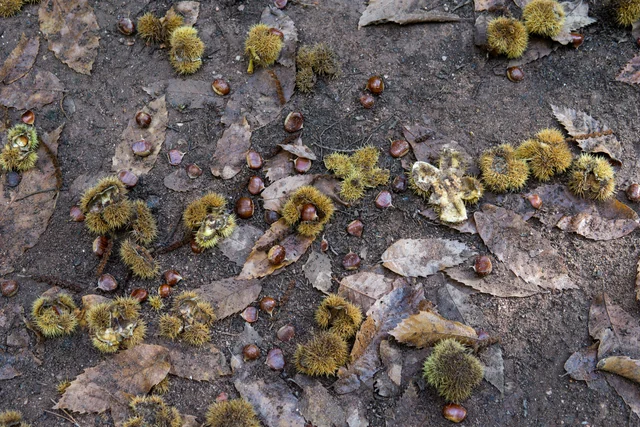
What's hidden in the hedgehog?

Open urchins and bright chestnuts between fallen leaves.
Chestnuts and hedgehogs on the ground in Guirbaden, Mollkirch, France, in 2020. Botany illustration; not a record of Cabeceiras.
Photography: AudreyMuratet · CC BY-SA 4.0
About this photograph

Date given at source: . Source consulted in 2026-11-07. EXIF orientation, proportional resizing and WebP conversion; no retouching or clipping of the file.

Request withdrawal or correct authorship

The chestnut is the fruit; the hedgehog involves the whole.

Inclui uma atividade para experimentar →Explorar: Do ouriço à semente →
Read here and consult sources

Castanea sativa loses the leaves at the unfavorable time and can reach large size. The form of the Polytechnic Institute of Castelo Branco describes narrow and yellow flowers in long and pendant ears. Later, the chestnuts are grouped within the hedgehog: the chestnut is the fruit, while the hedgehog involves the set.

Notice the layers: the brown and shiny cover belongs to the fruit; inside there is usually a seed, with a yellowish film. The tree also took place in the workshops: the source refers to wood used in carpentry, woodworking, basketry and turnery. They are general characteristics and uses, without assigning a workshop or exemplary to the municipality.

Before the hedgehog there are flowers. UTAD Digital Flora indicates May and June as the flowering season of the species. It is a general botanical reference, not a prediction for a tree of Cabeceiras: to know its rhythm, compare photographs of the same specimen on different dates. A tree without chestnuts on a spring visit does not tell the same story as an open hedgehog in autumn.

The chestnut belongs to the family Fagaceae, the same large botanical family of oaks. Compare the fruits helps to realize that kinship does not mean equal appearance: go back to the reading of the oak and look for what involves the acorn, then return to the scheme of the layers of the chestnut.

Palavras desta história: ver explicações →See the plants photographed in the municipality
Source and context

Polytechnic Institute of Castelo Branco — botanical record of Castanea sativa

UTAD Botanical Garden — Castanea sativa, Flora Digital de Portugal

Accessed: . Editorial summary; the date of consultation is not the date of the facts.
Flora · general description of Arundo donax

Cane doesn't end where the ground begins

Underneath the stems is another part of the plant.

Explorar: Das margens ao acompanhamento →
Read here and consult sources

The cane, Arundo donax, is a perennial herb of large size. The ICNF describes robust and hollow stems, which can reach six meters, and a rhizomatous structure, which extends under the ground. Knowing the part that is not seen helps to look at a cane beyond the tall stems. The national distribution indicated in the form does not confirm a record in a concrete site of Cabeceiras.

The flowers appear together in large, branched sets, of violet tone; the fiche indicates flowering from August to October. The leaves are long, narrow and end in tip. The description helps to separate three parts of the plant: the tall stems, the leaves accompanying them and the floral structures.

Viable flowers and seeds are not the same. The ICNF describes fruits that, outside the native area, do not produce viable seeds, so seeing a flowering cane is not enough to conclude how it is multiplying. The underground structure remains part of the question.

Source and context

ICNF — SIVEEI, Arundo donax; updated record 09/03/2023

Accessed: . Editorial summary; the date of consultation is not the date of the facts.
Sliding crops · olive trees

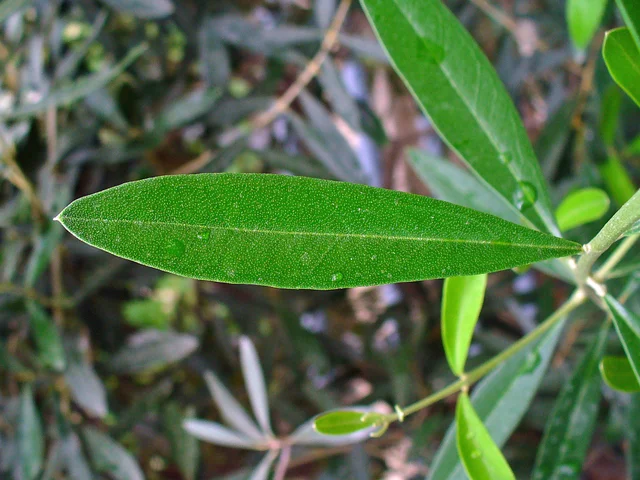
One leaf, two faces

Elongated and green olive leaf, with light central ribbedness and other leaves at the bottom.
Olive leaf photographed in Stutensee, Germany, in 2011. Botanical illustration; it is not a record of Cabeceiras. This frame does not show the two faces of the same leaf.
Photography: H. Zell · CC BY-SA 3.0
About this photograph

Date given at source: . Source consulted in 2026-11-07. EXIF orientation, proportional resizing and WebP conversion; no retouching or clipping of the file.

Request withdrawal or correct authorship

The silver side of the olive tree also tells a story.

Inclui uma atividade para experimentar →Explorar: Da folha ao fruto e ao lagar →
Read here and consult sources

On the half slopes of Cabeceiras, the municipal portrait includes olive trees. The cultivated olive tree has green-gray leaves on top and silver-gray under it, where there are hairs. The small flowers have four white petals joined at the base.

The fruit is olive, an oil-rich drupa. The description of the University of Évora accompanies the change from green to red and dark shades during maturation, but refers to variants that remain green even mature. The color alone does not tell the whole story of the fruit. From tree to olive oil, there is a link that can continue in reading about the Ramil mill.

The record distinguishes the cultivated olive tree from the wild variant, the zambujeiro. In the latter, it describes smaller leaves and fruits and thorny lower branches. The comparison shows why a single characteristic, such as the silvery tone of the leaf, does not solve all the differences.

The olive tree is perennial: it maintains foliage throughout the year. This allows you to return to the same tree at different times and compare leaves, flowers and fruits without expecting all to be present simultaneously.

Palavras desta história: ver explicações →
Source and context

University of Évora — Virtual Museum of Biodiversity, Olea europaea

Municipality — landscape and vegetation

Accessed: . Editorial summary; the date of consultation is not the date of the facts.

Vegetation described for the territory

The forest also has a history

Names that are part of the mountain memory.

Inclui uma atividade para experimentar →Explorar: Ler uma árvore por partes →
Read here and consult sources

Carvalhos and chestnut trees are part of the mountain vegetation described by the municipality. The same source counts the partial replacement of this vegetation by pine-bravo. Therefore, a wooded slope also keeps planting choices and changes in land use. Looking only at the green does not arrive: it is worth noticing the species, spots and spaces between trees. This municipal description is not a current survey of each forest.

The publication Forests do Alto Minho distinguishes soutos, oriented to the production of chestnut, candlesticks, for the production of sticks. They are uses of chestnut, not two species of tree. This regional comparison helps to ask questions about the landscape of Cabeceiras; it does not identify the function of a concrete portion of the municipality.

There is still a forest below the canopy. The sub-basket gathers plants that grow under the trees; dead wood can also sustain insects that feed on it and fungi. A forest landscape is not, therefore, limited to the number of living trunks. To observe it, look for different layers — canopy, low vegetation and fallen wood — without concluding that the species cited for another region are present in that area.

Palavras desta história: ver explicações →
Source and context

Municipality — landscape and vegetation

High CIM Minho — High Forests Minho, sours and candlesticks (habitat 9260)

Accessed: . Editorial summary; the date of consultation is not the date of the facts.

Local register · Union of parishes of Arco de Baúlhe e Vila Nune · general botany

Flowers and fruits in the same branch

The chickenshit has a calendar that overlaps.

Inclui uma atividade para experimentar →Explorar: Frutos com histórias diferentes →
Read here and consult sources

The medronho, Arbutus unedo, keeps dark green leaves and bright during the year. In autumn, little white bell-shaped flowers appear. The fruits take about a year to mature, so mature medronhos can coincide with the next flowering.

The form of the School of Education of Lisbon distinguishes two encounters with animals: insects, especially bees, participate in pollination; birds that eat the fruits help transport seeds. They are different functions in the plant cycle.

The leaves give other clues besides color: they have serrated margin and secondary ribs distributed from a central rib. The size varies between bush and small tree. The record of the Lisbon Polytechnic refers to tolerance to dry climate and different soils, showing that the fruit calendar is not the only interesting characteristic of the plant.

Food uses include fresh fruit, jams and jams. The same source places the tradition of medronho drinks in the Algarve and other Mediterranean territories; this information does not transform these products into a documented specialty of Cabeceiras.

The photograph of migr, registered in 2025-08-29, shows this species in the Union of parishes of Arco de Baúlhe e Vila Nune. It opens the register to compare the visible details with the botanical description. The observation documents this meeting; it does not indicate that the plant is always visible in the same place.

Palavras desta história: ver explicações →See the plants photographed in the municipality
Source and context

Lisbon Polytechnic — form Arbutus unedo

iNaturalist — Arbutus unedo, migr observation in 2025-08-29

Accessed: . Editorial summary; the date of consultation is not the date of the facts.

Botanic · general characteristics

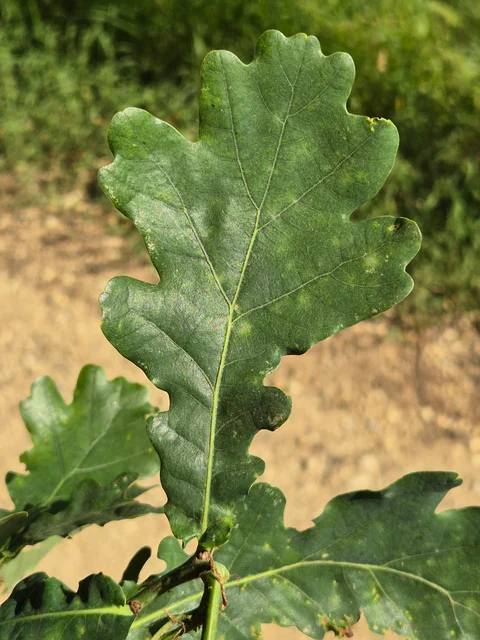
A leaf drawn in waves

Oak green leaf with margin cut into visible wolves and ribs, still connected to the branch.
Leaf of Quercus robur photographed near Hollenstein, in the forest of Hollabrunn, Austria, in 2025. Illustration of the species; it is not a record of Cabeceiras nor identifies the broteroan subspecies.
Photography: Stefan.lefnaer · CC BY-SA 4.0
About this photograph

Date given at source: . Source consulted in 2026-11-07. EXIF orientation, proportional resizing and WebP conversion; no retouching or clipping of the file.

Request withdrawal or correct authorship

In the oak, notice the contour and the foot of the leaf.

Inclui uma atividade para experimentar →Explorar: A bolota entre a árvore e a história →
Read here and consult sources

The outline of the leaf has broad and unequal lobes: curves that resemble small waves. The description of the University of Évora adds a short petiole, with less than five millimeters, and secondary ribs curves that are not parallel. Instead of just looking at the silhouette, compare contour, ribs and link to the branch.

The fruits appear supported by peduncles and have a dome of brownish scales. The name used by the source is Quercus robur subsp. broteroana. These characteristics help to understand the botanical description; they do not identify the subspecies in the photographs or places of this guide.

The description presents deciduous leaves to marcescents. In the first case, they fall seasonally; in the marcescence, dried leaves may remain trapped for some time. A brown leaf in the branch is therefore not necessarily a living leaf.

The chart associates this oak to humid environments and refers to intolerance to summer drought. The leaf outline describes a structure; moisture and response to drought describe relationships with the environment. They are complementary clues to read the plant and landscape.

Palavras desta história: ver explicações →See the plants photographed in the municipality
Source and context

University of Évora — Quercus robur subsp. broteroana, description by Carlos Vila-Viçosa

Accessed: . Editorial summary; the date of consultation is not the date of the facts.

Local register · Union of parishes of Gondiães e Vilar de Cunhas · general botany

In the carqueja, the stems also work

Not all photosynthesis is on the leaves.

Inclui uma atividade para experimentar →
Read here and consult sources

The carqueja integrates the municipal description of the serrana vegetation. In the form of the Polytechnic Institute of Castelo Branco, Pterospartum tridentatum presents very small leaves and winged stems that make photosynthesis. The flowers are yellow and the fruit is a pod. These details invite to look at the shape of the branches, beyond the color of the flowers.

The chart describes a woody and rigid shrub, which can be upright or more lying and reach about a meter. The flowers appear in small tight groups. In the fruit, the compressed pod usually holds two to five seeds. Caule, flower and fruit give different clues: yellow color, alone, is not enough to recognize the plant.

The same document mentions rural uses as a bed of animals and incorporation into the crop grounds, along with other forests. They are general uses of the species. To know a local historical reference, follow the reading of Cavez: the memory of 1758 mentions carqueja and other wood in the landscape of coal production, without describing a production recipe.

The photograph of João Lima, registered in 2025-07-15, shows this species in the Union of parishes of Gondiães e Vilar de Cunhas. It opens the register to compare the visible details with the botanical description. The observation documents this meeting; it does not indicate that the plant is always visible in the same place.

Palavras desta história: ver explicações →
Source and context

Polytechnic Institute of Castelo Branco — Pterospartum tridentatum, characteristics

Municipality — landscape and vegetation

iNaturalist — Genista tridentata, João Lima observation in 2025-07-15

Accessed: . Editorial summary; the date of consultation is not the date of the facts.

Forest landscape · botanical of the species

Needles come in pairs

A little detail to observe in the pine-bravo.

Inclui uma atividade para experimentar →Explorar: Uma árvore dentro da floresta →
Read here and consult sources

The municipality refers to the pine-bravo in the transformation of the mountain forest landscape. In the description of the University of Évora, Pinus pinaster has persistent, rigid and pointed leaves, needle-shaped. They grow in pairs on a very short branch and can reach 25 centimeters. A pair of needles allows you to begin to repair the tree beyond your canopy.

In the same plant there are male and female reproductive structures. Males form yellowish sets; females give rise to pine cones with woody scales. Also note the trunk: the bark is thick, red-brown and very split. They are general characteristics of the species, not a survey of the municipality pine forests.

The environment adds another clue. The University of Évora associates the pine-bravo to sunny sites and acidic soils, often sandy; inside it also refers to it on shale substrates. It can form pine forests or integrate mixed forests with other pines and oaks.

When looking at a slope, it distinguishes two scales: the tree, with its needles and pine cones, and the set of plants around it. The botanical description gives context, but does not allow to conclude the origin or age of a settlement only by appearance.

Palavras desta história: ver explicações →
Source and context

University of Évora — Virtual Museum of Biodiversity, Pinus pinaster

Municipality — landscape and vegetation

Accessed: . Editorial summary; the date of consultation is not the date of the facts.

General botany · birch

A tree of light bark

The birch attracts attention even before we look at the leaves.

Inclui uma atividade para experimentar →Explorar: Flores discretas, estratégias diferentes →
Read here and consult sources

Betula celtiberica's record describes a deciduous tree, silvery white trunk, and elongated to triangular contour leaves, with bite margins. The species is associated with humid environments, including watercourse margins, and needs plenty of light.

The presentation of the Gulbenkian Garden places flowering in April and May and describes small winged fruits scattered by the wind. The bark, leaves and reproductive structures offer different clues throughout the year. It is information about the species; it does not confirm its presence in a parish nor guarantees the same dates in all locations.

The male and female flowers are found in the same tree, but in different structures. Gulbenkian describes the male ones gathered in yellow-green and the female ones initially erect. The word flower does not always mean large and showy petals: observing a tree can require attention to discrete structures.

The chart also highlights shallow roots, with horizontal development, and the ability to burst from the toilet. The visible trunk is only part of the plant; growing by seed and producing new sprouts are distinct processes. They are characteristics of the sheet of Betula celtiberica, without assigning a copy to Cabeceiras.

Palavras desta história: ver explicações →
Source and context

Calouste Gulbenkian Foundation — Celtic betula, trunk and leaves

Accessed: . Editorial summary; the date of consultation is not the date of the facts.

Botanic of the species · with local registration

A fruit with a wing

In the ash, the shape helps travel.

Inclui uma atividade para experimentar →Explorar: Três formas de continuar a viagem →
Read here and consult sources

The fruit of the ash has a wing and receives the name of samara. There is another detail to discover: the leaf is divided into several narrow folioles. Do not confuse each of these parts with an entire leaf.

Fraxinus angustifolia can grow in forests of shores and slopes. The local photograph documents a copy in Gondiães e Vilar de Cunhas; it does not show a fruit in travel or allows to describe its entire habitat.

The Gulbenkian chart describes leaves with three to eleven folioli, of sawed margins. Angustifolia termination refers precisely to this narrow form. In the fruit, the wing prolongs the part where the seeds are: fruit and seed are not the same structure. The tree loses the leaves seasonally; branches, leaves and fruits offer different clues throughout the year.

The ash binds this form of leaf to the availability of water. Gulbenkian plug refers to tolerance to different temperatures, but sensitivity to dryness, and preference for deep soils. It also describes a high and irregular canopy and a dark trunk, deeply cracked. The leaf is not the only part that helps to know the tree: the bark, the canopy and the environment complete the observation, without a single feature sufficient to identify a specimen.

Palavras desta história: ver explicações →
Source and context

University of Évora — BioMontado, chips Fraxinus angustifolia and Hedera hibernica

Portuguese Society of Botany — Flora-On, Fraxinus angustifolia: ecology

Calouste Gulbenkian Foundation — Straits leaves, fruit and habitat

Accessed: . Editorial summary; the date of consultation is not the date of the facts.

Botanic of the species · with local registration

White flowers, small red fruits

The woodwork changes appearance throughout the reproductive cycle.

Inclui uma atividade para experimentar →Explorar: Uma folha simples ou um conjunto de folíolos? →
Read here and consult sources

The pine tree, Crataegus monogyna, is a shrub or small deciduous leaf tree. The leaves are simple, alternating and lobulated; the thorns explain the name white thorn. In the description of the Museum of Natural History and Science of the University of Porto, the white flowers have five petals.

The small red fruits are pomos and the fiche refers to a seed in each fruit. Leaves, flowers and fruits allow comparing different moments of the plant. The local photographic record linked to this history documents an observation, not all phases of the cycle or the distribution of the species by the municipality.

The botanical family also helps to make comparisons: the wood and silva belong to the Rosaceae, although they have different leaves and fruits. In the forest, a simple leaf has limbo cut into wolves; in silva, a composite leaf is divided into folioli. Being in the same family does not mean having the same shape.

The collection of the University of Porto associates the Piliteiro to the sub-basket and the forests in well drained soils. The distribution presented extends through Europe, Asia and North Africa. This framework is broader than the local record: a photograph of Cabeceiras documents a meeting, while the botanical record describes the species.

Palavras desta história: ver explicações →
Source and context

University of Porto — living botanical collection, Crataegus monogyna

University of Évora — Rubus ulmifolius, leaves and fruits

Accessed: . Editorial summary; the date of consultation is not the date of the facts.

Forest Park · plantation of 2016 and biology of the species

A tree with fan leaves

Ginkgo has an easy signature to search the leaves.

Inclui uma atividade para experimentar →Explorar: Duas árvores, duas formas de olhar →
Read here and consult sources

The leaves of Ginkgo biloba open in fan and can present a central division. In autumn, they become golden before falling, describes the Gulbenkian. The connection to Cabeceiras has a date: the municipal news of 18 March 2016 records the plantation of ginkgo and metasequoia in the Forest Park. The record tells the history of this plantation; it does not confirm the current state of the specimens.

The fan shape also appears in the leaf ribs. Gulbenkian explains that the division into two lobes, when it exists, is at the origin of the bilobe name. It is not necessary that all leaves have an equal cut to belong to the same species.

Ginkgo has male and female individuals. In female trees, seeds are formed with a fleshy cover that can remember a plum, but are not fruits like a plum tree. The interest of this reading is to observe forms and know the reproduction; the municipal news does not identify the sex of the specimen planted in Cabeceiras.

Origin and use are also part of history. Gulbenkian is located at the origin of ginkgo in southeast China and refers to its planting in Portuguese parks, gardens and ruins. It prefers places with sun and soil with water available, but well drained. A garden can therefore gather trees with very different origins: being planted in Cabeceiras does not make a species originally from the municipality.

Palavras desta história: ver explicações →
Source and context

Municipality — World Tree Day, 18/03/2016

Calouste Gulbenkian Foundation — Ginkgo

Accessed: . Editorial summary; the date of consultation is not the date of the facts.

Serra da Cabreira · regional and general botanical reference

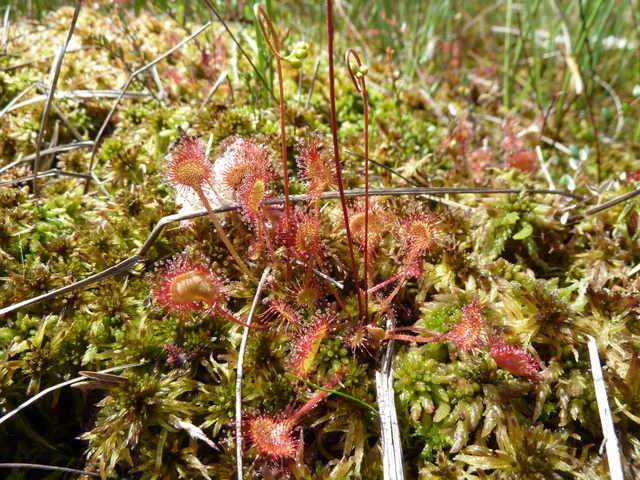
It looks dew, but it's a trap.

Rounded leaves of rosemary with reddish hair and bright drops between moss.
Rorela in the natural monument Swamp, near Máchovo jezero, Chéquia, in 2013. Illustration of the species; it is not a register of the Cabreira.
Photography: Stanislav Rada · CC BY-SA 3.0
About this photograph

Date given at source: . Source consulted in 2026-11-07. EXIF orientation, proportional resizing and WebP conversion; no retouching or clipping of the file.

Request withdrawal or correct authorship

On the roll, the leaves also capture food.

Inclui uma atividade para experimentar →
Read here and consult sources

The leaves of Drosera rotundifolia have small glandular hairs with a sticky secretion. When an insect gets stuck, enzymes help to decompose it and the plant absorbs nutrients through the leaves. This strategy can be especially useful in soils very poor in nutrients. The species is referred by Visit Cabeceiras to the Cabreira; the mechanism described by the North American forest service is general biology, not an observation made in the mountains.

The trap is not the flower. The leaves are available on a rosette near the base; the flowers appear on a stem and the fruits are capsules with numerous small seeds. The photograph allows for comparing leaves and stems, but does not show the digestion process. In the description of USDA, the leaf can fold around the prey: a sequence in time that a single image does not show.

Palavras desta história: ver explicações →
Source and context

USDA Forest Service — Robin F. Matthews, Drosera rotundifolia, February review, 1994
Accessed:

Visit Cabeceiras — natural heritage of Serra da Cabreira
Accessed:

Editorial summary; the date of consultation is not the date of the facts.

Forest Park · plantation of 2016 and general botany

A conifer who undresses in the fall

Having cones doesn't mean keeping leaves all year round.

Inclui uma atividade para experimentar →
Read here and consult sources

The municipal news of March 2016 records the planting of a metasequoia in the Forest Park, along with a ginkgo. This episode opens a window to meet Metasequoia glyptostroboides, the living species of the genus described by the Botanical Garden of the University of Cambridge. The news does not provide a detailed botanical identification nor confirms the current survival of the specimen.

In Cambridge's description, this conifer loses the leaves and gets shades covered in autumn. Leaves, buds and branches are available in opposite pairs. The bark is split and the tree can reach large size. These are general characteristics, not measured from a tree of Cabeceiras.

Compare it with ginkgo: both can change color and lose foliage, but the shape and organization of the leaves are very different. The calendar of a tree and the drawing of a leaf tell different parts of its history.

The scientific history has a twist: Cambridge reports that the metasequoia was known only through fossils until 1941, the year it was found alive in Sichuan, China. Then the collection and distribution of seeds contributed to its presence in gardens of various countries. The chart distinguishes the limited wild population from the wide use as a cultivated tree. A specimen in a park and a population in the original environment tell different stories.

Palavras desta história: ver explicações →
Source and context

Municipality — World Tree Day, 18/03/2016

Cambridge University Botanic Garden — Metasequoia glyptostroboides, deciduous foliage and layout of leaves

Accessed: . Editorial summary; the date of consultation is not the date of the facts.

YOUR LOCAL GUIDE

What would you like to discover?

Take a closer look.