Discover Cabeceiras de BastoFree independent guide
ViveCabeceirasYOUR GUIDE TO CABECEIRAS
ENEnglish
SearchSaved

Plants

Choose a story to start with. You can change the subject or fine tune the search.

4 stories · Read the landscape through the plants · Search: madeira

Read the landscape through the plants

Trees, forests, vineyards and fields reveal different ways of occupying the territory.

Choose a story · 4
Botany · general features

What is hidden inside a chestnut burr?
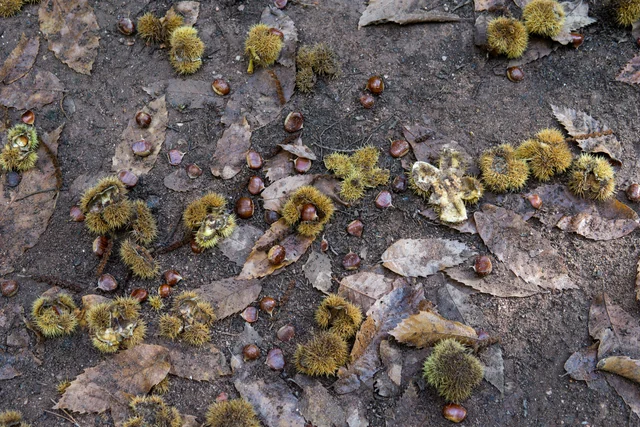
Open chestnut burrs and shiny brown chestnuts among fallen leaves.
Chestnuts and burrs on the ground at Guirbaden, Mollkirch, France, in 2020. Botanical illustration, not an observation from Cabeceiras.
Photography: AudreyMuratet · CC BY-SA 4.0
About this photograph

Date given at source: . Source consulted in 2026-11-07. EXIF orientation, proportional resizing and WebP conversion; no retouching or clipping of the file.

Request removal or correct the photo credit

The chestnut is the fruit; the burr encloses the cluster.

Includes an activity to try →Explore: From hedgehog to seed →
Read here and view sources

Castanea sativa sheds its leaves in the unfavourable season and can grow into a large tree. The Castelo Branco Polytechnic profile describes narrow yellow flowers in long hanging spikes. Later, chestnuts develop together inside a prickly burr: the chestnut is the fruit, while the burr encloses the cluster.

Notice the layers: the shiny brown covering belongs to the fruit; inside there is usually one seed, with a yellowish skin. The tree also had a place in workshops: the source mentions wood used in carpentry, cabinetmaking, basketry and woodturning. These are general characteristics and uses, without attributing a workshop or individual tree to the municipality.

Flowers come before the burr. UTAD’s Digital Flora gives May and June as the species’ flowering period. This is a general botanical reference, not a prediction for a tree in Cabeceiras: compare photographs of the same tree on different dates to learn its rhythm. A tree without chestnuts on a spring visit tells a different story from an open burr in autumn.

Chestnut belongs to the Fagaceae family, the same broad botanical family as oaks. Comparing their fruits shows that kinship does not mean identical appearance: return to the oak story and look for what surrounds the acorn, then revisit the chestnut’s layers.

Words in this story: see explanations →See the plants photographed in the municipality
Source and context

Polytechnic Institute of Castelo Branco — botanical record of Castanea sativa

UTAD Botanical Garden — Castanea sativa, Flora Digital de Portugal

Accessed: . Editorial summary; the date of consultation is not the date of the facts.

Vegetation described for the area

The forest has a history too

Names that belong to the memory of the mountains.

Includes an activity to try →Explore: Read a tree per part →
Read here and view sources

Oaks and chestnuts form part of the mountain vegetation described by the municipality. The same source describes the partial replacement of that vegetation by maritime pine. A wooded hillside therefore also records planting choices and changes in land use. Looking only at the greenery is not enough: notice the species, the patches and the spaces between trees. This municipal description is not a current survey of every wood.

The same tree species can create different working landscapes. The publication Florestas do Alto Minho distinguishes chestnut orchards, managed for fruit, from chestnut coppices, managed for poles. These are uses of the chestnut tree, not two tree species. This regional comparison helps us ask questions about the landscape of Cabeceiras; it does not identify the purpose of any particular local plot.

There is also a forest beneath the canopy. The understorey consists of plants growing under the trees; dead wood can support wood-feeding insects and fungi too. A forest landscape is therefore more than a count of living trunks. Look for different layers — canopy, low vegetation and fallen wood — without assuming that species mentioned for another region occur in that spot.

Words in this story: see explanations →
Source and context

Municipality — landscape and vegetation

High CIM Minho — High Forests Minho, sours and candlesticks (habitat 9260)

Accessed: . Editorial summary; the date of consultation is not the date of the facts.

Cork oak · botany and local landscape

Cork begins on a tree

A cork oak’s bark is one of the first clues.

Explore: A tree, different materials →
Read here and view sources

Quercus suber has thick, elastic, deeply cracked bark: cork. The municipal description includes cork oaks on the hillsides of Cabeceiras. Leaves remain for more than one season; the University of Évora mentions up to three years. Evergreen foliage does not mean that every leaf lasts forever.

The fruits are acorns. The profile describes their cups as having long, velvety scales. Bark, leaves and fruits offer different clues for observing the tree, without removing cork or breaking off branches. The local reference documents the landscape; the botanical description explains general features of the species.

Inside, cork consists of microscopic cells containing gas similar to air. APCOR relates this structure to its lightness, compressibility and ability to regain its shape. Suberin in the cell walls helps impede the passage of liquids and gases. A stopper looks simple, but the material’s behaviour begins at a scale our eyes cannot see.

The association also describes turning used stoppers into granules for new products, such as floor coverings and soles. This is a general example of reuse, not an industrial activity confirmed in Cabeceiras. Compare it with the wooden clogs of Outeiro and the containers of Faia: other stories of tree-derived materials, with different uses and working methods.

Words in this story: see explanations →
Source and context

University of Évora — Quercus suber, botanical description

Municipality — landscape and vegetation

APCOR — Cork, cellular structure, properties and reuse (page consulted in the staging subdomain)

Accessed: . Editorial summary; the date of consultation is not the date of the facts.

General botany · alder

Seeds that travel by water

Alder has a close relationship with rivers.

Explore: The tree, the river and the craft →
Read here and view sources

In the University of Évora profile published under the name Alnus glutinosa, alder seeds have air-containing tissues that aid dispersal by water. The tree tolerates long periods with submerged roots. Woods dominated by alder are known in Portuguese as amiais.

Its connection with water thus extends from growing along banks to the journey of its seeds. There is also a naming change to understand: Flora-On uses Alnus lusitanica for native Portuguese alders, citing a 2017 study. Here each name remains linked to its source; the story does not identify a particular tree in the municipality.

The profile published as Alnus glutinosa describes a deciduous tree, which loses foliage for part of the year. The leaves are alternate with doubly toothed edges; the bark, smooth when young, becomes darker and cracked. These features concern different plant parts and different stages of its life.

That source gives December to February as the flowering period. Male flowers appear in elongated groups called catkins, while female groups have a different shape. Winter can therefore reveal details hidden on a visit when the crown is full of leaves. This calendar belongs to the consulted description and may vary with local conditions; it does not announce flowering for a particular tree in Cabeceiras.

Words in this story: see explanations →
Source and context

University of Évora — Alnus glutinous, breeding and habitat

Portuguese Society of Botany — Flora-On, Alnus: ecology, symbiosis and taxonomic note

Accessed: . Editorial summary; the date of consultation is not the date of the facts.

YOUR LOCAL GUIDE

What would you like to discover?

Take a closer look.