Discover Cabeceiras de BastoFree independent guide
ViveCabeceirasYOUR GUIDE TO CABECEIRAS
ENEnglish
SearchSaved

Stories of Cabeceiras

Choose a story to start with. You can change the subject or fine tune the search.

3 stories · All themes · Search: franca

Travel through time

Documents, details and traditions: there is more to discover than a date on a stone.

Choose a story · 2
Cavez · settlement and devotion in 1758

Eight settlements and six chapels

In Cavez, an old list connects villages, residents and monasteries.

Includes an activity to try →
Read here and view sources

On 25 May 1758, vicar Manuel Pacheco da Cunha listed eight settlements: Cavez, Vila Franca, Ponte, Arosa, Rabiçais, Moimenta, Revoriça and Parada. He placed the church in the middle of the parish and described six chapels. The names help reveal a network of settlement; they are not a current list of administrative places.

São Gregório in Vila Franca, São Mamede in Arosa and Santa Maria Madalena in Moimenta were attributed to the abbot of Pombeiro, with their upkeep linked to the Benedictine congregation of Tibães. São Bartolomeu in Ponte had João Correia of Guimarães as patron. Responsibility for São Caetano, in Raviçais in the chapel passage, and Santa Luzia in Revoriça fell to the residents. The transcription itself uses both Rabiçais and Raviçais.

The account also describes five altars in the parish church and a brotherhood of the Souls. The parish emerges as a place of worship and collective organisation, with distinct responsibilities. The São Bartolomeu pilgrimage is mentioned for 23 and 24 August; these dates belong to the historical testimony, not to a current events calendar.

The parish’s connections went beyond its chapels. The vicar wrote that Cavez had no mail service of its own and used Raposeira’s, which he placed one league away. He also stated that the parish had no fair. These clues invite reflection on where news arrived and services gathered at that time; they neither describe current provision nor allow a league to be converted automatically into a road distance.

Getting to know the parish See Fact sheet: Capela de São Bartolomeu de Cavez See Fact sheet: Igreja de São João de Cavez e cruzeiro
Source and context

Municipality of Cabeceiras de Basto — Parish memories of 1758: Cavez

Accessed: . Editorial summary; the date of consultation is not the date of the facts.
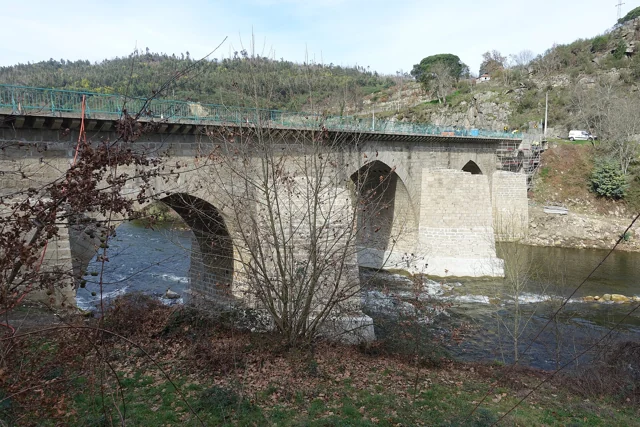
Local legend · Cavez Bridge

The voice that said to build further upstream

Ponte de Cavez on the river Tâmega, with stone arches, board and wooded banks.
Ponte de Cavez on the Tâmega · the monument to which legend refers.© Joseolgonⓘ

Around the bridge, memory imagined its own paths.

Includes an activity to try →
Read here and view sources

The legend shared by the Museum has masons try to build the bridge at Vila Franca and then beside Poço das Laranjeiras. In both places, a supernatural voice told them to move upstream. Tradition attributed it to Saint Bartholomew.

On the third attempt, the narrative places construction beside the chapel. This is a story about the memory of a place, not documentary proof of site selection or an itinerary for finding the episodes.

In another part of the tradition collected by the Museum, feeding the builders receives a miraculous explanation: springs of water, wine and olive oil emerge, and fish appear in the river. The narrative connects building effort with religious protection. Reading it beside the history of the works reveals two different ways of telling the same place.

See Fact sheet: Ponte de Cavez See Fact sheet: Capela de São Bartolomeu de Cavez
Source and context

Land Museum of Basto — Ponte de Cavez, 27/02/2022

Accessed: . Editorial summary; the date of consultation is not the date of the facts.

Crafts and memories

Through hands, food and community: small stories of how people lived and what they pass on.

Choose a story · 1
Bucos · testimony collected in 2020

Leaving with memories of the game

Players’ testimonies also speak of emigration.

Includes an activity to try →Explore: A tradition goes from hand to hand →
Read here and view sources

In Vila Boa de Bucos on 23 October 2020, Fernando Lima recounted emigrating after military service. Leaving interrupted his practice of Jogo do Pau, but he still enjoyed watching his cousin and the cousin’s sons. Before emigrating, he met other shepherds in the hills: playing was also a way to socialise and make the day with the flock feel shorter.

The National Inventory record includes another link with emigration: Custódio Bastos of Bucos, who left for France, kept his lodão staff as a memento. His learning had passed through his father, Manuel Henriques Bastos, and Mestre Calado filho.

There are also stories of return. In testimony gathered in October 2020, Fernando Oliveira recalled Ernesto Santos, who worked in Leiria, returned to Bucos after retirement and taught new generations. Leaving, keeping a reminder and returning to teach are different experiences within the same tradition. These are memories collected during research, not an updated picture of participants or training sessions.

Source and context

MatrixPCI — Cabeceiras de Basto Stick Game, INPCI_2023_016

Accessed: . Editorial summary; the date of consultation is not the date of the facts.

YOUR LOCAL GUIDE

What would you like to discover?

Take a closer look.