Discover Cabeceiras de BastoFree independent guide
ViveCabeceirasYOUR GUIDE TO CABECEIRAS
ENEnglish
SearchSaved

Traditions

Choose a story to start with. You can change the subject or fine tune the search.

29 stories · Crafts and memories · Search: forma

Crafts and memories

In the hands, at the table and in the community: little stories of how one lives and what one transmits.

Choose a story · 29
Arco de Baúlhe and Refojos · history of trade

When the metal sheet was forming

From the workshop came objects to the house, the countryside and the fair.

Explore: What was the metal for? →
Read here and view sources

João Pacheco, no Arco de Baúlhe, and Luziário Pereira de Magalhães, with their son António, in Refojos, are protagonists in the investigation of the Museum on lattice. The workshop of Luziário and António was in the Beco dos Ofícios; the nearby fair was the main point of sale. Teresa Soeiro relates the decline of craft with the diffusion of aluminum and plastic.

The inventory brings this work closer to everyday gestures: the MTB 241 copper mug served to make coffee, the MTB 240 cantara contained water and the lamps lit. The functions are documented for identified pieces. Knowing the objects helps to understand the workshop, but the collection does not confirm that these craftsmen or establishments continue in activity.

Teresa Soeiro's investigation gave rise to the exhibition The Art of lattice in Cabeceiras de Basto, in the Museum's facilities in Arco de Baúlhe. The work retreated to the artisans who began using white iron, or flander leaf, at the beginning of the Modern Era. The collection of the last professional routes was thus linked to a longer history of materials.

The objects reveal the variety of tasks: lighting a house, transporting wine, watering plants or storing oil for a locomotive. The craft passed through the house, field and transport. Comparing these functions helps to discover metallurgical work in gestures that seem to belong to separate worlds.

Words in this story: see explanations →Getting to know the parish
Source and context

Basto Land Museum — Latoaria, Teresa Soeiro text and inventory of pieces

Accessed: . Editorial summary; the date of consultation is not the date of the facts.
Gondiães · documented transformations in 2012

Broa changed tool

Tradition also incorporates new ways of working.

Includes an activity to try →
Read here and view sources

The record of 2012 contrasts the wood mass to the mechanical crusher then used in Gondiães. It also recalls the passage from the community oven to the House of Martyr.

The ingredients, previously offered by the inhabitants, began to be bought. The transformation of the tools and supply coexisted with the collective preparation of the party.

The help also came from those who lived outside. The Museum collected testimonies from emigrants from Lyon to participate and collaborate. Among the tasks remembered were carrying flour and carrying wood. The move to the mechanical crusher did not eliminate these works: machinery, materials and people remained part of the same preparation.

Words in this story: see explanations →Getting to know the parish
Source and context

Basto Land Museum — Visit to the Feast of Popes, published in 22/01/2012

Accessed: . Editorial summary; the date of consultation is not the date of the facts.

Outeiro · memory of wooden footwear

Carolinas: a name to wear

A board and a resistant strip could form the simplest model.

Read here and view sources

In the study of 2017, Teresa Soeiro describes the carolinas made by the tamanqueiros of Outeiro or by their apprentices. A cut board accompanied the foot and a strip of reused leather, or other resistant material, held it. It was the cheapest model. The same book shows that the names varied: in Penafiel, carolinas designated another type of footwear.

Source and context

Teresa Soeiro — Soqueiros e Tamanqueiros, municipal edition of 2017, p. 96 (viewer page 98)

Accessed: . Editorial summary; the date of consultation is not the date of the facts.

Pedraça · inventoried object 2015

One almude, two colors in memory

The inventory records more than the form of an object.

Includes an activity to try →
Read here and view sources

The Almude L023, associated with the Casa de Passo de Vides, in Pedraça, served to transport and measure wine. The plug of 2015 gives it 28 liters and describes zinc plate painted brown, with paint to peel; the original color was blue. The capacity belongs to this invented piece, not to all almudes. Even a layer of paint helps to tell the life of an object.

The record indicates 55 cm tall and 28 in diameter and identifies Jacqueline Vilela Passos as owner. External measurement, capacity and property are distinct information: joints make the description more useful than the name of the object alone.

The brown painting and the traces of blue also show that a piece may have been transformed throughout use. The inventory does not give the date of repainting. The observation of the ink allows to count a change, but does not reconstruct all the episodes of the almude's life.

Source and context

Basto Land Museum — Latoaria in Cabeceiras de Basto (05/11/2015), L023

Accessed: . Editorial summary; the date of consultation is not the date of the facts.

Lands of Basto · everyday objects

Two funnels, close tasks

A familiar form can hold different uses.

Includes an activity to try →Explore: Transfer, measure and serve →
Read here and view sources

In the inventory of 2016, the L63 funnel appears linked to the transfer of wine; the L18, to the passage of liquids between containers. Both of them are zinc foil. Reading the registered function avoids guessing the use only by form. Compare them to the muffler funnel: a similar object can enter another task.

The L63 is 17 cm tall and 17,7 in diameter; the L18 is smaller, 12,5 cm tall and ten cm in diameter. The inventory associates the first to Álvaro Magalhães, from the place of Devesa, Basto, and the second to Maria da Conceição Magalhães, no Arco de Baúlhe. These are data from registered owners, not indications of who manufactured the parts.

Measures, material and function make the comparison more concrete. A larger diameter does not in itself reveal how many liters passed through the funnel or what work was done in a given house.

Source and context

Basto Land Museum — Latoaria in Cabeceiras de Basto V (18/01/2016), L63, L18 and MSRM88

Accessed: . Editorial summary; the date of consultation is not the date of the facts.

Outeiro · clog materials and tools

Before the punch, a piece of alder

The wood was also chosen.

Includes an activity to try →
Read here and view sources

In the Museum's inventory, a pine tree torus is a raw material for the base of the punches. The hatchet cracked the wood, the rhinestone crushed it and the chisel prepared the edge where the leather was preached. A form used by Manuel Alves Leite connects the objects to the family history of the tamancaria.

The work continued with other tools: the Torquesa pulled the leather onto the stick and the sovela opened holes for the nails. Each object retains a specific gesture. The inventory allows to follow these operations without indicating a currently visitable workshop.

Words in this story: see explanations →Getting to know the parish
Source and context

Land Museum of Basto / Teresa Soeiro — In the country of Tamanco, introduction and inventory T10/T13/T16–T19

Accessed: . Editorial summary; the date of consultation is not the date of the facts.

Vila Nune · communications in 1758

The news had day to come

The post office linked Vila Nune to Porto through two support points.

Includes an activity to try →
Read here and view sources

In the Parochial Memoirs of 1758, the vicar of Vila Nune tells that the residents resorted to the post office of Raposeira, in the couto of Refojos, and Mondim. They arrived from Porto on Monday and left on Thursday. The news had its own paths and days: communicating also required waiting.

The vicar located each of the two points of mail about a league. The indication approximates service and distance: it was not enough to know when news came, it was also necessary to have a place outside the parish. The report does not say who carried the letters between that point and each resident.

When comparing documents there is a difference: Santa Senhorinha also resorted to Raposeira, but his abbot mentions arrival on Tuesday. We keep the two versions. Only these answers do not allow to decide whether the difference is due to the way of describing the service, an error or other circumstance.

Getting to know the parish
Source and context

Municipality — Parish Memoirs of Vila Nune, 23/05/1758

Municipality — Memória de Santa Senhorinha, 23/05/1758, replies 15, 19 and 20; transcription of José Viriato Capela (2003)

Accessed: . Editorial summary; the date of consultation is not the date of the facts.

crafts · Faia, Basto and Refojos

The wood also keeps the wine

Pipes, barrels and barrels tell a business story.

Includes an activity to try →
Read here and view sources

The municipality associates these works to Faia and also refers to tannaria in Basto and Refojos. The container is part of the wine culture as much as the vineyard. In the Ethnographic Court of 24 September 2023, dedicated to the arts and crafts, Faia introduced the oil tankers. The municipal news shows how this knowledge was also chosen to represent the parish at a collective party. The episode does not confirm the existence of a visitable workshop today. The presentation of the parish adds the manual manufacture of footwear to its craft traditions. The wood of wine containers is thus part of a more varied working memory, without identifying today's artisans or workshops here.

To understand how a container is built, it is worth knowing two words of the craft. The Lourinhã Museum identifies the trims and rims as central elements: wooden pieces form the body, while the rims involve them. The description highlights the work of the curvature and thickness of the trims. It is a general explanation of the tannaria, used here to read the objects; it does not document the sequence of manufacture of a workshop of Faia.

When looking at a pipe, look for the vertical lines between pieces and the rims that cross the set. Compare later with the wooden base of a punch: a material can be cluttered to support a foot or worked on several pieces to form a volume. The finished object holds shape, fit and use decisions.

Words in this story: see explanations →Getting to know the parish
Source and context

Municipality — crafts and services of the parishes

Municipality — Arts and Crafts in the Ethnographic Court, news of 25/09/2023

Municipality — presentation of Faia: settlement and traditional activities

Lourinhã Museum — Tanoeiro, elements and work of the plasters; general technical context

Accessed: . Editorial summary; the date of consultation is not the date of the facts.

Heritage · Painzela

One house, two centuries in sight

The building and garden don't count exactly the same time.

Explore: Painzela per layer →
Read here and view sources

The House of Pielas and its garden are not presented as a work of one moment. The municipality attributes to the 18th century the architecture of the house and to the 19th century the garden, whose English influence is indicated as hypothesis.

Separating these layers helps to read the set: a building can receive new spaces and new ways to frame it over time. The reference is patrimonial, without confirming current conditions of visiting private property.

Getting to know the parish See Fact sheet: Casa de Pielas, jardins e anexos
Source and context

Municipality — assets of Painzela

Accessed: . Editorial summary; the date of consultation is not the date of the facts.

Faia · sacred art, 2025

Roots and light give another life to the chapel

In Lady of Amparo, the materials also tell a story.

Includes an activity to try →Explore: Material, memory and transformation →
Read here and view sources

Olive roots shaped the new altar and the ambão of the chapel of Our Lady of Amparo. The news of the Archdiocese of Braga of 6 October 2025 assigns the work to Atelier Amadeus and describes a remodeling centered on the altar. A suspended cross integrates the element called Body of Light.

The parish priest Rui Filipe Marques Araújo explained the symbolism of enlightenment: sets of lights refer to the Trinity, the Evangelists and the Apostles. The publication also highlights the contribution of artists, technicians, workers and community. The intervention shows a heritage that continues to receive new forms and meanings; the account of 2025 does not indicate visiting hours.

The report presents the celebration as a meeting of the Faia with the communities of Arco de Baúlhe e Vila Nune, presided over by José Cordeiro. The choice of roots also receives a religious interpretation: according to the parish priest, the transformation of previously discarded material expresses renewal and redemption. It is the symbolic reading attributed to the responsible in the news, distinct from the description of the materials. To understand the work, we can look at these two layers: how it was made and what meaning it was given.

Getting to know the parish See Fact sheet: Capela da Senhora do Amparo da Faia
Source and context

Archdiocese of Braga — renewal of Lady of Amparo, news of 06/10/2025

Accessed: . Editorial summary; the date of consultation is not the date of the facts.

Outeiro · history of the clog

A craft learned alongside the master

In Outeiro, the art of clogs passed from hand to hand.

Includes an activity to try →Explore: Three supports of the work of the tamanceiro →
Read here and view sources

In the study published in 2017, Teresa Soeiro tells that Manuel Alves Leite, born in Pinhel in 1899, learned from Bernardino José Pereira, Sobreira's tamanqueiro. The knowledge was transmitted to the descendants. This learning history brings the tamancaria closer to families and places, without assuming that the workshop remains open.

The inventory of the Museum allows you to enter the work space. It calls craft to the low table used by Manuel António Teixeira Leite. A bank with a small strain served as support in the finishing of the sticks; a form of wood and leather links production to the generation of Manuel Alves Leite. The objects show different supports of the work, without reconstructing the disposition of a concrete workshop.

The measures help distinguish the supports: table T15 is 82 cm long, 74 wide and 55 high; seat T14, 87 long, 28 wide and 50 high. Despite close lengths, they offer very different surfaces. The inventory connects the seat to the finish of the sticks, supported by a small stem.

Words in this story: see explanations →Getting to know the parish
Source and context

Teresa Soeiro — Soqueiros and Tamanqueiros, municipal edition of 2017, chapter The tamanqueiros of Outeiro, p. 68
Accessed:

Land Museum of Basto / Teresa Soeiro — In the country of Tamanco, introduction and inventory T10/T13/T16–T19
Accessed:

Editorial summary; the date of consultation is not the date of the facts.

Cambezes · Rio Douro · rural memory

The herd was also a village matter

In Cambezes, the inter-help reached the pastures.

Includes an activity to try →
Read here and view sources

The municipal guide presents Cambezes through archaeological remains, legends and a life marked by mutual help. It highlights collaboration in tasks and shepherding instead.

This memory invites you to look at the village beyond the houses: also the relationships between people are part of the heritage. The source does not describe the scale of pastors nor confirms a current calendar.

The turner highlights a way to organize shepherding among inhabitants. To understand how it worked in Cambezes, it would be interesting to know the rules, the participation of houses and changes over time. The guide does not provide these details. The collaboration mentioned is a starting point to collect memory, not a ready scale of tasks.

Compare this story with the water shifts of Levada de Víbora: both speak of collective organization, but only the leva survey describes eleven shifts of twenty-four hours. Transporting this rule to Cambezes' flock would invent a similarity that sources do not demonstrate.

Getting to know the parish
Source and context

Municipality — Village Guide of Serra da Cabreira: landscape, work and heritage

Municipality — Extension of water supply network in Cambezes, Riodouro (place of village)

Accessed: . Editorial summary; the date of consultation is not the date of the facts.

Vilela · Rio Douro

The granite also draws the village

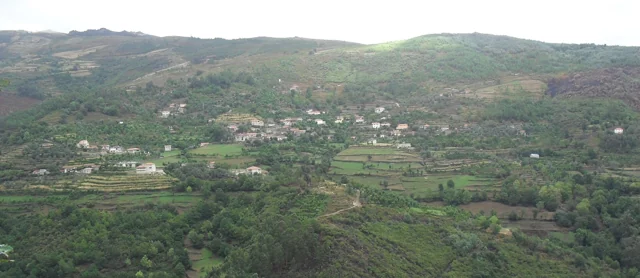
Panoramic view of Vilela, Rio Douro, with houses and agricultural plots on the slopes.
Vilela · architecture and landscape of Rio Douro© Ambcruzⓘ

In Vilela, the walls help to recognize the landscape.

Includes an activity to try →
Read here and view sources

The municipal presentation of the Cavez stream trail highlights the granite masonry in the old streets of Vilela, in Rio Douro. After the levadas and the lameiros, the reading of the territory continues in the houses: the material of the region also participates in the form of the settlement.

The municipal text presents a sequence that unites buildings and agricultural work: levadas, mills and lameiros de regádio precede the description of the streets of the village. Vernacular architecture is here the construction linked to the materials and practices of the place. The granite does not appear only as rock of the landscape; it enters the walls and the visual organization of the settlement.

To explore this relationship, it compares Vilela's photograph with reading on granite grains. A view of the village shows volumes and surfaces; a close look at the rock shows another scale. The municipal description does not date each house nor allows to conclude that all the walls have the same history.

Words in this story: see explanations →Getting to know the parish See Fact sheet: Vilela, Rio Douro See Fact sheet: Trilho da Ribeira de Cavez
Source and context

Municipality — stream of Cavez and agricultural landscape

Accessed: . Editorial summary; the date of consultation is not the date of the facts.

Saint Nicholas · testimony of 1758

By nightfall, cattle would come home

Between the fields and the mountain, there was a daily rhythm.

Includes an activity to try →Explore: Between the field and the hill →
Read here and view sources

In 1758, the parish priest of St. Nicholas described goats on the hills and work animals taken there when there was no pasture in the fields. At night, the cattle returned home.

The daily rhythm linked places with different functions: fields, mount and shelter. It is a memory of rural practices, without confirmation that today they remain the same.

The description separates the goats, raised with greater abundance in the hills, from the cattle used by farmers at work. The latter also sought pasture there in part of the year, when it was missing in the fields. The trip to the hill thus had a relationship with the availability of food and with the function of the animals. The rector does not present a fixed schedule for these movements: what leaves is the link between necessity, landscape and night return.

Getting to know the parish
Source and context

Basto Land Museum — St Nicholas Parish Memories (1758)

Accessed: . Editorial summary; the date of consultation is not the date of the facts.

Land Museum Collection of Basto · Arco de Baúlhe

This mug made coffee

Not all mugs were just for drinking.

Includes an activity to try →Explore: Three objects, three heights →
Read here and view sources

The MTB 241 copper mug was for making coffee. The inventory records 12 cm high and 7,2 in diameter.

The piece belongs to the Basto Land Museum in Arco de Baúlhe. There is no date of manufacture or recipe indicated. Compare the measurements in the scheme: similar heights can hide very different widths.

Source and context

Basto Land Museum — Latoaria, Teresa Soeiro text and inventory of pieces

Accessed: . Editorial summary; the date of consultation is not the date of the facts.

Bucos · testimony collected in 2020

Whoever left also took the memory of the game

Emigration appears in the testimony of the players.

Includes an activity to try →Explore: A tradition goes from hand to hand →
Read here and view sources

Fernando Lima told, in Vila Boa from Bucos, to 23 October 2020, which emigrated after the military service. The match interrupted the practice of the game of the cock, but still liked to watch the cousin and the children of it. Before emigrating, he found other shepherds in the mountains: playing was also a way to live and make the day with the flock less long.

The National Inventory card contains another link to emigration: Custódio Bastos, from Bucos, who left for France, kept his lodon stick as a souvenir. The learning had passed by the father, Manuel Henriques Bastos, and Mestre Calado son.

There are still stories of return. In a testimony collected in October 2020, Fernando Oliveira recalls Ernesto Santos, who worked in Leiria and, after the reform, returned to Bucos and taught new generations. Leaving, keeping a memory and teaching again are different experiences within the same tradition. They are memories collected by the investigation, not an updated portrait of the participants or the trainings.

Source and context

MatrixPCI — Cabeceiras de Basto Stick Game, INPCI_2023_016

Accessed: . Editorial summary; the date of consultation is not the date of the facts.

Cabeceiras de Basto · cooperative history since 1996

Land products also bring people together

A cooperative links flavors to rural work.

Read here and view sources

The Municipality is located in 1996 the foundation of RuralBasto, created in Cabeceiras and extended to the other municipalities of the region. The presentation distinguishes a marketing section, which includes honey, wine, bread, tobacco and other products, and a forest section. The history of flavors also goes through these forms of cooperation. The institutional description does not confirm the current stock, time or conditions of sale.

Source and context

Municipality — AgroFlorestal Development Cooperative of Basto RuralBasto

Accessed: . Editorial summary; the date of consultation is not the date of the facts.

Refojos · flavours described in 1956

New chestnuts and clay mugs

The memory of the party also has flavors.

Includes an activity to try →
Read here and view sources

In the description of 1956 published by the Museum, the food establishments and tents were filled. Regional wine accompanied new lunches or chestnuts, served in glassy white clay mugs. They are details of a chronicle that brings the fair closer to its daily gestures.

The table appears in the middle of a moving fair. The chronicle evokes groups crossing paths, buses and trains, blankets coming from Barroso and the arrival of people in the Alameda do Seco and the Praça da República. Eating and drinking were part of this meeting, alongside the trade, the religious festival and the livestock contest.

There are two dates to be kept: the quoted text came out in the newspaper in 16 September 1956; the Museum re-disclosed it in 26 September 2024. The excerpt has the expressive language of a chronicle, does not present visitor counts or meals sold. By comparing it with the memory of dried nuts in crops, we discover the same fruit in different occasions and forms of conservation.

Source and context

Basto Land Museum — St Michael of other times, 26/09/2024; excerpts from The Journal of Cabeceiras of 16/09/1956 and 08/09/1977

Accessed: . Editorial summary; the date of consultation is not the date of the facts.

Outeiro · festive traditions

Three names in the calendar of devotion

The pilgrimages also help to know Outeiro.

Explore: Places, objects and encounters →
Read here and view sources

The municipal presentation of Outeiro highlights Santa Maria, Senhora da Livração and Senhor do Livramento among its pilgrimages. These names add a community dimension to the parish known by the Câstaria and the Tamancaria. The source describes traditions, but does not provide here a program dated: this reading does not announce the holding of parties or its schedules.

Source and context

Municipality — Parish of Outeiro: pilgrimages and crafts

Accessed: . Editorial summary; the date of consultation is not the date of the facts.

Rural heritage · survey of 2008

The stones of the road to the mill

A little sidewalk thing tells a work story.

Read here and view sources

In Carrazedo, Bucos, the survey of 11 January 2008 recorded about 30 meters of sidewalk by the cruise, giving access to two mills. The granite slabs had different shapes and sizes. These short roads are also part of the rural heritage: they linked the village to the places where the cereals were transformed. The inventory does not confirm the current status or access. The record of Carrazedo presents the village to which this memory belongs; it does not indicate the exact location of the thirty meters of sidewalk.

See Fact sheet: Carrazedo
Source and context

Municipality — sidewalk inventory, Carrazedo, C5 fiche (11/01/2008)

Accessed: . Editorial summary; the date of consultation is not the date of the facts.

Arco de Baúlhe · railway collection

A little tin would help take care of the train.

The railroad also depended on discreet objects.

Includes an activity to try →
Read here and view sources

A locomotive needed maintenance, and the inventory of the museum conserves a clue of this work: the AB 295C rail station, of the Railway Center of Arco de Baúlhe. It was made of zinc plate, stored three liters of oil and was intended for lubrication of parts of the locomotive.

The chart records 34,5 cm in height and 18 in diameter. These measures help imagine the scale of the container next to the large machines. The inventory identifies the function and the object, but not the concrete locomotive in which it was used nor its current exposure.

See Fact sheet: Núcleo Ferroviário de Arco de Baúlhe
Source and context

Basto Land Museum — Latoaria: MTB251 and AB295C inventory

Accessed: . Editorial summary; the date of consultation is not the date of the facts.

Saint Lady and Refojos · mail described in 1758

To receive news, it was necessary to count on Fox

The letters linked parishes before they got further.

Includes an activity to try →Explore: Four Ways to Expect News →
Read here and view sources

In 1758, receiving news in Santa Senhorinha depended on the post office of Raposeira, in Refojos. The memory indicates a quarter of league distance and a connection to Porto: departure on Thursday and arrival on Tuesday.

These two days allow us to imagine a weekly pace of news. They do not allow us to calculate how long a concrete letter took: the text does not describe its entire path. Raposeira also appears in the memories of other parishes, showing how a service connected different communities.

The response of Vila Nune does not coincide on the day of arrival: it mentions Monday for the post office of Raposeira and Mondim. This difference deserves to be visible. Compare sources is also to realize where they do not agree, instead of turning separate accounts into a unique calendar.

Source and context

Municipality — Memória de Santa Senhorinha, 23/05/1758, replies 15, 19 and 20; transcription of José Viriato Capela (2003)

Municipality — Parish Memoirs of Vila Nune, 23/05/1758

Accessed: . Editorial summary; the date of consultation is not the date of the facts.

Cabeceiras de Basto · hydraulic heritage documented in 2011

Before grinding, it was necessary to store water

Dams and puddles were part of the work of the mill.

Explore: Four questions before reaching the flour →
Read here and view sources

The Museum distinguishes the dams, which dam the current, the prey or pools used to store water when the flow is not enough to move the mill. In the study published in 2011, identified dams associated with 360 mills and puddles in 11 cases. These numbers belong to the published survey: they do not indicate how many mills are in operation today.

Not all dams had the same origin. The description includes forms supported by the rocky outcrops themselves and constructions made with stone and earth. The relief and availability of water helped determine the solution: the mill was part of a system adapted to the terrain.

Source and context

Basto Land Museum — Mills of Cabeceiras de Basto: water capture and conduction, 07/07/2011

Accessed: . Editorial summary; the date of consultation is not the date of the facts.

Cabeceiras de Basto · hydraulic heritage documented in 2011

The water also had a built path

A levada isn't always a stone-cut channel.

Includes an activity to try →
Read here and view sources

According to the Museum, the levadas lead the water from the dams or from the puddles to the mills. In Cabeceiras, the study describes both granite channels worked as well as streams on firm terrain or dug in the rock. To perceive a mill, it is important to look at the set: building, capture and conduction of the water. It is an explanation of the documented heritage, not an indication of access to the canals.

The materials also tell what has changed. The article of 2011 mentions reconstructions in cement or fiber cement that altered the original configuration of some levadas. Distinguishing the old form of later interventions helps to read this heritage as a history of adaptations, not as a landscape that stood still in time.

Source and context

Basto Land Museum — Mills of Cabeceiras de Basto: water capture and conduction, 07/07/2011

Accessed: . Editorial summary; the date of consultation is not the date of the facts.

St Nicholas · associative memory and folklore

A memory that also dances

St. Nicholas has an associative history linked to folklore.

Read here and view sources

The municipal directory indicates 2002 as the year of foundation of the Associação Grupo Folclórico de S. Nicolau and places it in Cumieira. The presentation highlights participation in festivals, festivals and pilgrimages as a way to disseminate folklore and ethnography of the peoples of Basto. The dance adds a collective dimension to the memory of the parish, without this reference announcing current performances or essays.

Source and context

Municipality of Cabeceiras de Basto — Associativism: Culture and Entertainment, presentations by the Eagles of Painzela and the Folkloric Group of St. Nicholas

Accessed: . Editorial summary; the date of consultation is not the date of the facts.

Lands of Basto · from fibre to fabric

Yarn is not weaving

Between the fiber and a cloth, there's a small world of tools.

Includes an activity to try →
Read here and view sources

The Basto Land Flax Specs Note distinguishes yarn preparation from fabric construction. In the wiring can enter the spindle and spindle, but the document also refers to the spindle. The wire passes through with the trouble and can then form threads in the folding. To weave, you have to prepare the web and the thread that will cross it. The shuttle, shaped like a small boat, carries the plot between the threads of the web. This description covers the Lands of Basto; it does not identify a specific workshop of Cabeceiras.

Words in this story: see explanations →
Source and context

AMBT / CETRAD–UTAD — Land Linen Specification of Basto, pp. 19–27

Accessed: . Editorial summary; the date of consultation is not the date of the facts.

Holy Lady · objects and memory of devotion

Devotion also fit a candle

Small objects help to get to know the people of other times.

Explore: Objects, words and memory →
Read here and view sources

In the study of Odília Alves Gameiro, the offerings mentioned in the reports of Santa Senhorinha include wax, candles, cirios and candeias. The author interprets its low cost as a sign of a cult accessible to different social groups. The doubling of bells and oral transmission also appear in the dissemination of the narrated miracles. They are elements of the history of devotion, not proof of the supernatural events described.

The study distinguishes the offering that accompanies a request from that which thanks a grace received. The same object could thus participate in different moments of devotion. Its interpretation depends on the context narrated, and not just on the material of which it was made.

Source and context

Odília Alves Gameiro — The nobiliarchic appropriation of a rural cult: the hagiography of Santa Senhorinha of Basto, Archipelago · History, 2001, pp. 561–562 and 571–572

Accessed: . Editorial summary; the date of consultation is not the date of the facts.

Basto Land Museum · inventory published in 2016

Two containers to carry the light

Before lighting up, we had to transport the oil.

Explore: Liquids with different tasks →
Read here and view sources

The inventory published by the Museum in January 2016 presents two oil almotolias, identified as MTB 436 and MTB 226. The function recorded is to transport oil. Both are metal and have the same dimensions indicated: 17,5 cm in height and ten in diameter.

The coincidence of the measures does not transform two pieces into one. Each inventory number allows distinguishing the object and associating it with its record. The Basto Land Museum appears as owner of both; the text does not indicate manufacturer, production date or home where they were used.

It is a way of looking backstage at lighting: besides the lamp, there were containers to carry the fuel. This reading documents historical objects without proposing their current use.

Source and context

Basto Land Museum — Latoaria in Cabeceiras de Basto V, 18/01/2016, MTB 436 and MTB 226

Accessed: . Editorial summary; the date of consultation is not the date of the facts.

Painzela · transformation of mills in the 20th century

When the mill changed energy

In Painzela, the story continued beyond the levada.

Includes an activity to try →
Read here and view sources

The municipal inventory of 2008 describes the Lagar do Senhor Novo, in place of the Church, as successor of the Lagar Velho. Built in 1971, it used electric motorization. It was recovered in 2001 and deactivated shortly thereafter.

The change allows us to compare two ways of moving a mill in the same parish. The survey is historical and does not confirm the operation or current visits.

Source and context

Municipality — Lagares inventory, LA13, survey of 06/05/2008

Accessed: . Editorial summary; the date of consultation is not the date of the facts.

YOUR LOCAL GUIDE

What would you like to discover?

Take a closer look.