Discover Cabeceiras de BastoFree independent guide
ViveCabeceirasYOUR GUIDE TO CABECEIRAS
ENEnglish
SearchSaved

Stories of Cabeceiras

Choose a story to start with. You can change the subject or fine tune the search.

11 stories · All themes · Search: castanho

Time travel

Documents, details and traditions: there is more to discover than a date on a stone.

Choose a story · 2
Refojos · art and architecture

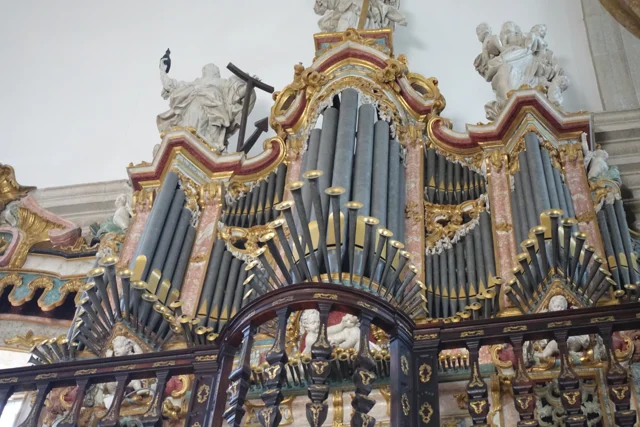
Two organs, one of them mute
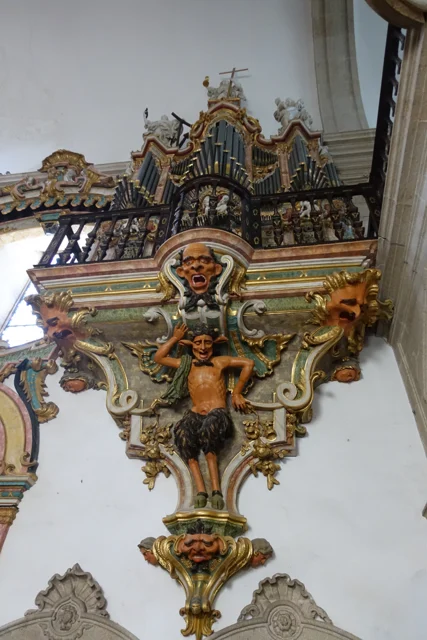
Organ with tubes and golden cut, on carved figures and decorative faces.
View of the organ and the decoration that sustains it, photographed in 2016. The image does not determine which of the two organs is the mute.
Photography: Joseolgon · CC BY-SA 4.0
About this photograph

Date given at source: . Source consulted in 2026-11-07. EXIF orientation, proportional resizing and WebP conversion; no retouching or clipping of the file.
Request removal or correct the photo credit

See more 2 photos and details
Organ tubes at different heights, surrounded by golden cut and light sculptures.
Details of the tubes, cut and sculptures of the organ in 2016.
Photography: Joseolgon · CC BY-SA 4.0
About this photograph

Date given at source: . Source consulted in 2026-11-07. EXIF orientation, proportional resizing and WebP conversion; no retouching or clipping of the file.

Request removal or correct the photo credit

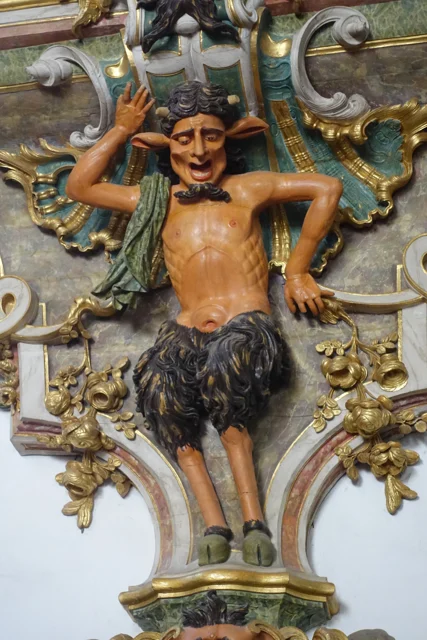
A figure carved with horns, pointed ears and fur-covered legs between golden elements.
Details of a figure carved under the organ in 2016.
Photography: Joseolgon · CC BY-SA 4.0
About this photograph

Date given at source: . Source consulted in 2026-11-07. EXIF orientation, proportional resizing and WebP conversion; no retouching or clipping of the file.

Request removal or correct the photo credit

An invitation to look beyond the facade.

Includes an activity to try →Explore: The pulpits had more than one step. →
Read here and view sources

The municipal description identifies two lateral organs, being a mute. The visual symmetry of the church does not correspond, therefore, to two sound instruments. Next to the entrance appear frowns; later, the wood creates another surprise effect.

The two pulpits are painted brown to imitate marble and partially golden. The fountain places the execution in 1777–1780 and the painting and browning in 1786–1789. Shape, material and finishing count different stages of the same work. This patrimonial description does not confirm the current functioning of the organ.

The choir adds another reading of the wood: the Municipality describes a brown chair, of 1767–1770, organized in two levels and in the shape of U. São 45 seats, with the place of the abbot to the center. The disposition helps imagine a community gathered, instead of looking at each chair separately.

At the top, the circular zimbarium is accompanied by interior and exterior balconies. The description identifies the twelve apostles and, on the top, St. Michael. From furniture to silhouette, they change the scale and the observation point. The photographs of this reading show details of the organ; they do not document all these elements.

Words in this story: see explanations →See Fact sheet: Mosteiro de São Miguel de Refojos
Source and context

Municipality — history and art of Mosteiro de São Miguel de Refojos

Accessed: . Editorial summary; the date of consultation is not the date of the facts.
Refojos · furniture of the sacristy

Wood inside, glow outside

The furniture of the sacristy brings together materials with different functions.

Includes an activity to try →Explore: Materials, appearance and conservation →
Read here and view sources

The municipal news about the restoration of 2014 describes two arches and two counters with brown structure, jacaranda coating and cut brass decoration. The municipality identifies Agostinho Marques, notchmaker of Braga, as the author of this work of the early 18th century. The contrast between wood and metal is a clue to look at these furniture more closely.

In 2014, the restoration separated materials and tasks: the brass elements were removed for treatment, while the wood received intervention against insects and structural corrections. After cleaning and protecting, the metallic decoration returned to the furniture. The visible brightness results from a set of care, not just adding gold. It is the report of a professional intervention, not a proposal for home treatment.

Getting to know the parish See Fact sheet: Núcleo de Arte Sacra
Source and context

Municipality — Restoration of tokers and furniture, 14/11/2014

Accessed: . Editorial summary; the date of consultation is not the date of the facts.

Life you do not always see

Knowing animals begins by perceiving the territory and respecting the distance.

Choose a story · 4
Biology of the species · Portuguese context

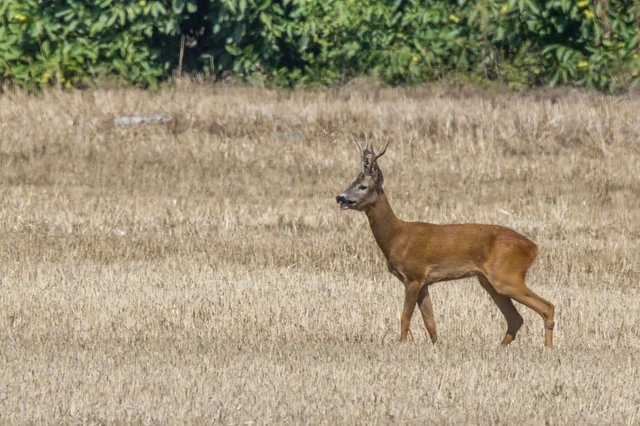
The hind changes its coat

Profile hind in a field, with stems, raised ears and reddish brown coat.
Male hind in Dobruja, Romania, in August 2022. Illustration of the species; it is not a record of Cabeceiras.
Photography: Charles J. Sharp · CC BY-SA 4.0
About this photograph

Date given at source: . Source consulted in 2026-11-07. EXIF orientation, proportional resizing and WebP conversion of the current version in Commons; no retouching or additional clipping.

Request removal or correct the photo credit

A summer coat, a winter coat.

Includes an activity to try →Explore: The same world, different rhythms →
Read here and view sources

In the hind, Capreolus capreolus, the fur is reddish brown in summer to gray in winter. It feeds on plants and also occupies open areas and shrubs. This description of the species does not identify a spot of sighting in the municipality. The hind is a small cervid: the description of the platform points to 30 kg. The males have stems; the white spot on the back has a kidney shape in males and hearts in females.

The stems also follow a cycle: the platform refers to the growth and annual fall in the hind and deer. Therefore, they are not a structure that always remains the same. In the head, the nose and the upper lip mostly black contrast with the lower lip white.

The hours of activity add another difference. Although it is mainly crepuscular and nocturnal, the source presents the hind as the Portuguese cervid with the highest daytime activity. They are trends of the species, not a guaranteed hour to observe it. To know an animal, form, season and behavior need to be read together.

Words in this story: see explanations →
Source and context

Lobo-Iberico platform in Portugal — wolf prey; registration of Cabreira without date indicated

Accessed: . Editorial summary; the date of consultation is not the date of the facts.

Fox · general biology

Between the woods and the countryside

For the fox, a varied landscape offers different environments.

Read here and view sources

The red fox (Vulpes vulpes) occupies many habitats, from coast to mountain. The Virtual Museum of Biodiversity highlights the preference for shrubs and woods interspersed with agricultural fields or pastures. The long, hairy tail and pointed snout help recognize its profile.

The distribution described covers mainland Portugal, but does not replace a register located at Cabeceiras de Basto.

The coat can combine brown, red and grey tones; the tail tip can present a whitish spot. The description also mentions that the cubs are brown until approximately six months. Thus, color and age must enter the animal's reading rather than always expect the same appearance.

Source and context

University of Évora — Virtual Museum of Biodiversity: Vulpes vulpes

Accessed: . Editorial summary; the date of consultation is not the date of the facts.

Abadim · local register and general biology

The wings give a clue to the finch

Males and females have different colors, but share marks on their wings.

Includes an activity to try →Explore: Colors, seasons and food →
Read here and view sources

The common finch, Fringilla coelebs, appears in a record of naturpel of 6 February 2022, located in Abadim by crossing the public point with CAOP2025. The image allows you to look for the contrast of the clear marks on the wings and tones of the chest, although the movement reduces the sharpness.

Birds of Portugal describe the males with bluish barrette and chest and reddish faces. The females have more discrete shades, brown and gray, but retain a contrasting pattern on the wings. The beak is conical and robust. Compare various features is more useful than looking for a single color.

The species is resident in Portugal and receives winter birds in autumn. At that time there may be more individuals, but behave more discreetly than in spring. This general description does not allow determining whether the bird photographed in February was born in the region or arrived from another territory.

Source and context

Birds of Portugal — Common finch

Accessed: . Editorial summary; the date of consultation is not the date of the facts.

Cavez · local register and general biology

A shell, lots of drawings

Not all snails of the same species wear the same pattern.

Includes an activity to try →
Read here and view sources

João Lima photographed this snail in 15 May 2024. The record is identified as Cepaea nemoralis and the published point is in Cavez, at the intersection with the limits CAOP2025. In the image, the dark bands accompany the turns of the shell between wet leaves.

The Carnegie Museum of Natural History describes a shell that can have bands of different widths or not present bands. The edge of the opening is usually brown, but not always. The species can also be confused with Cepaea hortensis. Color, drawing and shape need to be seen together; a photograph that hides the opening leaves part of the clues out of sight.

Try to follow the spiral with your eyes.

Source and context

Carnegie Museum of Natural History — Cepaea nemoralis

Accessed: . Editorial summary; the date of consultation is not the date of the facts.

Read the landscape through the plants

Trees, forests, vineyards and fields reveal different ways of occupying the territory.

Choose a story · 3
Forest landscape · species botany

Needles come in pairs

A small detail to spot on maritime pine.

Includes an activity to try →Explore: A tree inside the forest →
Read here and view sources

The municipality mentions maritime pine in the transformation of the mountain forest landscape. In the University of Évora description, Pinus pinaster has stiff, pointed, evergreen needle leaves. They grow in pairs on a very short shoot and can reach 25 centimetres. A pair of needles is a starting point for noticing more than the tree’s crown.

Male and female reproductive structures occur on the same plant. The male structures form yellowish clusters; the female structures develop into cones with woody scales. Look at the trunk too: the bark is thick, reddish-brown and deeply cracked. These are general features of the species, not a survey of local pine woods.

The environment offers another clue. The University of Évora associates maritime pine with sunny places and acidic, often sandy soils; inland it also mentions schist substrates. It can form pine woods or join mixed forests with other pines and oaks.

When looking at a hillside, distinguish two scales: the tree with its needles and cones, and the plants around it. The botanical description provides context, but appearance alone cannot reveal a stand’s origin or age.

Words in this story: see explanations →
Source and context

University of Évora — Virtual Museum of Biodiversity, Pinus pinaster

Municipality — landscape and vegetation

Accessed: . Editorial summary; the date of consultation is not the date of the facts.

Forest landscape · maritime pine botany

A pine cone has little homes for seeds

The woody scales hide a detail worth noticing.

Explore: A tree, several clues →
Read here and view sources

In maritime pine, Pinus pinaster, the cone contains two seeds per scale, according to the University of Évora description. The trunk has thick, reddish-brown, deeply cracked bark. After recognising the paired needles, these other shapes deserve attention. The municipality mentions maritime pine in the mountain landscape; these features help explain the species without constituting an inventory of local pine woods.

Different male and female reproductive structures occur on the same tree: the species is monoecious. The profile describes the male structures as yellowish clusters and the female ones as scaly structures that form cones. Looking only at a mature cone therefore leaves part of the cycle undiscovered.

The environment matters too. The University of Évora associates maritime pine with sunny places and acidic, often sandy soils, also mentioning inland occurrences on schist substrates. It can form pine woods or be part of mixed forests. This describes general preferences and occurrence; it does not turn every hillside with these conditions into a pine wood.

Words in this story: see explanations →
Source and context

University of Évora — Virtual Museum of Biodiversity, Pinus pinaster

Municipality — landscape and vegetation

Accessed: . Editorial summary; the date of consultation is not the date of the facts.

Flora · general biology of a species invasive in Portugal

Yellow flowers, contested space

A striking plant can change the vegetation around it.

Explore: A landscape, different ways to grow →
Read here and view sources

Silver wattle, Acacia dealbata, has yellow flowers grouped in small round clusters and finely divided leaves. Native to south-eastern Australia and Tasmania, it is described by the University of Évora as invasive in Portugal. It can form dense stands that hinder native vegetation, particularly after disturbances such as fire. This profile explains the species; it does not locate a population in Cabeceiras or identify all acacias by the same name.

There is more to observe than yellow flowers: the evergreen leaves divide repeatedly into small units, giving the crown a delicate appearance. The profile gives January to April as the flowering period and describes flattened, reddish-brown pods. These are general species features, not a calendar confirmed for a place in the municipality.

The introduction history also helps explain the landscape. The University of Évora mentions ornamental, forestry and soil-stabilisation uses. A plant introduced for one purpose may later spread and alter the space available to other species.

Source and context

University of Évora — Virtual Museum of Biodiversity, Acacia dealbata

Accessed: . Editorial summary; the date of consultation is not the date of the facts.

A world under the leaves

A first look at the fungi. Continue in the gallery to see the local records already documented.

Choose a story · 1
Abadim · local register and general biology

A small landscape on the stone

The protrusions of a lichen give relief to the rock.

Includes an activity to try →Explore: Still in the small world →
Read here and view sources

In the photograph of Pedro Andrade, of 31 January 2025, a brown-gray lichen has rounded protrusions over rock. The record is identified as Lasallia pustulata and located in Abadim by crossing the public point with CAOP2025.

The University of Évora describes this species as Saxon, that is, linked to rocks. The stem is umbilicalized: it is attached to the support only by the central zone. The protrusions of the upper face are another detail described by the source.

The photograph allows you to observe the relief, but does not show the fixture point hidden below. Compare what you see with what the description explains is a way to learn without lifting or highlighting the lichen.

The record of Évora describes a single wolf, which can reach ten centimeters, and small structures branched on the margins, the isids. The surface can present a whitish coating, called pruin. Edge, margin and relief are three different observations; no measurements of the photograph should be estimated without a known scale.

Words in this story: see explanations →
Source and context

University of Évora — Biodiversity of Mitra, Lasallia pustulata

Accessed: . Editorial summary; the date of consultation is not the date of the facts.

Crafts and memories

In the hands, at the table and in the community: little stories of how one lives and what one transmits.

Choose a story · 1
Pedraça · inventoried object 2015

One almude, two colors in memory

The inventory records more than the form of an object.

Includes an activity to try →
Read here and view sources

The Almude L023, associated with the Casa de Passo de Vides, in Pedraça, served to transport and measure wine. The plug of 2015 gives it 28 liters and describes zinc plate painted brown, with paint to peel; the original color was blue. The capacity belongs to this invented piece, not to all almudes. Even a layer of paint helps to tell the life of an object.

The record indicates 55 cm tall and 28 in diameter and identifies Jacqueline Vilela Passos as owner. External measurement, capacity and property are distinct information: joints make the description more useful than the name of the object alone.

The brown painting and the traces of blue also show that a piece may have been transformed throughout use. The inventory does not give the date of repainting. The observation of the ink allows to count a change, but does not reconstruct all the episodes of the almude's life.

Source and context

Basto Land Museum — Latoaria in Cabeceiras de Basto (05/11/2015), L023

Accessed: . Editorial summary; the date of consultation is not the date of the facts.

YOUR LOCAL GUIDE

What would you like to discover?

Take a closer look.