Discover Cabeceiras de BastoFree independent guide
ViveCabeceirasYOUR GUIDE TO CABECEIRAS
ENEnglish
SearchSaved

Stories of Cabeceiras

Choose a story to start with. You can change the subject or fine tune the search.

24 stories · All themes · Search: raízes

Read the landscape through the plants

Trees, forests, vineyards and fields reveal different ways of occupying the territory.

Choose a story · 8
General biology · alders and bacteria

Alder has partners in its roots

A tree does not live alone, even underground.

Read here and view sources

Flora-On describes an association between alder roots and Frankia alni, a filamentous bacterium able to fix nitrogen. This partnership differs from mycorrhizas, which involve fungi. Learning what happens in the soil adds another dimension to riverside woods. This is general biology, without confirmation of the association in a particular local tree.

The same portal places alders in woods along rivers and streams, damp ravines and permanently moist alluvial ground. Woods dominated by these trees are known in Portuguese as amial or ameal. The tree above ground therefore belongs both to a watery environment and to a network of underground relationships.

Scientific names have a history too. Flora-On’s taxonomic note points to a study distinguishing Portugal’s native alder as Alnus lusitanica, although the page presents information under Alnus glutinosa. A name change in a source can reflect research; it does not mean two different trees were observed in the same place.

Words in this story: see explanations →
Source and context

Portuguese Society of Botany — Flora-On, Alnus: ecology, symbiosis and taxonomic note

Accessed: . Editorial summary; the date of consultation is not the date of the facts.
Arco de Baúlhe · March 2023 planting

An orange tree beside railway memories

In the museum garden, the community has put down roots too.

Read here and view sources

On 21 March 2023, users of the Espaços de Convívio e Lazer in Arco de Baúlhe and Vila Nune joined the initiative As plantas do nosso Jardim. At the railway museum they planted an orange tree in the leisure area and aromatic plants in a bed. The municipal report reveals another side of the museum: a place for meeting and participation. It describes that planting, without guaranteeing that all the plants survive today.

See Fact sheet: Núcleo Ferroviário de Arco de Baúlhe
Source and context

Municipality — World Tree and Poetry Day, 21/03/2023

Accessed: . Editorial summary; the date of consultation is not the date of the facts.

General botany · alder

Seeds that travel by water

Alder has a close relationship with rivers.

Explore: The tree, the river and the craft →
Read here and view sources

In the University of Évora profile published under the name Alnus glutinosa, alder seeds have air-containing tissues that aid dispersal by water. The tree tolerates long periods with submerged roots. Woods dominated by alder are known in Portuguese as amiais.

Its connection with water thus extends from growing along banks to the journey of its seeds. There is also a naming change to understand: Flora-On uses Alnus lusitanica for native Portuguese alders, citing a 2017 study. Here each name remains linked to its source; the story does not identify a particular tree in the municipality.

The profile published as Alnus glutinosa describes a deciduous tree, which loses foliage for part of the year. The leaves are alternate with doubly toothed edges; the bark, smooth when young, becomes darker and cracked. These features concern different plant parts and different stages of its life.

That source gives December to February as the flowering period. Male flowers appear in elongated groups called catkins, while female groups have a different shape. Winter can therefore reveal details hidden on a visit when the crown is full of leaves. This calendar belongs to the consulted description and may vary with local conditions; it does not announce flowering for a particular tree in Cabeceiras.

Words in this story: see explanations →
Source and context

University of Évora — Alnus glutinous, breeding and habitat

Portuguese Society of Botany — Flora-On, Alnus: ecology, symbiosis and taxonomic note

Accessed: . Editorial summary; the date of consultation is not the date of the facts.

General botany · birch

A tree with pale bark

Birch catches the eye before you even look at its leaves.

Includes an activity to try →Explore: Discreet flowers, different strategies →
Read here and view sources

The Betula celtiberica profile describes a deciduous tree with a silvery-white trunk and leaves ranging from oval to triangular, with toothed edges. The species is associated with moist environments, including watercourse banks, and needs plenty of light.

The Gulbenkian Garden presentation places flowering in April and May and describes small winged fruits dispersed by wind. Bark, leaves and reproductive structures offer different clues throughout the year. This information concerns the species; it does not confirm its presence in a parish or guarantee the same dates everywhere.

Male and female flowers occur on the same tree but in different structures. Gulbenkian describes male flowers grouped in greenish-yellow catkins and female structures that are upright at first. A flower does not always have large, showy petals: observing a tree may require attention to discreet structures.

The profile also highlights shallow, horizontally spreading roots and the ability to produce shoots from the stump. The visible trunk is only part of the plant; growing from seed and producing new shoots are distinct processes. These are features from the Betula celtiberica profile, without attributing a particular tree to Cabeceiras.

Words in this story: see explanations →
Source and context

Calouste Gulbenkian Foundation — Celtic betula, trunk and leaves

Accessed: . Editorial summary; the date of consultation is not the date of the facts.

General botany · ivy

Not all flowers arrive in spring

Ivy brings flowers to autumn too.

Read here and view sources

The Hedera hibernica profile places its small greenish-yellow flowers in September and October. It mentions the importance of flowers and fruits for insects and birds, and the plant’s use as nesting shelter. This shows how one climber can take part in several ecological relationships.

The profile also explains how the plant occupies space. Ivy is woody and perennial; its long, flexible branches have roots that cling to surfaces. With support it climbs trees, rocks or walls; without a vertical surface it can spread over the ground. Climbing and ground cover are thus two growth forms of the same species.

The described leaves may be oval or have three to five lobes. Compare leaf shape with branch position, but do not use a single detail to name the plant. To follow the seasons, record leaves, flowers and fruits separately: keeping leaves all year does not mean flowering every month.

Words in this story: see explanations →
Source and context

University of Évora — BioMontado, chips Fraxinus angustifolia and Hedera hibernica

Accessed: . Editorial summary; the date of consultation is not the date of the facts.

Observation in Gondiães e Vilar de Cunhas · botanical context

When ferns fill the landscape

One fern may be a small detail; many together form a fern bed.

Includes an activity to try →Explore: From where to the surface where it grows →
Read here and view sources

Flora-On describes Pteridium aquilinum subsp. aquilinum as a coloniser of burnt areas and abandoned pastures, where it can become dominant. This helps explain how a fern patch forms, but does not prove the history of the photographed ground. The Gondiães e Vilar de Cunhas observation identifies Pteridium aquilinum at species level: the image confirms neither the subspecies nor an earlier fire. Compare the whole hillside with the outline of a single frond.

The University of Évora profile describes a long underground rhizome from which leaves emerge. The greenery at the surface is only part of the plant: a stem extends below ground. Rhizome is not another word for root.

The fronds have a long stalk and a blade with an oval to triangular outline, divided into segments. The upper surface is hairless and the underside hairy. The description gives a usual leaf size of thirty centimetres to one and a half metres, sometimes larger. These are species measurements, not measurements of the photographed plant.

This fern can occur in sun or shade, including in understorey and on acidic ground. A patch alone does not show whether a site experienced fire, agricultural abandonment or another change.

Words in this story: see explanations →
Source and context

Portuguese Society of Botany — Flora-On: Pteridium aquilinum subsp. aquilinum
Accessed:

University of Évora — Biodiversity of Mitra, Pteridium aquilinum
Accessed:

Editorial summary; the date of consultation is not the date of the facts.

General botany · pedunculate oak ecology

An oak also tells a story of water

A tree’s landscape begins with soil and climate.

Explore: Water, shadow or altitude? →
Read here and view sources

The University of Évora profile for Quercus robur subsp. broteroana describes a preference for very moist environments, tolerance of waterlogged soils and difficulty with summer drought. This helps explain why oak woods are not distributed at random. It is ecological information about the taxon described in the source, without confirming that subspecies in a particular tree or parish in this guide.

The description adds a preference for siliceous ground and places the taxon mainly in north-western Portugal. Several pieces therefore fit together: available water, soil type and climate. Finding a tree beside water does not mean that all trees in the same family need the same conditions.

Compare it with the cork oak in the next story: both belong to Quercus, but their profiles do not assign exactly the same preferences. This comparison turns a walk into a question about the landscape: what changes between a damp bank, a sheltered slope and an exposed summit?

Source and context

University of Évora — Quercus robur subsp. broteroana, description by Carlos Vila-Viçosa

Accessed: . Editorial summary; the date of consultation is not the date of the facts.

General biology · mosses, without a local species inventory

A small carpet full of life

Mosses invite a closer look.

Includes an activity to try →Explore: Small shapes, big differences →
Read here and view sources

Bryophytes are small plants whose life cycle depends heavily on moisture. Their diversity is not only green: there are different shapes, colours and textures. According to the scientific presentation from Serralves, they contribute to nutrient recycling and can colonise surfaces where other plants cannot yet establish themselves, helping soil form. Learning about this group brings new questions to a walk, without needing to pull up specimens.

Mosses have no true roots. Kew describes rhizoids as small filaments whose main role is anchoring the plant to rock, bark or soil. Absorbent surfaces help take up water and minerals from the surroundings. Contact with moisture is therefore part of how they live.

They do not produce flowers either: they reproduce through spores. Spaces between the small plants help retain water, keeping the soil and nearby surroundings moist. These carpets can also shelter small animals.

This does not mean all mosses need the same conditions. Species are adapted to very different environments, and some survive dry periods in a dormant state. A green patch on a wall is not enough to identify a species or explain its whole life cycle.

Words in this story: see explanations →
Source and context

Serralves / MHNC-UP and CIBIO-INBIO — Briophytes, 20 of November 2016

Royal Botanic Gardens, Kew — 7 interesting things about moss, Ellen McHale, 23/05/2020

Accessed: . Editorial summary; the date of consultation is not the date of the facts.

A world beneath the leaves

A first look at the fungi. Continue in the gallery to see the local records already documented.

Choose a story · 9
Micorrizas · general ecology

Not every root makes a partner

Some associations are more specific.

Includes an activity to try →Explore: From root to landscape →
Read here and view sources

Partnerships are not all alike: some fungi associate with different plants, while others depend on a particular plant species.

Observing vegetation therefore helps us ask questions about what happens below ground. It does not, however, confirm which association is present at a particular point.

The partnership may involve trees, shrubs or herbaceous plants. The plant supplies organic compounds, while the association between roots and mycelium extends the search for water and nutrients. The plant partner is part of the fungus’s ecology, not just scenery around the mushroom.

Consider two different questions: “Which plants grow in this woodland?” and “Which plant does this fungus associate with?” The first can guide observation; answering the second requires knowledge of the association. Even in woodland with several tree types, seeing a mushroom near a trunk does not automatically identify its underground partner.

Source and context

Silvestrian Resource Competence Centre — General Mycology

Accessed: . Editorial summary; the date of consultation is not the date of the facts.

General ecology · mycorrhizae

Roots have partners

An exchange that takes place out of sight.

Includes an activity to try →Explore: The partnership between roots and fungi →
Read here and view sources

In mycorrhizas, a plant and a fungus form a partnership. The plant supplies organic compounds; the mycelium associated with the roots helps obtain water and nutrients.

Oaks, chestnuts and pines can take part in these relationships. A nearby tree gives an observation context, but does not reveal a mushroom’s identity on its own.

Researcher Susana Gonçalves also distinguishes ectomycorrhizas: in these associations, the fungus surrounds the root tips. This example shows that there are different kinds of relationships between plants and fungi, beyond the visible appearance of mushrooms.

The partnership extends the area from which the plant can obtain resources: its roots connect with the fungal network. But the participants are not always the same. Some fungi can associate with several plants, while others have very specific partners. Knowing the trees in a place therefore helps us understand the environment without replacing identification of the fungus.

Words in this story: see explanations →See local fungal records
Source and context

Silvestrian Resource Competence Centre — General Mycology
Accessed:

Gulbenkian Garden — ecology of fungi, with Susana Gonçalves (17/04/2023)
Accessed:

Editorial summary; the date of consultation is not the date of the facts.

Ecology of fungi · General explanation

Some fungi live at others’ expense

Cooperation and parasitism are different relationships.

Explore: What relationship is this? →
Read here and view sources

Parasitic fungi use the resources of living organisms: plants, animals or other fungi. They may cause disease and, in some cases, the host’s death. This CCRES explanation helps distinguish ways of life; it does not diagnose trees or animals observed in the municipality.

One example helps explain the difference between what we see and what happens in the soil. In British research on Armillaria by the Royal Horticultural Society, the fungi can feed on roots or buried dead wood. Mushrooms do not always appear beside the trunk: the connection may run through roots or cords of mycelium called rhizomorphs.

The survey collected 170 suspected cases from British parks and gardens, with photographs in 113. These numbers describe the submissions received, not disease frequency in a forest or the situation in Cabeceiras. The relationship with the host requires more evidence than a mushroom’s position in a photograph.

Words in this story: see explanations →
Source and context

Silvestrian Resource Competence Centre — General Mycology
Accessed:

Royal Horticultural Society — Honey Fungus Hunt, British survey results and context
Accessed:

Editorial summary; the date of consultation is not the date of the facts.

Knowledge of nature · General biology

A lichen is a partnership

The world of fungi goes far beyond caps.

Includes an activity to try →Explore: From surface to invisible relationships →
Read here and view sources

In a lichen, a fungus associates with an alga or cyanobacterium capable of photosynthesis. The photosynthetic partner provides nutrients; the fungus helps protect it from drying and radiation.

The University of Évora describes crustose, foliose and fruticose forms, among others. This offers a new way to notice surfaces and textures without confusing colour with identification. This story explains lichen biology; it is not an inventory of species confirmed in Cabeceiras.

Reproduction can carry the partnership too: lichen fragments can disperse both partners together. By contrast, the fungus’s spores need to encounter a photosynthetic partner to form a new lichen.

The shapes can resemble a crust, divided leaves or small shrubs. These words describe appearance, with boundaries that are not always rigid. Lichens are not mosses either: mosses are plants, whereas lichens are classified with fungi.

The growing surface deserves attention too: lichens may grow on rocks, bark, soil and artificial surfaces. The University of Évora explains that identification combines appearance with substrate and habitat; sometimes it requires microscopy or other specialist methods. A photograph can record the encounter without resolving the name.

Another aspect is the study of air. Lichens can accumulate compounds from the atmosphere and are used as bioindicators or biomonitors. A patch on a wall cannot, by itself, classify a village’s air quality. That conclusion requires a suitable study, just as assessing a river combines different observations.

Words in this story: see explanations →
Source and context

University of Évora — Biodiversity of Mitra: Lichens

Australian National Botanic Gardens / Australian National Herbarium — What is a lichen?, Heino Lepp

Accessed: . Editorial summary; the date of consultation is not the date of the facts.

Abadim · photographed record and general biology

The marks on a cap can change too

A photograph captures only one moment in a mushroom’s life.

Explore: From hat to hidden life →
Read here and view sources

Naturalis describes Amanita muscaria with white spots that can disappear and a cap whose red colour can fade to paler orange or yellow tones. Its appearance is therefore not always the same. The photographed record from Abadim shows pale spots on a red cap; it does not follow the same specimen’s development. These details help explain the species, not identify mushrooms for consumption.

The shape changes too: Naturalis describes a cap that begins globose and expands until flat. The gills are white. Colour, spots and shape belong to a developing organism, so an image should not be treated as an unchanging template for the species.

There is also a story underground. The source states that Amanita muscaria forms ectomycorrhizas, associations with tree roots. It mentions environments with broadleaved trees and conifers on sandy or peaty soils. The Abadim record documents the mushroom photographed; it identifies neither the partner tree nor that underground connection at that point.

Source and context

Naturalis Biodiversity Center — Amanita muscaria

Accessed: . Editorial summary; the date of consultation is not the date of the facts.

Fungal habitats · general explanation

From tree bark to meadow soil

Bark, leaves, wood or soil: the surface a fungus grows on offers a first clue.

Includes an activity to try →Explore: Start with support →
Read here and view sources

A fallen trunk, a layer of leaves and a pasture offer different environments for fungi. CCRES uses terms that help describe them: corticolous fungi live on tree bark; praticolous fungi grow in the soil of meadows and pastures.

There are other clues in this vocabulary. Lignicolous fungi grow on dead wood, foliicolous fungi on fallen leaves and humicolous fungi on decomposing plant remains. Coprophilous fungi are associated with animal dung. These terms describe a substrate or environment, not individual species.

When observing, start by recording where the visible structure appears: on bark, wood, leaves or soil? Keep this description separate from identification. Knowing where it grows helps us ask questions; it is not enough to identify a fungus, explain how it feeds in each case or establish whether it is edible.

Words in this story: see explanations →
Source and context

Silvestrian Resource Competence Centre — General Mycology

Accessed: . Editorial summary; the date of consultation is not the date of the facts.

General biology of fungi · no local occurrence attributed

They look like plants? Look a little deeper

The difference begins in the cells.

Explore: From what is done to how you live →
Read here and view sources

Fungi belong to a kingdom of their own. Unlike plants, they do not have chlorophyll for photosynthesis: they obtain food from their surroundings. Their cell walls contain chitin, a material also found in the external skeleton of insects. This comparison, explained by Kew Gardens, helps show why a mushroom is not a small plant.

The comparison extends to energy reserves: plants store starch, while fungi store glycogen. Their cell-wall materials also differ: cellulose in plants, chitin in most fungi. These are not features you can confirm by looking at a cap beside a path.

So how does food reach them? Many fungi release enzymes that break down organic matter outside their bodies, then absorb the resulting products. A decaying trunk, a fallen leaf and a living root therefore raise different questions about each fungus’s food and relationships.

Source and context

Royal Botanic Gardens, Kew — What in earth? Understanding what fungi really are, Eddie Johnston (07/10/2022)

Accessed: . Editorial summary; the date of consultation is not the date of the facts.

General biology · no local occurrence assigned

There is life inside a plant too

A healthy leaf can shelter invisible fungi.

Explore: A plant, different relationships →
Read here and view sources

Not all fungi live in plain sight. Endophytes inhabit the inside of living, healthy plants, unlike epiphytes, which grow on their surfaces. The Royal Botanic Garden Edinburgh studies these communities, including those living in conifer needles.

Living inside a plant does not mean always playing the same role. Some relationships are beneficial, others can be harmful, and many remain poorly understood. Certain fungi associate only with particular hosts.

The relationship can also change over time. Some endophytes begin decomposing tissues after they die. Others can cause disease, especially when the plant is under stress. The word endophyte describes where they live at this stage, not a promise of permanent protection.

This is not a story that can be resolved by looking at a leaf: researchers combine laboratory isolation with analysis of genetic material. This general explanation does not identify the fungi in a tree in Cabeceiras.

Source and context

Royal Botanic Garden Edinburgh — Fungal Endophytes

Accessed: . Editorial summary; the date of consultation is not the date of the facts.

Gardens and conservation · general ecology

A garden can welcome an invisible world too

More habitats, more stories to discover.

Includes an activity to try →Explore: From design to ecological relations →
Read here and view sources

A garden does not need to look the same throughout. In an interview published by the Gulbenkian Garden, researcher Susana Gonçalves proposes combining small habitats and a variety of native plants to encourage fungal diversity. A meadow, a small woodland and a border offer different settings.

Care continues beneath our feet: keeping soil covered helps prevent drying and erosion. Branches and dead wood can support decomposers and other organisms. Retaining old trees, however, requires assessment and monitoring of the risk of falling.

This is a way to understand ecological relationships, not a survey of gardens in Cabeceiras. Try looking at a green space as a collection of environments: what is exposed, what is shaded, and where is there plant material on the ground?

Source and context

Gulbenkian Garden — ecology of fungi, with Susana Gonçalves (17/04/2023)

Accessed: . Editorial summary; the date of consultation is not the date of the facts.

Crafts and memories

In the hands, at the table and in the community: little stories of how one lives and what one transmits.

Choose a story · 1
Faia · sacred art, 2025

Roots and light give another life to the chapel

In Lady of Amparo, the materials also tell a story.

Includes an activity to try →Explore: Material, memory and transformation →
Read here and view sources

Olive roots shaped the new altar and the ambão of the chapel of Our Lady of Amparo. The news of the Archdiocese of Braga of 6 October 2025 assigns the work to Atelier Amadeus and describes a remodeling centered on the altar. A suspended cross integrates the element called Body of Light.

The parish priest Rui Filipe Marques Araújo explained the symbolism of enlightenment: sets of lights refer to the Trinity, the Evangelists and the Apostles. The publication also highlights the contribution of artists, technicians, workers and community. The intervention shows a heritage that continues to receive new forms and meanings; the account of 2025 does not indicate visiting hours.

The report presents the celebration as a meeting of the Faia with the communities of Arco de Baúlhe e Vila Nune, presided over by José Cordeiro. The choice of roots also receives a religious interpretation: according to the parish priest, the transformation of previously discarded material expresses renewal and redemption. It is the symbolic reading attributed to the responsible in the news, distinct from the description of the materials. To understand the work, we can look at these two layers: how it was made and what meaning it was given.

Getting to know the parish See Fact sheet: Capela da Senhora do Amparo da Faia
Source and context

Archdiocese of Braga — renewal of Lady of Amparo, news of 06/10/2025

Accessed: . Editorial summary; the date of consultation is not the date of the facts.

The flavours of Cabeceiras

From the garden to the pot, from the oven to the table.

Choose a story · 1
Local gastronomic tradition

Greens with beans

A winter dish rooted in rural life.

Explore: A kitchen, different moments →View ingredients and preparation →
Read here and view sources

Cabeceiras chose couves com feijões, greens with beans, for the Referencial Gastronómico do Minho. The description connects couve-galega and yellow beans, also called moleiro, with hearth cooking. For more substantial meals, the cooking liquid from pork and the addition of sausages enriched the dish. The Museum also preserves a family version recorded in February 2010: Maria da Conceição Gonçalves Mouta, born in Cavez and living in Pedraça, had learned the dish from her grandmother. In that preparation, the greens and potatoes used the cooking liquid from the beans and meat; olive oil was added at the table.

Source and context

Gastronomic Reference of Minho — Cabeceiras, pp. 214–215
Accessed:

Basto Land Museum — food collections, 2010 and 2011
Accessed:

Editorial summary; the date of consultation is not the date of the facts.

Life you do not always see

Knowing animals begins by perceiving the territory and respecting the distance.

Choose a story · 4
Soil life · general ecology

Beneath our feet, a world of mixtures

Soil contains water and air too.

Includes an activity to try →Explore: From the ground to the water, follow the connections →
Read here and view sources

The ground is not a solid block: mineral particles and organic matter share space with water, air and organisms. Rock, climate and living things all take part in soil formation.

Looking only at the surface leaves much life undiscovered. This explanation helps explore gardens and woods, but does not replace an analysis of Cabeceiras’s soils.

Life is not evenly distributed. FAO describes areas of intense activity near roots, where plant remains accumulate, and along the walls of earthworm tunnels. The immediate surroundings of a root have a name: the rhizosphere. Thinking about these small zones helps explain why two nearby pieces of soil can offer different conditions to organisms.

Some inhabitants are unlikely to be seen on a walk. Bacteria take part in transforming organic matter; some associate with roots and contribute to nitrogen fixation. Fungi also break down remains and can form relationships with plants. They do not all do the same job: soil brings together overlapping activities, from feeding to the transformation of materials.

A covering of leaves is more than a finishing layer on a woodland floor. It is material that can feed this community. In the interview published by the Gulbenkian, the researchers recommend retaining some leaf litter in green spaces and avoiding frequent deep disturbance of the soil. These are general conservation guidelines, not an assessment or prescription for every plot in the municipality.

Words in this story: see explanations →
Source and context

Calouste Gulbenkian Foundation / Wilder — Cristina Cruz, Teresa Dias and Silvana Munzi (FCUL), 26/03/2024

FAO — What is soil biodiversity?

Accessed: . Editorial summary; the date of consultation is not the date of the facts.

Serra da Cabreira · regional reference and species biology

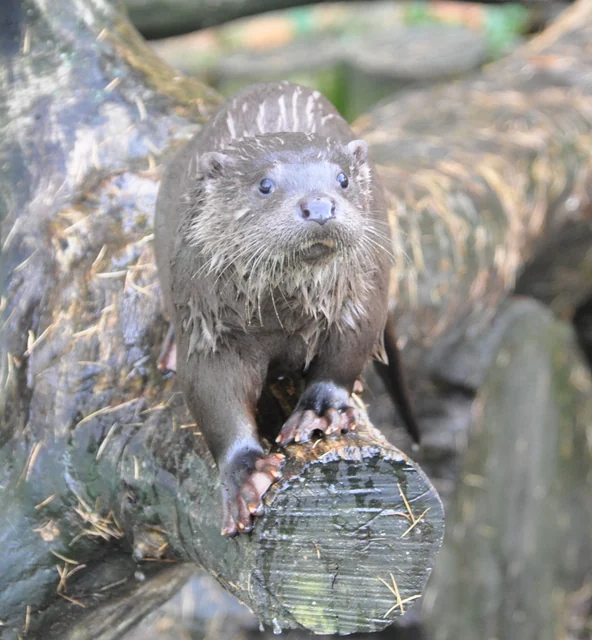
The otter wears its diving suit

Otter front view over wood, with snout, mustaches and visible paws.
European otter at the Lüneburg Heath fauna park, Germany, in 2009. Animal in fauna park; it is not a record of Cabeceiras.
Photography: Quartl · CC BY-SA 3.0
About this photograph

Date given at source: . Source consulted in 2026-11-07. EXIF orientation, proportional resizing and WebP conversion of the current version in Commons; no retouching or additional clipping.

Request removal or correct the photo credit

Waterproof fur and feet that help it swim.

Includes an activity to try →Explore: Body and environment →
Read here and view sources

The Eurasian otter, Lutra lutra, has webbed feet and a thick coat that protects it in water. Its life connects the river with its banks: vegetation offers shelter and roots can hide dens. It is mainly active at dusk and at night.

Vieira do Minho’s municipal website includes the otter among Cabreira’s mammals. This regional reference helps introduce the species but does not identify a sighting location.

The University of Évora’s description also mentions a long tail tapering at the tip and a muzzle with long whiskers. Otters do not depend only on rivers: the species also uses reservoirs, estuaries and, less often, the marine coast. These features help us get to know the animal without turning the story into a sighting point.

Source and context

University of Évora — Virtual Museum of Biodiversity, Lutra lutra; David Germano
Consultations: ,

Vieira Tourism of Minho — fauna of Serra da Cabreira, regional reference
Accessed:

Editorial summary; the date of consultation is not the date of the facts.

Serra da Cabreira · regional reference and species biology

A newt between water and land

Its skin also changes with its surroundings.

Includes an activity to try →Explore: From egg to change of environment →
Read here and view sources

Bosca’s newt, Lissotriton boscai, has smoother skin during its aquatic phase and rougher skin during its terrestrial phase. For reproduction, it can use ponds, slow-flowing streams and even water tanks. Out of water it finds shelter in damp places among roots, stones and trunks. Its orange belly explains its Portuguese name, tritão-de-ventre-laranja.

It is mentioned among Cabreira’s amphibians by Vieira do Minho’s municipal website, without an associated observation point.

The University of Évora’s description notes four toes on the front feet and five on the hind feet, as well as a laterally flattened tail. These are species features, not a reason to take the animal out of the water. The same source gives a total length of up to nine centimetres, with females generally larger and more robust than males.

The mating season can change its appearance too. The University of Évora describes a small crest on the tail and, in males, a whitish lengthwise stripe, more marked near the tip. Comparing two images therefore means considering sex and season as well as species name. Not every visible difference means different species.

Diet follows the change of habitat. According to the Charcos com Vida project, larvae and aquatic adults catch small water-dwelling invertebrates; on land, adults mainly eat soft-bodied animals such as earthworms and slugs. The female lays eggs individually on aquatic plants or leaves over several days. The diagram below connects these stages without assigning dates to their occurrence in Cabreira.

Source and context

University of Évora — Virtual Museum of Biodiversity, Lissotriton boscai

Vieira Tourism of Minho — fauna of Serra da Cabreira, regional reference

Charcoals with Life / CIIMAR — Orange belly triton, life cycle and feeding

Accessed: . Editorial summary; the date of consultation is not the date of the facts.

Soil life · general ecology

Earthworms change the landscape too

A tunnel can send leaves on a journey.

Includes an activity to try →Explore: A leaf can follow several paths →
Read here and view sources

Many earthworms eat plant remains or carry them through the tunnels they dig. A fallen leaf can therefore continue its journey beneath the surface.

By transforming organic matter and changing where they live, these animals act as ecosystem engineers. This is a general role, not an identification of species present in the municipality.

They do not all feed in the same place. FAO’s overview distinguishes worms that use debris near the surface from those feeding in deeper layers. Tunnels vary too: mainly vertical or horizontal, long-lasting or temporary shelters against unfavourable conditions.

Material passes through the digestive tract and returns to the soil as casts that bring together particles, organic matter and microorganisms. The work is therefore more than digging a tunnel: it involves transport and transformation. The tunnels support aeration, drainage and root penetration. Activity on the scale of a small animal can change the space available for water, air and other living things.

These differences explain why we should not imagine all earthworms as copies of one species. The story describes general roles and ways of life; it cannot count populations or measure a plot’s fertility just from the presence of one animal.

Source and context

Calouste Gulbenkian Foundation / Wilder — Cristina Cruz, Teresa Dias and Silvana Munzi (FCUL), 26/03/2024

FAO — Earthworms: food, galleries and soil structure

Accessed: . Editorial summary; the date of consultation is not the date of the facts.

Between rivers and mountains

Water and relief form the municipality. Choose a name and follow the landscape.

Choose a story · 1
Geology and relief of the municipality

The mountains is also read in stone

Before the roads and houses, there is a landscape of rocks.

Explore: From rock to field, follow the materials →
Read here and view sources

The Municipal Archaeological Charter describes large granite outcrops with erosion marks. The relief descends from the southern periphery of the Cabreira towards the basin of the Tâmega, in a succession of heads. Looking at these forms helps connect the mountain to the valley: the stone is part of the history of the territory, even when it was not worked by anyone.

A rock can change without leaving the place. It is called meteorization to this change: there can be physical fragmentation, chemical transformation of minerals or intervention of living beings. The British Geological Survey gives simple examples: roots that widen cracks, water that freezes and expands in fractures, or rainwater that reacts with minerals. They are general mechanisms; they do not allow to attribute a cause to every block that is in the Cabreira.

When the materials are removed and transported by water, wind or ice, erosion enters the scene. The distinction helps to imagine two steps: the rock changes; part of its materials can then travel. It is not necessary that the two happen at the same rate, nor that a fragment reaches directly into the river.

The reading tour ends in the veigas of the Tâmega, where the municipal source describes deposits of sand and clay. Between the exposed rock and a lowland field there are thus different questions: of what is made the stone, how is changed and where do the transported materials end?

Words in this story: see explanations →
Source and context

Municipality — Archaeological Charter: Orography and geology

British Geological Survey — Weathering: physical, chemical and biological alteration of rocks

Geological Society — Weathering: difference between change and erosion

Accessed: . Editorial summary; the date of consultation is not the date of the facts.

YOUR LOCAL GUIDE

What would you like to discover?

Take a closer look.