It looks like dew, but it is a trap
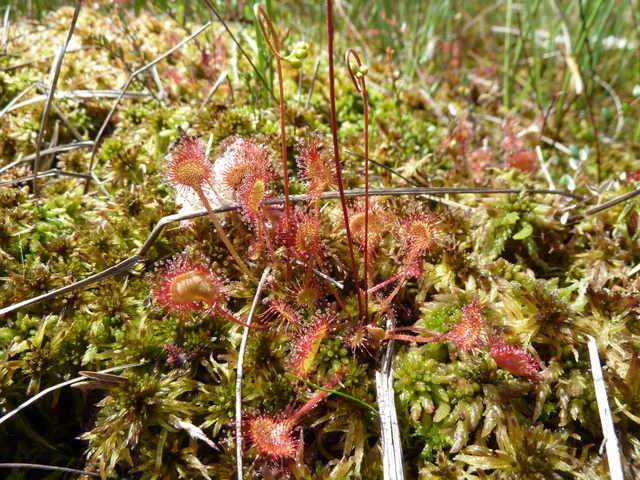

About this photograph
Date given at source: . Source consulted in 2026-11-07. EXIF orientation, proportional resizing and WebP conversion; no retouching or clipping of the file.
Sundew leaves also catch food.
Includes an activity to try →Read here and view sources
Drosera rotundifolia leaves have small glandular hairs with a sticky secretion. When an insect becomes trapped, enzymes help break it down and the plant absorbs nutrients through its leaves. This strategy can be particularly useful in nutrient-poor soils. Visit Cabeceiras mentions the species for Cabreira; the mechanism described by the US Forest Service is general biology, not an observation made in these mountains.
The trap is not the flower. Leaves form a rosette near the base; flowers grow on a stalk and fruits are capsules containing many tiny seeds. The photograph lets us compare leaves and stalks, but does not show digestion. In the USDA description, the leaf can bend around its prey: a sequence over time that one image cannot demonstrate.
Source and context
USDA Forest Service — Robin F. Matthews, Drosera rotundifolia, February review, 1994
Accessed:
Visit Cabeceiras — natural heritage of Serra da Cabreira
Accessed:
Editorial summary; the date of consultation is not the date of the facts.