Discover Cabeceiras de BastoFree independent guide
ViveCabeceirasYOUR GUIDE TO CABECEIRAS
ENEnglish
SearchSaved

Plants

Choose a story to start with. You can change the subject or fine tune the search.

2 stories · Read the landscape through the plants · Search: datas

Read the landscape through the plants

Trees, forests, vineyards and fields reveal different ways of occupying the territory.

Choose a story · 2
Botany · general features

What is hidden inside a chestnut burr?
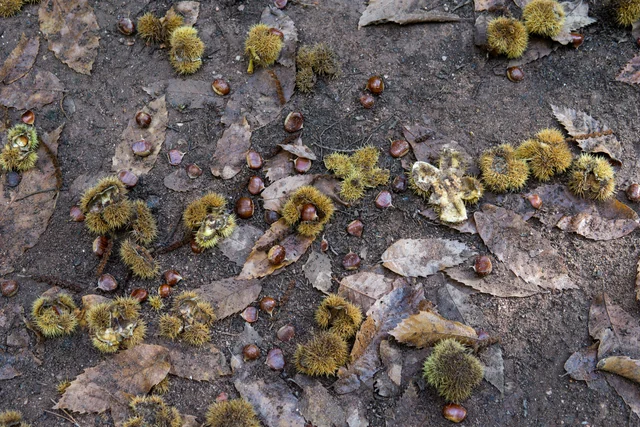
Open chestnut burrs and shiny brown chestnuts among fallen leaves.
Chestnuts and burrs on the ground at Guirbaden, Mollkirch, France, in 2020. Botanical illustration, not an observation from Cabeceiras.
Photography: AudreyMuratet · CC BY-SA 4.0
About this photograph

Date given at source: . Source consulted in 2026-11-07. EXIF orientation, proportional resizing and WebP conversion; no retouching or clipping of the file.

Request removal or correct the photo credit

The chestnut is the fruit; the burr encloses the cluster.

Includes an activity to try →Explore: From hedgehog to seed →
Read here and view sources

Castanea sativa sheds its leaves in the unfavourable season and can grow into a large tree. The Castelo Branco Polytechnic profile describes narrow yellow flowers in long hanging spikes. Later, chestnuts develop together inside a prickly burr: the chestnut is the fruit, while the burr encloses the cluster.

Notice the layers: the shiny brown covering belongs to the fruit; inside there is usually one seed, with a yellowish skin. The tree also had a place in workshops: the source mentions wood used in carpentry, cabinetmaking, basketry and woodturning. These are general characteristics and uses, without attributing a workshop or individual tree to the municipality.

Flowers come before the burr. UTAD’s Digital Flora gives May and June as the species’ flowering period. This is a general botanical reference, not a prediction for a tree in Cabeceiras: compare photographs of the same tree on different dates to learn its rhythm. A tree without chestnuts on a spring visit tells a different story from an open burr in autumn.

Chestnut belongs to the Fagaceae family, the same broad botanical family as oaks. Comparing their fruits shows that kinship does not mean identical appearance: return to the oak story and look for what surrounds the acorn, then revisit the chestnut’s layers.

Words in this story: see explanations →See the plants photographed in the municipality
Source and context

Polytechnic Institute of Castelo Branco — botanical record of Castanea sativa

UTAD Botanical Garden — Castanea sativa, Flora Digital de Portugal

Accessed: . Editorial summary; the date of consultation is not the date of the facts.

General botany · birch

A tree with pale bark

Birch catches the eye before you even look at its leaves.

Includes an activity to try →Explore: Discreet flowers, different strategies →
Read here and view sources

The Betula celtiberica profile describes a deciduous tree with a silvery-white trunk and leaves ranging from oval to triangular, with toothed edges. The species is associated with moist environments, including watercourse banks, and needs plenty of light.

The Gulbenkian Garden presentation places flowering in April and May and describes small winged fruits dispersed by wind. Bark, leaves and reproductive structures offer different clues throughout the year. This information concerns the species; it does not confirm its presence in a parish or guarantee the same dates everywhere.

Male and female flowers occur on the same tree but in different structures. Gulbenkian describes male flowers grouped in greenish-yellow catkins and female structures that are upright at first. A flower does not always have large, showy petals: observing a tree may require attention to discreet structures.

The profile also highlights shallow, horizontally spreading roots and the ability to produce shoots from the stump. The visible trunk is only part of the plant; growing from seed and producing new shoots are distinct processes. These are features from the Betula celtiberica profile, without attributing a particular tree to Cabeceiras.

Words in this story: see explanations →
Source and context

Calouste Gulbenkian Foundation — Celtic betula, trunk and leaves

Accessed: . Editorial summary; the date of consultation is not the date of the facts.

YOUR LOCAL GUIDE

What would you like to discover?

Take a closer look.