Discover Cabeceiras de BastoFree independent guide
ViveCabeceirasYOUR GUIDE TO CABECEIRAS
ENEnglish
SearchSaved

Stories of Cabeceiras

Choose a story to start with. You can change the subject or fine tune the search.

13 stories · All themes · Search: alves

Crafts and memories

Through hands, food and community: small stories of how people lived and what they pass on.

Choose a story · 6
Pedraça · memory of learning linen crafts

A bowl of seeds, a skill passed on

Learning from another person is heritage too.

Includes an activity to try →Explore: Follow the thread to another object →
Read here and view sources

A bowl of seeds can be the start of a craft. In the Terra Inesgotável catalogue, Teresa Soeiro recounts how Fátima Mota of Pedraça learned from weaver Amélia Alves de Moura. After joining a flax harvest, she received linseed from her. She took it to her father, a farmer, who sowed it; harvesting the seeds allowed a larger area to be planted the following year. In this way, she obtained raw material to spin and weave independently.

The story brings three contributions together: the weaver’s teaching, the father’s farming and Fátima Mota’s own practice. Cloth begins long before the loom, through the connection between cultivation and learning.

The same catalogue shows linen grown and woven by Fátima Mota used in experimental footwear. Tradition enters another conversation: how can an old material and skill be used in a new object? The reference documents that experiment; it is not a catalogue of products currently for sale.

Source and context

Museum of the Footwear — Inexhaustible Land, pp. 42–43 (PDF pp. 44–45)

Accessed: . Editorial summary; the date of consultation is not the date of the facts.
Outeiro · footwear uses in the Museum inventory

From the fair to work in the fields

A pair of chancas could follow different moments of life.

Includes an activity to try →Explore: From materials to paths →
Read here and view sources

The pair of women’s chancas MTB 449 was made by José Alves Leite and acquired by the Museu das Terras de Basto. Wood, leather, rubber, tacks and cord make up the piece, which measures 26 centimetres long and 15.5 high.

The record associates this footwear with fairs and Sundays. Once more worn, it moved to farm work: wear could change the occasion of use without ending the object’s life. This is a documented description, not a rule for every family.

The collection also includes men’s chancas MTB 450, likewise made by José Alves Leite and acquired by the Museum. The record again mentions more worn footwear moving to the fields. Comparing the pieces lets us follow documented materials and uses without reducing all clog making to a single model.

Pair MTB 450 measures 28 centimetres long, 16 high and 9.5 wide. For MTB 449, the recorded width is 7.5 centimetres. The differences describe these two museum pieces, not a size chart for all socos or chancas. The inventory number keeps each set of dimensions connected with the right object.

Source and context

Basto Land Museum — In the country of Tamanco, women's Chancas MTB 449

Accessed: . Editorial summary; the date of consultation is not the date of the facts.

Community associations · Outeiro

Outeiro and football

Sport is part of local memory too.

Includes an activity to try →
Read here and view sources

The municipal introduction gives 1980 as the founding year of the Associação Desportiva e Cultural de Outeiro, links it to football and identifies Pinhel. This is a starting point for discovering community associations; the directory does not confirm a current activity programme here.

In the same directory, the São Nicolau association is also listed as founded in 1980, while São Sebastião de Passos appears in 1985. Comparing these entries connects football history with neighbouring communities. The dates refer to each association, not to the first match played in each parish.

Pinhel connects this reading with another Outeiro story: it is also the birthplace of clog maker Manuel Alves Leite. Different activities and periods share the same territory, which can be explored through both crafts and sporting encounters.

Getting to know the parish
Source and context

Municipality — sports associations
Accessed:

Teresa Soeiro — Soqueiros and Tamanqueiros, municipal edition of 2017, chapter The tamanqueiros of Outeiro, p. 68
Accessed:

Editorial summary; the date of consultation is not the date of the facts.

Outeiro · history of clog making

Learning a craft beside a master

In Outeiro, clog making passed from hand to hand.

Includes an activity to try →Explore: Three supports of the work of the tamanceiro →
Read here and view sources

In the study published in 2017, Teresa Soeiro recounts how Manuel Alves Leite, born in Pinhel in 1899, learned from Bernardino José Pereira, a clog maker from Sobreira. The skill passed to his descendants. This story of learning brings clog making close to families and places, without assuming that the workshop remains open.

The Museum’s inventory offers a glimpse of the workspace. It calls the low table used by Manuel António Teixeira Leite an ofício. A bench with a small block supported the finishing of the wooden soles; a wood-and-leather last connects production with Manuel Alves Leite’s generation. The objects show different working supports without reconstructing the layout of a particular workshop.

Dimensions help distinguish the supports: table T15 measures 82 centimetres long, 74 wide and 55 high; bench T14 is 87 long, 28 wide and 50 high. Despite similar lengths, they offer very different surfaces. The inventory links the bench with finishing the wooden soles, supported on a small block.

Words in this story: see explanations →Getting to know the parish
Source and context

Teresa Soeiro — Soqueiros and Tamanqueiros, municipal edition of 2017, chapter The tamanqueiros of Outeiro, p. 68
Accessed:

Land Museum of Basto / Teresa Soeiro — In the country of Tamanco, introduction and inventory T10/T13/T16–T19
Accessed:

Editorial summary; the date of consultation is not the date of the facts.

Outeiro · clog-making materials and tools

Before the clog, a piece of alder

Choosing the wood was part of the work.

Includes an activity to try →
Read here and view sources

In the Museum’s inventory, an alder log from Pinhel is raw material for clog soles. The axe split the wood, the adze shaped it and the chisel prepared the edge where leather was nailed. A last used by Manuel Alves Leite connects the objects with the family history of clog making.

Work continued with other tools: pincers pulled the leather onto the wood and an awl opened holes for nails. Each object preserves a particular gesture. The inventory lets us follow these operations without indicating a workshop currently open to visitors.

Words in this story: see explanations →Getting to know the parish
Source and context

Land Museum of Basto / Teresa Soeiro — In the country of Tamanco, introduction and inventory T10/T13/T16–T19

Accessed: . Editorial summary; the date of consultation is not the date of the facts.

Santa Senhorinha · objects and devotional memory

Devotion in a candle

Small objects help us understand people from other times.

Explore: Objects, words and memory →
Read here and view sources

In Odília Alves Gameiro’s study, offerings mentioned in accounts of Santa Senhorinha include wax, candles, large ceremonial candles and oil lamps. The author interprets their low cost as a sign of devotion accessible to different social groups. Bell ringing and oral transmission also appear in the spread of the narrated miracles. These are elements of the history of devotion, not proof of the supernatural events described.

The study distinguishes an offering accompanying a request from one giving thanks for a received favour. The same object could therefore take part in different moments of devotion. Its interpretation depends on the narrated context, not only on the material from which it was made.

Source and context

Odília Alves Gameiro — The nobiliarchic appropriation of a rural cult: the hagiography of Santa Senhorinha of Basto, Archipelago · History, 2001, pp. 561–562 and 571–572

Accessed: . Editorial summary; the date of consultation is not the date of the facts.

The flavours of Cabeceiras

From the garden to the pot, from the oven to the table.

Choose a story · 2
Sweets · contest of 2019

Beans make it to dessert too

The story of Miguelitos has a date and a named creator.

Read here and view sources

Alice da Conceição de Magalhães Alves’s Miguelitos won the Concurso Doce Cabeceirense, whose result was announced at the Casa do Tempo on 18 May 2019. The municipal report describes a rolled preparation made with yellow beans, flour and Vinho Verde, filled with eggs and honey. The competition was part of the Mosteiro de Emoções programme. In February 2020, the municipality highlighted them again as the dessert for the Fim de Semana Gastronómico, alongside cozido as the main course. The sweet thus moved from the competition to the promotion of local food; the report does not confirm current availability.

Source and context

Municipality — Miguelitos win the Sweet Head Competition, 20/05/2019
Accessed:

Municipality — Gastronomic Weekend announcement, 07/02/2020
Accessed:

Editorial summary; the date of consultation is not the date of the facts.

Bucos · 1758 account

Three grains in one landscape

The pantry in Bucos did not depend on just one grain.

Includes an activity to try →Explore: From grain to mill →
Read here and view sources

The parish priest’s 1758 account lists milho-alvo, milhão and rye, saying they were produced in similar proportions. It also mentions some wine and few chestnuts. This is the agricultural picture he left in writing, not a description of present-day harvests.

And where was the grain processed? In the same account, António Alves Teixeira describes mills on the parish’s two watercourses and farmers taking grain there. The document links the list of crops to milling, although it gives no recipes or breakdown of how each grain was used for food or other purposes. The date, 22 May 1758, marks the moment of the account: the proportions given are the vicar’s assessment, not a weighing of a harvest.

Getting to know the parish
Source and context

Municipality — Parish memories of Bucos (1758)

Accessed: . Editorial summary; the date of consultation is not the date of the facts.

Read the landscape through the plants

Trees, forests, vineyards and fields reveal different ways of occupying the territory.

Choose a story · 1
Painzela · gardens and skills

Plants shaped by human hands

Camellias and yews are part of the story of these gardens.

Includes an activity to try →Explore: The garden also holds knowledge →
Read here and view sources

Camellias and yews trimmed into geometric or animal shapes: this is the art of topiary. The Portuguese Historic Gardens Association links this tradition to the school of Manuel Joaquim Alves Soares, continued by his son Joaquim. Casa de Piellas, in Painzela, is part of this history. It is private property; check the visiting conditions in its place profile.

The Rota do Tâmega presentation links this school of gardening to support from the sisters Emília Ermelinda and Justina Praxedes Pinto Basto. In the mid-19th century, they are said to have supported Manuel Joaquim Alves Soares’s training in Porto and England. The story of these plant shapes therefore also involves the sharing of knowledge and its transmission between generations.

Looking at topiary means looking both at a plant and at human skill. Geometric shapes organise lines and volumes; animal shapes evoke living creatures. The association identifies examples of this tradition at several estates in Basto, not just Piellas.

Words in this story: see explanations →Getting to know the parish See Fact sheet: Casa de Pielas, jardins e anexos
Source and context

Portuguese Association of Historical Gardens — Route Tâmega

Portuguese Association of Historical Gardens — Casa de Piellas, Painzela

Accessed: . Editorial summary; the date of consultation is not the date of the facts.

Travel through time

Documents, details and traditions: there is more to discover than a date on a stone.

Choose a story · 4
Religious tradition · Santa Senhorinha

The story of the frogs that fell silent

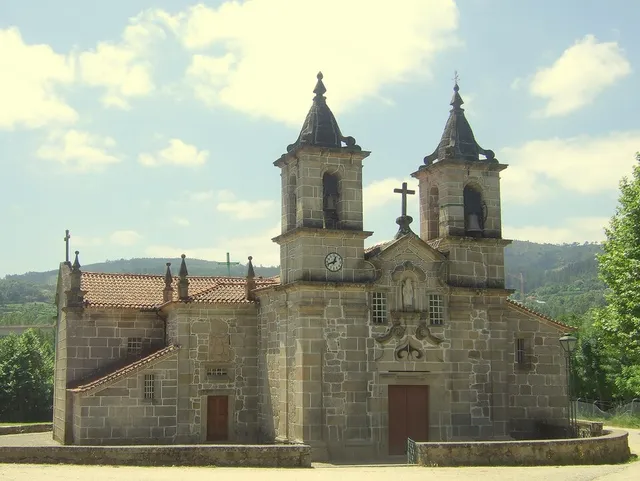
Façade of the Church of Santa Senhorinha de Basto, with its two towers
Igreja de Santa Senhorinha · place of worship, not representation of the episode© Bocacheteⓘ

A small scene passed through centuries of devotion.

Read here and view sources

In the religious narrative studied by Odília Alves Gameiro, croaking frogs disturbed the nuns as they prepared for a religious office. Senhorinha is said to have silenced the noise. The municipality includes this episode among miracles attributed to the saint. It is a story from devotional tradition, told to explore the imagery surrounding her cult, without presenting it as a demonstrated event.

Getting to know the parish
Source and context

Odília Alves Gameiro — The nobiliary appropriation of a rural cult, pp. 563–564

Municipality — Basto (Santa Senhorinha)

Accessed: . Editorial summary; the date of consultation is not the date of the facts.

Bucos · 1758 account

A chapel shortened the distance

In Casares, reaching church was a practical matter.

Includes an activity to try →
Read here and view sources

In the account of 22 May 1758, the chapel of Santa Maria at Casares served to administer the sacraments to residents living far from the parish church. Distance helped explain the distribution of places of worship.

Vicar António Alves Teixeira also mentions Santa Ana at Carrazedo, administered by Manuel Gomes Martins. These are references in the document, without confirmation of current access or condition.

The parish church stood in Bucos, which the vicar presented as the parish’s most populous settlement. He also named Vila Boa, Carrazedo and Casares. This group of places helps explain why a single church did not meet every resident’s needs in the same way.

The document also distinguishes who administered each chapel: at Casares, the commander; at Carrazedo, priest Manuel Gomes Martins. Place, dedication and administration are three different clues. Administering sacraments because of distance is explicitly stated for Casares; that function should not automatically be attributed to every chapel mentioned.

Getting to know the parish
Source and context

Municipality — Parish memories of Bucos (1758)

Accessed: . Editorial summary; the date of consultation is not the date of the facts.

Santa Senhorinha · transmission of religious accounts

A story that reached us in copies

Texts have their own journey through time.

Explore: Three ways to get to know Saint Lady →
Read here and view sources

Odília Alves Gameiro studies three texts on the life and miracles of Saint Senhorinha, preserved in 16th-century copies: two in Latin and one in Portuguese. Their similarities suggest a medieval original, according to the researcher. Reading these versions allows the construction of memory and devotion to be studied. The date of a copy is not necessarily the date of the story it tells.

The two Latin accounts studied come from Coimbra: one from the Colégio da Graça and the other from Santa Cruz. This provenance shows that the memory of a saint connected with Basto travelled beyond the place of worship. Each copy is also an object with a history of preservation and transmission.

Three periods must be distinguished: the life being narrated, the composition of the account and the surviving copy. The research places Senhorinha in the second half of the 10th century, but does not turn the 16th-century texts into accounts written by people who knew her. Similarities and differences between versions are themselves part of the historian’s work.

The study also reads the accounts in the context of a rural community: harvests, food and journeys appear among the concerns represented. Beyond recounting wonders, hagiography offers insight into that imagination and the values the text seeks to convey.

Words in this story: see explanations →
Source and context

Odília Alves Gameiro — The nobiliarchic appropriation of a rural cult: the hagiography of Santa Senhorinha of Basto, Archipelago · History, 2001, pp. 561–562 and 571–572

Accessed: . Editorial summary; the date of consultation is not the date of the facts.

Santa Senhorinha · a historical reading of hagiography

Bread tells a story of devotion too

In Saint Senhorinha’s accounts, food reveals rural concerns.

Includes an activity to try →
Read here and view sources

Odília Alves Gameiro identifies wheat fields and vineyards in the narratives, fears of losing harvests in a storm, and episodes of insufficient food for the community. She relates the reference to white bread to the nuns’ social position.

Reading these passages reveals themes and values in religious texts: sustenance, dependence on natural cycles and social differences. It does not amount to proving the miracles described or reconstructing a menu. To compare with another kind of source, follow the crops described by the abbot in 1758.

Source and context

Odília Alves Gameiro — The nobiliary appropriation of a rural cult, 2001, pp. 562–563

Accessed: . Editorial summary; the date of consultation is not the date of the facts.

YOUR LOCAL GUIDE

What would you like to discover?

Take a closer look.