Discover Cabeceiras de BastoFree independent guide
ViveCabeceirasYOUR GUIDE TO CABECEIRAS
ENEnglish
SearchSaved

Plants

Choose a story to start with. You can change the subject or fine tune the search.

4 stories · Read the landscape through the plants · Search: serras

Read the landscape through the plants

Trees, forests, vineyards and fields reveal different ways of occupying the territory.

Choose a story · 4
Serra da Cabreira · flora and habitat

A carnivorous plant in the mountains

Sundew is one of Cabreira’s small surprises.

Includes an activity to try →Explore: Moisture connects these stories →
Read here and view sources

Visit Cabeceiras includes Drosera rotundifolia in the mountain flora. Flora-On describes its habitat as waterlogged meadows, marshes and peat bogs with Sphagnum mosses, generally in mountain areas. The reference concerns Cabreira as a whole; it does not identify an observation point in this guide.

A review by the US Forest Service helps explain this connection with water: it describes continuously moist conditions and soils that are often acidic and poor in nutrients. The plant tolerates prolonged dry spells poorly. This explanation concerns the species in general, rather than measurements of soil or water in Cabreira.

Source and context

Visit Cabeceiras — natural heritage of Serra da Cabreira
Accessed:

Portuguese Botany Society — Flora-On, Drosera rotundifolia
Accessed:

USDA Forest Service — Robin F. Matthews, Drosera rotundifolia, February review, 1994
Accessed:

Editorial summary; the date of consultation is not the date of the facts.
Cork oak · general ecology and local context

Cork oaks do not grow all the way up the mountain

Altitude also changes the conditions a tree faces.

Read here and view sources

The University of Évora describes cork oak as sensitive to winter minimum temperatures and generally absent above roughly one thousand metres. The municipal reference places cork oaks on the hillsides of Cabeceiras. Together these descriptions help explain why we should not imagine identical vegetation from valley to summit. The approximate limit is a general characteristic, not a survey of each local slope.

Cold is only part of the picture. The profile describes a preference for light- to medium-textured soils with an acidic or neutral reaction, avoiding limestone soils; it also mentions cool, sheltered places. Altitude on a map is therefore not enough to predict where a cork oak grows.

Its firm, evergreen leaves and cork-covered trunk help us observe the tree closely. Try changing scale in the landscape: first notice the tree, then the hillside’s position and shelter around it. The species name tells part of the story; the environment tells another.

Source and context

University of Évora — Quercus suber, botanical description

Municipality — landscape and vegetation

Accessed: . Editorial summary; the date of consultation is not the date of the facts.

Alvite · written account from 1758

Orada changed from summit to valley

The same mountain could reveal different landscapes.

Includes an activity to try →Explore: What changed between the high and the valley? →
Read here and view sources

In the account of 1758, Orada has a stony summit with few trees, described as harsh and cold. On its lower slopes, the scene changes: chestnuts, oaks, vines trained up trees, olive oil and cereals enter the description.

The vicar places residents in the lower areas near the valley, not on the mountain top. Altitude, settlement and cultivation help us read the whole picture. This is the written portrait of that year, not a survey of today’s vegetation.

Source and context

Municipality — Memory of Alvite, 23/05/1758; transcription of José Viriato Chapel (2003)

Accessed: . Editorial summary; the date of consultation is not the date of the facts.

Serra da Cabreira · regional reference and general botany

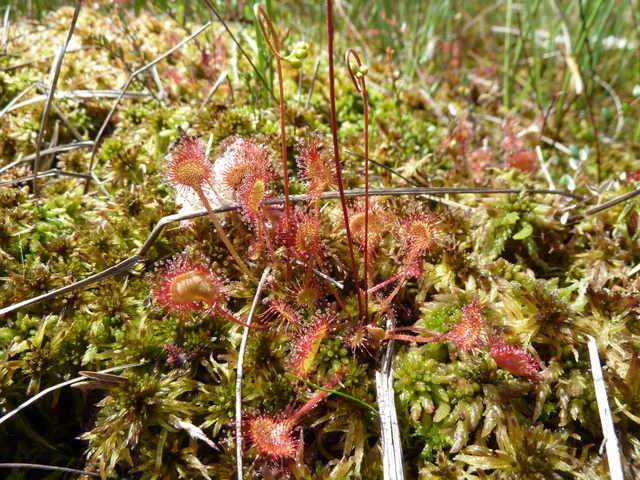
It looks like dew, but it is a trap

Rounded sundew leaves with reddish hairs and shining droplets among mosses.
Sundew in the Swamp natural monument near Máchovo jezero, Czechia, in 2013. Species illustration, not an observation from Cabreira.
Photography: Stanislav Rada · CC BY-SA 3.0
About this photograph

Date given at source: . Source consulted in 2026-11-07. EXIF orientation, proportional resizing and WebP conversion; no retouching or clipping of the file.

Request removal or correct the photo credit

Sundew leaves also catch food.

Includes an activity to try →
Read here and view sources

Drosera rotundifolia leaves have small glandular hairs with a sticky secretion. When an insect becomes trapped, enzymes help break it down and the plant absorbs nutrients through its leaves. This strategy can be particularly useful in nutrient-poor soils. Visit Cabeceiras mentions the species for Cabreira; the mechanism described by the US Forest Service is general biology, not an observation made in these mountains.

The trap is not the flower. Leaves form a rosette near the base; flowers grow on a stalk and fruits are capsules containing many tiny seeds. The photograph lets us compare leaves and stalks, but does not show digestion. In the USDA description, the leaf can bend around its prey: a sequence over time that one image cannot demonstrate.

Words in this story: see explanations →
Source and context

USDA Forest Service — Robin F. Matthews, Drosera rotundifolia, February review, 1994
Accessed:

Visit Cabeceiras — natural heritage of Serra da Cabreira
Accessed:

Editorial summary; the date of consultation is not the date of the facts.

YOUR LOCAL GUIDE

What would you like to discover?

Take a closer look.