Discover Cabeceiras de BastoFree independent guide
ViveCabeceirasYOUR GUIDE TO CABECEIRAS
ENEnglish
SearchSaved

Stories of Cabeceiras

Choose a story to start with. You can change the subject or fine tune the search.

16 leituras · Todos os temas · Pesquisa: mamíferos

The life you don't always see

Knowing animals begins by perceiving the territory and respecting the distance.

Escolher uma história · 16
The occurrence referred to in the environmental document

Iberian wolf

A documented presence in the landscape of the municipality.

Inclui uma atividade para experimentar →Explorar: Conhecer o lobo através da paisagem →
Read here and consult sources

The environmental assessment of the PDM marks a pack in the territory, based on information from the ICNF. It is a reference to the ecological importance of Cabeceiras, not a promise of sighting. Knowing this presence does not require looking for animals or disseminating shelter sites. The national platform relates the scarcity of wild prey to livestock consumption and conflict with pastoral communities. It points to the protection of herds and the recovery of natural prey as complementary parts of conservation.

A pack is also a changing family. The platform describes a breeding couple, descendants of different years and sometimes other related adults. The group defends a territory, but its composition changes with births, growth and dispersion.

In the general cycle presented to Portugal, the cubs are born at the end of April or in May. During the summer, the meeting places become centers of family activity; in the autumn, the young begin to accompany the adults in travel and hunting. It is not an observation calendar for a concrete pack.

When growing up, some youths leave the group of origin to search for territory, partner or other pack. Others remain longer when there is enough food. Therefore, a count at one time does not describe an immutable family: social life accompanies the annual cycle and landscape opportunities.

Source and context

PDM — Environmental Assessment, p. 50
Accessed:

Lobo-Iberico platform in Portugal — wolf prey; registration of Cabreira without date indicated
Accessed:

Lobo-Iberico Platform in Portugal — Life in pack
Accessed:

Editorial summary; the date of consultation is not the date of the facts.
Mammals · local habits and reference

The boar comes out when the light goes down

A long snout and a very varied diet.

Inclui uma atividade para experimentar →
Read here and consult sources

The wild boar, Sus scrofa, is omnivorous and has mainly crepuscular and nocturnal habits. During the day it can shelter in dense woods. The Lobo-Iberic Platform documents a wild boar predatored by wolves in Serra da Cabreira, in Cabeceiras, without indicating the date of that record. The elongated snout and abundant fur distinguish it from the domestic pig. Although omnivorous, the source describes a mainly vegetable feed. The food flexibility helps to understand its adaptation to different landscapes.

The platform presents it as a pig-bravo and refers to marked differences between the sexes. It also describes the expansion of the species in Portugal, including areas close to urban centers. This national framework does not allow to calculate how many boars live in Cabeceiras.

The Cabreira register and the description of habits answer different questions: one document a meeting between predator and prey; the other helps to understand the life of the species. We do not know, from this isolated reference, the frequency of predation or the size of local populations.

Source and context

Lobo-Iberico platform in Portugal — wolf prey; registration of Cabreira without date indicated

Accessed: . Editorial summary; the date of consultation is not the date of the facts.
Biology of the species · Portuguese context

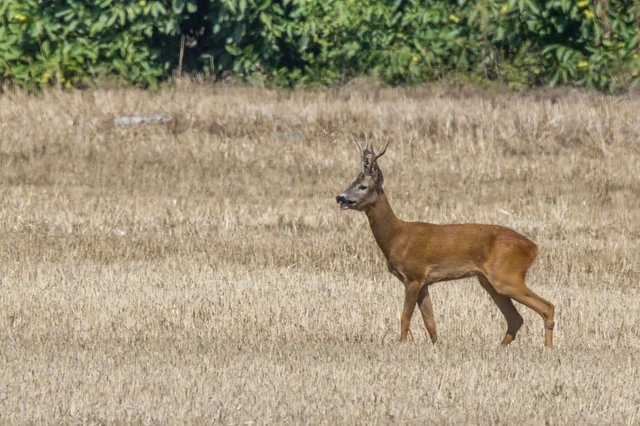
The hind changes its coat

Profile hind in a field, with stems, raised ears and reddish brown coat.
Male hind in Dobruja, Romania, in August 2022. Illustration of the species; it is not a record of Cabeceiras.
Photography: Charles J. Sharp · CC BY-SA 4.0
About this photograph

Date given at source: . Source consulted in 2026-11-07. EXIF orientation, proportional resizing and WebP conversion of the current version in Commons; no retouching or additional clipping.

Request withdrawal or correct authorship

A summer coat, a winter coat.

Inclui uma atividade para experimentar →Explorar: O mesmo mundo, ritmos diferentes →
Read here and consult sources

In the hind, Capreolus capreolus, the fur is reddish brown in summer to gray in winter. It feeds on plants and also occupies open areas and shrubs. This description of the species does not identify a spot of sighting in the municipality. The hind is a small cervid: the description of the platform points to 30 kg. The males have stems; the white spot on the back has a kidney shape in males and hearts in females.

The stems also follow a cycle: the platform refers to the growth and annual fall in the hind and deer. Therefore, they are not a structure that always remains the same. In the head, the nose and the upper lip mostly black contrast with the lower lip white.

The hours of activity add another difference. Although it is mainly crepuscular and nocturnal, the source presents the hind as the Portuguese cervid with the highest daytime activity. They are trends of the species, not a guaranteed hour to observe it. To know an animal, form, season and behavior need to be read together.

Palavras desta história: ver explicações →
Source and context

Lobo-Iberico platform in Portugal — wolf prey; registration of Cabreira without date indicated

Accessed: . Editorial summary; the date of consultation is not the date of the facts.
Serra da Cabreira · regional reference and biology of the species

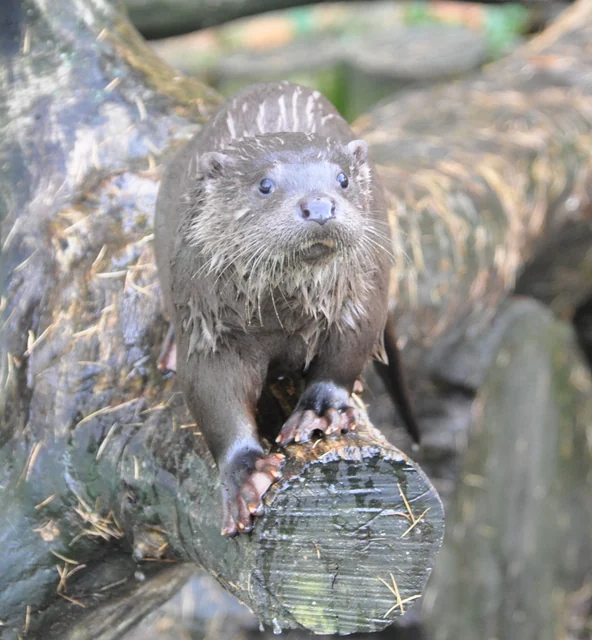
The otter wears the scuba suit

Otter front view over wood, with snout, mustaches and visible paws.
European otter at the Lüneburg Heath fauna park, Germany, in 2009. Animal in fauna park; it is not a record of Cabeceiras.
Photography: Quartl · CC BY-SA 3.0
About this photograph

Date given at source: . Source consulted in 2026-11-07. EXIF orientation, proportional resizing and WebP conversion of the current version in Commons; no retouching or additional clipping.

Request withdrawal or correct authorship

By the waterproof and paws that help you swim.

Inclui uma atividade para experimentar →Explorar: O corpo e o ambiente →
Read here and consult sources

The European otter, Lutra lutra, has membranes between its fingers and a thick coat that protects it in the water. Its life connects the river to its banks: vegetation offers shelter and roots can hide burrows. It is mainly active at dusk and at night.

The municipal portal of Vieira do Minho includes the otter among the mammals of the Cabreira. This regional reference allows to know the species, but does not indicate a spot of sighting.

The description of the University of Évora also refers to the long tail, tapered at the tip, and the snout with long mustaches. The otter does not depend only on rivers: the species also uses albufeiras, estuaries and, less often, the sea coast. These characteristics help to know the animal without converting the reading into a spot.

Source and context

University of Évora — Virtual Museum of Biodiversity, Lutra lutra; David Germano
Consultations: ,

Vieira Tourism of Minho — fauna of Serra da Cabreira, regional reference
Accessed:

Editorial summary; the date of consultation is not the date of the facts.
Serra da Cabreira · regional reference and biology of the species

A mole connected to the current

Cold water also has its inhabitants.

Explorar: O rio também é uma despensa →
Read here and consult sources

The water mole, Galemys pyrenaicus, is associated with cold, clear and well-oxygenated waters, often in rapid mountain rivers. The University of Évora also refers to the use of slower waters, such as canals and lakes: preference is not exclusive. Its natural distribution is limited to the Iberian Peninsula and the Pyrenees. In conservation, there are vegetation margins, shelters and habitat continuity; the chart identifies silting and isolation between threats. The municipal description of the fauna of Cabreira mentions the species, but this reading does not have a geolocalized register in the municipality.

The prolonged snout in a small trunk helps to search for larvae of invertebrates underwater, according to the description of the Generalitat of Catalonia. The technical file housed by ICNF highlights the invertebrates from the bottom of the river as a food base, including groups of tricopters, plecopters, ephemeropters and dipteres. The small animals that look like details of the river are part of the feeding of a mammal.

The profile of the ICNF presents a caveat for Portugal: it considers unfavourable the habitats of standing water, such as albufeiras and small lagoons of altitude. We should not turn the general reference to slow waters into an invitation to search for the species in any lake. Adequate habitat also involves food, shelters on the banks and connection to other sections of the river.

Palavras desta história: ver explicações →
Source and context

University of Évora — Virtual Museum of Biodiversity, Galemys pyrenaicus

Vieira Tourism of Minho — fauna of Serra da Cabreira, regional reference

ICNF — Galemys pyrenaicus, ecology and nutrition (historical references)

Generalitat de Catalunya — Iberian Desmán, description of snout and feeding

Accessed: . Editorial summary; the date of consultation is not the date of the facts.
Serra da Cabreira · regional reference and biology of the species

The wildcat needs a varied landscape

Woods to shelter, open spaces to hunt.

Read here and consult sources

The wild cat, Felis silvestris, is associated with forests and woods, often close to rocky areas and water lines. It can seek food in undisturbed meadows. The thick tail, with dark rings and rounded tip, is one of its traits described by the University of Évora. The similarity with domestic cats calls for care in identification.

The municipal source refers to the Cabreira, without locating a population in a parish.

The description of the University of Évora adds retractable claws and especially twilight and nighttime activity: the twilight corresponds to the transition between day and night. The source points to the fragmentation of habitats and hybridization with domestic cats between threats. The outer aspect, by itself, does not solve all identification doubts.

Source and context

University of Évora — Virtual Museum of Biodiversity, Felis silvestris; David Germano
Consultations: ,

Vieira Tourism of Minho — fauna of Serra da Cabreira, regional reference
Accessed:

Editorial summary; the date of consultation is not the date of the facts.

Badger · general biology

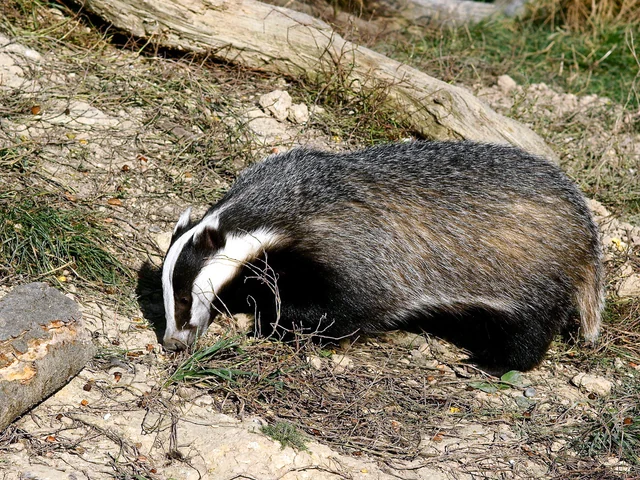
A house under the ground

Badger with gray body and head with light and dark bands, next to the ground.
Badger at the British Wildlife Centre in Newchapel, Surrey, UK, in 2011. Animal in fauna park; not a record of Cabeceiras.
Photography: Peter Trimming · CC BY 2.0
About this photograph

Date given at source: . Source consulted in 2026-11-07. EXIF orientation, proportional resizing and WebP conversion of the current version in Commons; no retouching or additional clipping.

Request withdrawal or correct authorship

Badger spends most of his life out of our sight.

Inclui uma atividade para experimentar →Explorar: Pelo, espinhos e vida na água →
Read here and consult sources

The badger (Meles meles) has mainly nocturnal activity and shelters in extensive underground burrows. The two dark bands on the white head are a striking visual clue; the short legs have strong claws. The Virtual Museum of Biodiversity describes its presence in forests, forests and agricultural landscapes with vegetation. This chart explains the species in mainland Portugal; it does not document an observation in Cabeceiras de Basto. The claws are long and not retractable: they do not collect like those of the cats. The tail is short and clear, another contrast with the fox's long tail. These details help compare descriptions without searching or disturbing burrows.

Source and context

University of Évora — Virtual Museum of Biodiversity: Meles meles

Accessed: . Editorial summary; the date of consultation is not the date of the facts.

Hedgehog · General biology

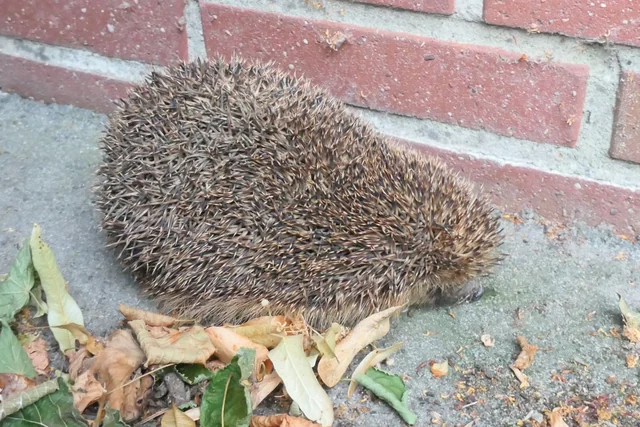
Winter is not a sleep after

Hedgehog next to a brick wall, with visible thorns and little head exposed.
Goldfish in Kalkar, Germany, in 2025. Illustration of the species; it is not a record of Cabeceiras.
Photography: Pieter Delicaat · CC BY-SA 4.0
About this photograph

Date given at source: . Source consulted in 2026-11-07. EXIF orientation, proportional resizing and WebP conversion of the current version in Commons; no retouching or additional clipping.

Request withdrawal or correct authorship

The hedgehog can return to activity when the temperature rises.

Inclui uma atividade para experimentar →
Read here and consult sources

According to FCT NOVA, the hibernation of the hedgehog (Erinaceus europaeus) can be interrupted for warmer periods. This nocturnal and solitary mammal eats, among other foods, insects, worms, snails and fruit. Faced with a threat, he curls up and exposes the thorns. Woods, hedges, meadows and gardens are part of their habitats. This is general biology: the source does not confirm a register in the municipality. The short legs have five fingers and there is a small tail under the thorns. FCT NOVA also mentions the ability to climb and move in the water. These are general characteristics of the species, not proposed to test the capabilities of an animal found.

Source and context

FCT NOVA — FCT VIVA: Erinaceus europaeus

Accessed: . Editorial summary; the date of consultation is not the date of the facts.

Fox · general biology

Between the woods and the countryside

For the fox, a varied landscape offers different environments.

Read here and consult sources

The red fox (Vulpes vulpes) occupies many habitats, from coast to mountain. The Virtual Museum of Biodiversity highlights the preference for shrubs and woods interspersed with agricultural fields or pastures. The long, hairy tail and pointed snout help recognize its profile.

The distribution described covers mainland Portugal, but does not replace a register located at Cabeceiras de Basto.

The coat can combine brown, red and grey tones; the tail tip can present a whitish spot. The description also mentions that the cubs are brown until approximately six months. Thus, color and age must enter the animal's reading rather than always expect the same appearance.

Source and context

University of Évora — Virtual Museum of Biodiversity: Vulpes vulpes

Accessed: . Editorial summary; the date of consultation is not the date of the facts.

Cabeceiras and Serra da Cabreira · documented distribution of the breed

Little horse, mountain pass

Garrano is part of the Northwest's living heritage.

Read here and consult sources

The DGAV catalogue includes Cabeceiras de Basto in the Garrana breed breeding area and refers to its presence in Serra da Cabreira. It describes brown horses, sometimes dark, with an adult height of less than 1,35 meters to the garrote. Its movements adapt to the mountain paths. Even when created in freedom, Garrano is a domestic horse. The documented distribution links the breed to the territory, without guaranteeing meetings on a rail or identifying a concrete herd.

The race pattern describes a compact body, short and strong limbs, black manes and tail. Fitness is not limited to saddle: it includes cargo transportation, traction and agricultural work. Horses are part of a landscape also worked by people, where walking mode is of practical importance.

The catalogue distinguishes locked step and walking. In the first describes four beats; in the walk, members on the same side raise and land together, producing two beats per past. They are descriptions of movements, not two names for the same movement. Reading this detail helps to understand why the heritage of a race includes more than appearance.

Palavras desta história: ver explicações →
Source and context

DGAV — Garrana, distribution and pattern of race, p.2

Accessed: . Editorial summary; the date of consultation is not the date of the facts.

Cabeceiras de Basto · occurrence referred to in environmental study

A bat also entered the territory documents

An environmental reference adds nightlife to the portrait of Cabeceiras.

Explorar: Do registo às perguntas sobre a espécie →
Read here and consult sources

The environmental report of the Ribeira de Pena–Vieira do Minho line, filed by the Portuguese Environment Agency, refers to a register of large-tailed bat, Rhinolophus ferrumequinum, in a shelter associated with Cabeceiras de Basto. It is a documentary reference to the occurrence of the species, not a current population count. The information does not allow to assign here a parish or announce a place of observation.

Source and context

Matos, Fonseca & Associados / REN — EIA da Linha Dupla Ribeira de Pena–Vieira do Minho 1/2, relatório síntese, p.169; arquivo APA

Accessed: . Editorial summary; the date of consultation is not the date of the facts.

Bats · general biology without local observation point

Listen to the echo to find the way

The night can be explored through sound.

Inclui uma atividade para experimentar →Explorar: O caminho do som do morcego →
Read here and consult sources

In echolocation, bats emit sound pulses and receive echoes that return from objects. This helps them to understand what is ahead and to accompany moving prey. Ricardo Rocha’s explanation for Gulbenkian also recalls that they are not blind: the vision participates in their lives. Researchers use devices to capture sounds that we often cannot hear. It is a general explanation, without identifying species by the observed flight.

An ultrasound detector makes sounds accessible that the human ear does not capture. Bats.pt presents it as an observation tool: listening with equipment adds clues, but this reading does not teach to identify a species from an isolated sound.

Source and context

Calouste Gulbenkian Foundation / Wilder — How do bats hunt at night?, 25/09/2019, with Ricardo Rocha

Bats.pt — As noted, general observation guidelines

Accessed: . Editorial summary; the date of consultation is not the date of the facts.

Bats · general ecological functions

Small hunters with a role in the landscape

Eating insects also connects bats to fields and forests.

Inclui uma atividade para experimentar →Explorar: Comer, orientar-se e repousar →
Read here and consult sources

Insectivorous bats connect night to fields and forests. By feeding, they help control insect populations, including species that can affect agriculture and trees. The text of ICNF invites you to know this ecological function beyond the myths associated with bats.

Worldwide, there are other diets and other relationships: bats that consume fruit can contribute to the regeneration of forests; those that feed on pollen participate in pollination. These global examples do not attribute these diets to species registered in Cabeceiras.

Thinking about food is a way of relating the animal to the landscape. What resources do you look for? What other organisms enter this relationship? The ecological role is not limited to the number of individuals we can see. For local history, this explanation follows the reading of the documental register of ferred bat; it does not add a new observation.

Palavras desta história: ver explicações →
Source and context

ICNF — There are bats in the air..., text by Cristina Girão Vieira

Accessed: . Editorial summary; the date of consultation is not the date of the facts.

Serra da Cabreira · biology of the species

A bird of prey that nests on the ground

The hunting tartaranion is also called the hunting eagle.

Read here and consult sources

Visit Cabeceiras includes the tartaranhão-hunter in the fauna of Cabreira. SPEA describes Circus pygargus as a summer bird, which returns to Portugal in the spring to nest. It prefers open spaces, mainly insects hunting and nests in the soil, among high vegetation. The reference covers the mountains; it does not identify nests or sighting points in the municipality.

The annual cycle connects continents. The LIFE SOS Pygargus project describes the winter in Africa and the return to the Iberian Peninsula in the spring, for reproduction, with permanence in breeding territories until September. This general calendar does not mark exact dates of arrival and departure to the Cabreira.

The long and narrow wings and tail are part of the portrait presented by LPN. Its mini-guide includes low mountain woods between habitats and refers to nests in high fields or landings. The menu is also broader than insects: it can include birds, small mammals and lizards. A prey of open spaces thus depends on both prey and vegetation suitable for nesting on the ground.

Palavras desta história: ver explicações →
Source and context

Visit Cabeceiras — natural heritage of Serra da Cabreira
Accessed:

SPEA — Hunting Eagle / Circus pygargus
Accessed:

LPN — Bird guide, Imperial LIFE project: hunting turtle
Accessed:

Palombar / LIFE SOS Pygargus — Identification: migration and breeding period (text consulted in search result)
Accessed:

Editorial summary; the date of consultation is not the date of the facts.

Reptiles · general biology, no local occurrence confirmed in this form

A snake can have more than one drawing

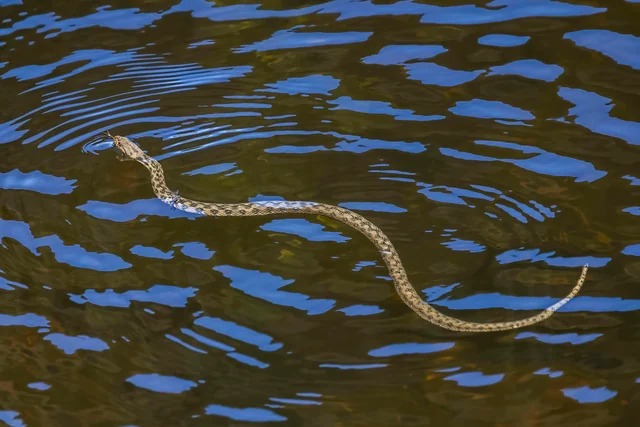
Snake with the body wavy to the surface of the water, between blue reflexes and small ripples.
Viperine water snake swimming in Extremadura, Spain, in 2022. Illustration of the species; not a record of Cabeceiras.
Photography: Charles J. Sharp · CC BY-SA 4.0
About this photograph

Date given at source: . Source consulted in 2026-11-07. EXIF orientation, proportional resize and WebP conversion; no retouching or new clipping of file obtained in Commons.

Request withdrawal or correct authorship

In viperine water snake, the back pattern is not always the same.

Inclui uma atividade para experimentar →Explorar: O mesmo ambiente, modos de vida diferentes →
Read here and consult sources

Natrix maura may present a zigzag stripe, but also a pattern of two clear longitudinal lines. The Spanish biodiversity inventory still describes variation in body tones. A single design does not summarize all individuals of the species.

The chart of the Northern Coastal Natural Park explains the connection to rivers, ponds, streams and other aquatic environments, without excluding displacements on land. It is a general context about the species: it is not an observation in Cabeceiras. Reading compares variation and habitat; it is not a key to identifying snakes found in the field.

The Charcos com Vida project describes a feed mainly in water: invertebrates, larvae and adults of amphibians and small fish enter the menu. The aquatic environment is, thus, a feeding space, besides displacement. The same snake can be preyed on birds and mammals; taking the place of predator does not remove it from the food network.

It is usually daytime, but in summer it can maintain activity at dusk or during the night. Behavior also changes before a threat: the record refers to the expansion of the head and other defensive signs that contribute to the similarity with a viper and to the common name. This explanation of the name does not allow to decide the species or safety of a meeting by the shape of the head.

Palavras desta história: ver explicações →
Source and context

Inventory Español del Patrimonio Natural y la Biodiversidad — Natrix maura, description of the species

Co-management of the Northern Coastal Natural Park — Reptiles and amphibians, record of the viperine water snake

Lived Chargings — Viperine Water Cobra, Feeding and Behaviour

Accessed: . Editorial summary; the date of consultation is not the date of the facts.

Refojos de Basto · local register and general biology

A rapture with a varied menu

The common-buthium seeks food in the landscape sky and also on the ground.

Inclui uma atividade para experimentar →Explorar: Do poiso à paisagem →
Read here and consult sources

The photograph of ecovore shows Buteo buteo landed among branches, in a record of 1 July 2025. The published point, crossed with CAOP2025, is located in the parish of Refojos de Basto. The image allows to observe the inn bird; it does not show a hunt.

Also called eagle-d’asa-round, this prey may show marked differences in the amount of white and brown plumage. The University of Évora describes a species resident in mainland Portugal, with reinforcement of winter birds from northern Europe. Color alone does not solve all identifications.

The BTO describes a feed that takes advantage of available prey: rabbits and small mammals, but also birds, amphibians, large insects and earthworms. The search for food can take you to the ground. Compared with the hunting tartaranion helps you realize that two prey can share some food without having the same way of life.

Source and context

University of Évora — Buteo buteo: plumage and distribution

British Trust for Ornithology — BirdFacts: Buzzard

Accessed: . Editorial summary; the date of consultation is not the date of the facts.

YOUR LOCAL GUIDE

What would you like to discover?

Take a closer look.