Discover Cabeceiras de BastoFree independent guide
ViveCabeceirasYOUR GUIDE TO CABECEIRAS
ENEnglish
SearchSaved

Animals

Choose a story to start with. You can change the subject or fine tune the search.

12 stories · Life you do not always see · Search: linha

Life you do not always see

Knowing animals begins by perceiving the territory and respecting the distance.

Choose a story · 12
Gondiães · record from 1994 and general species biology

An ocellated lizard was recorded in Gondiães

A line in a table preserves an observation from 1994.

Includes an activity to try →
Read here and view sources

A scientific article published in 1996 records Lacerta lepida in Gondiães, Cabeceiras de Basto, on 16 April 1994. The University of Évora lists that former name among the synonyms of Timon lepidus, the ocellated lizard. It describes the species as the Iberian Peninsula’s largest lizard, with dark-edged blue spots on its flanks. The record documents a past occurrence; it does not confirm a current presence or identify an observation point.

Source and context

J. Teixeira et al. — Nuevos datos sobre la distribución de la herpetofauna en Portugal, Boletín AHE 7 (1996), p. 11; PDF sheet 13
Accessed:

University of Évora — Virtual Museum of Biodiversity, Timon lepidus; MVBIO / Darío Estradiz López
Accessed:

Editorial summary; the date of consultation is not the date of the facts.
Mammals · behaviour and local reference

Wild boar come out as the light fades

A long snout and a very varied diet.

Includes an activity to try →
Read here and view sources

The wild boar, Sus scrofa, is omnivorous and is mainly active at dusk and at night. During the day it may shelter in dense scrub. Plataforma Lobo-ibérico documents a wild boar killed by wolves in Serra da Cabreira, in Cabeceiras, without giving the record’s date. Its long snout and thick coat distinguish it from the domestic pig. Despite being omnivorous, the source describes a mainly plant-based diet. This flexibility helps explain its adaptation to different landscapes.

The platform also uses the Portuguese name porco-bravo and describes marked differences between the sexes. It discusses the species’ expansion in Portugal, including areas near urban centres. That national context cannot tell us how many wild boar live in Cabeceiras.

The Cabreira record and the description of habits answer different questions: one documents an encounter between predator and prey; the other helps explain the species’ life. This single reference cannot establish how often predation occurs or the size of local populations.

Source and context

Lobo-Iberico platform in Portugal — wolf prey; registration of Cabreira without date indicated

Accessed: . Editorial summary; the date of consultation is not the date of the facts.

Species biology · photograph recorded in the municipality

A grasshopper makes it through winter

The name Egyptian grasshopper does not confine the species to one country.

Includes an activity to try →
Read here and view sources

The name Egyptian grasshopper does not confine Anacridium aegyptium to one country. The Gulbenkian profile describes its distribution across parts of Europe, North Africa and the Middle East, and its presence in mainland Portugal in orchards, gardens, scrub and open woodland.

At the Gulbenkian Garden in Lisbon, adults are described as surviving the winter and basking on trees and shrubs on bright days. This observation helps explain the species, but cannot automatically be transferred to Cabeceiras. The local photographic record was made in September: it shows an encounter on that date, not winter behaviour in the municipality.

The Lisbon garden’s description mentions observation sites including rosemary hedges, strawberry trees, olive trees and other evergreen trees. Vegetation enters the story as part of the habitat adults use. These references do not tell you where to look for the grasshopper in Cabeceiras; they help explain why a profile can bring together an insect, a season and plants. When comparing the September photograph with the winter account, always record date and place separately.

Source and context

Calouste Gulbenkian Foundation — Anacridium aegyptium

Accessed: . Editorial summary; the date of consultation is not the date of the facts.

Species biology · photograph recorded in the municipality

Wing patterns tell a story of plants

A closer look at wings leads to the small world of grasses and herbs.

Includes an activity to try →Explore: Wings, plants and observation →
Read here and view sources

A photograph of Cymbalophora pudica offers a close look at its wing pattern. The Naturdata profile gives a wingspan of 35 to 43 millimetres: the distance between the tips of the open wings, not body length. This measurement comes from the species profile; it was not calculated from the local photograph.

The same source associates the species with the plant genera Taraxacum and Plantago, gives a flight period from August to October, and describes a distribution across the Iberian Peninsula, the Balearic Islands and North Africa. These details place the individual in a wider context.

The municipality’s photographic record, made in October, shows a particular encounter. It does not demonstrate the individual’s relationship with those plants or measure abundance or flight season in Cabeceiras. The image and profile answer different questions: one documents an encounter; the other brings together general species characteristics.

Words in this story: see explanations →
Source and context

Naturdata — Cymbalophora pudica

Accessed: . Editorial summary; the date of consultation is not the date of the facts.

Serra da Cabreira · regional reference and species biology

A desman’s life in the current

Cold water has its own inhabitants too.

Explore: The river is also a pantry →
Read here and view sources

The Pyrenean desman, Galemys pyrenaicus, is associated with cold, clear, well-oxygenated water, often in fast-flowing mountain rivers. The University of Évora also mentions the use of slower water, such as canals and lakes: a preference is not exclusivity. Its natural range is limited to the Iberian Peninsula and the Pyrenees. Conservation involves vegetated banks, shelters and connected habitats; the profile identifies silting and isolation among the threats. The municipal description of Cabreira’s fauna mentions the species, but this story has no geolocated record in the municipality.

Its elongated snout, shaped like a small trunk, helps it search for invertebrate larvae underwater, according to the Generalitat of Catalonia’s description. The technical profile hosted by ICNF highlights riverbed invertebrates as its food base, including caddisflies, stoneflies, mayflies and true flies. Small animals that may seem like details of the river are part of a mammal’s diet.

The ICNF profile adds a qualification for Portugal: it considers still-water habitats, such as reservoirs and small high-altitude lakes, unfavourable. The general reference to slower water should not become an invitation to search for the species in any lake. Suitable habitat also involves food, bank shelters and connections with other river sections.

Words in this story: see explanations →
Source and context

University of Évora — Virtual Museum of Biodiversity, Galemys pyrenaicus

Vieira Tourism of Minho — fauna of Serra da Cabreira, regional reference

ICNF — Galemys pyrenaicus, ecology and nutrition (historical references)

Generalitat de Catalunya — Iberian Desmán, description of snout and feeding

Accessed: . Editorial summary; the date of consultation is not the date of the facts.

Serra da Cabreira · regional reference and species biology

Wildcats need a varied landscape

Woodland for shelter, open ground for hunting.

Read here and view sources

The wildcat, Felis silvestris, is associated with scrub and woodland, often near rocky areas and watercourses. It may search for food in undisturbed meadows. A thick tail with dark rings and a rounded tip is one of the features described by the University of Évora. Its resemblance to domestic cats calls for care in identification.

The municipal source mentions it for Cabreira without locating a population in a particular parish.

The University of Évora’s description adds retractable claws and mainly crepuscular and nocturnal activity: twilight is the transition between day and night. The source lists habitat fragmentation and hybridisation with domestic cats among the threats. Appearance alone does not resolve every identification question.

Source and context

University of Évora — Virtual Museum of Biodiversity, Felis silvestris; David Germano
Consultations: ,

Vieira Tourism of Minho — fauna of Serra da Cabreira, regional reference
Accessed:

Editorial summary; the date of consultation is not the date of the facts.

Serra da Cabreira · general species behaviour

A tail that distracts a predator

The gold-striped salamander has a surprising defence.

Includes an activity to try →
Read here and view sources

When threatened, this salamander can shed its tail and regenerate it later. The detached part keeps moving, distracting the predator while the animal seeks shelter. Parque Biológico de Gaia describes this mechanism for the species mentioned by Visit Cabeceiras for Cabreira. It is something to learn about without touching or provoking the animal.

Parque Biológico de Gaia highlights this ability as unique among the salamanders of the Iberian Peninsula. The mechanism has two stages: immediate distraction by the detached tail, and later regeneration. These do not happen at the same time.

Compare this story with growth: losing part of the tail in defence and undergoing metamorphosis are different processes. A single photograph does not show the complete sequence of either. Learning about behaviour helps us understand the animal without trying to recreate a threatening situation.

Source and context

Gaia Biological Park — Chioglossa lusitanica
Accessed:

Visit Cabeceiras — natural heritage of Serra da Cabreira
Accessed:

Editorial summary; the date of consultation is not the date of the facts.

Soil life · general ecology

Earthworms change the landscape too

A tunnel can send leaves on a journey.

Includes an activity to try →Explore: A leaf can follow several paths →
Read here and view sources

Many earthworms eat plant remains or carry them through the tunnels they dig. A fallen leaf can therefore continue its journey beneath the surface.

By transforming organic matter and changing where they live, these animals act as ecosystem engineers. This is a general role, not an identification of species present in the municipality.

They do not all feed in the same place. FAO’s overview distinguishes worms that use debris near the surface from those feeding in deeper layers. Tunnels vary too: mainly vertical or horizontal, long-lasting or temporary shelters against unfavourable conditions.

Material passes through the digestive tract and returns to the soil as casts that bring together particles, organic matter and microorganisms. The work is therefore more than digging a tunnel: it involves transport and transformation. The tunnels support aeration, drainage and root penetration. Activity on the scale of a small animal can change the space available for water, air and other living things.

These differences explain why we should not imagine all earthworms as copies of one species. The story describes general roles and ways of life; it cannot count populations or measure a plot’s fertility just from the presence of one animal.

Source and context

Calouste Gulbenkian Foundation / Wilder — Cristina Cruz, Teresa Dias and Silvana Munzi (FCUL), 26/03/2024

FAO — Earthworms: food, galleries and soil structure

Accessed: . Editorial summary; the date of consultation is not the date of the facts.

Cabeceiras de Basto · occurrence mentioned in an environmental study

A bat entered the area’s records too

An environmental reference adds nocturnal life to the portrait of Cabeceiras.

Explore: From registration to questions about the species →
Read here and view sources

The environmental report for the Ribeira de Pena–Vieira do Minho power line, archived by the Portuguese Environment Agency, mentions a greater horseshoe bat, Rhinolophus ferrumequinum, record in a roost associated with Cabeceiras de Basto. This is documentary evidence of the species’ occurrence, not a current population count. The information does not allow a parish to be assigned here or an observation location to be announced.

Source and context

Matos, Fonseca & Associados / REN — EIA da Linha Dupla Ribeira de Pena–Vieira do Minho 1/2, relatório síntese, p.169; arquivo APA

Accessed: . Editorial summary; the date of consultation is not the date of the facts.

Reptiles · general biology, without a confirmed local record in this profile

One snake can have different patterns

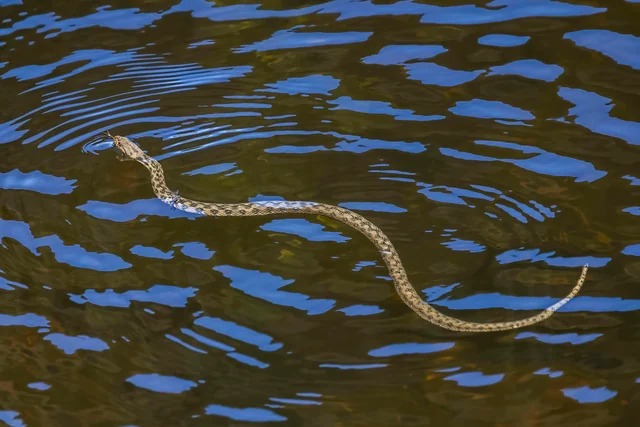
Snake with the body wavy to the surface of the water, between blue reflexes and small ripples.
Viperine water snake swimming in Extremadura, Spain, in 2022. Illustration of the species; not a record of Cabeceiras.
Photography: Charles J. Sharp · CC BY-SA 4.0
About this photograph

Date given at source: . Source consulted in 2026-11-07. EXIF orientation, proportional resize and WebP conversion; no retouching or new clipping of file obtained in Commons.

Request removal or correct the photo credit

The viperine snake’s back does not always have the same pattern.

Includes an activity to try →Explore: The same environment, different ways of life →
Read here and view sources

Natrix maura, the viperine snake, can have a zigzag stripe, but also a pattern of two pale lengthwise lines. The Spanish biodiversity inventory also describes variation in body tones. A single pattern does not represent every individual of the species.

The Parque Natural do Litoral Norte profile explains its association with rivers, ponds, streams and other aquatic environments, without excluding movement on land. This is general species context, not an observation in Cabeceiras. The story compares variation and habitat; it is not a key for identifying snakes encountered outdoors.

The Charcos com Vida project describes feeding mainly in water: invertebrates, amphibian larvae and adults, and small fish are on the menu. Water is therefore a feeding space as well as a means of movement. The snake can itself be prey for birds and mammals; being a predator does not remove it from the food web.

It is usually active by day but may remain active at dusk or at night in summer. Behaviour also changes when threatened: the profile mentions widening the head and other defensive signals that contribute to its resemblance to a viper and its common name. This explanation of the name does not allow the species or the safety of an encounter to be decided from head shape.

Words in this story: see explanations →
Source and context

Inventory Español del Patrimonio Natural y la Biodiversidad — Natrix maura, description of the species

Co-management of the Northern Coastal Natural Park — Reptiles and amphibians, record of the viperine water snake

Lived Chargings — Viperine Water Cobra, Feeding and Behaviour

Accessed: . Editorial summary; the date of consultation is not the date of the facts.

Birds · general biology in Portugal

An acrobat among the leaves

The blue tit even searches for food upside down.

Read here and view sources

A blue cap and wings, white cheeks and a dark line beside the eyes help identify Cyanistes caeruleus. Its yellowish breast adds to the contrast. But watch how it moves too: the University of Évora describes this small bird hopping along branches and hanging upside down as it feeds.

Among the leaves, it searches for insects and spiders. In autumn and winter, fruits and seeds may also form part of its diet. Its food is therefore not a fixed list for every season: what it finds in the landscape changes.

The blue tit is resident and occurs across mainland Portugal. The Gulbenkian profile describes a range of wooded habitats, from woods and riverside trees to orchards, hedges and gardens. A garden and a wooded riverbank offer different settings in which to learn about this bird. These sources explain the species in Portugal; they do not document an encounter in a parish of Cabeceiras.

Words in this story: see explanations →
Source and context

University of Évora — Biodiversity of Mitra: Cyanistes caeruleus

Calouste Gulbenkian Foundation / João E. Rabaça — Blue Chapim

Accessed: . Editorial summary; the date of consultation is not the date of the facts.

Arco de Baúlhe e Vila Nune · local record and general biology

A slug with a leopard pattern

Discreet animals deserve a place in the municipality’s portrait too.

Includes an activity to try →
Read here and view sources

Mauro’s photograph shows a slug with dark markings and extended tentacles on stone. The record, dated 17 September 2021, is identified as Limax maximus. Comparing the published point with CAOP2025 places it in Arco de Baúlhe e Vila Nune.

The Royal Horticultural Society includes this species in its comparison of large patterned slugs, noting its nocturnal behaviour. The local photograph records an encounter; it cannot predict when the animal will appear in the same place again. Its body pattern offers a good question to begin with: where do you see separate spots, and where do they seem to form lines?

Alongside the photograph of the Cavez snail, it offers two different ways to discover land molluscs: the spiral of a shell and the pattern of an elongated body.

Source and context

Royal Horticultural Society — slug research and comparison with Limax maximus

Accessed: . Editorial summary; the date of consultation is not the date of the facts.

YOUR LOCAL GUIDE

What would you like to discover?

Take a closer look.