Discover Cabeceiras de BastoFree independent guide
ViveCabeceirasYOUR GUIDE TO CABECEIRAS
ENEnglish
SearchSaved

Animals

Choose a story to start with. You can change the subject or fine tune the search.

53 stories · Life you do not always see · Search: lã

Life you do not always see

Knowing animals begins by perceiving the territory and respecting the distance.

Choose a story · 53
Reptiles · general biology, without a confirmed local record in this profile

A lizard between sun and moisture
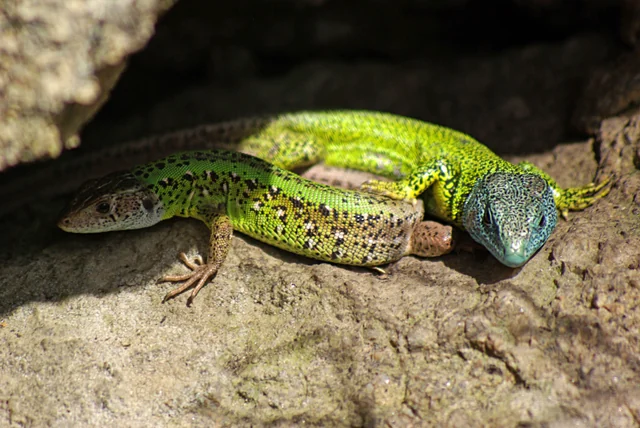
Two lizards on stone, one in the foreground and the other in the back, with green coloring and dark spots.
Water lizards photographed in Candelario, Salamanca, Spain, in 2013. Illustration of the species; it is not a record of Cabeceiras.
Photography: David Perez (DPC) · CC BY3.0
About this photograph

Date given at source: . Source consulted in 2026-11-07. EXIF orientation, proportional resize and WebP conversion; no retouching or new clipping of file obtained in Commons.

Request removal or correct the photo credit

Needing warmth does not mean living far from water.

Includes an activity to try →Explore: Grow and feed by the water →
Read here and view sources

Schreiber’s green lizard, Lacerta schreiberi, is associated with damp habitats, riverside vegetation, walls and brambles. The description published in Ambienta explains that it uses the sun’s warmth for activity but shelters during summer’s hottest hours. Being close to water and choosing somewhere to warm up are parts of the same life.

It feeds mainly on invertebrates, including insects and arachnids. Colour varies too: males’ throats can turn intense blue during the breeding season. These general features do not confirm the species of an animal glimpsed in passing. The consulted source is not a Cabeceiras record.

Age also changes the spaces it seeks. The Charcos com Vida project distinguishes adults needing shelters among rocks and dense scrub from juveniles associated with herbaceous vegetation. A varied bank can offer different refuges rather than acting as a uniform strip.

According to the same profile, reproduction takes place between spring and midsummer. Females lay between six and seventeen eggs, with incubation generally lasting two to three months. These ranges describe the species, not a clutch monitored in the municipality.

The lizard both hunts small invertebrates and provides food for other animals. The source names birds of prey, genets and otters among its predators. This is another connection between bank vegetation, water and the food web.

Words in this story: see explanations →
Source and context

Khris Valero — Lacerta schreiberi, magazine Ambienta, January 2004, pp. 61–62; archive of the Spanish Ministry MAPA

Charcoals with Life — Water Lizard, habitat and life cycle

Accessed: . Editorial summary; the date of consultation is not the date of the facts.
General biology · aquatic insects, without a local species inventory

Tiny shelters beneath the water

Some larvae use sand and plant fragments.

Includes an activity to try →
Read here and view sources

Caddisfly larvae live in water; many build shelters from sand or plant fragments. They form part of river and stream food webs, providing food for fish, birds and amphibians. The Tagis guide highlights their usefulness as ecological indicators. Finding one individual, however, does not certify water quality on its own.

The submerged shelter is only part of the story. The adult has hairy wings and slender antennae, and holds its wings like a small roof over its body when resting. It may resemble a butterfly or moth, but those have scales on their wings. Adult caddisflies usually fly around dusk and live near freshwater bodies.

There is no single menu for all larvae either: depending on the group, they may eat algae, plants, organic remains or other invertebrates. They are consumers and, at the same time, food for other animals. A food web describes these relationships better than a line assigning just one food to each species.

Words in this story: see explanations →
Source and context

Tagis — Insects in Order, Odonata, dragonflies, dragonflies and friganiums (pp. 39–43 and 74)

Accessed: . Editorial summary; the date of consultation is not the date of the facts.
Species recorded in the municipality · general ecology

An old trunk still nourishes life

For beetle larvae, decaying wood can be both home and food.

Includes an activity to try →Explore: A photograph, several phases of history →
Read here and view sources

The larvae of Dorcus parallelipipedus live and feed in decaying wood, according to The Wildlife Trusts. The catalogue photograph documents an adult observed in the municipality; it does not show larvae or confirm the tree in which they developed. Connect this story with wood fungi: an ageing trunk can support different forms of life. There is no need to dismantle an animal’s shelter to observe it. In adults, The Wildlife Trusts highlights the broad head, jaws and entirely black wing cases. These are clues to compare with the available photograph, without concluding that every dark beetle belongs to this species.

Source and context

The Wildlife Trusts — Lesser stag beetle, Dorcus parallelipipedus
Consultations: ,

Editorial summary; the date of consultation is not the date of the facts.
Cavez · record from 2016–2017 and general biology

A preferred current changes with age

For a young nase, a calm stretch can make a difference.

Explore: The same river, different ways of living →
Read here and view sources

The Douro nase, Pseudochondrostoma duriense, is native to the Iberian Peninsula. Santa Maria da Feira’s municipal profile describes adults in strong-current river sections and juveniles preferring slower water and fine substrates. It also mentions upstream movements before reproduction. The Cavez record from 2016–2017 confirms the species in that survey; it does not describe the sampled fish’s ages or behaviour.

There is a clue in the mouth: the lower lip is straight and has a well-developed horny edge. The body may show small dark spots. These features complement the habitat story; they do not replace careful identification.

The municipal source places upstream migrations between March and June and gives an approximate lifespan of six years. Upstream means towards the source. The calendar and lifespan describe the species in general, without dating a movement or determining the age of fish sampled in the Tâmega.

Words in this story: see explanations →
Source and context

Municipality of Santa Maria da Feira — Northern Boga, fauna catalogue
Accessed:

Biosphere / Iberdrola, APA file — Monitoring of ichthyofauna 2016–2017, February 2018; pp. 5, 35 and 40, station record 22 on p. 175 PDF
Accessed:

Editorial summary; the date of consultation is not the date of the facts.

Gondiães · record from 1994 and general species biology

An ocellated lizard was recorded in Gondiães

A line in a table preserves an observation from 1994.

Includes an activity to try →
Read here and view sources

A scientific article published in 1996 records Lacerta lepida in Gondiães, Cabeceiras de Basto, on 16 April 1994. The University of Évora lists that former name among the synonyms of Timon lepidus, the ocellated lizard. It describes the species as the Iberian Peninsula’s largest lizard, with dark-edged blue spots on its flanks. The record documents a past occurrence; it does not confirm a current presence or identify an observation point.

Source and context

J. Teixeira et al. — Nuevos datos sobre la distribución de la herpetofauna en Portugal, Boletín AHE 7 (1996), p. 11; PDF sheet 13
Accessed:

University of Évora — Virtual Museum of Biodiversity, Timon lepidus; MVBIO / Darío Estradiz López
Accessed:

Editorial summary; the date of consultation is not the date of the facts.

Ocellated lizard · general ecology, with a historical reference to Gondiães

Sun in view, shelter nearby

An ocellated lizard needs more than open ground.

Explore: Sun, water and different shapes →
Read here and view sources

The University of Évora profile associates the ocellated lizard with sunny areas that offer shelter: shrubs, stone walls, burrows and other cavities. It also describes the use of farmland and pinewood clearings. This is general ecology for a species with a historical record in Gondiães, not an inventory of animals or shelters currently present in that parish.

Timon lepidus is known in Portuguese as sardão or lagarto-ocelado. The University of Évora’s description highlights blue spots edged in black on the flanks and a robust head. Total length may reach 80 centimetres, including the tail: this does not mean an 80-centimetre body alone. The tail can exceed twice the body length.

Sun and shelter are two parts of the same habitat. A clearing offers exposure, while shrubs, cavities and walls provide refuges. The profile describes that combination, not a preference for any simply open terrain. The Gondiães record connects the species with local natural history; the habitat explanation does not turn every wall in the parish into a confirmed presence site.

Words in this story: see explanations →
Source and context

University of Évora — Virtual Museum of Biodiversity, Timon lepidus; MVBIO / Darío Estradiz López
Accessed:

J. Teixeira et al. — Nuevos datos sobre la distribución de la herpetofauna en Portugal, Boletín AHE 7 (1996), p. 11; PDF sheet 13
Accessed:

Editorial summary; the date of consultation is not the date of the facts.

Reptiles · general biology, without a confirmed local record in this profile

No legs, but not a snake

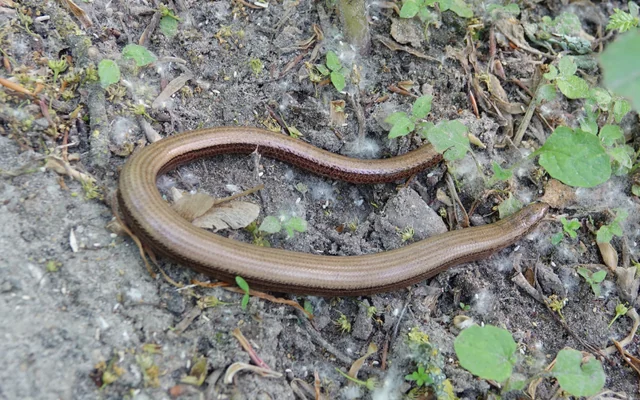
Licran of elongated brown body, bent on the ground between leaves and small plants.
Licensing photographed in Wyhl am Kaiserstuhl, Germany, in 2024. Illustration of the species; it is not a record of Cabeceiras.
Photography: Gzen92 · CC BY-SA 4.0
About this photograph

Date given at source: . Source consulted in 2026-11-07. EXIF orientation, proportional resize and WebP conversion; no retouching or new clipping of file obtained in Commons.

Request removal or correct the photo credit

A slow worm’s silhouette does not tell the whole story.

Includes an activity to try →Explore: Body and Way of Life →
Read here and view sources

The slow worm, Anguis fragilis, is a legless lizard. The Xunta de Galicia’s agricultural biodiversity guide describes it in cool, damp places such as meadows and walls, where it feeds on slugs and insects. Its elongated shape may resemble a small snake, but that similarity does not determine its group.

This explanation helps compare forms and ways of life. The guide concerns Galicia’s agricultural landscape; it does not prove an occurrence in Cabeceiras or allow identification from an unclear photograph alone.

There is more to observe than the absence of legs. The Wildlife Trusts highlights movable eyelids, which let the slow worm blink, and the ability to shed its tail. The female retains eggs inside her body until the young are born. These are general characteristics of Anguis fragilis, without a local record associated with this story.

Its rhythm also changes through the year. The organisation describes a state of winter dormancy called brumation. The source’s calendar concerns the United Kingdom and is not transferred to Cabeceiras. Getting to know the species means distinguishing body shape, behaviour and the information’s geographical context.

Words in this story: see explanations →
Source and context

Xunta de Galicia — Guía for the conservation of biodiversity in Galicia, Anguis fragilis, p. 54

The Wildlife Trusts — Slow worm (Anguis fragilis), general biology; British context

Accessed: . Editorial summary; the date of consultation is not the date of the facts.

Species biology · documentary reference in the municipality

A mussel begins by travelling with a fish

Two lives connected beneath the surface.

Includes an activity to try →Explore: The mussel ride with the fish →
Read here and view sources

The larvae of Margaritifera margaritifera, called glochidia, attach themselves to the gills of salmonids such as trout. The fish acts as a host and carries them while they develop.

After their transformation, they detach and settle on the bottom. Success at this stage also depends on where they land: dispersal and finding conditions for survival are different things. The diagram summarises general biology, not reproduction observed in the municipality.

This journey does not immediately produce an adult capable of reproducing. The ICNF profile places sexual maturity between seven and twenty years and describes a long lifespan. These are general values from that source, not ages measured in specimens from Cabeceiras. The presence of adults and the arrival of new generations are therefore different questions when studying a population.

Words in this story: see explanations →
Source and context

ICNF — Margaritifera margaritifera, ecology, reproduction and threats, pp. 2–3
Accessed:

PDM — Environmental Assessment, p. 50
Accessed:

Editorial summary; the date of consultation is not the date of the facts.

Serra da Cabreira · species biology

A bird of prey that nests on the ground

Montagu’s harrier is also known in Portuguese as águia-caçadeira.

Read here and view sources

Visit Cabeceiras includes Montagu’s harrier among Cabreira’s fauna. SPEA describes Circus pygargus as a summer visitor that returns to Portugal in spring to breed. It prefers open spaces, hunts mainly insects and nests on the ground among tall vegetation. The reference covers the mountain range; it does not identify nests or sighting points in the municipality.

Its annual cycle connects continents. The LIFE SOS Pygargus project describes wintering in Africa and a return to the Iberian Peninsula in spring to breed, with birds remaining in breeding territories until September. This general calendar does not set precise arrival or departure dates for Cabreira.

Long, narrow wings and a long, narrow tail are part of the portrait presented by LPN. Its mini-guide includes low mountain scrub among the habitats and mentions nests in cereal fields or tall fallow vegetation. The menu is also broader than insects: it may include birds, small mammals and lizards. A bird of prey in open country therefore depends on both prey and suitable vegetation for nesting on the ground.

Words in this story: see explanations →
Source and context

Visit Cabeceiras — natural heritage of Serra da Cabreira
Accessed:

SPEA — Hunting Eagle / Circus pygargus
Accessed:

LPN — Bird guide, Imperial LIFE project: hunting turtle
Accessed:

Palombar / LIFE SOS Pygargus — Identification: migration and breeding period (text consulted in search result)
Accessed:

Editorial summary; the date of consultation is not the date of the facts.

Interpretation centre

A first encounter at Moinhos de Rei

Learn about Cabreira before heading into the countryside.

Explore: From interpretation to discovery →
Read here and view sources

The Núcleo Interpretativo de Vida Selvagem opened on 31 August 2013 in Abadim. The municipal presentation explains its connection with the fauna and flora of Serra da Cabreira and with raising awareness of the forest. Consult the place profile to prepare your visit.

The building has a history too: the municipal presentation places the centre in a small annex previously used by the Social Services. Its new role brought learning about animals and plants together with an appreciation of the forest and local customs.

It is a starting point for asking questions about the landscape: how are scrub, trees and animals connected? The following stories let you continue exploring at home. Learning about a species or habitat does not guarantee a sighting during a visit.

See Fact sheet: Núcleo Interpretativo de Vida Selvagem
Source and context

Municipality — Núcleo Interpretativo de Vida Selvagem

Accessed: . Editorial summary; the date of consultation is not the date of the facts.

Occurrence mentioned in the environmental document

The Iberian wolf

A documented presence in the municipality’s landscape.

Includes an activity to try →Explore: Meet the wolf through the landscape →
Read here and view sources

The environmental assessment of the municipal master plan records a wolf pack in the area, based on ICNF information. This reflects Cabeceiras’s ecological importance; it is not a promise of a sighting. Learning about this presence does not require searching for the animals or revealing their shelters. The national platform links a shortage of wild prey with livestock consumption and conflict with pastoral communities. It presents protecting flocks and restoring natural prey as complementary parts of conservation.

A pack is also a family that changes. The platform describes a breeding pair, offspring from different years and sometimes other related adults. The group defends a territory, but its composition changes through births, growth and dispersal.

In the general cycle described for Portugal, pups are born in late April or May. During summer, rendezvous sites become centres of family activity; in autumn, the young begin accompanying adults as they travel and hunt. This is not an observation calendar for a particular pack.

As they grow, some young wolves leave their original group to seek a territory, a mate or another pack. Others stay longer when enough food is available. A count at one moment therefore does not describe an unchanging family: social life follows the annual cycle and the opportunities offered by the landscape.

Source and context

PDM — Environmental Assessment, p. 50
Accessed:

Lobo-Iberico platform in Portugal — wolf prey; registration of Cabreira without date indicated
Accessed:

Lobo-Iberico Platform in Portugal — Life in pack
Accessed:

Editorial summary; the date of consultation is not the date of the facts.

Mammals · behaviour and local reference

Wild boar come out as the light fades

A long snout and a very varied diet.

Includes an activity to try →
Read here and view sources

The wild boar, Sus scrofa, is omnivorous and is mainly active at dusk and at night. During the day it may shelter in dense scrub. Plataforma Lobo-ibérico documents a wild boar killed by wolves in Serra da Cabreira, in Cabeceiras, without giving the record’s date. Its long snout and thick coat distinguish it from the domestic pig. Despite being omnivorous, the source describes a mainly plant-based diet. This flexibility helps explain its adaptation to different landscapes.

The platform also uses the Portuguese name porco-bravo and describes marked differences between the sexes. It discusses the species’ expansion in Portugal, including areas near urban centres. That national context cannot tell us how many wild boar live in Cabeceiras.

The Cabreira record and the description of habits answer different questions: one documents an encounter between predator and prey; the other helps explain the species’ life. This single reference cannot establish how often predation occurs or the size of local populations.

Source and context

Lobo-Iberico platform in Portugal — wolf prey; registration of Cabreira without date indicated

Accessed: . Editorial summary; the date of consultation is not the date of the facts.

Species biology · Portuguese context

Roe deer change their coats

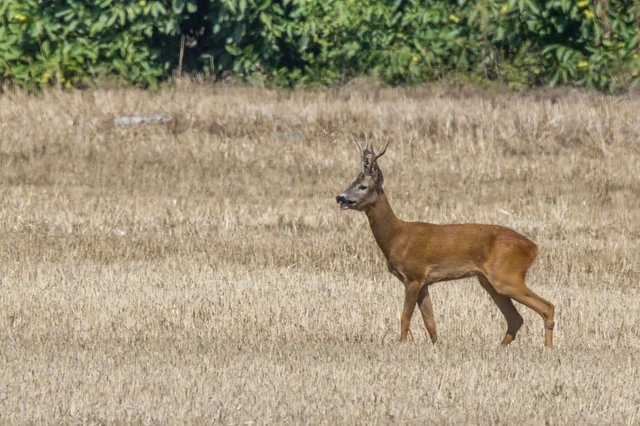
Profile hind in a field, with stems, raised ears and reddish brown coat.
Male hind in Dobruja, Romania, in August 2022. Illustration of the species; it is not a record of Cabeceiras.
Photography: Charles J. Sharp · CC BY-SA 4.0
About this photograph

Date given at source: . Source consulted in 2026-11-07. EXIF orientation, proportional resizing and WebP conversion of the current version in Commons; no retouching or additional clipping.

Request removal or correct the photo credit

One coat for summer, another for winter.

Includes an activity to try →Explore: The same world, different rhythms →
Read here and view sources

The roe deer, Capreolus capreolus, changes from a reddish-brown coat in summer to a grey one in winter. It eats plants and also uses open areas and scrub. This species description does not identify a sighting point in the municipality. Roe deer are small deer: the platform’s description gives a weight of up to 30 kg. Males have antlers; the white rump patch is kidney-shaped in males and heart-shaped in females.

Antlers follow a cycle too: the platform describes annual growth and shedding in roe deer and red deer. They are therefore not a feature that stays the same all year. On the head, the mostly black nose and upper lip contrast with the white lower lip.

Activity patterns add another difference. Although mainly active at dusk and at night, the source presents the roe deer as Portugal’s most daytime-active deer. These are species tendencies, not a guaranteed time to see one. Shape, season and behaviour need to be considered together when learning about an animal.

Words in this story: see explanations →
Source and context

Lobo-Iberico platform in Portugal — wolf prey; registration of Cabreira without date indicated

Accessed: . Editorial summary; the date of consultation is not the date of the facts.

Wolf ecology · Portuguese context and documentary reference to Cabreira

A landscape is food too

The wolf belongs to a network of relationships.

Explore: Who lives in the landscape? →
Read here and view sources

Wild boar, roe deer, red deer and Iberian ibex are the main natural wolf prey presented by the platform for Portugal. This national list does not mean that all occur in Cabeceiras. Understanding a predator also means understanding its prey. The platform explains that restoring wild prey depends on both natural expansion and reintroductions. These stories have different scales and origins: restoring a species in one region does not demonstrate its presence in another.

The page includes a photograph whose caption identifies a wild boar killed by wolves in Serra da Cabreira, in Cabeceiras de Basto, credited to Ismael Cunha. The caption establishes a local connection but gives no date and cannot show how often predation occurs. The photograph has not been reproduced here.

Another distinction is useful when looking at mountain animals: a domestic breed kept free-ranging, such as the Garrano, does not thereby become a wild species. A landscape can bring together animals with different histories. This comparison does not demonstrate that a particular animal is wolf prey or that all the species mentioned share the same stretch of mountain.

Source and context

Lobo-Iberico platform in Portugal — wolf prey; registration of Cabreira without date indicated

Accessed: . Editorial summary; the date of consultation is not the date of the facts.

Serra da Cabreira · species biology

A tail longer than the body

The gold-striped salamander’s life is closely tied to moisture.

Read here and view sources

The gold-striped salamander, Chioglossa lusitanica, is mentioned by Visit Cabeceiras for Serra da Cabreira. It has a slender body, a tail longer than its body and two golden or orange stripes along its dark back.

According to LPN, vegetation influences how it uses space: in farmland and forests of exotic species it tends to stay closer to streams, while in native woodland it may move farther from water. The bank is therefore part of this amphibian’s story. This is species biology, not a sighting point.

It is endemic to the Iberian Peninsula and is nocturnal. Its front feet have four toes and its hind feet five: details that help us learn about the species without handling it.

Parque Biológico de Gaia describes a terrestrial life beside watercourses, abundant vegetation and high humidity, with a diet of small invertebrates. Being associated with streams does not mean spending its whole life swimming. When reading about eggs and larvae, compare the life stage with the habitat used: the relationship with water changes during development.

Source and context

Visit Cabeceiras — natural heritage of Serra da Cabreira
Accessed:

Gaia Biological Park — Chioglossa lusitanica
Accessed:

Link to Nature Protection — Salamander-lusitan
Accessed:

Editorial summary; the date of consultation is not the date of the facts.

Cavez · monitoring in 2016–2017

Six species beneath the surface

A sampling survey offers a small portrait of the Tâmega at Cavez.

Includes an activity to try →Explore: You know the six fish from the lift →
Read here and view sources

At station 22, the 2016–2017 report recorded six fish: barbo-comum, boga-do-Norte, escalo-do-Norte, bordalo, góbio and perca-sol, using their Portuguese common names. The station profile places it in Cavez. These results document that survey; they are neither a current inventory nor directions to fishing spots.

The six names open six ways of looking at the river. The barbel leads to migration within fresh water; the nase to differences between young and adult fish; the chub to scale patterns. The bordalo and gudgeon help explore diet. The pumpkinseed introduces geographical origin. Open the cards to choose a clue and reach the species explanation.

Sampling surveys and biological profiles serve different purposes. The survey documents fish recorded at that place and time. The profiles explain general species characteristics, without demonstrating that all these behaviours were observed in Cavez. Read both together while keeping that distinction.

Getting to know the parish
Source and context

Biosphere / Iberdrola, APA file — Monitoring of ichthyofauna 2016–2017, February 2018; pp. 5, 35 and 40, station record 22 on p. 175 PDF
Accessed:

Mora Fluviary — Barbo-common, biology of the species
Accessed:

Municipality of Santa Maria da Feira — Northern Boga, fauna catalogue
Accessed:

Arouca Geopark — Northern scale, Squalius carolitertii: description and biology
Accessed:

ICNF — embroidery, ecology and riverside vegetation, pp. 2–3 (bibliography up to 2005)
Accessed:

Gaia Biological Park — Gobio, Gobio lozanoi: habitat, food and size
Accessed:

Águeda River Interpretation Center — Sun Loss
Accessed:

Editorial summary; the date of consultation is not the date of the facts.

Serra da Cabreira · species life cycle

Before the salamander, a life in water

The stream is also where the transformation begins.

Explore: Growing up and being able to reproduce are different moments →
Read here and view sources

The gold-striped salamander’s life begins in connection with water. LPN describes eggs often attached to the substrate and larvae that remain in quiet water until metamorphosis, in a development period that may last one to two years.

During this stage, they feed on small aquatic animals, including insects, molluscs and crustaceans. Pollution and habitat loss threaten this cycle; water and surrounding vegetation matter together. The story explains the biology of the species mentioned for Cabreira, without locating breeding areas.

Completing metamorphosis is not the same as becoming able to reproduce. LPN places male sexual maturity at around three to four years and female maturity between four and five. Body transformation and reproductive maturity are therefore distinct stages. These ranges describe species biology; they cannot predict the age of an individual seen in a photograph.

Words in this story: see explanations →
Source and context

Link to Nature Protection — Salamander-lusitan
Accessed:

Visit Cabeceiras — natural heritage of Serra da Cabreira
Accessed:

Editorial summary; the date of consultation is not the date of the facts.

Species biology · record in Rio Douro

A small frog with a strong connection to water

Some lives depend on the bank as much as the stream.

Includes an activity to try →Explore: One photograph opens other questions →
Read here and view sources

The Iberian frog naturally lives in the Iberian Peninsula: that is what it means to be endemic to this territory. With a slender body and pointed snout, it can reach about 5.5 centimetres. Reproduction takes place in water, and the species prefers mountain streams with vegetation along the banks and rocky beds.

The photograph recorded in Rio Douro opens a window onto this discreet life. On its own, it does not demonstrate water quality: pollution and changes to riverside habitats are among the threats described by the University of Évora.

The description also highlights a dark stripe crossing the eye area, with a narrower pale stripe beneath. These are details to appreciate in a photograph without handling the animal.

Source and context

University of Évora — Virtual Museum of Biodiversity

Accessed: . Editorial summary; the date of consultation is not the date of the facts.

Species biology · trace recorded in Cavez

At dusk, a bird can seem like an insect

Not every bird is discovered by looking up at the sky.

Includes an activity to try →
Read here and view sources

The European nightjar feeds on insects and becomes active at dusk and during the night. Its continuous song can resemble a cicada’s sound. In Portugal it is a summer visitor, associated mainly with the north and the transition between woodland and open spaces. The Cavez record shows a feather attributed to this species by the iNaturalist community. It is a trace: not a photograph of the whole bird or proof of a nest at that point. Curiosity begins with a feather and continues into the soundscape.

Long wings and a long tail may be visible in silhouette, but low light hides details. The Aves de Portugal profile explains that females lack the white wing patches of males; juveniles lack them too. The absence of a mark alone does not determine age and sex.

The source describes a late arrival, with song easier to detect in May and June. This is a Portuguese pattern, not a sightings calendar for Cavez. The recorded feather cannot tell us when the bird sang, where it nested or how long it stayed in the area.

To understand journeys, researchers need another kind of record. The BTO presents tracking studies that located an important wintering area in grassland and shrub landscapes south of the equatorial forest, mainly in the Democratic Republic of the Congo. This information concerns birds tracked in those studies, not a demonstrated destination for the bird associated with the Cavez feather. A feather documents a trace in one place; tracking connects positions over time to study movements.

Source and context

Poultry of Portugal — Caprimulgus europaeus

British Trust for Ornithology — BirdFacts: Nightjar, Caprimulgus europaeus; follow-up and winter studies

Accessed: . Editorial summary; the date of consultation is not the date of the facts.

Bucos · an account from 1758

Animals in an old portrait

An account of the mountains written in 1758.

Includes an activity to try →
Read here and view sources

The vicar of Bucos mentions partridges, rabbits, wolves, foxes and wild boar, describing them as not very abundant. He notes carqueja, heather and gorse on the hills. This is the landscape he recorded at that time, not a current inventory or a promise of seeing these animals.

The account also mentions goats as the most abundant livestock, along with some larger livestock. The same document therefore brings together farm animals and fauna the vicar describes as game. Separating the two groups helps us read rural life in that period.

The statement about low abundance is the author’s judgement, with no counting method presented. It does not allow a direct comparison between 1758 and a present-day wildlife census. Part of the account’s interest lies in what he chose to observe: animals, scrub, terrain and mountain uses appear together.

Source and context

Municipality — Parish memories of Bucos (1758)

Accessed: . Editorial summary; the date of consultation is not the date of the facts.

Serra da Cabreira · regional reference and species biology

A desman’s life in the current

Cold water has its own inhabitants too.

Explore: The river is also a pantry →
Read here and view sources

The Pyrenean desman, Galemys pyrenaicus, is associated with cold, clear, well-oxygenated water, often in fast-flowing mountain rivers. The University of Évora also mentions the use of slower water, such as canals and lakes: a preference is not exclusivity. Its natural range is limited to the Iberian Peninsula and the Pyrenees. Conservation involves vegetated banks, shelters and connected habitats; the profile identifies silting and isolation among the threats. The municipal description of Cabreira’s fauna mentions the species, but this story has no geolocated record in the municipality.

Its elongated snout, shaped like a small trunk, helps it search for invertebrate larvae underwater, according to the Generalitat of Catalonia’s description. The technical profile hosted by ICNF highlights riverbed invertebrates as its food base, including caddisflies, stoneflies, mayflies and true flies. Small animals that may seem like details of the river are part of a mammal’s diet.

The ICNF profile adds a qualification for Portugal: it considers still-water habitats, such as reservoirs and small high-altitude lakes, unfavourable. The general reference to slower water should not become an invitation to search for the species in any lake. Suitable habitat also involves food, bank shelters and connections with other river sections.

Words in this story: see explanations →
Source and context

University of Évora — Virtual Museum of Biodiversity, Galemys pyrenaicus

Vieira Tourism of Minho — fauna of Serra da Cabreira, regional reference

ICNF — Galemys pyrenaicus, ecology and nutrition (historical references)

Generalitat de Catalunya — Iberian Desmán, description of snout and feeding

Accessed: . Editorial summary; the date of consultation is not the date of the facts.

Serra da Cabreira · regional reference and species biology

Wildcats need a varied landscape

Woodland for shelter, open ground for hunting.

Read here and view sources

The wildcat, Felis silvestris, is associated with scrub and woodland, often near rocky areas and watercourses. It may search for food in undisturbed meadows. A thick tail with dark rings and a rounded tip is one of the features described by the University of Évora. Its resemblance to domestic cats calls for care in identification.

The municipal source mentions it for Cabreira without locating a population in a particular parish.

The University of Évora’s description adds retractable claws and mainly crepuscular and nocturnal activity: twilight is the transition between day and night. The source lists habitat fragmentation and hybridisation with domestic cats among the threats. Appearance alone does not resolve every identification question.

Source and context

University of Évora — Virtual Museum of Biodiversity, Felis silvestris; David Germano
Consultations: ,

Vieira Tourism of Minho — fauna of Serra da Cabreira, regional reference
Accessed:

Editorial summary; the date of consultation is not the date of the facts.

Serra da Cabreira · regional reference and species biology

A newt between water and land

Its skin also changes with its surroundings.

Includes an activity to try →Explore: From egg to change of environment →
Read here and view sources

Bosca’s newt, Lissotriton boscai, has smoother skin during its aquatic phase and rougher skin during its terrestrial phase. For reproduction, it can use ponds, slow-flowing streams and even water tanks. Out of water it finds shelter in damp places among roots, stones and trunks. Its orange belly explains its Portuguese name, tritão-de-ventre-laranja.

It is mentioned among Cabreira’s amphibians by Vieira do Minho’s municipal website, without an associated observation point.

The University of Évora’s description notes four toes on the front feet and five on the hind feet, as well as a laterally flattened tail. These are species features, not a reason to take the animal out of the water. The same source gives a total length of up to nine centimetres, with females generally larger and more robust than males.

The mating season can change its appearance too. The University of Évora describes a small crest on the tail and, in males, a whitish lengthwise stripe, more marked near the tip. Comparing two images therefore means considering sex and season as well as species name. Not every visible difference means different species.

Diet follows the change of habitat. According to the Charcos com Vida project, larvae and aquatic adults catch small water-dwelling invertebrates; on land, adults mainly eat soft-bodied animals such as earthworms and slugs. The female lays eggs individually on aquatic plants or leaves over several days. The diagram below connects these stages without assigning dates to their occurrence in Cabreira.

Source and context

University of Évora — Virtual Museum of Biodiversity, Lissotriton boscai

Vieira Tourism of Minho — fauna of Serra da Cabreira, regional reference

Charcoals with Life / CIIMAR — Orange belly triton, life cycle and feeding

Accessed: . Editorial summary; the date of consultation is not the date of the facts.

Serra da Cabreira · regional reference and species biology

Some newts spend another winter in water

In the cold of higher ground, development can take longer.

Read here and view sources

In the palmate newt, Lissotriton helveticus, mating takes place in pond water. Parque Biológico de Gaia explains that in higher, colder areas, larvae may spend the winter in water before completing metamorphosis the following year. It feeds on small invertebrates. The municipal description of Cabreira mentions this species; the cycle described here is general biology, not reproduction observed in a local pond.

Two stages need to be distinguished. The Parque Biológico profile gives about fifteen days to a month between egg-laying and hatching; metamorphosis follows later. Hatching means leaving the egg, not completing larval development. The possibility of spending another winter in water shows why one calendar does not fit every set of conditions.

Words in this story: see explanations →
Source and context

Gaia Biological Park — Spanked Triton, Lissotriton helveticus

Vieira Tourism of Minho — fauna of Serra da Cabreira, regional reference

Accessed: . Editorial summary; the date of consultation is not the date of the facts.

Cavez · record from 2016–2017 and general biology

Not every river fish came from here

The pumpkinseed tells a story of introduction.

Explore: The same river, different ways of living →
Read here and view sources

The pumpkinseed, Lepomis gibbosus, originates from North America. The Águeda River Interpretation Centre describes it as a non-native species with a deep, laterally flattened body, living in still water but also in rivers. During breeding, males may make it harder for juveniles of native species to reach bank shelters. It was recorded in Cavez in 2016–2017; that record does not measure its local impact.

Bluish bands from the head to the flanks and a dark spot at the edge of the gill cover are part of the description. Juveniles have a simpler pattern on a greenish or olive background. Age also changes appearance.

The menu includes insects, crustaceans, gastropods and fish larvae. This variety helps show that its diet is not limited to one prey. The profile also distinguishes lentic environments, such as reservoirs, from lotic environments, such as rivers and streams: the species can use both. Geographical origin, presence in a survey and effects on other species are different kinds of information.

Words in this story: see explanations →
Source and context

Águeda River Interpretation Center — Sun Loss
Accessed:

Biosphere / Iberdrola, APA file — Monitoring of ichthyofauna 2016–2017, February 2018; pp. 5, 35 and 40, station record 22 on p. 175 PDF
Accessed:

Editorial summary; the date of consultation is not the date of the facts.

Cavez · record from 2016–2017 and general biology

A fish’s menu can include insects

Feeding connects life in and out of the water.

Includes an activity to try →Explore: Who feeds on what? →
Read here and view sources

The ICNF profile describes the bordalo, the Squalius alburnoides complex, as feeding mainly on insect larvae. In summer and early autumn it notes greater consumption of terrestrial insects. This makes a small connection between the river and its banks. The bordalo appears in the Cavez study from 2016–2017 under the name Iberocypris alburnoides; the local study did not analyse this seasonal dietary change.

The same profile describes the use of rivers and streams with varied features, including small, shallow watercourses with emergent aquatic vegetation. Habitat is not just water: shelters, vegetation and alternating areas of different current speeds also enter the story.

A completely bare bank therefore changes more than the view. The profile links loss of riverside vegetation with reduced shade, shelter and feeding places. These general ecological relationships help interpret the river; they are not a current assessment of a Cavez river section. The local 2016–2017 record and the biological explanation answer different questions: where the fish was documented, and how it relates to its environment.

Source and context

ICNF — embroidery, ecology and riverside vegetation, pp. 2–3 (bibliography up to 2005)
Accessed:

Biosphere / Iberdrola, APA file — Monitoring of ichthyofauna 2016–2017, February 2018; pp. 5, 35 and 40, station record 22 on p. 175 PDF
Accessed:

Editorial summary; the date of consultation is not the date of the facts.

Serra da Cabreira · general species behaviour

A tail that distracts a predator

The gold-striped salamander has a surprising defence.

Includes an activity to try →
Read here and view sources

When threatened, this salamander can shed its tail and regenerate it later. The detached part keeps moving, distracting the predator while the animal seeks shelter. Parque Biológico de Gaia describes this mechanism for the species mentioned by Visit Cabeceiras for Cabreira. It is something to learn about without touching or provoking the animal.

Parque Biológico de Gaia highlights this ability as unique among the salamanders of the Iberian Peninsula. The mechanism has two stages: immediate distraction by the detached tail, and later regeneration. These do not happen at the same time.

Compare this story with growth: losing part of the tail in defence and undergoing metamorphosis are different processes. A single photograph does not show the complete sequence of either. Learning about behaviour helps us understand the animal without trying to recreate a threatening situation.

Source and context

Gaia Biological Park — Chioglossa lusitanica
Accessed:

Visit Cabeceiras — natural heritage of Serra da Cabreira
Accessed:

Editorial summary; the date of consultation is not the date of the facts.

Serra da Cabreira · regional reference and species biology

Bright colours, a quiet whistle

There is more to a bullfinch than its plumage.

Read here and view sources

The male Eurasian bullfinch, Pyrrhula pyrrhula, combines a pinkish breast with a black cap; the female has more subdued colours. The British Trust for Ornithology describes a soft, single-whistle call and the consumption of fruit-tree buds in spring. Vieira do Minho’s municipal website includes the bullfinch among Cabreira’s birds. That reference covers the mountain range, without confirming an occurrence in a parish or route in this guide.

Reproduction has different stages. In the ringing and nest-record data gathered by the BTO, a typical clutch has four to five eggs and incubation, undertaken by the female, generally lasts 14–16 days. Hatching begins another stage: the chicks’ development until they leave the nest. The published intervals are not a calendar for Cabreira.

The profile also helps distinguish a typical value from observed extremes. A clutch outside the usual number does not automatically belong to another species. Reading nature means understanding what was measured, in which population and with what variation.

Words in this story: see explanations →
Source and context

British Trust for Ornithology — BirdFacts: Bullfinch, Pyrrhula pyrrhula

Vieira Tourism of Minho — fauna of Serra da Cabreira, regional reference

Accessed: . Editorial summary; the date of consultation is not the date of the facts.

Amphibians · general biology

Skin that breathes too

In amphibians, skin does more than cover the body.

Explore: From body to environment →
Read here and view sources

Amphibians’ bare, permeable skin takes part in breathing. Aquário Vasco da Gama explains that respiratory exchange may also involve gills and lungs, depending on life stage. This permeability helps explain their sensitivity to environmental change. It is general biology for getting to know the frogs, salamanders and newts in this collection.

Their body temperature follows environmental conditions: they are ectothermic animals. This is different from skin permeability, although both help explain their relationship with where they live. Protecting water alone is not enough either: many species use terrestrial habitats at other life stages.

Words in this story: see explanations →
Source and context

Vasco da Gama Aquarium — Thematic Sheets: Amphibians, 2th cycle, pp. 1–2

Accessed: . Editorial summary; the date of consultation is not the date of the facts.

Amphibians · comparing groups

A tail offers a clue

Compare an adult frog with an adult salamander.

Includes an activity to try →
Read here and view sources

Frogs and toads belong to the anurans: as adults they have no tail, and their hind legs are developed for jumping. In urodeles, such as salamanders and newts, the tail remains in adulthood. Life stage matters in this comparison: a tadpole has a tail. This distinction between groups is not enough to identify a species.

Start by comparing the same life stage. A tadpole and an adult frog are not two different groups; they are developmental forms. Comparing an adult frog with an adult newt, however, reveals the difference between anurans and urodeles. Aquário Vasco da Gama also describes urodele limbs as suited to walking, in contrast with anurans’ developed hind legs.

Source and context

Vasco da Gama Aquarium — Thematic Sheets: Amphibians, 2th cycle, pp. 1–2

Accessed: . Editorial summary; the date of consultation is not the date of the facts.

Fox · general biology

Between woodland and field

A varied landscape offers foxes different environments.

Read here and view sources

The red fox, Vulpes vulpes, occupies many habitats, from coast to mountain. Museu Virtual da Biodiversidade highlights a preference for scrub and woodland interspersed with farmland or pasture. A long, bushy tail and pointed muzzle help identify its outline.

The distribution described covers mainland Portugal but does not replace a located record in Cabeceiras de Basto.

The coat can combine brown, reddish and grey tones; the tail tip may have a whitish patch. The description also notes that cubs are brownish until about six months old. Colour and age should therefore be considered when looking at the animal, rather than expecting the same appearance every time.

Source and context

University of Évora — Virtual Museum of Biodiversity: Vulpes vulpes

Accessed: . Editorial summary; the date of consultation is not the date of the facts.

General biology · dragonflies and damselflies, without a confirmed local record

Resting wings offer a clue

Dragonflies and damselflies do not rest in the same way.

Includes an activity to try →Explore: Wings, water and food →
Read here and view sources

The Tagis guide describes damselflies with two similar pairs of wings, usually held closed or slightly apart vertically when perched. Dragonflies keep theirs open horizontally. This is an initial observation clue, not a species identification. Adult dragonflies can move away from watercourses thanks to their flying ability.

Both groups belong to the order Odonata. The guide highlights compound eyes, short antennae and jaws used to capture other animals. Their prey includes flies and mosquitoes: these wings are part of a predator story, not just one of colours.

The connection with water also changes with life stage. Dragonflies need water to complete their cycle, but adults can hunt in sunny clearings far from the river where they began life. Seeing an adult above a path does not locate its breeding point. Compare wing position, behaviour and habitat without turning one clue into an identification.

Source and context

Tagis — Insects in Order, Odonata, dragonflies, dragonflies and friganiums (pp. 39–43 and 74)

Accessed: . Editorial summary; the date of consultation is not the date of the facts.

Portuguese fauna · general biology, without a local record

A light that carries a message

Fireflies’ glow is part of how they interact.

Explore: The night has different signs →
Read here and view sources

Fireflies’ light results from a chemical reaction and can serve communication or defence. Parque Biológico de Gaia explains that in most species in this group, larvae and adults can produce light. During reproduction, luminous signals help partners find each other.

There is a less visible life behind the glow too: in Portugal, larvae feed mainly on snails and slugs. Intense lighting can disrupt communication between these insects. This story introduces features of the group and the importance of darkness; it does not confirm firefly species, periods of abundance or observation points in Cabeceiras.

Source and context

Gaia Biological Park — firefly and firefly biology

Accessed: . Editorial summary; the date of consultation is not the date of the facts.

Cabeceiras and Serra da Cabreira · documented distribution of the breed

A small horse with a mountain stride

The Garrano is part of north-western Portugal’s living heritage.

Read here and view sources

The DGAV catalogue includes Cabeceiras de Basto in the Garrano breed’s breeding area and mentions its presence in Serra da Cabreira. It describes brown horses, sometimes dark brown, with an adult height below 1.35 metres at the withers. Their gaits suit mountain paths. Even when kept free-ranging, the Garrano is a domestic horse. The documented distribution connects the breed with the territory, without guaranteeing encounters on a trail or identifying a particular herd.

The breed standard describes a compact body, short strong limbs, and a black mane and tail. Its uses are not limited to riding: they include carrying loads, draught work and farm work. The horse belongs to a landscape also shaped by people, where its way of moving has practical importance.

The catalogue distinguishes passo travado from andadura. It describes four beats in the first; in andadura, the limbs on the same side lift and land together, producing two beats per stride. These are descriptions of movements, not two names for the same gait. This detail helps explain why a breed’s heritage includes more than appearance.

Words in this story: see explanations →
Source and context

DGAV — Garrana, distribution and pattern of race, p.2

Accessed: . Editorial summary; the date of consultation is not the date of the facts.

General biology · bee nesting places

Not all bees look for the same home

Learning about shelters adds another dimension to flowers.

Includes an activity to try →Explore: Flowers, shelters and wood →
Read here and view sources

A flower can provide food, but it does not meet all a bee’s needs. Entomologists Renata Santos and Albano Soares distinguish carpenter bees, which use dead wood for nesting, from mining bees, which need bare soil. A garden’s variety also includes different nesting places.

So-called insect hotels serve only some species, notably certain cavity-nesting bees. They are a supplement, not a universal home. The idea is to recognise connections between flowers, soil and wood, not to search for or open nests. These general examples do not confirm local nests.

Time matters too: different plants can provide flowers at different times. The researchers recommend diversity in flower shapes and flowering periods. When thinking about a garden, it is useful to connect three questions: what provides food, where might there be shelter, and when in the year are those resources available?

Source and context

Calouste Gulbenkian Foundation — explanations of entomologists Renata Santos and Albano Soares, 07/06/2022

Accessed: . Editorial summary; the date of consultation is not the date of the facts.

Orada · animals in Alvite’s account from 1758

Orada was grazing land too

A mountain can tell stories of animals and work.

Read here and view sources

In the account of Alvite, the parish priest described poor grazing on Orada, used throughout the year by cattle, working equines, sheep and goats. He also mentioned rabbits and partridges in a hunting context. This is testimony from 1758, not a current wildlife inventory or directions to hunting locations.

Source and context

Municipality — Alvite Parish Memories, 1758; transcription of José Viriato Chapel (2003)

Accessed: . Editorial summary; the date of consultation is not the date of the facts.

Soil life · general ecology

Beneath our feet, a world of mixtures

Soil contains water and air too.

Includes an activity to try →Explore: From the ground to the water, follow the connections →
Read here and view sources

The ground is not a solid block: mineral particles and organic matter share space with water, air and organisms. Rock, climate and living things all take part in soil formation.

Looking only at the surface leaves much life undiscovered. This explanation helps explore gardens and woods, but does not replace an analysis of Cabeceiras’s soils.

Life is not evenly distributed. FAO describes areas of intense activity near roots, where plant remains accumulate, and along the walls of earthworm tunnels. The immediate surroundings of a root have a name: the rhizosphere. Thinking about these small zones helps explain why two nearby pieces of soil can offer different conditions to organisms.

Some inhabitants are unlikely to be seen on a walk. Bacteria take part in transforming organic matter; some associate with roots and contribute to nitrogen fixation. Fungi also break down remains and can form relationships with plants. They do not all do the same job: soil brings together overlapping activities, from feeding to the transformation of materials.

A covering of leaves is more than a finishing layer on a woodland floor. It is material that can feed this community. In the interview published by the Gulbenkian, the researchers recommend retaining some leaf litter in green spaces and avoiding frequent deep disturbance of the soil. These are general conservation guidelines, not an assessment or prescription for every plot in the municipality.

Words in this story: see explanations →
Source and context

Calouste Gulbenkian Foundation / Wilder — Cristina Cruz, Teresa Dias and Silvana Munzi (FCUL), 26/03/2024

FAO — What is soil biodiversity?

Accessed: . Editorial summary; the date of consultation is not the date of the facts.

Soil life · general ecology

Earthworms change the landscape too

A tunnel can send leaves on a journey.

Includes an activity to try →Explore: A leaf can follow several paths →
Read here and view sources

Many earthworms eat plant remains or carry them through the tunnels they dig. A fallen leaf can therefore continue its journey beneath the surface.

By transforming organic matter and changing where they live, these animals act as ecosystem engineers. This is a general role, not an identification of species present in the municipality.

They do not all feed in the same place. FAO’s overview distinguishes worms that use debris near the surface from those feeding in deeper layers. Tunnels vary too: mainly vertical or horizontal, long-lasting or temporary shelters against unfavourable conditions.

Material passes through the digestive tract and returns to the soil as casts that bring together particles, organic matter and microorganisms. The work is therefore more than digging a tunnel: it involves transport and transformation. The tunnels support aeration, drainage and root penetration. Activity on the scale of a small animal can change the space available for water, air and other living things.

These differences explain why we should not imagine all earthworms as copies of one species. The story describes general roles and ways of life; it cannot count populations or measure a plot’s fertility just from the presence of one animal.

Source and context

Calouste Gulbenkian Foundation / Wilder — Cristina Cruz, Teresa Dias and Silvana Munzi (FCUL), 26/03/2024

FAO — Earthworms: food, galleries and soil structure

Accessed: . Editorial summary; the date of consultation is not the date of the facts.

Soil life · general ecology

Tiny animals graze on fungi

Springtails live in a world measured in millimetres.

Includes an activity to try →
Read here and view sources

Some mites and springtails feed on fungi in the soil. This relationship connects small animals with leaf decomposition and nutrient cycling.

Springtails are microarthropods, only a few millimetres long. Many have a forked structure, the furcula, that lets them jump and escape predators. The description helps us imagine hidden soil life; it does not identify species present in Cabeceiras.

Scale helps tell this story. According to FAO, mites and springtails feeding on bacteria and fungi can affect microbial communities in a small area of soil. At the same time, larger animals change the structure in which that life develops. Climate, plants and soil properties complete the setting.

A food web beneath our feet is therefore not an isolated sequence of meals. What one organism eats and the spaces another transforms can influence each other. Following a fallen leaf to fungi and small animals is a way into that web, without assuming that all springtails have exactly the same diet.

Words in this story: see explanations →
Source and context

Calouste Gulbenkian Foundation / Wilder — Cristina Cruz, Teresa Dias and Silvana Munzi (FCUL), 26/03/2024

FAO — What is soil biodiversity?

Accessed: . Editorial summary; the date of consultation is not the date of the facts.

Painzela · local record and general biology

Similar names, different relatives

A swallow is not a small swift.

Includes an activity to try →Explore: How would you like to discover birds? →
Read here and view sources

Swallows and swifts catch insects in flight, but belong to different orders. Swallows are Passeriformes, like blackbirds and tits; swifts are Apodiformes, like hummingbirds. Their similar Portuguese names conceal different family relationships.

Nesting places tell stories too: the Gulbenkian guide describes the house martin’s nests of mud and small grasses beside roofs. Common and pallid swifts use recesses among roof tiles and beside chimneys. These are examples from Portugal, not locations of nests in the municipality.

In Painzela, a photograph by birdlovers records a barn swallow on 8 August 2025. Hirundo rustica builds cup-shaped mud nests and catches small insects in flight, according to the University of Évora. The photograph shows a pause on a wire, not a nest or feeding. It provides a local connection to one species in this family, without making the location a guaranteed place to see it.

Source and context

Calouste Gulbenkian Foundation / Wilder — Essential guide for swallows and swallows, 09/05/2024

University of Évora — Hirundo rustica

Accessed: . Editorial summary; the date of consultation is not the date of the facts.

Cabeceiras de Basto · occurrence mentioned in an environmental study

A bat entered the area’s records too

An environmental reference adds nocturnal life to the portrait of Cabeceiras.

Explore: From registration to questions about the species →
Read here and view sources

The environmental report for the Ribeira de Pena–Vieira do Minho power line, archived by the Portuguese Environment Agency, mentions a greater horseshoe bat, Rhinolophus ferrumequinum, record in a roost associated with Cabeceiras de Basto. This is documentary evidence of the species’ occurrence, not a current population count. The information does not allow a parish to be assigned here or an observation location to be announced.

Source and context

Matos, Fonseca & Associados / REN — EIA of the Double Line Ribeira de Pena–Vieira do Minho1/2, summary report, p.169; APA archive

Accessed: . Editorial summary; the date of consultation is not the date of the facts.

Bats · general ecological roles

Small hunters with a role in the landscape

Eating insects connects bats with fields and forests too.

Includes an activity to try →Explore: Eat, orient and rest →
Read here and view sources

Insect-eating bats connect the night with fields and forests. By feeding, they help control insect populations, including species that can affect farming and trees. The ICNF text invites us to discover this ecological role beyond the myths surrounding bats.

Worldwide, there are other diets and relationships: fruit-eating bats can contribute to forest regeneration, while pollen-feeding bats take part in pollination. These global examples do not assign those diets to species recorded in Cabeceiras.

Thinking about food is a way to connect an animal with the landscape. What resources does it seek? What other organisms are involved? Ecological roles are not limited to the number of individuals we can see. In the local story, this explanation accompanies the documentary record of the greater horseshoe bat; it adds no new observation.

Words in this story: see explanations →
Source and context

ICNF — There are bats in the air..., text by Cristina Girão Vieira

Accessed: . Editorial summary; the date of consultation is not the date of the facts.

General ecology · how a river is studied

River life tells a story too

Looking at water clarity is not enough.

Includes an activity to try →Explore: Read the river through different lanes →
Read here and view sources

Studying a river involves knowing which organisms live in it and how abundant they are. The Portuguese Environment Agency includes benthic invertebrates among the elements used in biological assessment, alongside other groups such as fish and plants.

Assessment also considers chemical, physical-chemical and hydromorphological aspects. Observations, sampling and analysis need to be combined: clear water or a single animal is not enough to classify a river. This explanation does not assign a current status to Cabeceiras’s watercourses.

Words in this story: see explanations →
Source and context

APA — Rivers and albufeiras: benthic invertebrates and biological evaluation

APA — Environmental State Report: Water status assessment

Accessed: . Editorial summary; the date of consultation is not the date of the facts.

Rio Douro · animals mentioned in 1758

Animals remembered in the mountains

A list from 1758 combines encounters, abundance and passing visitors.

Read here and view sources

The vicar of Rio Douro names rabbits, hares, partridges, wolves, foxes and badgers when describing the mountains in 1758. He adds wild boar passing through and places partridges in only some areas. These differences in wording are part of the testimony and deserve to be retained.

The account describes cold, windy mountains with snow in winter. It connects animals with landscape but provides no counts, observation methods or scientific inventory. It cannot establish that every species mentioned still occupies the same places today.

Source and context

Municipality — Parish Memoirs of Rio Douro, António Carneiro da Costa, 22/05/1758

Accessed: . Editorial summary; the date of consultation is not the date of the facts.

Reptiles · general biology, without a confirmed local record in this profile

One snake can have different patterns

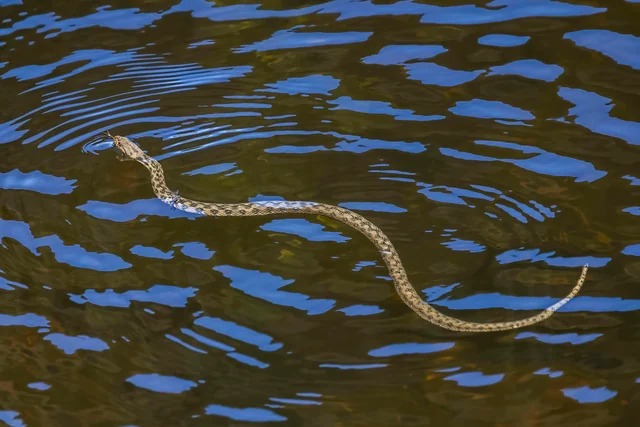
Snake with the body wavy to the surface of the water, between blue reflexes and small ripples.
Viperine water snake swimming in Extremadura, Spain, in 2022. Illustration of the species; not a record of Cabeceiras.
Photography: Charles J. Sharp · CC BY-SA 4.0
About this photograph

Date given at source: . Source consulted in 2026-11-07. EXIF orientation, proportional resize and WebP conversion; no retouching or new clipping of file obtained in Commons.

Request removal or correct the photo credit

The viperine snake’s back does not always have the same pattern.

Includes an activity to try →Explore: The same environment, different ways of life →
Read here and view sources

Natrix maura, the viperine snake, can have a zigzag stripe, but also a pattern of two pale lengthwise lines. The Spanish biodiversity inventory also describes variation in body tones. A single pattern does not represent every individual of the species.

The Parque Natural do Litoral Norte profile explains its association with rivers, ponds, streams and other aquatic environments, without excluding movement on land. This is general species context, not an observation in Cabeceiras. The story compares variation and habitat; it is not a key for identifying snakes encountered outdoors.

The Charcos com Vida project describes feeding mainly in water: invertebrates, amphibian larvae and adults, and small fish are on the menu. Water is therefore a feeding space as well as a means of movement. The snake can itself be prey for birds and mammals; being a predator does not remove it from the food web.

It is usually active by day but may remain active at dusk or at night in summer. Behaviour also changes when threatened: the profile mentions widening the head and other defensive signals that contribute to its resemblance to a viper and its common name. This explanation of the name does not allow the species or the safety of an encounter to be decided from head shape.

Words in this story: see explanations →
Source and context

Inventory Español del Patrimonio Natural y la Biodiversidad — Natrix maura, description of the species

Co-management of the Northern Coastal Natural Park — Reptiles and amphibians, record of the viperine water snake

Lived Chargings — Viperine Water Cobra, Feeding and Behaviour

Accessed: . Editorial summary; the date of consultation is not the date of the facts.

Cavez · record from 2016–2017 and general biology

A fish with a network of scales

Dark scale edges create a pattern on the northern Iberian chub.

Includes an activity to try →
Read here and view sources

The Arouca Geopark profile describes Squalius carolitertii with an elongated body, a large rounded head and scales with darker edges that create a net-like pattern. It presents the fish as endemic to Iberia: its natural distribution belongs to the Iberian Peninsula, not just Cabeceiras.

The description mentions mountain and lowland rivers, reminding us that one species can occupy different settings along the river network. These general features help introduce the fish; they are not enough to identify an individual from a distance.

The local connection comes from another source: the northern Iberian chub appears in the Cavez sampling survey from 2016–2017. The report documents that survey without establishing current presence or abundance.

The Geopark profile gives a maximum length of 25 centimetres and a breeding season between April and June. It describes the dorsal fin with a straight outline and the anal fin with a convex one. These are details to compare in a suitable illustration or photograph, not dimensions or dates measured during the Cavez survey. The spindle-shaped body, broader in the middle and tapered at the ends, completes this small exploration of form.

Words in this story: see explanations →
Source and context

Arouca Geopark — Northern scale, Squalius carolitertii: description and biology
Accessed:

Biosphere / Iberdrola, APA file — Monitoring of ichthyofauna 2016–2017, February 2018; pp. 5, 35 and 40, station record 22 on p. 175 PDF
Accessed:

Editorial summary; the date of consultation is not the date of the facts.

Birds · general biology in Portugal

An acrobat among the leaves

The blue tit even searches for food upside down.

Read here and view sources

A blue cap and wings, white cheeks and a dark line beside the eyes help identify Cyanistes caeruleus. Its yellowish breast adds to the contrast. But watch how it moves too: the University of Évora describes this small bird hopping along branches and hanging upside down as it feeds.

Among the leaves, it searches for insects and spiders. In autumn and winter, fruits and seeds may also form part of its diet. Its food is therefore not a fixed list for every season: what it finds in the landscape changes.

The blue tit is resident and occurs across mainland Portugal. The Gulbenkian profile describes a range of wooded habitats, from woods and riverside trees to orchards, hedges and gardens. A garden and a wooded riverbank offer different settings in which to learn about this bird. These sources explain the species in Portugal; they do not document an encounter in a parish of Cabeceiras.

Words in this story: see explanations →
Source and context

University of Évora — Biodiversity of Mitra: Cyanistes caeruleus

Calouste Gulbenkian Foundation / João E. Rabaça — Blue Chapim

Accessed: . Editorial summary; the date of consultation is not the date of the facts.

Bucos · local record and general biology

A red breast, a changing menu

In winter, fruits also feature in the robin’s diet.

Read here and view sources

Erithacus rubecula owes part of its scientific name to its breast patch: rubecula evokes a reddish colour. João E. Rabaça’s description for the Gulbenkian presents a bird frequently found in wooded areas of Portugal, including parks and gardens, particularly in winter. It is a good starting point for looking at a familiar bird with a fresh question: what is it searching for to eat?

For much of the year, it feeds mainly on insects. In winter, fruits and berries become more important in its diet. This change connects the bird with plants and seasons: getting to know an animal also means discovering the food the landscape offers throughout the year.

Resident and migrant are not always opposing labels for an entire species. In the British example described by the BTO, resident robins share their winter surroundings with visitors from northern and eastern Europe. This example helps explain different movements within one species; it does not identify the origin of a robin observed in Cabeceiras.

There is a documented encounter in the municipality: Pedro Mendes published a robin observation dated 3 October 2021. Comparing its public location with CAOP2025 places it in Bucos, and the community identification was research grade when consulted on 7 November 2026. The record confirms that encounter, not the bird’s migratory origin. All rights to the photograph are reserved; it can be viewed at the source.

Words in this story: see explanations →
Source and context

Calouste Gulbenkian Foundation / João E. Rabaça — Red-necked pisco

British Trust for Ornithology — BirdFacts: Robin, Erithacus rubecula

iNaturalist — pisco observed by Pedro Mendes in03/10/2021, Bucos; photograph with all rights reserved

Accessed: . Editorial summary; the date of consultation is not the date of the facts.

Refojos de Basto · local record and general biology

A bird of prey with a varied menu

The common buzzard searches for food from the sky and on the ground.

Includes an activity to try →Explore: From perch to landscape →
Read here and view sources

Ecovore’s photograph shows Buteo buteo perched among branches in a record dated 1 July 2025. Comparing the published location with CAOP2025 places it in the parish of Refojos de Basto. The image lets us observe a perched bird; it does not show a hunt.

Also known in Portuguese as águia-d’asa-redonda, this bird of prey can vary greatly in the amount of white and brown in its plumage. The University of Évora describes a species resident in mainland Portugal, joined by wintering birds from northern Europe. Colour alone does not settle every identification.

The BTO describes a diet that makes use of available prey: rabbits and small mammals, but also birds, amphibians, large insects and earthworms. Searching for food can bring the buzzard down to the ground. Compare it with Montagu’s harrier: two birds of prey can share some foods without having the same way of life.

Source and context

University of Évora — Buteo buteo: plumage and distribution

British Trust for Ornithology — BirdFacts: Buzzard

Accessed: . Editorial summary; the date of consultation is not the date of the facts.

Cavez · local record and general biology

A long tail beside the water

The grey wagtail brings curiosity to the riverbank.

Includes an activity to try →Explore: The riverbank has many stories →
Read here and view sources

In David Matos’s photograph, the bird is perched beside water and a rocky surface. The record, dated 12 August 2024, is located in Cavez when its public point is compared with CAOP2025, and is identified as Motacilla cinerea. The long tail and yellow underside are details visible in this image.

The BTO describes a species associated mainly with fast-flowing water, which also uses slower rivers and the edges of lakes and ponds as it searches for aquatic insects. The habitat is more than a backdrop: it can provide food. The local photograph does not show a capture, so it cannot tell us what this bird ate during that encounter.

Compare it with the white-throated dipper: two birds associated with watercourses can find food in very different ways.

Source and context

British Trust for Ornithology — Grey Wagtail

Accessed: . Editorial summary; the date of consultation is not the date of the facts.

Cavez · local record and general biology

One shell, many patterns

Snails of the same species do not all wear the same pattern.

Includes an activity to try →
Read here and view sources

João Lima photographed this snail on 15 May 2024. The record is identified as Cepaea nemoralis, and comparing its published point with the CAOP2025 boundaries places it in Cavez. In the image, dark bands follow the shell’s whorls among wet leaves.

The Carnegie Museum of Natural History describes a shell that can have bands of different widths or no bands at all. The lip of the opening is usually brown, but not always. The species can also be confused with Cepaea hortensis. Colour, pattern and shape need to be considered together; a photograph that hides the opening leaves some clues out of sight.

Try following the spiral with your eyes. You do not need to move the animal to discover a pattern.

Source and context

Carnegie Museum of Natural History — Cepaea nemoralis

Accessed: . Editorial summary; the date of consultation is not the date of the facts.

Arco de Baúlhe e Vila Nune · local record and general biology

A slug with a leopard pattern

Discreet animals deserve a place in the municipality’s portrait too.

Includes an activity to try →
Read here and view sources

Mauro’s photograph shows a slug with dark markings and extended tentacles on stone. The record, dated 17 September 2021, is identified as Limax maximus. Comparing the published point with CAOP2025 places it in Arco de Baúlhe e Vila Nune.

The Royal Horticultural Society includes this species in its comparison of large patterned slugs, noting its nocturnal behaviour. The local photograph records an encounter; it cannot predict when the animal will appear in the same place again. Its body pattern offers a good question to begin with: where do you see separate spots, and where do they seem to form lines?

Alongside the photograph of the Cavez snail, it offers two different ways to discover land molluscs: the spiral of a shell and the pattern of an elongated body.

Source and context

Royal Horticultural Society — slug research and comparison with Limax maximus

Accessed: . Editorial summary; the date of consultation is not the date of the facts.

Greater horseshoe bat · biology described by a British source

Hunting can begin at rest

A perch can be part of a bat’s strategy.

Includes an activity to try →
Read here and view sources

Finding food does not always require continuous flight. The Bat Conservation Trust describes the greater horseshoe bat setting off from a regular perch to catch passing insects. Larger prey may be taken to a feeding perch. The same profile mentions catching prey in flight and, occasionally, on the ground.

Among the insects eaten, it lists beetles, moths, craneflies and caddisflies. The last group connects this story with insects whose larvae can build shelters in water: the adult form takes part in other food relationships.

The source describes the species in a British context. There is a documentary reference to Rhinolophus ferrumequinum in Cabeceiras, presented in another story; that does not demonstrate that these behaviours have been observed here. The comparison helps separate two questions: where has the animal been mentioned, and how can it live?

Source and context

Bat Conservation Trust — Greater horseshoe bat, behavior and feeding

Accessed: . Editorial summary; the date of consultation is not the date of the facts.

YOUR LOCAL GUIDE

What would you like to discover?

Take a closer look.