Discover Cabeceiras de BastoFree independent guide
ViveCabeceirasYOUR GUIDE TO CABECEIRAS
ENEnglish
SearchSaved

Animals

Choose a story to start with. You can change the subject or fine tune the search.

4 stories · Life you do not always see · Search: jardins

Life you do not always see

Knowing animals begins by perceiving the territory and respecting the distance.

Choose a story · 4
Species biology · photograph recorded in the municipality

A grasshopper makes it through winter

The name Egyptian grasshopper does not confine the species to one country.

Includes an activity to try →
Read here and view sources

The name Egyptian grasshopper does not limit Anacridium aegyptium to a country. Gulbenkian’s record refers to its distribution by Europe, North Africa and the Middle East and its presence in mainland Portugal, in orchards, gardens, forests and open forests.

In the Gulbenkian Garden in Lisbon, adults are described to spend the winter and enjoy the sun on trees and bushes on bright days. This observation helps to know the species, but does not automatically transfer to Cabeceiras. The local photographic record was made in September: it shows a meeting on that date, not the behavior during winter in the municipality.

In the description of the Lisbon garden, the observation sites include rosemary hedges, medronhos, olive trees and other trees that preserve leaves. The vegetation enters history as part of the environment used by adults. These references do not indicate where to look for the locust in Cabeceiras; they help to understand why a record can gather insect, season and plants. By comparing the September photograph with the winter report, it always records date and place separately.

Source and context

Calouste Gulbenkian Foundation — Anacridium aegyptium

Accessed: . Editorial summary; the date of consultation is not the date of the facts.
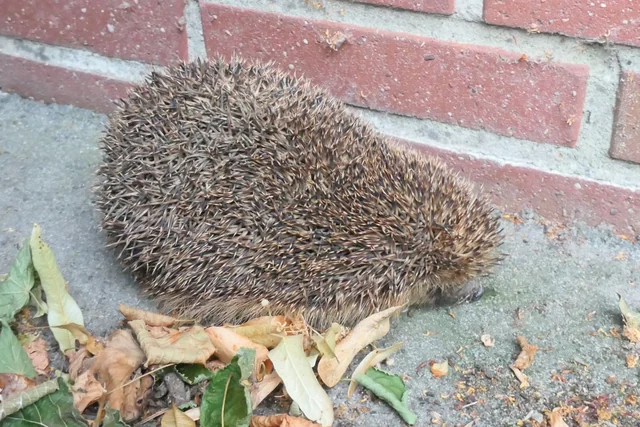
Hedgehog · general biology

Winter is not one unbroken sleep

Hedgehog next to a brick wall, with visible thorns and little head exposed.
Goldfish in Kalkar, Germany, in 2025. Illustration of the species; it is not a record of Cabeceiras.
Photography: Pieter Delicaat · CC BY-SA 4.0
About this photograph

Date given at source: . Source consulted in 2026-11-07. EXIF orientation, proportional resizing and WebP conversion of the current version in Commons; no retouching or additional clipping.

Request removal or correct the photo credit

Hedgehogs can become active again when temperatures rise.

Includes an activity to try →
Read here and view sources

According to FCT NOVA, the hibernation of the hedgehog (Erinaceus europaeus) can be interrupted for warmer periods. This nocturnal and solitary mammal eats, among other foods, insects, worms, snails and fruit. Faced with a threat, he curls up and exposes the thorns. Woods, hedges, meadows and gardens are part of their habitats. This is general biology: the source does not confirm a register in the municipality. The short legs have five fingers and there is a small tail under the thorns. FCT NOVA also mentions the ability to climb and move in the water. These are general characteristics of the species, not proposed to test the capabilities of an animal found.

Source and context

FCT NOVA — FCT VIVA: Erinaceus europaeus

Accessed: . Editorial summary; the date of consultation is not the date of the facts.

Birds · general biology in Portugal

An acrobat among the leaves

The blue tit even searches for food upside down.

Read here and view sources

A blue cap and wings, white cheeks and a dark line beside the eyes help identify Cyanistes caeruleus. Its yellowish breast adds to the contrast. But watch how it moves too: the University of Évora describes this small bird hopping along branches and hanging upside down as it feeds.

Among the leaves, it searches for insects and spiders. In autumn and winter, fruits and seeds may also form part of its diet. Its food is therefore not a fixed list for every season: what it finds in the landscape changes.

The blue tit is resident and occurs across mainland Portugal. The Gulbenkian profile describes a range of wooded habitats, from woods and riverside trees to orchards, hedges and gardens. A garden and a wooded riverbank offer different settings in which to learn about this bird. These sources explain the species in Portugal; they do not document an encounter in a parish of Cabeceiras.

Words in this story: see explanations →
Source and context

University of Évora — Biodiversity of Mitra: Cyanistes caeruleus

Calouste Gulbenkian Foundation / João E. Rabaça — Blue Chapim

Accessed: . Editorial summary; the date of consultation is not the date of the facts.

Bucos · local record and general biology

A red breast, a changing menu

In winter, fruits also feature in the robin’s diet.

Read here and view sources

Erithacus rubecula owes part of its scientific name to its breast patch: rubecula evokes a reddish colour. João E. Rabaça’s description for the Gulbenkian presents a bird frequently found in wooded areas of Portugal, including parks and gardens, particularly in winter. It is a good starting point for looking at a familiar bird with a fresh question: what is it searching for to eat?

For much of the year, it feeds mainly on insects. In winter, fruits and berries become more important in its diet. This change connects the bird with plants and seasons: getting to know an animal also means discovering the food the landscape offers throughout the year.

Resident and migrant are not always opposing labels for an entire species. In the British example described by the BTO, resident robins share their winter surroundings with visitors from northern and eastern Europe. This example helps explain different movements within one species; it does not identify the origin of a robin observed in Cabeceiras.

There is a documented encounter in the municipality: Pedro Mendes published a robin observation dated 3 October 2021. Comparing its public location with CAOP2025 places it in Bucos, and the community identification was research grade when consulted on 7 November 2026. The record confirms that encounter, not the bird’s migratory origin. All rights to the photograph are reserved; it can be viewed at the source.

Words in this story: see explanations →
Source and context

Calouste Gulbenkian Foundation / João E. Rabaça — Red-necked pisco

British Trust for Ornithology — BirdFacts: Robin, Erithacus rubecula

iNaturalist — pisco observed by Pedro Mendes in03/10/2021, Bucos; photograph with all rights reserved

Accessed: . Editorial summary; the date of consultation is not the date of the facts.

YOUR LOCAL GUIDE

What would you like to discover?

Take a closer look.