Discover Cabeceiras de BastoFree independent guide
ViveCabeceirasYOUR GUIDE TO CABECEIRAS
ENEnglish
SearchSaved

Animals

Choose a story to start with. You can change the subject or fine tune the search.

23 stories · Life you do not always see · Search: forma

Life you do not always see

Knowing animals begins by perceiving the territory and respecting the distance.

Choose a story · 23
Species biology · Portuguese context

Roe deer change their coats
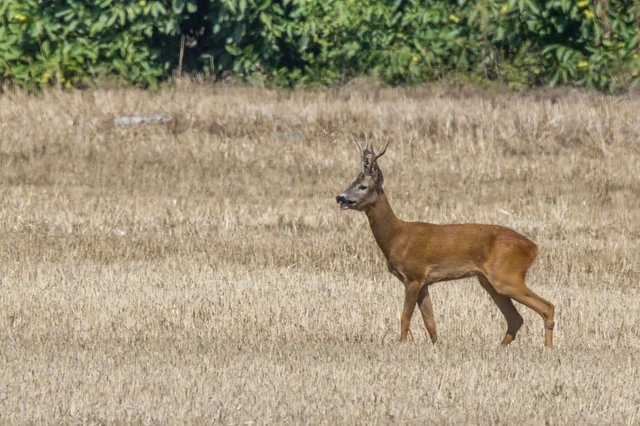
Profile hind in a field, with stems, raised ears and reddish brown coat.
Male hind in Dobruja, Romania, in August 2022. Illustration of the species; it is not a record of Cabeceiras.
Photography: Charles J. Sharp · CC BY-SA 4.0
About this photograph

Date given at source: . Source consulted in 2026-11-07. EXIF orientation, proportional resizing and WebP conversion of the current version in Commons; no retouching or additional clipping.

Request removal or correct the photo credit

One coat for summer, another for winter.

Includes an activity to try →Explore: The same world, different rhythms →
Read here and view sources

The roe deer, Capreolus capreolus, changes from a reddish-brown coat in summer to a grey one in winter. It eats plants and also uses open areas and scrub. This species description does not identify a sighting point in the municipality. Roe deer are small deer: the platform’s description gives a weight of up to 30 kg. Males have antlers; the white rump patch is kidney-shaped in males and heart-shaped in females.

Antlers follow a cycle too: the platform describes annual growth and shedding in roe deer and red deer. They are therefore not a feature that stays the same all year. On the head, the mostly black nose and upper lip contrast with the white lower lip.

Activity patterns add another difference. Although mainly active at dusk and at night, the source presents the roe deer as Portugal’s most daytime-active deer. These are species tendencies, not a guaranteed time to see one. Shape, season and behaviour need to be considered together when learning about an animal.

Words in this story: see explanations →
Source and context

Lobo-Iberico platform in Portugal — wolf prey; registration of Cabreira without date indicated

Accessed: . Editorial summary; the date of consultation is not the date of the facts.
Serra da Cabreira · species biology

A tail longer than the body

The gold-striped salamander’s life is closely tied to moisture.

Read here and view sources

The gold-striped salamander, Chioglossa lusitanica, is mentioned by Visit Cabeceiras for Serra da Cabreira. It has a slender body, a tail longer than its body and two golden or orange stripes along its dark back.

According to LPN, vegetation influences how it uses space: in farmland and forests of exotic species it tends to stay closer to streams, while in native woodland it may move farther from water. The bank is therefore part of this amphibian’s story. This is species biology, not a sighting point.

It is endemic to the Iberian Peninsula and is nocturnal. Its front feet have four toes and its hind feet five: details that help us learn about the species without handling it.

Parque Biológico de Gaia describes a terrestrial life beside watercourses, abundant vegetation and high humidity, with a diet of small invertebrates. Being associated with streams does not mean spending its whole life swimming. When reading about eggs and larvae, compare the life stage with the habitat used: the relationship with water changes during development.

Source and context

Visit Cabeceiras — natural heritage of Serra da Cabreira
Accessed:

Gaia Biological Park — Chioglossa lusitanica
Accessed:

Link to Nature Protection — Salamander-lusitan
Accessed:

Editorial summary; the date of consultation is not the date of the facts.
Serra da Cabreira · species life cycle

Before the salamander, a life in water

The stream is also where the transformation begins.

Explore: Growing up and being able to reproduce are different moments →
Read here and view sources

The gold-striped salamander’s life begins in connection with water. LPN describes eggs often attached to the substrate and larvae that remain in quiet water until metamorphosis, in a development period that may last one to two years.

During this stage, they feed on small aquatic animals, including insects, molluscs and crustaceans. Pollution and habitat loss threaten this cycle; water and surrounding vegetation matter together. The story explains the biology of the species mentioned for Cabreira, without locating breeding areas.

Completing metamorphosis is not the same as becoming able to reproduce. LPN places male sexual maturity at around three to four years and female maturity between four and five. Body transformation and reproductive maturity are therefore distinct stages. These ranges describe species biology; they cannot predict the age of an individual seen in a photograph.

Words in this story: see explanations →
Source and context

Link to Nature Protection — Salamander-lusitan
Accessed:

Visit Cabeceiras — natural heritage of Serra da Cabreira
Accessed:

Editorial summary; the date of consultation is not the date of the facts.
Species biology · with a local record

A small bird that dives

The white-throated dipper brings birdwatching into the current.

Includes an activity to try →Explore: The stream is more than water →
Read here and view sources

A compact body, short tail and white breast in adults offer clues to Cinclus cinclus, the white-throated dipper. This bird can dive and is associated with fast-flowing streams, especially in mountains. The gallery includes a local record; the photograph shows the bird in a hand, not the diving behaviour described here. Aves de Portugal describes fast, direct flight and classifies the species as resident: it may remain in breeding areas throughout the year. That general trait does not confirm a continuous presence at the local record’s location.

Underwater, the food it seeks includes small invertebrates. The BTO describes the bird entering the current from rocks or flying low to another perch. The stream is therefore a feeding space, not simply a backdrop where the bird appears.

Age also changes its appearance: juveniles are greyer and more mottled than white-breasted adults. This biological comparison does not assign an age to the photographed bird. A record shows an encounter; understanding what a species does requires bringing together other observations and sources.

Words in this story: see explanations →
Source and context

Birds of Portugal — Watermelon, identification, habits and distribution

British Trust for Ornithology — BirdFacts: Dipper, Cinclus cinclus

Accessed: . Editorial summary; the date of consultation is not the date of the facts.

Species biology · trace recorded in Cavez

At dusk, a bird can seem like an insect

Not every bird is discovered by looking up at the sky.

Includes an activity to try →
Read here and view sources

The European nightjar feeds on insects and becomes active at dusk and during the night. Its continuous song can resemble a cicada’s sound. In Portugal it is a summer visitor, associated mainly with the north and the transition between woodland and open spaces. The Cavez record shows a feather attributed to this species by the iNaturalist community. It is a trace: not a photograph of the whole bird or proof of a nest at that point. Curiosity begins with a feather and continues into the soundscape.

Long wings and a long tail may be visible in silhouette, but low light hides details. The Aves de Portugal profile explains that females lack the white wing patches of males; juveniles lack them too. The absence of a mark alone does not determine age and sex.

The source describes a late arrival, with song easier to detect in May and June. This is a Portuguese pattern, not a sightings calendar for Cavez. The recorded feather cannot tell us when the bird sang, where it nested or how long it stayed in the area.

To understand journeys, researchers need another kind of record. The BTO presents tracking studies that located an important wintering area in grassland and shrub landscapes south of the equatorial forest, mainly in the Democratic Republic of the Congo. This information concerns birds tracked in those studies, not a demonstrated destination for the bird associated with the Cavez feather. A feather documents a trace in one place; tracking connects positions over time to study movements.

Source and context

Poultry of Portugal — Caprimulgus europaeus

British Trust for Ornithology — BirdFacts: Nightjar, Caprimulgus europaeus; follow-up and winter studies

Accessed: . Editorial summary; the date of consultation is not the date of the facts.

Species recorded in the municipality · general ecology

An old trunk still nourishes life

For beetle larvae, decaying wood can be both home and food.

Includes an activity to try →Explore: A photograph, several phases of history →
Read here and view sources

The larvae of Dorcus parallelipipedus live and feed in decaying wood, according to The Wildlife Trusts. The catalogue photograph documents an adult observed in the municipality; it does not show larvae or confirm the tree in which they developed. Connect this story with wood fungi: an ageing trunk can support different forms of life. There is no need to dismantle an animal’s shelter to observe it. In adults, The Wildlife Trusts highlights the broad head, jaws and entirely black wing cases. These are clues to compare with the available photograph, without concluding that every dark beetle belongs to this species.

Source and context

The Wildlife Trusts — Lesser stag beetle, Dorcus parallelipipedus
Consultations: ,

Editorial summary; the date of consultation is not the date of the facts.

Ocellated lizard · general ecology, with a historical reference to Gondiães

Sun in view, shelter nearby

An ocellated lizard needs more than open ground.

Explore: Sun, water and different shapes →
Read here and view sources

The University of Évora profile associates the ocellated lizard with sunny areas that offer shelter: shrubs, stone walls, burrows and other cavities. It also describes the use of farmland and pinewood clearings. This is general ecology for a species with a historical record in Gondiães, not an inventory of animals or shelters currently present in that parish.

Timon lepidus is known in Portuguese as sardão or lagarto-ocelado. The University of Évora’s description highlights blue spots edged in black on the flanks and a robust head. Total length may reach 80 centimetres, including the tail: this does not mean an 80-centimetre body alone. The tail can exceed twice the body length.

Sun and shelter are two parts of the same habitat. A clearing offers exposure, while shrubs, cavities and walls provide refuges. The profile describes that combination, not a preference for any simply open terrain. The Gondiães record connects the species with local natural history; the habitat explanation does not turn every wall in the parish into a confirmed presence site.

Words in this story: see explanations →
Source and context

University of Évora — Virtual Museum of Biodiversity, Timon lepidus; MVBIO / Darío Estradiz López
Accessed:

J. Teixeira et al. — Nuevos datos sobre la distribución de la herpetofauna en Portugal, Boletín AHE 7 (1996), p. 11; PDF sheet 13
Accessed:

Editorial summary; the date of consultation is not the date of the facts.

Amphibians · comparing groups

A tail offers a clue

Compare an adult frog with an adult salamander.

Includes an activity to try →
Read here and view sources

Frogs and toads belong to the anurans: as adults they have no tail, and their hind legs are developed for jumping. In urodeles, such as salamanders and newts, the tail remains in adulthood. Life stage matters in this comparison: a tadpole has a tail. This distinction between groups is not enough to identify a species.

Start by comparing the same life stage. A tadpole and an adult frog are not two different groups; they are developmental forms. Comparing an adult frog with an adult newt, however, reveals the difference between anurans and urodeles. Aquário Vasco da Gama also describes urodele limbs as suited to walking, in contrast with anurans’ developed hind legs.

Source and context

Vasco da Gama Aquarium — Thematic Sheets: Amphibians, 2th cycle, pp. 1–2

Accessed: . Editorial summary; the date of consultation is not the date of the facts.

General biology · bee nesting places

Not all bees look for the same home

Learning about shelters adds another dimension to flowers.

Includes an activity to try →Explore: Flowers, shelters and wood →
Read here and view sources

A flower can provide food, but it does not meet all a bee’s needs. Entomologists Renata Santos and Albano Soares distinguish carpenter bees, which use dead wood for nesting, from mining bees, which need bare soil. A garden’s variety also includes different nesting places.

So-called insect hotels serve only some species, notably certain cavity-nesting bees. They are a supplement, not a universal home. The idea is to recognise connections between flowers, soil and wood, not to search for or open nests. These general examples do not confirm local nests.

Time matters too: different plants can provide flowers at different times. The researchers recommend diversity in flower shapes and flowering periods. When thinking about a garden, it is useful to connect three questions: what provides food, where might there be shelter, and when in the year are those resources available?

Source and context

Calouste Gulbenkian Foundation — explanations of entomologists Renata Santos and Albano Soares, 07/06/2022

Accessed: . Editorial summary; the date of consultation is not the date of the facts.

Soil life · general ecology

Beneath our feet, a world of mixtures

Soil contains water and air too.

Includes an activity to try →Explore: From the ground to the water, follow the connections →
Read here and view sources

The ground is not a solid block: mineral particles and organic matter share space with water, air and organisms. Rock, climate and living things all take part in soil formation.

Looking only at the surface leaves much life undiscovered. This explanation helps explore gardens and woods, but does not replace an analysis of Cabeceiras’s soils.

Life is not evenly distributed. FAO describes areas of intense activity near roots, where plant remains accumulate, and along the walls of earthworm tunnels. The immediate surroundings of a root have a name: the rhizosphere. Thinking about these small zones helps explain why two nearby pieces of soil can offer different conditions to organisms.

Some inhabitants are unlikely to be seen on a walk. Bacteria take part in transforming organic matter; some associate with roots and contribute to nitrogen fixation. Fungi also break down remains and can form relationships with plants. They do not all do the same job: soil brings together overlapping activities, from feeding to the transformation of materials.

A covering of leaves is more than a finishing layer on a woodland floor. It is material that can feed this community. In the interview published by the Gulbenkian, the researchers recommend retaining some leaf litter in green spaces and avoiding frequent deep disturbance of the soil. These are general conservation guidelines, not an assessment or prescription for every plot in the municipality.

Words in this story: see explanations →
Source and context

Calouste Gulbenkian Foundation / Wilder — Cristina Cruz, Teresa Dias and Silvana Munzi (FCUL), 26/03/2024

FAO — What is soil biodiversity?

Accessed: . Editorial summary; the date of consultation is not the date of the facts.

Soil life · general ecology

Tiny animals graze on fungi

Springtails live in a world measured in millimetres.

Includes an activity to try →
Read here and view sources

Some mites and springtails feed on fungi in the soil. This relationship connects small animals with leaf decomposition and nutrient cycling.

Springtails are microarthropods, only a few millimetres long. Many have a forked structure, the furcula, that lets them jump and escape predators. The description helps us imagine hidden soil life; it does not identify species present in Cabeceiras.

Scale helps tell this story. According to FAO, mites and springtails feeding on bacteria and fungi can affect microbial communities in a small area of soil. At the same time, larger animals change the structure in which that life develops. Climate, plants and soil properties complete the setting.

A food web beneath our feet is therefore not an isolated sequence of meals. What one organism eats and the spaces another transforms can influence each other. Following a fallen leaf to fungi and small animals is a way into that web, without assuming that all springtails have exactly the same diet.

Words in this story: see explanations →
Source and context

Calouste Gulbenkian Foundation / Wilder — Cristina Cruz, Teresa Dias and Silvana Munzi (FCUL), 26/03/2024

FAO — What is soil biodiversity?

Accessed: . Editorial summary; the date of consultation is not the date of the facts.

Painzela · local record and general biology

Similar names, different relatives

A swallow is not a small swift.

Includes an activity to try →Explore: How would you like to discover birds? →
Read here and view sources

Swallows and swifts catch insects in flight, but belong to different orders. Swallows are Passeriformes, like blackbirds and tits; swifts are Apodiformes, like hummingbirds. Their similar Portuguese names conceal different family relationships.

Nesting places tell stories too: the Gulbenkian guide describes the house martin’s nests of mud and small grasses beside roofs. Common and pallid swifts use recesses among roof tiles and beside chimneys. These are examples from Portugal, not locations of nests in the municipality.

In Painzela, a photograph by birdlovers records a barn swallow on 8 August 2025. Hirundo rustica builds cup-shaped mud nests and catches small insects in flight, according to the University of Évora. The photograph shows a pause on a wire, not a nest or feeding. It provides a local connection to one species in this family, without making the location a guaranteed place to see it.

Source and context

Calouste Gulbenkian Foundation / Wilder — Essential guide for swallows and swallows, 09/05/2024

University of Évora — Hirundo rustica

Accessed: . Editorial summary; the date of consultation is not the date of the facts.

Cabeceiras de Basto · occurrence mentioned in an environmental study

A bat entered the area’s records too

An environmental reference adds nocturnal life to the portrait of Cabeceiras.

Explore: From registration to questions about the species →
Read here and view sources

The environmental report for the Ribeira de Pena–Vieira do Minho power line, archived by the Portuguese Environment Agency, mentions a greater horseshoe bat, Rhinolophus ferrumequinum, record in a roost associated with Cabeceiras de Basto. This is documentary evidence of the species’ occurrence, not a current population count. The information does not allow a parish to be assigned here or an observation location to be announced.

Source and context

Matos, Fonseca & Associados / REN — EIA da Linha Dupla Ribeira de Pena–Vieira do Minho 1/2, relatório síntese, p.169; arquivo APA

Accessed: . Editorial summary; the date of consultation is not the date of the facts.

Bats · general ecological roles

Small hunters with a role in the landscape

Eating insects connects bats with fields and forests too.

Includes an activity to try →Explore: Eat, orient and rest →
Read here and view sources

Insect-eating bats connect the night with fields and forests. By feeding, they help control insect populations, including species that can affect farming and trees. The ICNF text invites us to discover this ecological role beyond the myths surrounding bats.

Worldwide, there are other diets and relationships: fruit-eating bats can contribute to forest regeneration, while pollen-feeding bats take part in pollination. These global examples do not assign those diets to species recorded in Cabeceiras.

Thinking about food is a way to connect an animal with the landscape. What resources does it seek? What other organisms are involved? Ecological roles are not limited to the number of individuals we can see. In the local story, this explanation accompanies the documentary record of the greater horseshoe bat; it adds no new observation.

Words in this story: see explanations →
Source and context

ICNF — There are bats in the air..., text by Cristina Girão Vieira

Accessed: . Editorial summary; the date of consultation is not the date of the facts.

Reptiles · general biology, without a confirmed local record in this profile

A lizard between sun and moisture

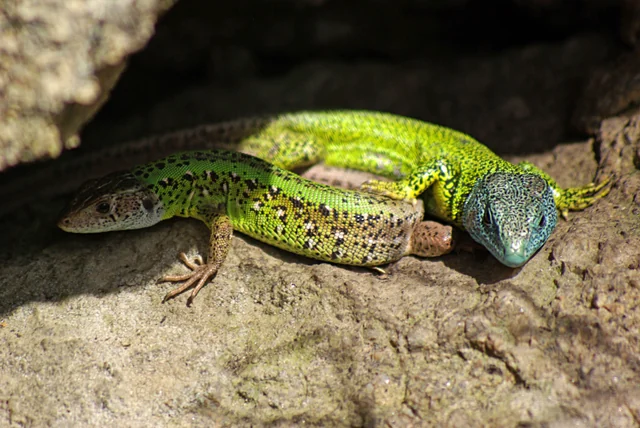
Two lizards on stone, one in the foreground and the other in the back, with green coloring and dark spots.
Water lizards photographed in Candelario, Salamanca, Spain, in 2013. Illustration of the species; it is not a record of Cabeceiras.
Photography: David Perez (DPC) · CC BY3.0
About this photograph

Date given at source: . Source consulted in 2026-11-07. EXIF orientation, proportional resize and WebP conversion; no retouching or new clipping of file obtained in Commons.

Request removal or correct the photo credit

Needing warmth does not mean living far from water.

Includes an activity to try →Explore: Grow and feed by the water →
Read here and view sources

Schreiber’s green lizard, Lacerta schreiberi, is associated with damp habitats, riverside vegetation, walls and brambles. The description published in Ambienta explains that it uses the sun’s warmth for activity but shelters during summer’s hottest hours. Being close to water and choosing somewhere to warm up are parts of the same life.

It feeds mainly on invertebrates, including insects and arachnids. Colour varies too: males’ throats can turn intense blue during the breeding season. These general features do not confirm the species of an animal glimpsed in passing. The consulted source is not a Cabeceiras record.

Age also changes the spaces it seeks. The Charcos com Vida project distinguishes adults needing shelters among rocks and dense scrub from juveniles associated with herbaceous vegetation. A varied bank can offer different refuges rather than acting as a uniform strip.

According to the same profile, reproduction takes place between spring and midsummer. Females lay between six and seventeen eggs, with incubation generally lasting two to three months. These ranges describe the species, not a clutch monitored in the municipality.

The lizard both hunts small invertebrates and provides food for other animals. The source names birds of prey, genets and otters among its predators. This is another connection between bank vegetation, water and the food web.

Words in this story: see explanations →
Source and context

Khris Valero — Lacerta schreiberi, magazine Ambienta, January 2004, pp. 61–62; archive of the Spanish Ministry MAPA

Charcoals with Life — Water Lizard, habitat and life cycle

Accessed: . Editorial summary; the date of consultation is not the date of the facts.

Reptiles · general biology, without a confirmed local record in this profile

No legs, but not a snake

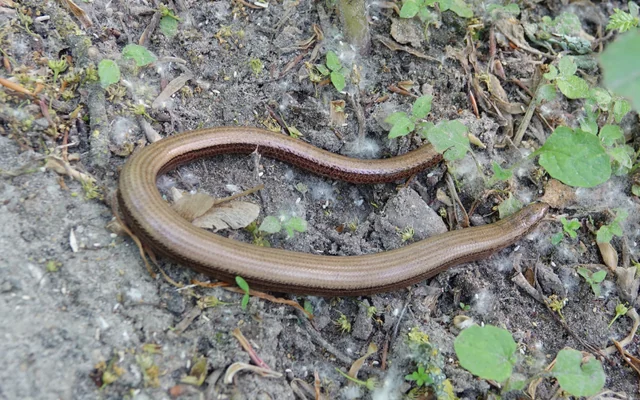
Licran of elongated brown body, bent on the ground between leaves and small plants.
Licensing photographed in Wyhl am Kaiserstuhl, Germany, in 2024. Illustration of the species; it is not a record of Cabeceiras.
Photography: Gzen92 · CC BY-SA 4.0
About this photograph

Date given at source: . Source consulted in 2026-11-07. EXIF orientation, proportional resize and WebP conversion; no retouching or new clipping of file obtained in Commons.

Request removal or correct the photo credit

A slow worm’s silhouette does not tell the whole story.

Includes an activity to try →Explore: Body and Way of Life →
Read here and view sources

The slow worm, Anguis fragilis, is a legless lizard. The Xunta de Galicia’s agricultural biodiversity guide describes it in cool, damp places such as meadows and walls, where it feeds on slugs and insects. Its elongated shape may resemble a small snake, but that similarity does not determine its group.

This explanation helps compare forms and ways of life. The guide concerns Galicia’s agricultural landscape; it does not prove an occurrence in Cabeceiras or allow identification from an unclear photograph alone.

There is more to observe than the absence of legs. The Wildlife Trusts highlights movable eyelids, which let the slow worm blink, and the ability to shed its tail. The female retains eggs inside her body until the young are born. These are general characteristics of Anguis fragilis, without a local record associated with this story.

Its rhythm also changes through the year. The organisation describes a state of winter dormancy called brumation. The source’s calendar concerns the United Kingdom and is not transferred to Cabeceiras. Getting to know the species means distinguishing body shape, behaviour and the information’s geographical context.

Words in this story: see explanations →
Source and context

Xunta de Galicia — Guía for the conservation of biodiversity in Galicia, Anguis fragilis, p. 54

The Wildlife Trusts — Slow worm (Anguis fragilis), general biology; British context

Accessed: . Editorial summary; the date of consultation is not the date of the facts.

Reptiles · general biology, without a confirmed local record in this profile

One snake can have different patterns

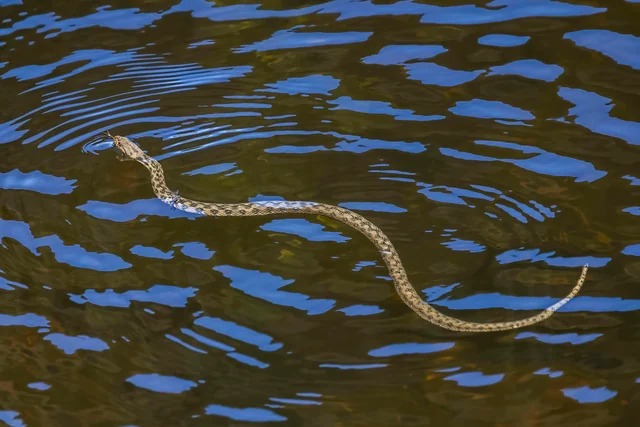
Snake with the body wavy to the surface of the water, between blue reflexes and small ripples.
Viperine water snake swimming in Extremadura, Spain, in 2022. Illustration of the species; not a record of Cabeceiras.
Photography: Charles J. Sharp · CC BY-SA 4.0
About this photograph

Date given at source: . Source consulted in 2026-11-07. EXIF orientation, proportional resize and WebP conversion; no retouching or new clipping of file obtained in Commons.

Request removal or correct the photo credit

The viperine snake’s back does not always have the same pattern.

Includes an activity to try →Explore: The same environment, different ways of life →
Read here and view sources

Natrix maura, the viperine snake, can have a zigzag stripe, but also a pattern of two pale lengthwise lines. The Spanish biodiversity inventory also describes variation in body tones. A single pattern does not represent every individual of the species.

The Parque Natural do Litoral Norte profile explains its association with rivers, ponds, streams and other aquatic environments, without excluding movement on land. This is general species context, not an observation in Cabeceiras. The story compares variation and habitat; it is not a key for identifying snakes encountered outdoors.

The Charcos com Vida project describes feeding mainly in water: invertebrates, amphibian larvae and adults, and small fish are on the menu. Water is therefore a feeding space as well as a means of movement. The snake can itself be prey for birds and mammals; being a predator does not remove it from the food web.

It is usually active by day but may remain active at dusk or at night in summer. Behaviour also changes when threatened: the profile mentions widening the head and other defensive signals that contribute to its resemblance to a viper and its common name. This explanation of the name does not allow the species or the safety of an encounter to be decided from head shape.

Words in this story: see explanations →
Source and context

Inventory Español del Patrimonio Natural y la Biodiversidad — Natrix maura, description of the species

Co-management of the Northern Coastal Natural Park — Reptiles and amphibians, record of the viperine water snake

Lived Chargings — Viperine Water Cobra, Feeding and Behaviour

Accessed: . Editorial summary; the date of consultation is not the date of the facts.

Cavez · record from 2016–2017 and general biology

A fish with a network of scales

Dark scale edges create a pattern on the northern Iberian chub.

Includes an activity to try →
Read here and view sources

The Arouca Geopark profile describes Squalius carolitertii with an elongated body, a large rounded head and scales with darker edges that create a net-like pattern. It presents the fish as endemic to Iberia: its natural distribution belongs to the Iberian Peninsula, not just Cabeceiras.

The description mentions mountain and lowland rivers, reminding us that one species can occupy different settings along the river network. These general features help introduce the fish; they are not enough to identify an individual from a distance.

The local connection comes from another source: the northern Iberian chub appears in the Cavez sampling survey from 2016–2017. The report documents that survey without establishing current presence or abundance.

The Geopark profile gives a maximum length of 25 centimetres and a breeding season between April and June. It describes the dorsal fin with a straight outline and the anal fin with a convex one. These are details to compare in a suitable illustration or photograph, not dimensions or dates measured during the Cavez survey. The spindle-shaped body, broader in the middle and tapered at the ends, completes this small exploration of form.

Words in this story: see explanations →
Source and context

Arouca Geopark — Northern scale, Squalius carolitertii: description and biology
Accessed:

Biosphere / Iberdrola, APA file — Monitoring of ichthyofauna 2016–2017, February 2018; pp. 5, 35 and 40, station record 22 on p. 175 PDF
Accessed:

Editorial summary; the date of consultation is not the date of the facts.

Cavez · local record and general biology

A long tail beside the water

The grey wagtail brings curiosity to the riverbank.

Includes an activity to try →Explore: The riverbank has many stories →
Read here and view sources

In David Matos’s photograph, the bird is perched beside water and a rocky surface. The record, dated 12 August 2024, is located in Cavez when its public point is compared with CAOP2025, and is identified as Motacilla cinerea. The long tail and yellow underside are details visible in this image.

The BTO describes a species associated mainly with fast-flowing water, which also uses slower rivers and the edges of lakes and ponds as it searches for aquatic insects. The habitat is more than a backdrop: it can provide food. The local photograph does not show a capture, so it cannot tell us what this bird ate during that encounter.

Compare it with the white-throated dipper: two birds associated with watercourses can find food in very different ways.

Source and context

British Trust for Ornithology — Grey Wagtail

Accessed: . Editorial summary; the date of consultation is not the date of the facts.

Abadim · local record and general biology

Wing markings offer a clue to the chaffinch

Males and females have different colours, but share wing markings.

Includes an activity to try →Explore: Colours, seasons and food →
Read here and view sources

The common chaffinch, Fringilla coelebs, appears in a record by naturpel dated 6 February 2022. Comparing its public point with CAOP2025 places it in Abadim. In the image, look for the contrasting pale wing markings and the shades of the breast, although movement makes the photograph less sharp.

Aves de Portugal describes males with a bluish cap and reddish breast and cheeks. Females have more subdued brown and grey tones, but retain a contrasting wing pattern. The bill is sturdy and conical. Comparing several features is more useful than looking for a single colour.

The species is resident in Portugal and is joined by wintering birds in autumn. There may then be more individuals, although they can behave less conspicuously than in spring. This general description cannot tell us whether the bird photographed in February was born in the region or arrived from elsewhere.

Source and context

Birds of Portugal — Common finch

Accessed: . Editorial summary; the date of consultation is not the date of the facts.

Cavez · local record and general biology

One shell, many patterns

Snails of the same species do not all wear the same pattern.

Includes an activity to try →
Read here and view sources

João Lima photographed this snail on 15 May 2024. The record is identified as Cepaea nemoralis, and comparing its published point with the CAOP2025 boundaries places it in Cavez. In the image, dark bands follow the shell’s whorls among wet leaves.

The Carnegie Museum of Natural History describes a shell that can have bands of different widths or no bands at all. The lip of the opening is usually brown, but not always. The species can also be confused with Cepaea hortensis. Colour, pattern and shape need to be considered together; a photograph that hides the opening leaves some clues out of sight.

Try following the spiral with your eyes. You do not need to move the animal to discover a pattern.

Source and context

Carnegie Museum of Natural History — Cepaea nemoralis

Accessed: . Editorial summary; the date of consultation is not the date of the facts.

Arco de Baúlhe e Vila Nune · local record and general biology

A slug with a leopard pattern

Discreet animals deserve a place in the municipality’s portrait too.

Includes an activity to try →
Read here and view sources

Mauro’s photograph shows a slug with dark markings and extended tentacles on stone. The record, dated 17 September 2021, is identified as Limax maximus. Comparing the published point with CAOP2025 places it in Arco de Baúlhe e Vila Nune.

The Royal Horticultural Society includes this species in its comparison of large patterned slugs, noting its nocturnal behaviour. The local photograph records an encounter; it cannot predict when the animal will appear in the same place again. Its body pattern offers a good question to begin with: where do you see separate spots, and where do they seem to form lines?

Alongside the photograph of the Cavez snail, it offers two different ways to discover land molluscs: the spiral of a shell and the pattern of an elongated body.

Source and context

Royal Horticultural Society — slug research and comparison with Limax maximus

Accessed: . Editorial summary; the date of consultation is not the date of the facts.

Greater horseshoe bat · biology described by a British source

Hunting can begin at rest

A perch can be part of a bat’s strategy.

Includes an activity to try →
Read here and view sources

Finding food does not always require continuous flight. The Bat Conservation Trust describes the greater horseshoe bat setting off from a regular perch to catch passing insects. Larger prey may be taken to a feeding perch. The same profile mentions catching prey in flight and, occasionally, on the ground.

Among the insects eaten, it lists beetles, moths, craneflies and caddisflies. The last group connects this story with insects whose larvae can build shelters in water: the adult form takes part in other food relationships.

The source describes the species in a British context. There is a documentary reference to Rhinolophus ferrumequinum in Cabeceiras, presented in another story; that does not demonstrate that these behaviours have been observed here. The comparison helps separate two questions: where has the animal been mentioned, and how can it live?

Source and context

Bat Conservation Trust — Greater horseshoe bat, behavior and feeding

Accessed: . Editorial summary; the date of consultation is not the date of the facts.

YOUR LOCAL GUIDE

What would you like to discover?

Take a closer look.