Discover Cabeceiras de BastoFree independent guide
ViveCabeceirasYOUR GUIDE TO CABECEIRAS
ENEnglish
SearchSaved

Story

Choose a story to start with. You can change the subject or fine tune the search.

5 stories · Travel through time · Search: escola

Travel through time

Documents, details and traditions: there is more to discover than a date on a stone.

Choose a story · 5
Arco de Baúlhe · remembering Júlio Henriques and the 2013 tribute

A botanist in the school library’s name

In Arco de Baúlhe, science can be found on a sign too.

Read here and view sources

Júlio Augusto Henriques was born in Arco de Baúlhe in 1838 and became a distinguished botanist. In June 2013, the municipality honoured him by naming the library at the Escola Básica do Arco after him. The announcement recalls his departure for Coimbra at sixteen and his dedication to science. Learning about the library’s namesake turns a name on a school door into a link between his birthplace, study and shared memory. This is the school library, distinct from the Biblioteca Municipal Dr. António Teixeira de Carvalho.

Source and context

Municipality — tribute to botanist Júlio Henriques in the school library of Arco de Baúlhe, news of 17/06/2013

Accessed: . Editorial summary; the date of consultation is not the date of the facts.
Refojos · changes in the 19th and 20th centuries

After the monks, new lives

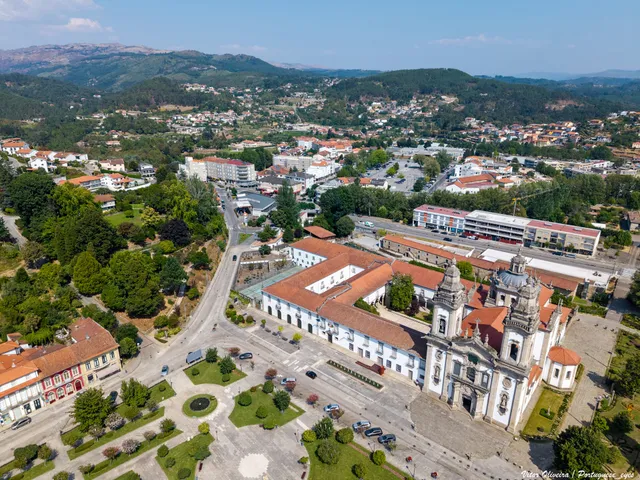
Aerial view of the Monastery of São Miguel and Praça da República in Refojos
Current view of the Monastery of Refojos and the square; it is not an image of the nineteenth-century uses.© Vitor Oliveira from Torres Vedras, PORTUGALⓘ

The town hall and school belong to the building’s history too.

Explore: The building changed its life by stages →
Read here and view sources

The dissolution of religious orders in 1834 changed the future of the Refojos complex, while the church retained its religious role. According to the municipal heritage nomination proposal, João António Fernandes Basto bought the Monastery at public auction between 1838 and 1842. In the 19th century, the complex also housed municipal services; in 1944, another part became a boarding school. Looking at the complex also reveals how old buildings were adapted for administration and education.

The document places the arrival of municipal services in the cloisters around 1855. For the school area, it records another change of ownership in 1959, to the Seminário Conciliar de Braga. The complex therefore did not have a single future after 1834: its different parts followed their own stories. The heritage proposal serves here as a historical source; it does not establish UNESCO designation or confirm the current use of each space.

Words in this story: see explanations →See Fact sheet: Mosteiro de São Miguel de Refojos
Source and context

Municipality — proposal for a heritage registration of the Monastery, pp. 9 and 11; later uses in p. 11 (candidature document, not a UNESCO classification)

Basto Land Museum — The place of the Pereiras of Refojos de Basto, 28/07/2024

Accessed: . Editorial summary; the date of consultation is not the date of the facts.

Arco de Baúlhe · history of the municipal library

In Arco, books found a home in 2005

A library holds encounters and discoveries too.

Read here and view sources

The Biblioteca Municipal Dr. António Teixeira de Carvalho opened in 2005 beside the Escola Básica do Arco de Baúlhe. The municipal presentation describes two reading rooms and an auditorium, along with spaces for work and meetings. It also recalls activities including storytelling, workshops, literary competitions, cinema and exhibitions. The building’s history shows how reading meets other forms of cultural participation. To plan a visit, consult the place listing.

Source and context

Municipality — Biblioteca Municipal Dr. António Teixeira de Carvalho: opening in 2005

Accessed: . Editorial summary; the date of consultation is not the date of the facts.

Pereiras, Refojos · former uses of the town hall

From prison to music

A building can change its role in the community.

Explore: The Pereiras beyond a building →
Read here and view sources

In Pereiras, the former town hall continued to serve as a prison until 1972, according to the Museu das Terras de Basto. After restoration, it became the Casa da Música. A municipal news item from July 2010 already listed it among places to discover in the municipality. The Museum’s article dates the town hall’s move to the Monastery to 1835 and the opening of the Casa da Música to 2003: the building continued changing roles after municipal administration left.

The building’s story begins before the prison preserved in local memory. The Museum’s article attributes the order to build the town hall in 1586 to the magistrate João Gil de Abreu Castelo Branco. It then suggests an 18th-century reconstruction on the site of the earlier building.

Its two storeys divided the functions: prison on the lower level, town council and hearings above. This arrangement brought administration and justice together. When the council left, the prison remained; when the prison closed, the building survived. Opening as the Casa da Música in 2003 added another use to a building with many chapters.

Source and context

Basto Land Museum — The place of the Pereiras of Refojos de Basto, 28/07/2024

Municipality — visits to see the municipality, news of 29/07/2010

Accessed: . Editorial summary; the date of consultation is not the date of the facts.

Pereiras, Refojos · football in the 20th century

When football gained a pitch

Pereiras also belongs to sporting memory.

Includes an activity to try →Explore: The Pereiras had several lives →
Read here and view sources

In Pereiras, the municipality’s memory also includes football. The Museu das Terras de Basto identifies the pitch opened in 1925 as the first in Cabeceiras de Basto. It became home to different sports clubs, linking the place to the game and to gatherings of those who followed it.

In 1982, construction of National Road 311 caused the pitch to move elsewhere. A sports facility can help tell the story of a settlement’s transformation: the space changes, but memory preserves the connection to the former site.

The Museum’s article, published in July 2024, places the pitch in a settlement that had shops, a school and fairs. Its bibliography includes O Jornal de Cabeceiras of 20 September 1925 and Ecos de Cabeceiras of 15 August that year. These are references cited by the Museum; their contents are not reproduced here.

Source and context

Basto Land Museum — The place of the Pereiras of Refojos de Basto, 28/07/2024

Accessed: . Editorial summary; the date of consultation is not the date of the facts.

YOUR LOCAL GUIDE

What would you like to discover?

Take a closer look.