Discover Cabeceiras de BastoFree independent guide
ViveCabeceirasYOUR GUIDE TO CABECEIRAS
ENEnglish
SearchSaved

Plants

Choose a story to start with. You can change the subject or fine tune the search.

5 stories · Read the landscape through the plants · Search: escola

Read the landscape through the plants

Trees, forests, vineyards and fields reveal different ways of occupying the territory.

Choose a story · 5
Refojos de Basto · history and mission of an educational centre

A green space can teach us too

At Vinha de Mouros, leisure meets environmental education.

Includes an activity to try →Explore: Choose what you want to observe →
Read here and view sources

The Vinha de Mouros Environmental Education Centre opened on 10 August 2001. In the municipal presentation, conserving and promoting local flora and fauna is part of its mission, alongside educational work with schools. The space was designed to bring different audiences closer to the municipality’s natural heritage.

The same presentation brings together different functions: picnic areas, play spaces, minigolf, a fitness circuit and support for the educational programme. A visit can therefore begin with a break and continue with questions about the landscape. The practical profile distinguishes facilities and conditions of use; this story does not announce a scheduled guided activity.

A useful question separates what we see from what we infer. A photograph of the park shows trees and tables, but does not identify every plant or demonstrate that an animal species lives freely there. The following stories help us look at leaves, soil and relationships between living things, without turning examples of general biology into an inventory of Vinha de Mouros.

See Fact sheet: Vinha de Mouros
Source and context

Municipality — Centro de Educação Ambiental of Vinha de Mouros: origin and objectives

Accessed: . Editorial summary; the date of consultation is not the date of the facts.
Painzela · gardens and skills

Plants shaped by human hands

Camellias and yews are part of the story of these gardens.

Includes an activity to try →Explore: The garden also holds knowledge →
Read here and view sources

Camellias and yews trimmed into geometric or animal shapes: this is the art of topiary. The Portuguese Historic Gardens Association links this tradition to the school of Manuel Joaquim Alves Soares, continued by his son Joaquim. Casa de Piellas, in Painzela, is part of this history. It is private property; check the visiting conditions in its place profile.

The Rota do Tâmega presentation links this school of gardening to support from the sisters Emília Ermelinda and Justina Praxedes Pinto Basto. In the mid-19th century, they are said to have supported Manuel Joaquim Alves Soares’s training in Porto and England. The story of these plant shapes therefore also involves the sharing of knowledge and its transmission between generations.

Looking at topiary means looking both at a plant and at human skill. Geometric shapes organise lines and volumes; animal shapes evoke living creatures. The association identifies examples of this tradition at several estates in Basto, not just Piellas.

Words in this story: see explanations →Getting to know the parish See Fact sheet: Casa de Pielas, jardins e anexos
Source and context

Portuguese Association of Historical Gardens — Route Tâmega

Portuguese Association of Historical Gardens — Casa de Piellas, Painzela

Accessed: . Editorial summary; the date of consultation is not the date of the facts.

Local observation · União das freguesias de Arco de Baúlhe e Vila Nune · general botany

Flowers and fruit on the same branch

The strawberry tree’s seasons overlap.

Includes an activity to try →Explore: Fruits with different stories →
Read here and view sources

The strawberry tree, Arbutus unedo, keeps glossy dark-green leaves throughout the year. Small white bell-shaped flowers appear in autumn. Its fruits take about a year to ripen, so ripe fruit can coincide with the next flowering season.

The Lisbon School of Education’s profile distinguishes two encounters with animals: insects, especially bees, take part in pollination, while birds eating the fruits help transport seeds. These are different roles in the plant’s life cycle.

The leaves offer clues beyond their colour: their edges are toothed, and secondary veins branch from a central vein. The plant ranges from a shrub to a small tree. The Lisbon Polytechnic profile mentions tolerance of dry climates and different soils, showing that its fruiting calendar is not its only interesting feature.

Food uses include fresh fruit, jams and jellies. The same source places the tradition of strawberry-tree fruit drinks in the Algarve and other Mediterranean areas; that information does not make them a documented speciality of Cabeceiras.

The photograph by migr, recorded on 2025-08-29, shows this species in União das freguesias de Arco de Baúlhe e Vila Nune. Open the observation to compare visible details with the botanical description. The record documents that encounter; it does not mean the plant will always be visible in the same place.

Words in this story: see explanations →See the plants photographed in the municipality
Source and context

Lisbon Polytechnic — form Arbutus unedo

iNaturalist — Arbutus unedo, migr observation in 2025-08-29

Accessed: . Editorial summary; the date of consultation is not the date of the facts.

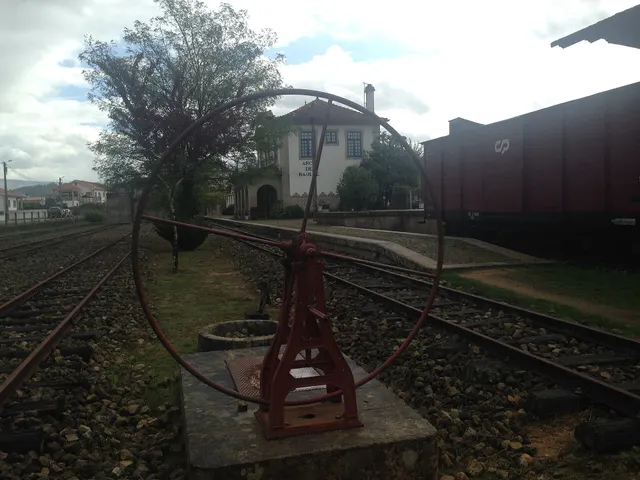
Arco de Baúlhe · educational project documented in 2016

A garden bed for learning through the senses

Turntable and tracks at the former Arco de Baúlhe station, with buildings and railway vehicles in the background.
Arco de Baúlhe station and surrounding. This photograph contextualizes the museum; it does not identify the site or plans of the 2016 program.© JP Ribeiroⓘ

Plants are part of the station’s memory too.

Read here and view sources

In a March 2016 announcement, the museum recalled an aromatic-herb project created in 2013 at the Arco de Baúlhe railway museum. For that month it proposed planting new aromatic plants and two fruit trees with children from the school centre and users of the day centre. The garden bed connected the museum with environmental education. The source documents the project and announced programme, without confirming the garden’s current composition.

Bringing children and older people together gives the garden another dimension: a plant can recall a kitchen or garden. Try asking someone which scent they associate with childhood and write down the answer and date. This idea draws on the museum’s announced intergenerational gathering; it is neither botanical identification nor advice about edible plants.

See Fact sheet: Núcleo Ferroviário de Arco de Baúlhe
Source and context

Basto Land Museum — The smells and aromas of our gardens, announcement of 15/03/2016

Accessed: . Editorial summary; the date of consultation is not the date of the facts.

General botany · bay laurel

Bay laurel has more than leaves

A tree familiar from cooking also has flowers.

Explore: What changes a tree? →
Read here and view sources

Bay laurel, Laurus nobilis, keeps foliage throughout the year. The Lisbon School of Education describes small pale-yellow flowers and insect pollination. It is dioecious: male and female flowers occur on different plants. Its leaves are used as a seasoning, but this story is not a guide to identifying plants for consumption. The description is general, with no local observation assigned.

The school’s profile places flowering in Portugal between February and April. The small flowers invite attention to a part of the tree beyond its aromatic leaves. Entomophilous pollination means that insects help transport pollen. This calendar is a general reference, not a prediction for an individual tree in Cabeceiras.

The leaf is simple and has pinnate venation: one main vein forms an axis for lateral veins, in a feather-like pattern. Leaf shape, flowers and reproductive organisation are different clues. A plant can retain its foliage and still change appearance when flowering.

Words in this story: see explanations →
Source and context

Lisbon High School of Education — Laurus nobilis

Accessed: . Editorial summary; the date of consultation is not the date of the facts.

YOUR LOCAL GUIDE

What would you like to discover?

Take a closer look.