Discover Cabeceiras de BastoFree independent guide
ViveCabeceirasYOUR GUIDE TO CABECEIRAS
ENEnglish
SearchSaved

Plants

Choose a story to start with. You can change the subject or fine tune the search.

4 leituras · Ler a paisagem pelas plantas · Pesquisa: 1758

Read the landscape through the plants

Trees, forests, vineyards and fields reveal different ways of occupying the territory.

Escolher uma história · 4
Environmental history · testimony of 1758

A landscape told in 1758

Urches, carquejas, oaks and animals in the words of the parish priest.

Read here and consult sources

The memory of St Nicholas describes differences between mountains: some covered with heather and carqueja, others with tojo and oaks. It also refers to rabbits, partridges, hares, wolves, boars and foxes. This testimony shows how nature was described in the 18th century; it is not a current inventory of species. The author also compares the land: distinguishes finer grain stones to the north and spring from the big penedos to the west and south.

Getting to know the parish
Source and context

Municipality — Parish memories of St Nicholas, 22/05/1758
Accessed:

Basto Land Museum — St Nicholas Parish Memories, 22 May 1758
Accessed:

Editorial summary; the date of consultation is not the date of the facts.
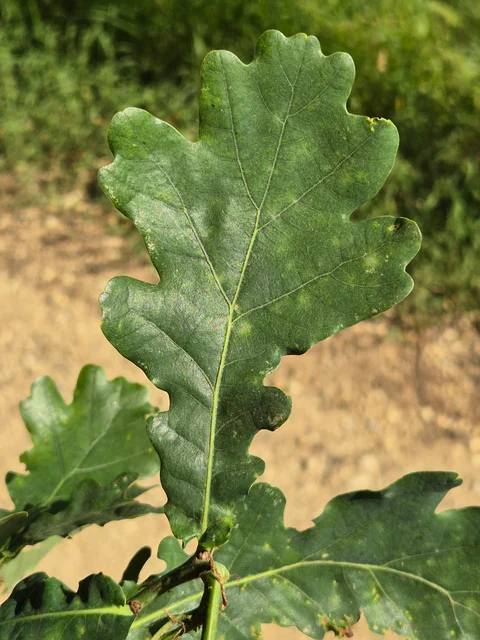
Botanic · general characteristics

A leaf drawn in waves

Oak green leaf with margin cut into visible wolves and ribs, still connected to the branch.
Leaf of Quercus robur photographed near Hollenstein, in the forest of Hollabrunn, Austria, in 2025. Illustration of the species; it is not a record of Cabeceiras nor identifies the broteroan subspecies.
Photography: Stefan.lefnaer · CC BY-SA 4.0
About this photograph

Date given at source: . Source consulted in 2026-11-07. EXIF orientation, proportional resizing and WebP conversion; no retouching or clipping of the file.

Request withdrawal or correct authorship

In the oak, notice the contour and the foot of the leaf.

Inclui uma atividade para experimentar →Explorar: A bolota entre a árvore e a história →
Read here and consult sources

The outline of the leaf has broad and unequal lobes: curves that resemble small waves. The description of the University of Évora adds a short petiole, with less than five millimeters, and secondary ribs curves that are not parallel. Instead of just looking at the silhouette, compare contour, ribs and link to the branch.

The fruits appear supported by peduncles and have a dome of brownish scales. The name used by the source is Quercus robur subsp. broteroana. These characteristics help to understand the botanical description; they do not identify the subspecies in the photographs or places of this guide.

The description presents deciduous leaves to marcescents. In the first case, they fall seasonally; in the marcescence, dried leaves may remain trapped for some time. A brown leaf in the branch is therefore not necessarily a living leaf.

The chart associates this oak to humid environments and refers to intolerance to summer drought. The leaf outline describes a structure; moisture and response to drought describe relationships with the environment. They are complementary clues to read the plant and landscape.

Palavras desta história: ver explicações →See the plants photographed in the municipality
Source and context

University of Évora — Quercus robur subsp. broteroana, description by Carlos Vila-Viçosa

Accessed: . Editorial summary; the date of consultation is not the date of the facts.

Local register · Union of parishes of Gondiães e Vilar de Cunhas · general botany

In the carqueja, the stems also work

Not all photosynthesis is on the leaves.

Inclui uma atividade para experimentar →
Read here and consult sources

The carqueja integrates the municipal description of the serrana vegetation. In the form of the Polytechnic Institute of Castelo Branco, Pterospartum tridentatum presents very small leaves and winged stems that make photosynthesis. The flowers are yellow and the fruit is a pod. These details invite to look at the shape of the branches, beyond the color of the flowers.

The chart describes a woody and rigid shrub, which can be upright or more lying and reach about a meter. The flowers appear in small tight groups. In the fruit, the compressed pod usually holds two to five seeds. Caule, flower and fruit give different clues: yellow color, alone, is not enough to recognize the plant.

The same document mentions rural uses as a bed of animals and incorporation into the crop grounds, along with other forests. They are general uses of the species. To know a local historical reference, follow the reading of Cavez: the memory of 1758 mentions carqueja and other wood in the landscape of coal production, without describing a production recipe.

The photograph of João Lima, registered in 2025-07-15, shows this species in the Union of parishes of Gondiães e Vilar de Cunhas. It opens the register to compare the visible details with the botanical description. The observation documents this meeting; it does not indicate that the plant is always visible in the same place.

Palavras desta história: ver explicações →
Source and context

Polytechnic Institute of Castelo Branco — Pterospartum tridentatum, characteristics

Municipality — landscape and vegetation

iNaturalist — Genista tridentata, João Lima observation in 2025-07-15

Accessed: . Editorial summary; the date of consultation is not the date of the facts.

Alvite · written memory in 1758

The Orada changed from high to valley

The same mountain could show different landscapes.

Inclui uma atividade para experimentar →Explorar: O que mudava entre o alto e o vale? →
Read here and consult sources

In the account of 1758, the Orada presents a high boulder, with few trees, described as rough and cold. In the faldas, the scenario changes: chestnut trees, oaks, hanged vine, olive oil and cereals enter the description.

The vicar places the residents in the low areas, next to the valley, and not at the top of the mountain. Altitude, settlement and cultivation help to read the set. It is the written portrait of that year, not a survey of the current vegetation.

Source and context

Municipality — Memory of Alvite, 23/05/1758; transcription of José Viriato Chapel (2003)

Accessed: . Editorial summary; the date of consultation is not the date of the facts.

YOUR LOCAL GUIDE

What would you like to discover?

Take a closer look.