Discover Cabeceiras de BastoFree independent guide
ViveCabeceirasYOUR GUIDE TO CABECEIRAS
ENEnglish
SearchSaved

Animals

Choose a story to start with. You can change the subject or fine tune the search.

4 stories · Life you do not always see · Search: raízes

Life you do not always see

Knowing animals begins by perceiving the territory and respecting the distance.

Choose a story · 4
Soil life · general ecology

Beneath our feet, a world of mixtures

Soil contains water and air too.

Includes an activity to try →Explore: From the ground to the water, follow the connections →
Read here and view sources

The ground is not a solid block: mineral particles and organic matter share space with water, air and organisms. Rock, climate and living things all take part in soil formation.

Looking only at the surface leaves much life undiscovered. This explanation helps explore gardens and woods, but does not replace an analysis of Cabeceiras’s soils.

Life is not evenly distributed. FAO describes areas of intense activity near roots, where plant remains accumulate, and along the walls of earthworm tunnels. The immediate surroundings of a root have a name: the rhizosphere. Thinking about these small zones helps explain why two nearby pieces of soil can offer different conditions to organisms.

Some inhabitants are unlikely to be seen on a walk. Bacteria take part in transforming organic matter; some associate with roots and contribute to nitrogen fixation. Fungi also break down remains and can form relationships with plants. They do not all do the same job: soil brings together overlapping activities, from feeding to the transformation of materials.

A covering of leaves is more than a finishing layer on a woodland floor. It is material that can feed this community. In the interview published by the Gulbenkian, the researchers recommend retaining some leaf litter in green spaces and avoiding frequent deep disturbance of the soil. These are general conservation guidelines, not an assessment or prescription for every plot in the municipality.

Words in this story: see explanations →
Source and context

Calouste Gulbenkian Foundation / Wilder — Cristina Cruz, Teresa Dias and Silvana Munzi (FCUL), 26/03/2024

FAO — What is soil biodiversity?

Accessed: . Editorial summary; the date of consultation is not the date of the facts.
Serra da Cabreira · regional reference and species biology

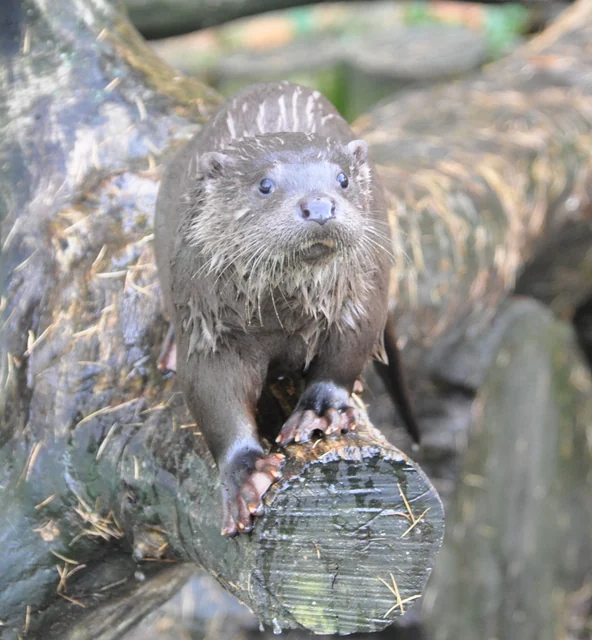
The otter wears its diving suit

Otter front view over wood, with snout, mustaches and visible paws.
European otter at the Lüneburg Heath fauna park, Germany, in 2009. Animal in fauna park; it is not a record of Cabeceiras.
Photography: Quartl · CC BY-SA 3.0
About this photograph

Date given at source: . Source consulted in 2026-11-07. EXIF orientation, proportional resizing and WebP conversion of the current version in Commons; no retouching or additional clipping.

Request removal or correct the photo credit

Waterproof fur and feet that help it swim.

Includes an activity to try →Explore: Body and environment →
Read here and view sources

The Eurasian otter, Lutra lutra, has webbed feet and a thick coat that protects it in water. Its life connects the river with its banks: vegetation offers shelter and roots can hide dens. It is mainly active at dusk and at night.

Vieira do Minho’s municipal website includes the otter among Cabreira’s mammals. This regional reference helps introduce the species but does not identify a sighting location.

The University of Évora’s description also mentions a long tail tapering at the tip and a muzzle with long whiskers. Otters do not depend only on rivers: the species also uses reservoirs, estuaries and, less often, the marine coast. These features help us get to know the animal without turning the story into a sighting point.

Source and context

University of Évora — Virtual Museum of Biodiversity, Lutra lutra; David Germano
Consultations: ,

Vieira Tourism of Minho — fauna of Serra da Cabreira, regional reference
Accessed:

Editorial summary; the date of consultation is not the date of the facts.

Serra da Cabreira · regional reference and species biology

A newt between water and land

Its skin also changes with its surroundings.

Includes an activity to try →Explore: From egg to change of environment →
Read here and view sources

Bosca’s newt, Lissotriton boscai, has smoother skin during its aquatic phase and rougher skin during its terrestrial phase. For reproduction, it can use ponds, slow-flowing streams and even water tanks. Out of water it finds shelter in damp places among roots, stones and trunks. Its orange belly explains its Portuguese name, tritão-de-ventre-laranja.

It is mentioned among Cabreira’s amphibians by Vieira do Minho’s municipal website, without an associated observation point.

The University of Évora’s description notes four toes on the front feet and five on the hind feet, as well as a laterally flattened tail. These are species features, not a reason to take the animal out of the water. The same source gives a total length of up to nine centimetres, with females generally larger and more robust than males.

The mating season can change its appearance too. The University of Évora describes a small crest on the tail and, in males, a whitish lengthwise stripe, more marked near the tip. Comparing two images therefore means considering sex and season as well as species name. Not every visible difference means different species.

Diet follows the change of habitat. According to the Charcos com Vida project, larvae and aquatic adults catch small water-dwelling invertebrates; on land, adults mainly eat soft-bodied animals such as earthworms and slugs. The female lays eggs individually on aquatic plants or leaves over several days. The diagram below connects these stages without assigning dates to their occurrence in Cabreira.

Source and context

University of Évora — Virtual Museum of Biodiversity, Lissotriton boscai

Vieira Tourism of Minho — fauna of Serra da Cabreira, regional reference

Charcoals with Life / CIIMAR — Orange belly triton, life cycle and feeding

Accessed: . Editorial summary; the date of consultation is not the date of the facts.

Soil life · general ecology

Earthworms change the landscape too

A tunnel can send leaves on a journey.

Includes an activity to try →Explore: A leaf can follow several paths →
Read here and view sources

Many earthworms eat plant remains or carry them through the tunnels they dig. A fallen leaf can therefore continue its journey beneath the surface.

By transforming organic matter and changing where they live, these animals act as ecosystem engineers. This is a general role, not an identification of species present in the municipality.

They do not all feed in the same place. FAO’s overview distinguishes worms that use debris near the surface from those feeding in deeper layers. Tunnels vary too: mainly vertical or horizontal, long-lasting or temporary shelters against unfavourable conditions.

Material passes through the digestive tract and returns to the soil as casts that bring together particles, organic matter and microorganisms. The work is therefore more than digging a tunnel: it involves transport and transformation. The tunnels support aeration, drainage and root penetration. Activity on the scale of a small animal can change the space available for water, air and other living things.

These differences explain why we should not imagine all earthworms as copies of one species. The story describes general roles and ways of life; it cannot count populations or measure a plot’s fertility just from the presence of one animal.

Source and context

Calouste Gulbenkian Foundation / Wilder — Cristina Cruz, Teresa Dias and Silvana Munzi (FCUL), 26/03/2024

FAO — Earthworms: food, galleries and soil structure

Accessed: . Editorial summary; the date of consultation is not the date of the facts.

YOUR LOCAL GUIDE

What would you like to discover?

Take a closer look.