Discover Cabeceiras de BastoFree independent guide
ViveCabeceirasYOUR GUIDE TO CABECEIRAS
ENEnglish
SearchSaved

Animals

Choose a story to start with. You can change the subject or fine tune the search.

5 stories · Life you do not always see · Search: répteis

Life you do not always see

Knowing animals begins by perceiving the territory and respecting the distance.

Choose a story · 5
Gondiães · record from 1994 and general species biology

An ocellated lizard was recorded in Gondiães

A line in a table preserves an observation from 1994.

Includes an activity to try →
Read here and view sources

A scientific article published in 1996 records Lacerta lepida in Gondiães, Cabeceiras de Basto, on 16 April 1994. The University of Évora lists that former name among the synonyms of Timon lepidus, the ocellated lizard. It describes the species as the Iberian Peninsula’s largest lizard, with dark-edged blue spots on its flanks. The record documents a past occurrence; it does not confirm a current presence or identify an observation point.

Source and context

J. Teixeira et al. — Nuevos datos sobre la distribución de la herpetofauna en Portugal, Boletín AHE 7 (1996), p. 11; PDF sheet 13
Accessed:

University of Évora — Virtual Museum of Biodiversity, Timon lepidus; MVBIO / Darío Estradiz López
Accessed:

Editorial summary; the date of consultation is not the date of the facts.
Ocellated lizard · general ecology, with a historical reference to Gondiães

Sun in view, shelter nearby

An ocellated lizard needs more than open ground.

Explore: Sun, water and different shapes →
Read here and view sources

The University of Évora profile associates the ocellated lizard with sunny areas that offer shelter: shrubs, stone walls, burrows and other cavities. It also describes the use of farmland and pinewood clearings. This is general ecology for a species with a historical record in Gondiães, not an inventory of animals or shelters currently present in that parish.

Timon lepidus is known in Portuguese as sardão or lagarto-ocelado. The University of Évora’s description highlights blue spots edged in black on the flanks and a robust head. Total length may reach 80 centimetres, including the tail: this does not mean an 80-centimetre body alone. The tail can exceed twice the body length.

Sun and shelter are two parts of the same habitat. A clearing offers exposure, while shrubs, cavities and walls provide refuges. The profile describes that combination, not a preference for any simply open terrain. The Gondiães record connects the species with local natural history; the habitat explanation does not turn every wall in the parish into a confirmed presence site.

Words in this story: see explanations →
Source and context

University of Évora — Virtual Museum of Biodiversity, Timon lepidus; MVBIO / Darío Estradiz López
Accessed:

J. Teixeira et al. — Nuevos datos sobre la distribución de la herpetofauna en Portugal, Boletín AHE 7 (1996), p. 11; PDF sheet 13
Accessed:

Editorial summary; the date of consultation is not the date of the facts.
Reptiles · general biology, without a confirmed local record in this profile

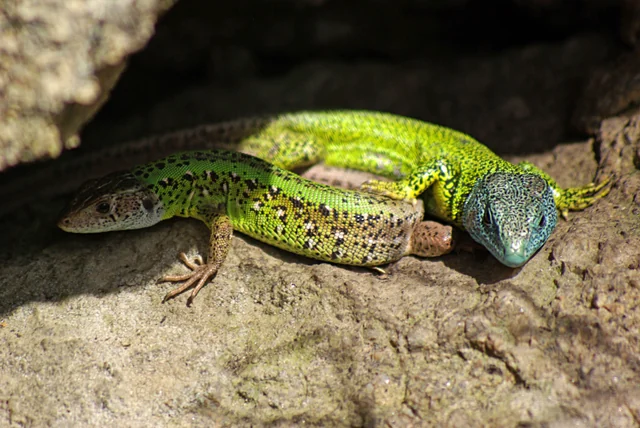
A lizard between sun and moisture

Two lizards on stone, one in the foreground and the other in the back, with green coloring and dark spots.
Water lizards photographed in Candelario, Salamanca, Spain, in 2013. Illustration of the species; it is not a record of Cabeceiras.
Photography: David Perez (DPC) · CC BY3.0
About this photograph

Date given at source: . Source consulted in 2026-11-07. EXIF orientation, proportional resize and WebP conversion; no retouching or new clipping of file obtained in Commons.

Request removal or correct the photo credit

Needing warmth does not mean living far from water.

Includes an activity to try →Explore: Grow and feed by the water →
Read here and view sources

Schreiber’s green lizard, Lacerta schreiberi, is associated with damp habitats, riverside vegetation, walls and brambles. The description published in Ambienta explains that it uses the sun’s warmth for activity but shelters during summer’s hottest hours. Being close to water and choosing somewhere to warm up are parts of the same life.

It feeds mainly on invertebrates, including insects and arachnids. Colour varies too: males’ throats can turn intense blue during the breeding season. These general features do not confirm the species of an animal glimpsed in passing. The consulted source is not a Cabeceiras record.

Age also changes the spaces it seeks. The Charcos com Vida project distinguishes adults needing shelters among rocks and dense scrub from juveniles associated with herbaceous vegetation. A varied bank can offer different refuges rather than acting as a uniform strip.

According to the same profile, reproduction takes place between spring and midsummer. Females lay between six and seventeen eggs, with incubation generally lasting two to three months. These ranges describe the species, not a clutch monitored in the municipality.

The lizard both hunts small invertebrates and provides food for other animals. The source names birds of prey, genets and otters among its predators. This is another connection between bank vegetation, water and the food web.

Words in this story: see explanations →
Source and context

Khris Valero — Lacerta schreiberi, magazine Ambienta, January 2004, pp. 61–62; archive of the Spanish Ministry MAPA

Charcoals with Life — Water Lizard, habitat and life cycle

Accessed: . Editorial summary; the date of consultation is not the date of the facts.
Reptiles · general biology, without a confirmed local record in this profile

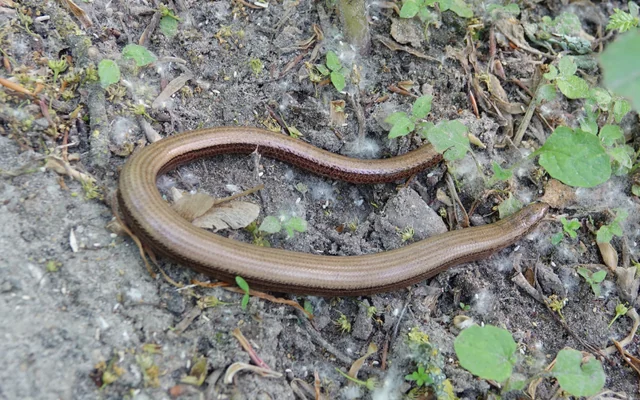
No legs, but not a snake

Licran of elongated brown body, bent on the ground between leaves and small plants.
Licensing photographed in Wyhl am Kaiserstuhl, Germany, in 2024. Illustration of the species; it is not a record of Cabeceiras.
Photography: Gzen92 · CC BY-SA 4.0
About this photograph

Date given at source: . Source consulted in 2026-11-07. EXIF orientation, proportional resize and WebP conversion; no retouching or new clipping of file obtained in Commons.

Request removal or correct the photo credit

A slow worm’s silhouette does not tell the whole story.

Includes an activity to try →Explore: Body and Way of Life →
Read here and view sources

The slow worm, Anguis fragilis, is a legless lizard. The Xunta de Galicia’s agricultural biodiversity guide describes it in cool, damp places such as meadows and walls, where it feeds on slugs and insects. Its elongated shape may resemble a small snake, but that similarity does not determine its group.

This explanation helps compare forms and ways of life. The guide concerns Galicia’s agricultural landscape; it does not prove an occurrence in Cabeceiras or allow identification from an unclear photograph alone.

There is more to observe than the absence of legs. The Wildlife Trusts highlights movable eyelids, which let the slow worm blink, and the ability to shed its tail. The female retains eggs inside her body until the young are born. These are general characteristics of Anguis fragilis, without a local record associated with this story.

Its rhythm also changes through the year. The organisation describes a state of winter dormancy called brumation. The source’s calendar concerns the United Kingdom and is not transferred to Cabeceiras. Getting to know the species means distinguishing body shape, behaviour and the information’s geographical context.

Words in this story: see explanations →
Source and context

Xunta de Galicia — Guía for the conservation of biodiversity in Galicia, Anguis fragilis, p. 54

The Wildlife Trusts — Slow worm (Anguis fragilis), general biology; British context

Accessed: . Editorial summary; the date of consultation is not the date of the facts.

Reptiles · general biology, without a confirmed local record in this profile

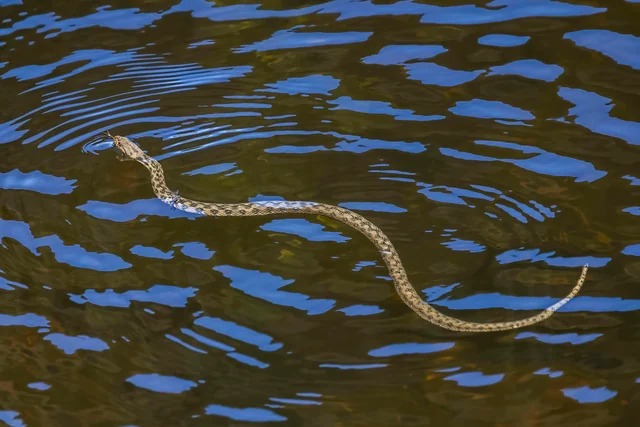
One snake can have different patterns

Snake with the body wavy to the surface of the water, between blue reflexes and small ripples.
Viperine water snake swimming in Extremadura, Spain, in 2022. Illustration of the species; not a record of Cabeceiras.
Photography: Charles J. Sharp · CC BY-SA 4.0
About this photograph

Date given at source: . Source consulted in 2026-11-07. EXIF orientation, proportional resize and WebP conversion; no retouching or new clipping of file obtained in Commons.

Request removal or correct the photo credit

The viperine snake’s back does not always have the same pattern.

Includes an activity to try →Explore: The same environment, different ways of life →
Read here and view sources

Natrix maura, the viperine snake, can have a zigzag stripe, but also a pattern of two pale lengthwise lines. The Spanish biodiversity inventory also describes variation in body tones. A single pattern does not represent every individual of the species.

The Parque Natural do Litoral Norte profile explains its association with rivers, ponds, streams and other aquatic environments, without excluding movement on land. This is general species context, not an observation in Cabeceiras. The story compares variation and habitat; it is not a key for identifying snakes encountered outdoors.

The Charcos com Vida project describes feeding mainly in water: invertebrates, amphibian larvae and adults, and small fish are on the menu. Water is therefore a feeding space as well as a means of movement. The snake can itself be prey for birds and mammals; being a predator does not remove it from the food web.

It is usually active by day but may remain active at dusk or at night in summer. Behaviour also changes when threatened: the profile mentions widening the head and other defensive signals that contribute to its resemblance to a viper and its common name. This explanation of the name does not allow the species or the safety of an encounter to be decided from head shape.

Words in this story: see explanations →
Source and context

Inventory Español del Patrimonio Natural y la Biodiversidad — Natrix maura, description of the species

Co-management of the Northern Coastal Natural Park — Reptiles and amphibians, record of the viperine water snake

Lived Chargings — Viperine Water Cobra, Feeding and Behaviour

Accessed: . Editorial summary; the date of consultation is not the date of the facts.

YOUR LOCAL GUIDE

What would you like to discover?

Take a closer look.