Discover Cabeceiras de BastoFree independent guide
ViveCabeceirasYOUR GUIDE TO CABECEIRAS
ENEnglish
SearchSaved

Stories of Cabeceiras

Choose a story to start with. You can change the subject or fine tune the search.

5 leituras · Todos os temas · Pesquisa: répteis

The life you don't always see

Knowing animals begins by perceiving the territory and respecting the distance.

Escolher uma história · 5
Gondiães · record 1994 and general biology of the species

A mackerel was registered in Gondiães

A line on a table holds an observation of 1994.

Inclui uma atividade para experimentar →
Read here and consult sources

A scientific article published in 1996 records Lepida Lacerta in Gondiães, Cabeceiras de Basto, to 16, April 1994. The University of Évora includes this ancient name among the synonyms of Timon lepidus, the Sardon. It describes it as the largest lizard on the Iberian Peninsula, with dark blue spots on its flanks. The record documents a past occurrence; it does not confirm the current presence or indicates an observation point.

Source and context

J. Teixeira et al. — Nuevos datos sobre la distribución de la herpetofauna en Portugal, Boletín AHE 7 (1996), p. 11; PDF sheet 13
Accessed:

University of Évora — Virtual Museum of Biodiversity, Timon lepidus; MVBIO / Darío Estradiz López
Accessed:

Editorial summary; the date of consultation is not the date of the facts.
Sardan · general ecology, with historical reference to Gondiães

Sun in sight, shelter nearby

For a freckle, an open space is not enough.

Explorar: Sol, água e formas diferentes →
Read here and consult sources

The form of the University of Évora associates sardão to areas with good sun exposure and refuges: shrubs, stone walls, burrows and other cavities. It also describes the use of agricultural fields and pine clearings. It is the general ecology of the species with a historical record in Gondiães, not an inventory of the animals or shelters that today exist in this parish.

The sardine, Timon lepidus, is also known as the occelated lizard. The description of the University of Évora highlights the blue patches bordered with black on the flanks and the robust head. The total length can reach 80 centimeters, including the tail: it is not 80 centimeters of body only. The tail can exceed twice the body length.

Sun and shelter are two parts of the same habitat. A clearing offers exhibition, but the bushes, cavities and walls introduce refuges into the landscape. This is the combination that the chart describes, not a preference for any ground simply open. The Gondiães register helps connect the species to local natural history; the explanation of the habitat does not transform all the walls of the parish into confirmed presence sites.

Palavras desta história: ver explicações →
Source and context

University of Évora — Virtual Museum of Biodiversity, Timon lepidus; MVBIO / Darío Estradiz López
Accessed:

J. Teixeira et al. — Nuevos datos sobre la distribución de la herpetofauna en Portugal, Boletín AHE 7 (1996), p. 11; PDF sheet 13
Accessed:

Editorial summary; the date of consultation is not the date of the facts.
Reptiles · general biology, no local occurrence confirmed in this form

A lizard between the sun and the humidity

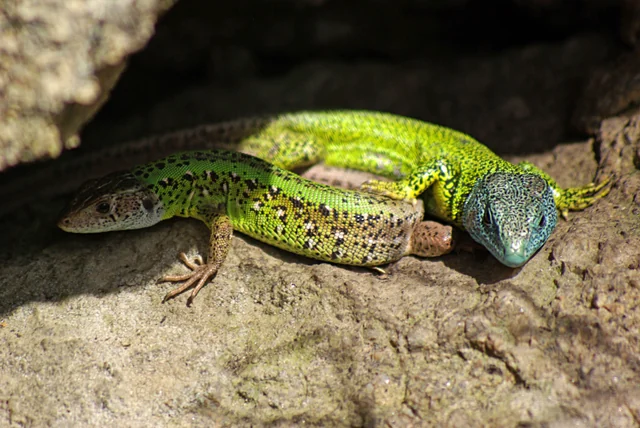
Two lizards on stone, one in the foreground and the other in the back, with green coloring and dark spots.
Water lizards photographed in Candelario, Salamanca, Spain, in 2013. Illustration of the species; it is not a record of Cabeceiras.
Photography: David Perez (DPC) · CC BY3.0
About this photograph

Date given at source: . Source consulted in 2026-11-07. EXIF orientation, proportional resize and WebP conversion; no retouching or new clipping of file obtained in Commons.

Request withdrawal or correct authorship

Needing heat doesn't mean living away from the water.

Inclui uma atividade para experimentar →Explorar: Crescer e alimentar-se junto da água →
Read here and consult sources

The water lizard, Lacerta schreiberi, is associated with humid environments, vegetation of the shores, walls and silvados. The description published in the magazine Ambienta explains that it uses the heat of the sun in its activity, but shelters in the hottest hours of summer. The proximity of the water and the choice of a place to warm up are part of the same life.

It feeds mainly on invertebrates, including insects and arachnides. The color also varies: in males, the throat can acquire an intense blue at the breeding season. These general characteristics do not confirm the species in an animal seen as passing through. The source consulted does not constitute a record of Cabeceiras.

Age also changes the space sought. The Charcos with Life project distinguishes adults who need refuges between rocks and dense forests of juveniles associated with herbaceous vegetation. A varied margin can offer different shelters instead of functioning as a uniform strip.

Reproduction takes place between spring and mid-summer, according to the same chart. The females lay between six and seventeen eggs, with an incubation usually two to three months. These intervals describe the species, not an accompanying posture in the municipality.

The lizard hunts small invertebrates as well as serves as food for other animals. The source refers, among its predators, birds of prey, gynet and otter. It is another link between the vegetation of the margin, the water and the food network.

Palavras desta história: ver explicações →
Source and context

Khris Valero — Lacerta schreiberi, magazine Ambienta, January 2004, pp. 61–62; archive of the Spanish Ministry MAPA

Charcoals with Life — Water Lizard, habitat and life cycle

Accessed: . Editorial summary; the date of consultation is not the date of the facts.
Reptiles · general biology, no local occurrence confirmed in this form

No paws, but not a snake

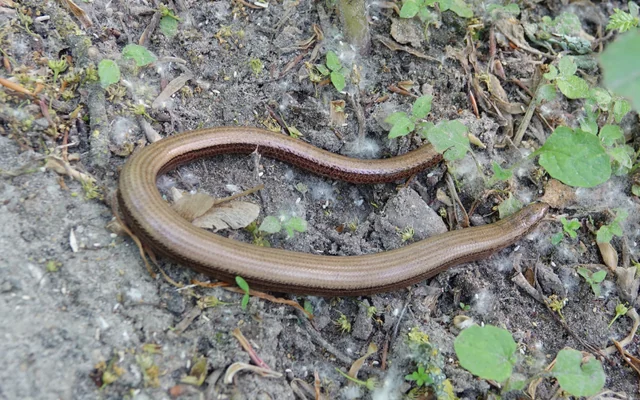
Licran of elongated brown body, bent on the ground between leaves and small plants.
Licensing photographed in Wyhl am Kaiserstuhl, Germany, in 2024. Illustration of the species; it is not a record of Cabeceiras.
Photography: Gzen92 · CC BY-SA 4.0
About this photograph

Date given at source: . Source consulted in 2026-11-07. EXIF orientation, proportional resize and WebP conversion; no retouching or new clipping of file obtained in Commons.

Request withdrawal or correct authorship

The silhouette doesn't tell the whole story of the licranço.

Inclui uma atividade para experimentar →Explorar: O corpo e o modo de vida →
Read here and consult sources

The licraço, Anguis fragilis, is a lizard without paws. The guide of agrarian biodiversity of the Xunta de Galicia describes it in cool and humid places, such as meadows and walls, where it feeds on slugs and insects. The elongated form may remind a small serpent, but this similarity does not determine the group to which it belongs.

This explanation serves to compare forms and ways of life. The guide refers to the Galician agrarian landscape; it does not prove an occurrence in Cabeceiras or allows to identify an animal only by an unclear photograph.

There is more to observe than the absence of paws. The Wildlife Trusts highlights the movable eyelids, which allow the licranço to blink, and the ability to loosen the tail. The female keeps the eggs inside the body until the birth of the cubs. They are general characteristics of Anguis fragilis, without a local record associated with this reading.

The pace also changes throughout the year. The organization describes a state of winter dormancy, called mist. The timing presented by the source concerns the UK: it is not transferred to Cabeceiras. To know the species, it is appropriate to distinguish the shape of the body, behavior and geographical context of the information.

Palavras desta história: ver explicações →
Source and context

Xunta de Galicia — Guía for the conservation of biodiversity in Galicia, Anguis fragilis, p. 54

The Wildlife Trusts — Slow worm (Anguis fragilis), general biology; British context

Accessed: . Editorial summary; the date of consultation is not the date of the facts.

Reptiles · general biology, no local occurrence confirmed in this form

A snake can have more than one drawing

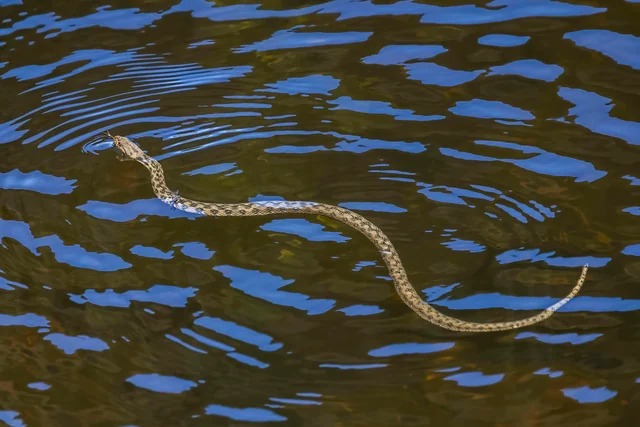
Snake with the body wavy to the surface of the water, between blue reflexes and small ripples.
Viperine water snake swimming in Extremadura, Spain, in 2022. Illustration of the species; not a record of Cabeceiras.
Photography: Charles J. Sharp · CC BY-SA 4.0
About this photograph

Date given at source: . Source consulted in 2026-11-07. EXIF orientation, proportional resize and WebP conversion; no retouching or new clipping of file obtained in Commons.

Request withdrawal or correct authorship

In viperine water snake, the back pattern is not always the same.

Inclui uma atividade para experimentar →Explorar: O mesmo ambiente, modos de vida diferentes →
Read here and consult sources

Natrix maura may present a zigzag stripe, but also a pattern of two clear longitudinal lines. The Spanish biodiversity inventory still describes variation in body tones. A single design does not summarize all individuals of the species.

The chart of the Northern Coastal Natural Park explains the connection to rivers, ponds, streams and other aquatic environments, without excluding displacements on land. It is a general context about the species: it is not an observation in Cabeceiras. Reading compares variation and habitat; it is not a key to identifying snakes found in the field.

The Charcos com Vida project describes a feed mainly in water: invertebrates, larvae and adults of amphibians and small fish enter the menu. The aquatic environment is, thus, a feeding space, besides displacement. The same snake can be preyed on birds and mammals; taking the place of predator does not remove it from the food network.

It is usually daytime, but in summer it can maintain activity at dusk or during the night. Behavior also changes before a threat: the record refers to the expansion of the head and other defensive signs that contribute to the similarity with a viper and to the common name. This explanation of the name does not allow to decide the species or safety of a meeting by the shape of the head.

Palavras desta história: ver explicações →
Source and context

Inventory Español del Patrimonio Natural y la Biodiversidad — Natrix maura, description of the species

Co-management of the Northern Coastal Natural Park — Reptiles and amphibians, record of the viperine water snake

Lived Chargings — Viperine Water Cobra, Feeding and Behaviour

Accessed: . Editorial summary; the date of consultation is not the date of the facts.

YOUR LOCAL GUIDE

What would you like to discover?

Take a closer look.