Discover Cabeceiras de BastoFree independent guide
ViveCabeceirasYOUR GUIDE TO CABECEIRAS
ENEnglish
SearchSaved

Animals

Choose a story to start with. You can change the subject or fine tune the search.

5 stories · Life you do not always see · Search: pedra

Life you do not always see

Knowing animals begins by perceiving the territory and respecting the distance.

Choose a story · 5
Species biology · with a local record

A small bird that dives

The white-throated dipper brings birdwatching into the current.

Includes an activity to try →Explore: The stream is more than water →
Read here and view sources

A compact body, short tail and white breast in adults offer clues to Cinclus cinclus, the white-throated dipper. This bird can dive and is associated with fast-flowing streams, especially in mountains. The gallery includes a local record; the photograph shows the bird in a hand, not the diving behaviour described here. Aves de Portugal describes fast, direct flight and classifies the species as resident: it may remain in breeding areas throughout the year. That general trait does not confirm a continuous presence at the local record’s location.

Underwater, the food it seeks includes small invertebrates. The BTO describes the bird entering the current from rocks or flying low to another perch. The stream is therefore a feeding space, not simply a backdrop where the bird appears.

Age also changes its appearance: juveniles are greyer and more mottled than white-breasted adults. This biological comparison does not assign an age to the photographed bird. A record shows an encounter; understanding what a species does requires bringing together other observations and sources.

Words in this story: see explanations →
Source and context

Birds of Portugal — Watermelon, identification, habits and distribution

British Trust for Ornithology — BirdFacts: Dipper, Cinclus cinclus

Accessed: . Editorial summary; the date of consultation is not the date of the facts.
Serra da Cabreira · regional reference and species biology

A newt between water and land

Its skin also changes with its surroundings.

Includes an activity to try →Explore: From egg to change of environment →
Read here and view sources

Bosca’s newt, Lissotriton boscai, has smoother skin during its aquatic phase and rougher skin during its terrestrial phase. For reproduction, it can use ponds, slow-flowing streams and even water tanks. Out of water it finds shelter in damp places among roots, stones and trunks. Its orange belly explains its Portuguese name, tritão-de-ventre-laranja.

It is mentioned among Cabreira’s amphibians by Vieira do Minho’s municipal website, without an associated observation point.

The University of Évora’s description notes four toes on the front feet and five on the hind feet, as well as a laterally flattened tail. These are species features, not a reason to take the animal out of the water. The same source gives a total length of up to nine centimetres, with females generally larger and more robust than males.

The mating season can change its appearance too. The University of Évora describes a small crest on the tail and, in males, a whitish lengthwise stripe, more marked near the tip. Comparing two images therefore means considering sex and season as well as species name. Not every visible difference means different species.

Diet follows the change of habitat. According to the Charcos com Vida project, larvae and aquatic adults catch small water-dwelling invertebrates; on land, adults mainly eat soft-bodied animals such as earthworms and slugs. The female lays eggs individually on aquatic plants or leaves over several days. The diagram below connects these stages without assigning dates to their occurrence in Cabreira.

Source and context

University of Évora — Virtual Museum of Biodiversity, Lissotriton boscai

Vieira Tourism of Minho — fauna of Serra da Cabreira, regional reference

Charcoals with Life / CIIMAR — Orange belly triton, life cycle and feeding

Accessed: . Editorial summary; the date of consultation is not the date of the facts.

Ocellated lizard · general ecology, with a historical reference to Gondiães

Sun in view, shelter nearby

An ocellated lizard needs more than open ground.

Explore: Sun, water and different shapes →
Read here and view sources

The University of Évora profile associates the ocellated lizard with sunny areas that offer shelter: shrubs, stone walls, burrows and other cavities. It also describes the use of farmland and pinewood clearings. This is general ecology for a species with a historical record in Gondiães, not an inventory of animals or shelters currently present in that parish.

Timon lepidus is known in Portuguese as sardão or lagarto-ocelado. The University of Évora’s description highlights blue spots edged in black on the flanks and a robust head. Total length may reach 80 centimetres, including the tail: this does not mean an 80-centimetre body alone. The tail can exceed twice the body length.

Sun and shelter are two parts of the same habitat. A clearing offers exposure, while shrubs, cavities and walls provide refuges. The profile describes that combination, not a preference for any simply open terrain. The Gondiães record connects the species with local natural history; the habitat explanation does not turn every wall in the parish into a confirmed presence site.

Words in this story: see explanations →
Source and context

University of Évora — Virtual Museum of Biodiversity, Timon lepidus; MVBIO / Darío Estradiz López
Accessed:

J. Teixeira et al. — Nuevos datos sobre la distribución de la herpetofauna en Portugal, Boletín AHE 7 (1996), p. 11; PDF sheet 13
Accessed:

Editorial summary; the date of consultation is not the date of the facts.

Reptiles · general biology, without a confirmed local record in this profile

A lizard between sun and moisture

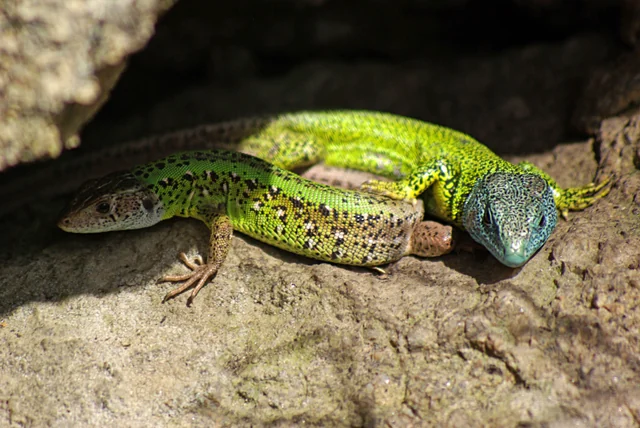
Two lizards on stone, one in the foreground and the other in the back, with green coloring and dark spots.
Water lizards photographed in Candelario, Salamanca, Spain, in 2013. Illustration of the species; it is not a record of Cabeceiras.
Photography: David Perez (DPC) · CC BY3.0
About this photograph

Date given at source: . Source consulted in 2026-11-07. EXIF orientation, proportional resize and WebP conversion; no retouching or new clipping of file obtained in Commons.

Request removal or correct the photo credit

Needing warmth does not mean living far from water.

Includes an activity to try →Explore: Grow and feed by the water →
Read here and view sources

Schreiber’s green lizard, Lacerta schreiberi, is associated with damp habitats, riverside vegetation, walls and brambles. The description published in Ambienta explains that it uses the sun’s warmth for activity but shelters during summer’s hottest hours. Being close to water and choosing somewhere to warm up are parts of the same life.

It feeds mainly on invertebrates, including insects and arachnids. Colour varies too: males’ throats can turn intense blue during the breeding season. These general features do not confirm the species of an animal glimpsed in passing. The consulted source is not a Cabeceiras record.

Age also changes the spaces it seeks. The Charcos com Vida project distinguishes adults needing shelters among rocks and dense scrub from juveniles associated with herbaceous vegetation. A varied bank can offer different refuges rather than acting as a uniform strip.

According to the same profile, reproduction takes place between spring and midsummer. Females lay between six and seventeen eggs, with incubation generally lasting two to three months. These ranges describe the species, not a clutch monitored in the municipality.

The lizard both hunts small invertebrates and provides food for other animals. The source names birds of prey, genets and otters among its predators. This is another connection between bank vegetation, water and the food web.

Words in this story: see explanations →
Source and context

Khris Valero — Lacerta schreiberi, magazine Ambienta, January 2004, pp. 61–62; archive of the Spanish Ministry MAPA

Charcoals with Life — Water Lizard, habitat and life cycle

Accessed: . Editorial summary; the date of consultation is not the date of the facts.

Arco de Baúlhe e Vila Nune · local record and general biology

A slug with a leopard pattern

Discreet animals deserve a place in the municipality’s portrait too.

Includes an activity to try →
Read here and view sources

Mauro’s photograph shows a slug with dark markings and extended tentacles on stone. The record, dated 17 September 2021, is identified as Limax maximus. Comparing the published point with CAOP2025 places it in Arco de Baúlhe e Vila Nune.

The Royal Horticultural Society includes this species in its comparison of large patterned slugs, noting its nocturnal behaviour. The local photograph records an encounter; it cannot predict when the animal will appear in the same place again. Its body pattern offers a good question to begin with: where do you see separate spots, and where do they seem to form lines?

Alongside the photograph of the Cavez snail, it offers two different ways to discover land molluscs: the spiral of a shell and the pattern of an elongated body.

Source and context

Royal Horticultural Society — slug research and comparison with Limax maximus

Accessed: . Editorial summary; the date of consultation is not the date of the facts.

YOUR LOCAL GUIDE

What would you like to discover?

Take a closer look.