Discover Cabeceiras de BastoFree independent guide
ViveCabeceirasYOUR GUIDE TO CABECEIRAS
ENEnglish
SearchSaved

Animals

Choose a story to start with. You can change the subject or fine tune the search.

33 stories · Life you do not always see · Search: insetos

Life you do not always see

Knowing animals begins by perceiving the territory and respecting the distance.

Choose a story · 33
Cavez · 2016–2017 registration and general biology

A fish's menu also has insects

Feeding connects life in and out of water.

Includes an activity to try →Explore: Who feeds on what? →
Read here and view sources

The chart of the ICNF describes the embroidery, complex Squalius alburnoids, as a consumer mainly of insect larvae. In summer and early autumn, it refers to higher consumption of terrestrial insects. It is a small link between the river and its margins. The embroidery appears in the study of Cavez of 2016–2017 under the name Iberocypris alburnoides; the local study did not analyze this seasonal change in feeding.

The same chart describes the use of rivers and streams with diverse characteristics, including small and shallow courses with emerging aquatic vegetation. The habitat is not only water: shelters, vegetation and alternation of zones with different current speeds enter history.

Therefore, a margin totally devoid of vegetation changes more than the view. The chart associates the loss of riverside vegetation with the reduction of shade, shelter and feeding sites. These general ecological relationships help to interpret the river; they are not a current evaluation of a section of Cavez. The local record of 2016–2017 and the biological explanation answer different questions: where the fish was documented and how it relates to the environment.

Source and context

ICNF — embroidery, ecology and riverside vegetation, pp. 2–3 (bibliography up to 2005)
Accessed:

Biosphere / Iberdrola, APA file — Monitoring of ichthyofauna 2016–2017, February 2018; pp. 5, 35 and 40, station record 22 on p. 175 PDF
Accessed:

Editorial summary; the date of consultation is not the date of the facts.
Species biology · trace recorded in Cavez

At nightfall, a bird looks like an insect

Not all birds are discovered with eyes in the sky.

Includes an activity to try →
Read here and view sources

The noitibo-European feeds on insects and goes into activity at dusk and at night. Its continuous singing can remember the sound of a cicada. In Portugal it is a summer bird, mainly associated to the north and the transition between forest and open spaces. The Cavez record shows a sentence attributed to this species by the iNaturalist community. It is a trace: it is not a photograph of the entire bird, nor does it prove the existence of a nest at that point. Curiosity begins in a feather and continues in the sound landscape.

The long wings and tail can be perceived in silhouette, but the little light hides details. Aves de Portugal’s record explains that females do not show white spots on the wings of males; juveniles do not have them either. The absence of a brand alone does not solve age and sex.

The source describes a late arrival and the easiest corner to detect in May and June. It is a Portuguese standard, not an agenda of sightings in Cavez. The recorded penalty does not allow to know when the bird sang, where it nested or how long it remained in the zone.

In order to know travel, investigators need another type of registration. The BTO presents follow-up studies that have located an important winter area in grass and shrub landscapes south of the equatorial forest, especially in the Democratic Republic of Congo. It is information on birds accompanied by those studies, not the proven destination of the specimen associated with the sentence of Cavez. A penalty documents a trace in one place; the follow-up allows you to connect positions over time and study movements.

Source and context

Poultry of Portugal — Caprimulgus europaeus

British Trust for Ornithology — BirdFacts: Nightjar, Caprimulgus europaeus; follow-up and winter studies

Accessed: . Editorial summary; the date of consultation is not the date of the facts.
Biology of the species · photograph registered in the municipality

A corner hidden in the green

Sometimes a bug can be heard before you see it.

Includes an activity to try →Explore: Sound, light or image? →
Read here and view sources

The large-salt-green, Tettigonia viridissima, can go unnoticed between leaves and branches. According to the Gulbenkian record, adult males reveal themselves in the corner, while males and females tend to hide in dense vegetation. The species occurs in environments with shrubs and trees, including gardens and urban green spaces.

The nymphs already look like adults, but have little developed wings. Compare life stages is different from identifying a behavior: the photograph recorded in Cabeceiras shows the insect on wood, without documenting the corner. The background of the image is also not enough to characterize the entire habitat where it was observed.

The development phase also changes what is easier to observe. The chart suggests looking for nymphs in herbaceous and shrubby vegetation, while adults are often hidden. The sound and image provide different clues: hearing a corner without seeing the animal and photographing an insect without hearing it are not equivalent records. In the local photograph, it preserves only what the frame allows to recognize.

Words in this story: see explanations →
Source and context

Calouste Gulbenkian Foundation — Great Green Rocket

Accessed: . Editorial summary; the date of consultation is not the date of the facts.
Bats · general ecological functions

Small hunters with a role in the landscape

Eating insects also connects bats to fields and forests.

Includes an activity to try →Explore: Eat, orient and rest →
Read here and view sources

Insectivorous bats connect night to fields and forests. By feeding, they help control insect populations, including species that can affect agriculture and trees. The text of ICNF invites you to know this ecological function beyond the myths associated with bats.

Worldwide, there are other diets and other relationships: bats that consume fruit can contribute to the regeneration of forests; those that feed on pollen participate in pollination. These global examples do not attribute these diets to species registered in Cabeceiras.

Thinking about food is a way of relating the animal to the landscape. What resources do you look for? What other organisms enter this relationship? The ecological role is not limited to the number of individuals we can see. For local history, this explanation follows the reading of the documental register of ferred bat; it does not add a new observation.

Words in this story: see explanations →
Source and context

ICNF — There are bats in the air..., text by Cristina Girão Vieira

Accessed: . Editorial summary; the date of consultation is not the date of the facts.

Biology of the species · photograph registered in the municipality

A grasshopper through the winter

The name Egyptian grasshopper does not limit the species to a country.

Includes an activity to try →
Read here and view sources

The name Egyptian grasshopper does not limit Anacridium aegyptium to a country. Gulbenkian’s record refers to its distribution by Europe, North Africa and the Middle East and its presence in mainland Portugal, in orchards, gardens, forests and open forests.

In the Gulbenkian Garden in Lisbon, adults are described to spend the winter and enjoy the sun on trees and bushes on bright days. This observation helps to know the species, but does not automatically transfer to Cabeceiras. The local photographic record was made in September: it shows a meeting on that date, not the behavior during winter in the municipality.

In the description of the Lisbon garden, the observation sites include rosemary hedges, medronhos, olive trees and other trees that preserve leaves. The vegetation enters history as part of the environment used by adults. These references do not indicate where to look for the locust in Cabeceiras; they help to understand why a record can gather insect, season and plants. By comparing the September photograph with the winter report, it always records date and place separately.

Source and context

Calouste Gulbenkian Foundation — Anacridium aegyptium

Accessed: . Editorial summary; the date of consultation is not the date of the facts.

Biology of the species · photograph registered in the municipality

The wings have a history of plants

A butterfly connects the look to the little world of herbs.

Includes an activity to try →Explore: Wings, plants and observation →
Read here and view sources

A photograph from Cymbalophora pudica allows you to look closely at the design of the wings. The Naturdata plug indicates a wingspan from 35 to 43 mm: the distance between the ends of the open wings, not the length of the body. It is a measure of the species' record; it was not calculated from the local photograph.

The same source associates the species with plants Taraxacum and Plantago, presents a flight period from August to October and indicates distribution in the Iberian Peninsula, Balearic Islands and North Africa. These data place the specimen in a broader context.

The photographic register of the municipality, in October, shows a concrete meeting. It does not demonstrate the relationship of the copy with those plants, nor measures the abundance or flight period in Cabeceiras. The image and the record answer different questions: one document the meeting; the other brings together general characteristics of the species.

Words in this story: see explanations →
Source and context

Naturdata — Cymbalophora pudica

Accessed: . Editorial summary; the date of consultation is not the date of the facts.

Species registered in the municipality · general ecology

An old log still feeds life

For the larvae of a beetle, decaying wood can be home and food.

Includes an activity to try →Explore: A photograph, several phases of history →
Read here and view sources

The larvae of Dorcus parallelipipedus live and feed on decomposing wood, according to The Wildlife Trusts. The photograph of the catalogue documents an adult observed in the municipality; it shows no larvae or confirms the tree where they developed. Add this story to that of wood fungi: an aging trunk can sustain different life forms. To observe, you don't have to undo your shelter. In the adult, The Wildlife Trusts highlights the wide head, jaws, and wing covers entirely black. They are clues to compare with the available photograph, without concluding that all dark beetles belong to this species.

Source and context

The Wildlife Trusts — Lesser stag beetle, Dorcus parallelipipedus
Consultations: ,

Editorial summary; the date of consultation is not the date of the facts.

General biology · aquatic insects, no local inventory of species

Small shelters underwater

Some larvae use sand and plant remains.

Includes an activity to try →
Read here and view sources

The larvae of the friganiums, or tricopters, live in the water; many build shelters with sand or vegetable fragments. They integrate the food chains of rivers and streams, serving as food for fish, birds and amphibians. Tagis' guide highlights its usefulness as ecological indicators. Finding a copy, however, does not alone certify the quality of the water.

The underwater shelter is only a part of the story. The adult has hair-covered wings, thin antennas and when he lands, he has wings like a small roof over the body. He may remember a butterfly, but these have scales on the wings. The adult friganiums usually fly at nightfall and live near fresh water masses.

Nor does there exist a single menu for all larvae: according to the group, they can consume algae, plants, organic remains or other invertebrates. They are consumers and, at the same time, food from other animals. A food network better describes these relationships than a row with only one food for each species.

Words in this story: see explanations →
Source and context

Tagis — Insects in Order, Odonata, dragonflies, dragonflies and friganiums (pp. 39–43 and 74)

Accessed: . Editorial summary; the date of consultation is not the date of the facts.

Portuguese fauna · general biology without local registration

A Light Bringing a Message

The glow of fireflies is part of your community life.

Explore: The night has different signs →
Read here and view sources

The light of the fireflies results from a chemical reaction and can serve for communication or defense. Gaia Biological Park explains that in most species of this group, larvae and adults can produce light. In reproduction, the luminous signals help the partners find themselves.

There is also a less visible life behind the glow: in Portugal, larvae feed mainly on snails and slugs. Intense lighting can disturb communication between these insects. This reading presents characteristics of the group and the importance of darkness; it does not confirm species of fireflies, times of abundance or points of observation in Cabeceiras.

Source and context

Gaia Biological Park — firefly and firefly biology

Accessed: . Editorial summary; the date of consultation is not the date of the facts.

Reptiles · general biology, no local occurrence confirmed in this form

A lizard between the sun and the humidity

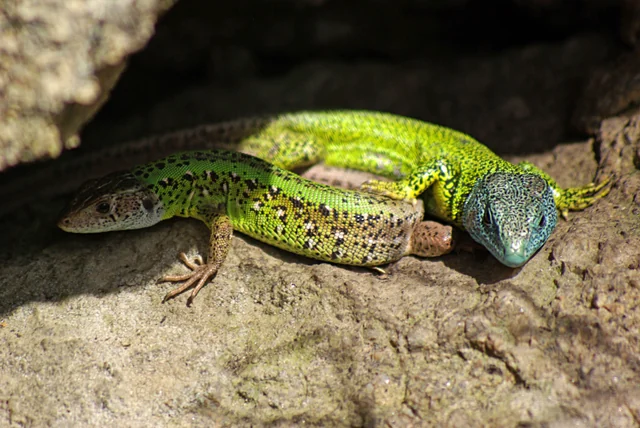
Two lizards on stone, one in the foreground and the other in the back, with green coloring and dark spots.
Water lizards photographed in Candelario, Salamanca, Spain, in 2013. Illustration of the species; it is not a record of Cabeceiras.
Photography: David Perez (DPC) · CC BY3.0
About this photograph

Date given at source: . Source consulted in 2026-11-07. EXIF orientation, proportional resize and WebP conversion; no retouching or new clipping of file obtained in Commons.

Request removal or correct the photo credit

Needing heat doesn't mean living away from the water.

Includes an activity to try →Explore: Grow and feed by the water →
Read here and view sources

The water lizard, Lacerta schreiberi, is associated with humid environments, vegetation of the shores, walls and silvados. The description published in the magazine Ambienta explains that it uses the heat of the sun in its activity, but shelters in the hottest hours of summer. The proximity of the water and the choice of a place to warm up are part of the same life.

It feeds mainly on invertebrates, including insects and arachnides. The color also varies: in males, the throat can acquire an intense blue at the breeding season. These general characteristics do not confirm the species in an animal seen as passing through. The source consulted does not constitute a record of Cabeceiras.

Age also changes the space sought. The Charcos with Life project distinguishes adults who need refuges between rocks and dense forests of juveniles associated with herbaceous vegetation. A varied margin can offer different shelters instead of functioning as a uniform strip.

Reproduction takes place between spring and mid-summer, according to the same chart. The females lay between six and seventeen eggs, with an incubation usually two to three months. These intervals describe the species, not an accompanying posture in the municipality.

The lizard hunts small invertebrates as well as serves as food for other animals. The source refers, among its predators, birds of prey, gynet and otter. It is another link between the vegetation of the margin, the water and the food network.

Words in this story: see explanations →
Source and context

Khris Valero — Lacerta schreiberi, magazine Ambienta, January 2004, pp. 61–62; archive of the Spanish Ministry MAPA

Charcoals with Life — Water Lizard, habitat and life cycle

Accessed: . Editorial summary; the date of consultation is not the date of the facts.

Birds · General biology in Portugal

An acrobat between the leaves

The blue chapim seeks food even upside down.

Read here and view sources

The barrette and the blue wings, the white faces and the dark line next to the eyes help to recognize Cyanistes caeruleus. The yellow breast completes the contrast. But it is worth looking at the movement: the University of Évora describes this small bird jumping through the branches and hanging upside down while feeding.

The foliage works as a search zone for insects and spiders. In autumn and winter, fruits and seeds can also enter the diet. The food does not fit in an equal list for all seasons: changes what the bird enjoys in the landscape.

The chapim-blue is resident and is distributed across the continental territory. Gulbenkian's chart describes varied wooded environments, from the woods to the galleries near the rivers, orchards, hedges and gardens. A garden and a wooded margin can offer different contexts to know this bird. These sources explain the species in Portugal; they do not document a meeting in a parish of Cabeceiras.

Words in this story: see explanations →
Source and context

University of Évora — Biodiversity of Mitra: Cyanistes caeruleus

Calouste Gulbenkian Foundation / João E. Rabaça — Blue Chapim

Accessed: . Editorial summary; the date of consultation is not the date of the facts.

Cavez · local register and general biology

A long tail by the water

The grey alveola leads to curiosity to the shore.

Includes an activity to try →Explore: The margin has several stories →
Read here and view sources

In the photograph of David Matos, the bird is located next to the water and a rocky surface. The record of 12 August 2024 is located in Cavez, at the intersection of the public point with CAOP2025, and is identified as Motacilla cinerea. The long tail and yellow at the bottom are visible details in this image.

The BTO describes a species mainly linked to rapid watercourses, which also uses slower rivers and shores of lakes and ponds, looking for aquatic insects. The environment is more than a scenario: it can offer food. The local photograph does not show a capture, so it does not allow to say what this bird ate at that meeting.

Compare the watermelon: two birds linked to watercourses may have very different ways of looking for food.

Source and context

British Trust for Ornithology — Grey Wagtail

Accessed: . Editorial summary; the date of consultation is not the date of the facts.

Big-ferradure bat · biology described in British source

Hunting can also get stopped

A landing could be part of a bat's strategy.

Includes an activity to try →
Read here and view sources

Not all food demand requires continuous flight. The Bat Conservation Trust describes the large ferrature bat from a habitual landing to catch passing insects. Larger prey can be taken to a feeding landing. The same record refers to capture in flight and occasionally on the ground.

Among the insects consumed, it lists beetles, nocturnal butterflies, tipules and tricopters. The latter group connects history to insects whose larvae can build shelters in the water: the adult form participates in other eating relationships.

The source describes the species in the British context. In Cabeceiras there is a documentary reference to Rhinolophus ferrumequinum, presented in another reading; this does not show that these behaviors have been observed here. The comparison helps to separate two questions: where was the animal mentioned and how can it live?

Source and context

Bat Conservation Trust — Greater horseshoe bat, behavior and feeding

Accessed: . Editorial summary; the date of consultation is not the date of the facts.

Serra da Cabreira · biology of the species

A bird of prey that nests on the ground

The hunting tartaranion is also called the hunting eagle.

Read here and view sources

Visit Cabeceiras includes the tartaranhão-hunter in the fauna of Cabreira. SPEA describes Circus pygargus as a summer bird, which returns to Portugal in the spring to nest. It prefers open spaces, mainly insects hunting and nests in the soil, among high vegetation. The reference covers the mountains; it does not identify nests or sighting points in the municipality.

The annual cycle connects continents. The LIFE SOS Pygargus project describes the winter in Africa and the return to the Iberian Peninsula in the spring, for reproduction, with permanence in breeding territories until September. This general calendar does not mark exact dates of arrival and departure to the Cabreira.

The long and narrow wings and tail are part of the portrait presented by LPN. Its mini-guide includes low mountain woods between habitats and refers to nests in high fields or landings. The menu is also broader than insects: it can include birds, small mammals and lizards. A prey of open spaces thus depends on both prey and vegetation suitable for nesting on the ground.

Words in this story: see explanations →
Source and context

Visit Cabeceiras — natural heritage of Serra da Cabreira
Accessed:

SPEA — Hunting Eagle / Circus pygargus
Accessed:

LPN — Bird guide, Imperial LIFE project: hunting turtle
Accessed:

Palombar / LIFE SOS Pygargus — Identification: migration and breeding period (text consulted in search result)
Accessed:

Editorial summary; the date of consultation is not the date of the facts.

Cavez · 2016–2017 monitoring

Six species under the surface

A sample shows a small portrait of the Tâmega in Cavez.

Includes an activity to try →Explore: You know the six fish from the lift →
Read here and view sources

At station 22, the report of 2016–2017 registered barbo-common, Northern boga-do-north, northern scale, embroidery, gobium and sunroof. The chart places the station in Cavez. These results document that campaign: they are neither a current inventory nor an indication of places to fish.

The six names open six ways to look at the river. The barb leads to migration in fresh water; the boga, the differences between young and adults; the scale, the drawing of scales. The embroidery and the gobium help to explore the food. The sunbath introduces the question of geographical origin. It opens the cards to choose one of these clues and get to the explanation of the species.

Sampling and biological datasheets have different functions.The survey documents the fish registered in that place and period.The datasheets explain the general characteristics of the species, without demonstrating that all these behaviors were observed in Cavez.

Getting to know the parish
Source and context

Biosphere / Iberdrola, APA file — Monitoring of ichthyofauna 2016–2017, February 2018; pp. 5, 35 and 40, station record 22 on p. 175 PDF
Accessed:

Mora Fluviary — Barbo-common, biology of the species
Accessed:

Municipality of Santa Maria da Feira — Northern Boga, fauna catalogue
Accessed:

Arouca Geopark — Northern scale, Squalius carolitertii: description and biology
Accessed:

ICNF — embroidery, ecology and riverside vegetation, pp. 2–3 (bibliography up to 2005)
Accessed:

Gaia Biological Park — Gobio, Gobio lozanoi: habitat, food and size
Accessed:

Águeda River Interpretation Center — Sun Loss
Accessed:

Editorial summary; the date of consultation is not the date of the facts.

Serra da Cabreira · life cycle of the species

Before the salamander, a life in the water

The stream is also the place where the transformation begins.

Explore: Growing up and being able to reproduce are different moments →
Read here and view sources

The life of the Salamander-lusitan begins with water. LPN often describes eggs attached to the substrate and larvae that remain in quiet areas until metamorphosis, in a development that can last one to two years.

During this phase, they feed on small aquatic animals, including insects, molluscs and crustaceans. Pollution and habitat loss threaten this cycle; water and surrounding vegetation matter together. The reading explains the biology of the species referred to for Cabreira, without locating breeding areas.

Finishing the metamorphosis is not the same as already being able to reproduce. LPN places the sexual maturity of males around three to four years and females between four and five. Transformation of the body and reproductive maturity are therefore distinct moments. The intervals describe the biology of the species; they do not allow for predicting the age of a specimen seen in a photograph.

Words in this story: see explanations →
Source and context

Link to Nature Protection — Salamander-lusitan
Accessed:

Visit Cabeceiras — natural heritage of Serra da Cabreira
Accessed:

Editorial summary; the date of consultation is not the date of the facts.

Ecology · general context to observe

From flower to flower, a shared task

Pollination involves much more than honeybee.

Includes an activity to try →Explore: Choose what you want to follow →
Read here and view sources

When visiting flowers, insects can transport pollen among plants. Bees, beetles and wasps participate in this task, explain entomologists Renata Santos and Albano Soares. Many bees live alone, without hive. This general explanation helps to look at flowers with other attention; the species present in Cabeceiras need local records.

Pollen exchanges between individuals contribute to the genetic diversity of plants. The explanation published by Gulbenkian relates pollinators to both wild plants and food crops, including apple trees, almonds and strawberry trees.

The flowers also have less remembered visitors: flower flies, daytime and night butterflies and some beetles. Observe who arrives, how long he stays and where he leaves is a way to start. The record of a visit, however, does not alone demonstrate that the insect has transferred pollen.

Source and context

Calouste Gulbenkian Foundation — explanations of entomologists Renata Santos and Albano Soares, 07/06/2022

Accessed: . Editorial summary; the date of consultation is not the date of the facts.

Serra da Cabreira · regional reference and biology of the species

A mole connected to the current

Cold water also has its inhabitants.

Explore: The river is also a pantry →
Read here and view sources

The water mole, Galemys pyrenaicus, is associated with cold, clear and well-oxygenated waters, often in rapid mountain rivers. The University of Évora also refers to the use of slower waters, such as canals and lakes: preference is not exclusive. Its natural distribution is limited to the Iberian Peninsula and the Pyrenees. In conservation, there are vegetation margins, shelters and habitat continuity; the chart identifies silting and isolation between threats. The municipal description of the fauna of Cabreira mentions the species, but this reading does not have a geolocalized register in the municipality.

The prolonged snout in a small trunk helps to search for larvae of invertebrates underwater, according to the description of the Generalitat of Catalonia. The technical file housed by ICNF highlights the invertebrates from the bottom of the river as a food base, including groups of tricopters, plecopters, ephemeropters and dipteres. The small animals that look like details of the river are part of the feeding of a mammal.

The profile of the ICNF presents a caveat for Portugal: it considers unfavourable the habitats of standing water, such as albufeiras and small lagoons of altitude. We should not turn the general reference to slow waters into an invitation to search for the species in any lake. Adequate habitat also involves food, shelters on the banks and connection to other sections of the river.

Words in this story: see explanations →
Source and context

University of Évora — Virtual Museum of Biodiversity, Galemys pyrenaicus

Vieira Tourism of Minho — fauna of Serra da Cabreira, regional reference

ICNF — Galemys pyrenaicus, ecology and nutrition (historical references)

Generalitat de Catalunya — Iberian Desmán, description of snout and feeding

Accessed: . Editorial summary; the date of consultation is not the date of the facts.

Cavez · 2016–2017 registration and general biology

Not all the fish from the river came from here.

Sunshine tells an introduction story.

Explore: The same river, different ways of living →
Read here and view sources

Sunshine, Lepomis gibbosus, is originally from North America. The Interpretation Center of the River of Águeda describes it as an exotic species, of high body and flattened laterally, which lives in still waters but also in rivers. In breeding season, males may hinder access by juveniles of native species to the shore shelters. It was registered in Cavez in 2016–2017; this record does not measure its local impact.

The bluish bands from the head to the flanks and a dark spot on the tip of the pearl are part of the description. In juveniles, the pattern is simpler, on a greenish or olivaceous background. Age also changes appearance.

The menu includes insects, crustaceans, sea snails, and fish larvae. This diversity helps to realize that food is not limited to a single prey. The chart also distinguishes lentic environments, such as albufeiras, from exotic environments, such as rivers and streams: the species can use both. The geographical origin, presence in a survey and the effect on other species are different information.

Words in this story: see explanations →
Source and context

Águeda River Interpretation Center — Sun Loss
Accessed:

Biosphere / Iberdrola, APA file — Monitoring of ichthyofauna 2016–2017, February 2018; pp. 5, 35 and 40, station record 22 on p. 175 PDF
Accessed:

Editorial summary; the date of consultation is not the date of the facts.

Pollinators · general biology

Small loads on the paws

The pollen can travel in plain sight.

Includes an activity to try →Explore: From flower to next discovery →
Read here and view sources

In honeybees and bees, pollen can accumulate in a rear-legged area suitable for transport. Other bees use sets of hair on their paws or under their abdomen. The entomologists heard by Gulbenkian explain that during visits to the flowers, part of the grain is on the way. The transport of food to the offspring is thus linked to pollination. It is a general explanation, without identifying an insect observed in the municipality. The color of the load also varies: experts refer to yellow, red or blue pollen, according to the plant of origin.

The scope is this set of hairs that works as a transport brush. The source also refers to groups that carry pollen in one part of the digestive tract and others that use the nests of other bees. Therefore, not all the relationship between a bee and pollen is presented as a visible load on the paws. What you see in a visit to the flower is only part of the story.

Words in this story: see explanations →
Source and context

Calouste Gulbenkian Foundation — explanations of entomologists Renata Santos and Albano Soares, 07/06/2022

Accessed: . Editorial summary; the date of consultation is not the date of the facts.

Hedgehog · General biology

Winter is not a sleep after

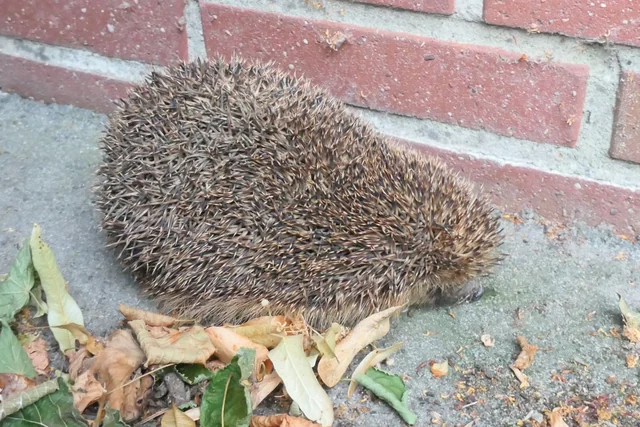
Hedgehog next to a brick wall, with visible thorns and little head exposed.
Goldfish in Kalkar, Germany, in 2025. Illustration of the species; it is not a record of Cabeceiras.
Photography: Pieter Delicaat · CC BY-SA 4.0
About this photograph

Date given at source: . Source consulted in 2026-11-07. EXIF orientation, proportional resizing and WebP conversion of the current version in Commons; no retouching or additional clipping.

Request removal or correct the photo credit

The hedgehog can return to activity when the temperature rises.

Includes an activity to try →
Read here and view sources

According to FCT NOVA, the hibernation of the hedgehog (Erinaceus europaeus) can be interrupted for warmer periods. This nocturnal and solitary mammal eats, among other foods, insects, worms, snails and fruit. Faced with a threat, he curls up and exposes the thorns. Woods, hedges, meadows and gardens are part of their habitats. This is general biology: the source does not confirm a register in the municipality. The short legs have five fingers and there is a small tail under the thorns. FCT NOVA also mentions the ability to climb and move in the water. These are general characteristics of the species, not proposed to test the capabilities of an animal found.

Source and context

FCT NOVA — FCT VIVA: Erinaceus europaeus

Accessed: . Editorial summary; the date of consultation is not the date of the facts.

General biology · dragonflies and dragonflies, without confirmed local occurrence

The inn wings give a clue

Dragonflies and dragonflies don't rest the same way.

Includes an activity to try →Explore: Wings, water and food →
Read here and view sources

The Tagis guide describes dragonflies with two pairs of similar wings, usually closed or slightly open vertically when they land. Dragonflies keep them open horizontally. It is a first observation clue, not a species identification. Dragonflies adults can move away from the watercourses thanks to their flight capacity.

Both groups belong to the Odonata order. The guide highlights the compound eyes, the short antennas and jaws used to capture other animals. Among the prey are flies and mosquitoes: these wings are part of a history of predators, not just colors.

Connection to water also changes with the phase of life. Dragonflies need it to complete the cycle, but adults can hunt in sunny clearings, far from the river where they were born. Seeing an adult on a path does not allow them to locate their breeding point. Compare the position of the wings, behavior and environment without turning an isolated clue into an identification.

Source and context

Tagis — Insects in Order, Odonata, dragonflies, dragonflies and friganiums (pp. 39–43 and 74)

Accessed: . Editorial summary; the date of consultation is not the date of the facts.

General biology · flower flies

Looks like a wasp, but it could be a fly.

The flowers receive visitors from many groups.

Includes an activity to try →
Read here and view sources

Not all bee or wasp-like insects belong to these groups. Flower flies are dipterans and many mimic the appearance of those insects, a resemblance that can drive away predators. Colors alone are not enough to identify the visitor of a flower.

The entomologists Renata Santos and Albano Soares, in the explanations published by Gulbenkian, highlight the pollen and nectar food and the role of these visitors in pollination. The flowers receive insects from various groups: observing who arrives and how to move can open new questions. The source describes general biology, not a species registered in the municipality.

The comparison with the bees must combine appearance and way of life. The outer similarity is related to the defense against predators; the visit to the flowers is related to the food and can contribute to the transport of pollen. They are different relationships in the same animal. Watching only bands of color does not reveal this whole story.

Source and context

Calouste Gulbenkian Foundation — explanations of entomologists Renata Santos and Albano Soares, 07/06/2022

Accessed: . Editorial summary; the date of consultation is not the date of the facts.

General biology · bee shelters

Not all bees are looking for the same house

Knowing the shelters adds another dimension to the flowers.

Includes an activity to try →Explore: Flowers, shelters and wood →
Read here and view sources

A flower can offer food, but it does not solve all the needs of a bee. Renata Santos and Albano Soares entomologists distinguish carpentine bees, who use dead wood to nest, from bees-miners, who need discovered soil. The diversity of shelters is also part of a garden.

The so-called insect hotels serve only part of the species, namely some that nest in cavities. They are a complement, not a universal home. The proposal is to recognize relationships between flowers, soil and wood; not to search or open nests. These general examples do not confirm local nests.

There is also a temporal dimension: different plants can offer flowers at different times. Researchers recommend diversity of forms and periods of flowering. Thus, when thinking of a garden, it is worth relating three questions: what provides food, where there can be shelter and at what time of year these resources are available.

Source and context

Calouste Gulbenkian Foundation — explanations of entomologists Renata Santos and Albano Soares, 07/06/2022

Accessed: . Editorial summary; the date of consultation is not the date of the facts.

Painzela · local register and general biology

Similar name, different kinship

A swallow is not a small swallow.

Includes an activity to try →Explore: How do you want to find out about the birds? →
Read here and view sources

Swallows and swallows catch insects in flight, but they belong to different orders. The first are Passeriformes, such as blackbirds and chapins; the second are Apodiformes, such as colibris. The similar name hides distinct kinships.

The shelters also tell stories: the Gulbenkian guide describes mud nests and small herbs of the beiral swallow next to the roofs. Black and pale swallows take advantage of recesses between tiles and chimneys. They are national examples, without locating nests in the municipality.

In Painzela, a photograph of birdlovers records a chimney swallow in 8 August 2025. Hirundo rustica builds bowl-shaped mud nests and captures small insects in flight, according to the University of Évora. The photograph shows a pause on a wire, not the nest or feeding. It is a local link to one of the species of this family, without converting the point into a guaranteed spot of observation.

Source and context

Calouste Gulbenkian Foundation / Wilder — Essential guide for swallows and swallows, 09/05/2024

University of Évora — Hirundo rustica

Accessed: . Editorial summary; the date of consultation is not the date of the facts.

Birds · General biology in Portugal

Not all swallows leave

The rock swallow spends the year in Portugal.

Read here and view sources

The rock swallow, Ptyoprogne rupestres, remains in Portugal all year round, although moving between regions. Resident does not mean immobile: the calendar of a bird can include travel without an annual trip to Africa.

The guide relates the migration of other swallows and swallows with the availability of the insects they feed on. Seeing a swallow is not enough to conclude that it has just returned. This national explanation does not confirm an observation in Cabeceiras.

Travels also vary among species. The guide describes travel between Europe and Africa and explains that the routes are not all the same. Food links these movements: in cold and rainy seasons, the search for insects takes many of these birds to warmer regions.

Words in this story: see explanations →
Source and context

Calouste Gulbenkian Foundation / Wilder — Essential guide for swallows and swallows, 09/05/2024

Accessed: . Editorial summary; the date of consultation is not the date of the facts.

Cabeceiras de Basto · occurrence referred to in environmental study

A bat also entered the territory documents

An environmental reference adds nightlife to the portrait of Cabeceiras.

Explore: From registration to questions about the species →
Read here and view sources

The environmental report of the Ribeira de Pena–Vieira do Minho line, filed by the Portuguese Environment Agency, refers to a register of large-tailed bat, Rhinolophus ferrumequinum, in a shelter associated with Cabeceiras de Basto. It is a documentary reference to the occurrence of the species, not a current population count. The information does not allow to assign here a parish or announce a place of observation.

Source and context

Matos, Fonseca & Associados / REN — EIA da Linha Dupla Ribeira de Pena–Vieira do Minho 1/2, relatório síntese, p.169; arquivo APA

Accessed: . Editorial summary; the date of consultation is not the date of the facts.

Bats · general biology without local observation point

Listen to the echo to find the way

The night can be explored through sound.

Includes an activity to try →Explore: The path of bat sound →
Read here and view sources

In echolocation, bats emit sound pulses and receive echoes that return from objects. This helps them to understand what is ahead and to accompany moving prey. Ricardo Rocha’s explanation for Gulbenkian also recalls that they are not blind: the vision participates in their lives. Researchers use devices to capture sounds that we often cannot hear. It is a general explanation, without identifying species by the observed flight.

An ultrasound detector makes sounds accessible that the human ear does not capture. Bats.pt presents it as an observation tool: listening with equipment adds clues, but this reading does not teach to identify a species from an isolated sound.

Source and context

Calouste Gulbenkian Foundation / Wilder — How do bats hunt at night?, 25/09/2019, with Ricardo Rocha

Bats.pt — As noted, general observation guidelines

Accessed: . Editorial summary; the date of consultation is not the date of the facts.

General ecology · how to study a river

The life of the river also tells a story

It is not enough to look at the transparency of water.

Includes an activity to try →Explore: Read the river through different lanes →
Read here and view sources

To study a river, it is interesting to know which organisms live in it and in what abundance. The Portuguese Environment Agency includes benthic invertebrates among the elements used in biological evaluation, together with other groups, such as fish and plants.

The evaluation also considers chemical, physicochemical and hydromorphological aspects. It is necessary to combine observations, sampling and analysis: transparent water or a single animal is not enough to classify a river. This explanation does not attribute a current state to watercourses of Cabeceiras.

Words in this story: see explanations →
Source and context

APA — Rivers and albufeiras: benthic invertebrates and biological evaluation

APA — Environmental State Report: Water status assessment

Accessed: . Editorial summary; the date of consultation is not the date of the facts.

Reptiles · general biology, no local occurrence confirmed in this form

No paws, but not a snake

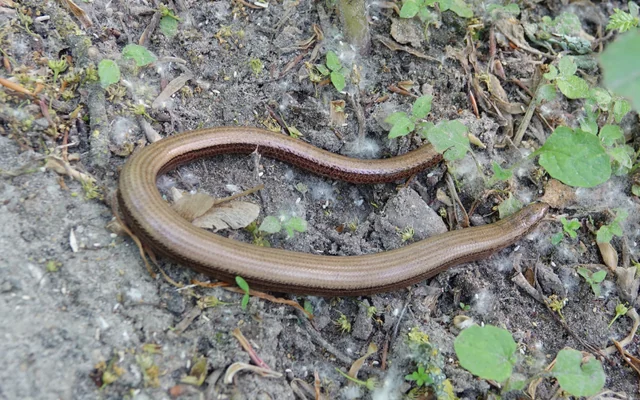
Licran of elongated brown body, bent on the ground between leaves and small plants.
Licensing photographed in Wyhl am Kaiserstuhl, Germany, in 2024. Illustration of the species; it is not a record of Cabeceiras.
Photography: Gzen92 · CC BY-SA 4.0
About this photograph

Date given at source: . Source consulted in 2026-11-07. EXIF orientation, proportional resize and WebP conversion; no retouching or new clipping of file obtained in Commons.

Request removal or correct the photo credit

The silhouette doesn't tell the whole story of the licranço.

Includes an activity to try →Explore: Body and Way of Life →
Read here and view sources

The licraço, Anguis fragilis, is a lizard without paws. The guide of agrarian biodiversity of the Xunta de Galicia describes it in cool and humid places, such as meadows and walls, where it feeds on slugs and insects. The elongated form may remind a small serpent, but this similarity does not determine the group to which it belongs.

This explanation serves to compare forms and ways of life. The guide refers to the Galician agrarian landscape; it does not prove an occurrence in Cabeceiras or allows to identify an animal only by an unclear photograph.

There is more to observe than the absence of paws. The Wildlife Trusts highlights the movable eyelids, which allow the licranço to blink, and the ability to loosen the tail. The female keeps the eggs inside the body until the birth of the cubs. They are general characteristics of Anguis fragilis, without a local record associated with this reading.

The pace also changes throughout the year. The organization describes a state of winter dormancy, called mist. The timing presented by the source concerns the UK: it is not transferred to Cabeceiras. To know the species, it is appropriate to distinguish the shape of the body, behavior and geographical context of the information.

Words in this story: see explanations →
Source and context

Xunta de Galicia — Guía for the conservation of biodiversity in Galicia, Anguis fragilis, p. 54

The Wildlife Trusts — Slow worm (Anguis fragilis), general biology; British context

Accessed: . Editorial summary; the date of consultation is not the date of the facts.

Cavez · 2016–2017 registration and general biology

A small fish, many small prey

The gobium links the life of the river to the invertebrates.

Read here and view sources

The Gaia Biological Park describes Gobio lozanoi as a freshwater river fish that feeds on small invertebrates and usually measures about 12 centimeters. It is a usual dimension indicated in this chart, not the size of all individuals nor a measure collected in Cabeceiras.

In the survey of Cavez of 2016–2017, the gobium is among the six registered species. Adding this evidence to the description of the feed helps to ask a question about the river: which small animals support the fish? The record does not identify the prey consumed at that point or prove a relationship with each insect presented on this site.

Source and context

Gaia Biological Park — Gobio, Gobio lozanoi: habitat, food and size
Accessed:

Biosphere / Iberdrola, APA file — Monitoring of ichthyofauna 2016–2017, February 2018; pp. 5, 35 and 40, station record 22 on p. 175 PDF
Accessed:

Editorial summary; the date of consultation is not the date of the facts.

Bucos · local register and general biology

A red breast, a menu that changes

In winter, the fruits also enter the feed of the pisco.

Read here and view sources

Erithacus rubecula should be part of the scientific name to the stain of the chest: rubecula evokes the reddish color. João E. Rabaça's description for Gulbenkian presents a frequent bird in wooded areas of Portugal, including parks and gardens, especially in winter. It is a good starting point to look at a family bird with another curiosity: what do you look for to eat?

During most of the year, food is essentially insectivorous. In winter, fruits and berries gain weight in the diet. The change connects the bird to plants and seasons: knowing an animal also goes through discovering the food that the landscape offers throughout the year.

Resident and migrant are not always opposite labels for an entire species. In the British example described by the BTO, resident piscos coexist in winter with visitors from northern and eastern Europe. This example helps to understand different movements within the same species; it does not identify the origin of a pisco observed in Cabeceiras.

There is a documented meeting in the municipality: Pedro Mendes published a pisco observation of 3 October 2021. The public point is in Bucos at the intersection with CAOP2025 and community identification had a degree of investigation in the consultation of 7 November 2026. The registration confirms this meeting; it does not identify the migratory origin of the bird. The photograph preserves all rights reserved and can be consulted at the source.

Words in this story: see explanations →
Source and context

Calouste Gulbenkian Foundation / João E. Rabaça — Red-necked pisco

British Trust for Ornithology — BirdFacts: Robin, Erithacus rubecula

iNaturalist — pisco observed by Pedro Mendes in03/10/2021, Bucos; photograph with all rights reserved

Accessed: . Editorial summary; the date of consultation is not the date of the facts.

Refojos de Basto · local register and general biology

A rapture with a varied menu

The common-buthium seeks food in the landscape sky and also on the ground.

Includes an activity to try →Explore: From poise to landscape →
Read here and view sources

The photograph of ecovore shows Buteo buteo landed among branches, in a record of 1 July 2025. The published point, crossed with CAOP2025, is located in the parish of Refojos de Basto. The image allows to observe the inn bird; it does not show a hunt.

Also called eagle-d’asa-round, this prey may show marked differences in the amount of white and brown plumage. The University of Évora describes a species resident in mainland Portugal, with reinforcement of winter birds from northern Europe. Color alone does not solve all identifications.

The BTO describes a feed that takes advantage of available prey: rabbits and small mammals, but also birds, amphibians, large insects and earthworms. The search for food can take you to the ground. Compared with the hunting tartaranion helps you realize that two prey can share some food without having the same way of life.

Source and context

University of Évora — Buteo buteo: plumage and distribution

British Trust for Ornithology — BirdFacts: Buzzard

Accessed: . Editorial summary; the date of consultation is not the date of the facts.

YOUR LOCAL GUIDE

What would you like to discover?

Take a closer look.