Discover Cabeceiras de BastoFree independent guide
ViveCabeceirasYOUR GUIDE TO CABECEIRAS
ENEnglish
SearchSaved

Animals

Choose a story to start with. You can change the subject or fine tune the search.

9 stories · Life you do not always see · Search: fora

Life you do not always see

Knowing animals begins by perceiving the territory and respecting the distance.

Choose a story · 9
Cavez · record from 2016–2017 and general biology

A fish’s menu can include insects

Feeding connects life in and out of the water.

Includes an activity to try →Explore: Who feeds on what? →
Read here and view sources

The chart of the ICNF describes the embroidery, complex Squalius alburnoids, as a consumer mainly of insect larvae. In summer and early autumn, it refers to higher consumption of terrestrial insects. It is a small link between the river and its margins. The embroidery appears in the study of Cavez of 2016–2017 under the name Iberocypris alburnoides; the local study did not analyze this seasonal change in feeding.

The same chart describes the use of rivers and streams with diverse characteristics, including small and shallow courses with emerging aquatic vegetation. The habitat is not only water: shelters, vegetation and alternation of zones with different current speeds enter history.

Therefore, a margin totally devoid of vegetation changes more than the view. The chart associates the loss of riverside vegetation with the reduction of shade, shelter and feeding sites. These general ecological relationships help to interpret the river; they are not a current evaluation of a section of Cavez. The local record of 2016–2017 and the biological explanation answer different questions: where the fish was documented and how it relates to the environment.

Source and context

ICNF — embroidery, ecology and riverside vegetation, pp. 2–3 (bibliography up to 2005)
Accessed:

Biosphere / Iberdrola, APA file — Monitoring of ichthyofauna 2016–2017, February 2018; pp. 5, 35 and 40, station record 22 on p. 175 PDF
Accessed:

Editorial summary; the date of consultation is not the date of the facts.
Badger · general biology

A home beneath the ground

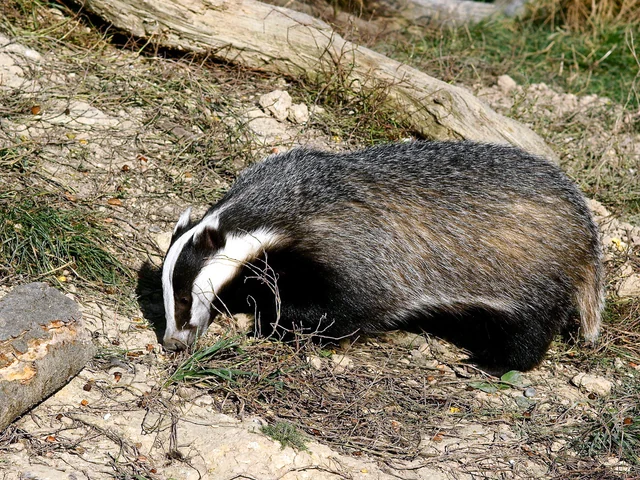
Badger with gray body and head with light and dark bands, next to the ground.
Badger at the British Wildlife Centre in Newchapel, Surrey, UK, in 2011. Animal in fauna park; not a record of Cabeceiras.
Photography: Peter Trimming · CC BY 2.0
About this photograph

Date given at source: . Source consulted in 2026-11-07. EXIF orientation, proportional resizing and WebP conversion of the current version in Commons; no retouching or additional clipping.

Request removal or correct the photo credit

Badgers spend much of their lives out of our sight.

Includes an activity to try →Explore: For the thorns and life in the water →
Read here and view sources

The badger (Meles meles) has mainly nocturnal activity and shelters in extensive underground burrows. The two dark bands on the white head are a striking visual clue; the short legs have strong claws. The Virtual Museum of Biodiversity describes its presence in forests, forests and agricultural landscapes with vegetation. This chart explains the species in mainland Portugal; it does not document an observation in Cabeceiras de Basto. The claws are long and not retractable: they do not collect like those of the cats. The tail is short and clear, another contrast with the fox's long tail. These details help compare descriptions without searching or disturbing burrows.

Source and context

University of Évora — Virtual Museum of Biodiversity: Meles meles

Accessed: . Editorial summary; the date of consultation is not the date of the facts.
Species recorded in the municipality · general ecology

An old trunk still nourishes life

For beetle larvae, decaying wood can be both home and food.

Includes an activity to try →Explore: A photograph, several phases of history →
Read here and view sources

The larvae of Dorcus parallelipipedus live and feed on decomposing wood, according to The Wildlife Trusts. The photograph of the catalogue documents an adult observed in the municipality; it shows no larvae or confirms the tree where they developed. Add this story to that of wood fungi: an aging trunk can sustain different life forms. To observe, you don't have to undo your shelter. In the adult, The Wildlife Trusts highlights the wide head, jaws, and wing covers entirely black. They are clues to compare with the available photograph, without concluding that all dark beetles belong to this species.

Source and context

The Wildlife Trusts — Lesser stag beetle, Dorcus parallelipipedus
Consultations: ,

Editorial summary; the date of consultation is not the date of the facts.

Bucos · an account from 1758

Animals in an old portrait

An account of the mountains written in 1758.

Includes an activity to try →
Read here and view sources

The vicar of Bucos mentions partridges, rabbits, wolves, foxes and wild boars, which he describes as sparsely plentiful. He points out carqueja, heather and tojo on the hills. It is the landscape that recorded at that time, not a current inventory nor a promise to spot these animals.

The memory also mentions goats as the most abundant cattle and some large cattle. Thus, the same document gathers farm animals and fauna that the vicar describes as hunting. Separating the two groups helps to read the rural life of the period.

The expression of little abundance is an appreciation of the author, without method of counting presented. It does not allow directly to compare 1758 with a census of current fauna. The interest of the report is also in what you choose to observe: animals, forests, terrain and uses of the mountains appear together.

Source and context

Municipality — Parish memories of Bucos (1758)

Accessed: . Editorial summary; the date of consultation is not the date of the facts.

Serra da Cabreira · regional reference and species biology

A newt between water and land

Its skin also changes with its surroundings.

Includes an activity to try →Explore: From egg to change of environment →
Read here and view sources

The orange triton, Lissotriton boscai, has smoother skin in the aquatic phase and more rough in the terrestrial phase. To reproduce it can use ponds, streams of little current and even tanks. Out of water finds refuge in moist places, between roots, stones and trunks. The orange belly helps explain the name.

It is mentioned among the amphibians of the Cabreira by the municipal portal of Vieira do Minho, without an associated observation point.

The description of the University of Évora refers to four fingers on the front legs and five on the back, besides a flattened tail laterally. They are characteristics of the species, not a reason to remove it from the water. The same source indicates a total length up to nine centimeters and females usually larger and more robust than males.

Also the mating season can change the look. The University of Évora describes a small crest on the tail and, in males, a whitish longitudinal strip, more marked next to the end. Compare two images therefore requires attention to sex and the phase of the year, besides the name of the species. Not all visible differences mean animals of different species.

Food follows the change of environment. According to the Charcos with Life project, larvae and aquatic adults capture small invertebrates from the water; on land, adults eat mostly soft-body animals, such as worms and slugs. The female lays eggs individually on aquatic plants or leaves, over several days. The scheme below connects these phases without assigning them dates of occurrence in the Cabreira.

Source and context

University of Évora — Virtual Museum of Biodiversity, Lissotriton boscai

Vieira Tourism of Minho — fauna of Serra da Cabreira, regional reference

Charcoals with Life / CIIMAR — Orange belly triton, life cycle and feeding

Accessed: . Editorial summary; the date of consultation is not the date of the facts.

Serra da Cabreira · regional reference and species biology

Bright colours, a quiet whistle

There is more to a bullfinch than its plumage.

Read here and view sources

The Pyrrhula pyrrhula male combines pink breast and black twig; the female has more discrete tones. The British Trust for Ornithology describes a soft call, in an isolated whistle, and the consumption of fruit tree shoots in the spring. Vieira municipal portal of Minho includes the gift-fafe among the Cabreira birds. This reference covers the mountains, without confirming an occurrence in a parish or route of this guide.

Reproduction has different stages. In the nesting and nesting data gathered by the BTO, the typical posture has four to five eggs and incubation, ensured by the female, usually lasts 14–16 days. After hatching another phase begins: the development of the cubs until they leave the nest. The published intervals are not a calendar for the Cabreira.

The chart also allows distinguishing a typical value from the observed extremes. A posture outside the most usual number does not automatically belong to another species. To read nature, it is important to know what was measured, in which population and with what variation.

Words in this story: see explanations →
Source and context

British Trust for Ornithology — BirdFacts: Bullfinch, Pyrrhula pyrrhula

Vieira Tourism of Minho — fauna of Serra da Cabreira, regional reference

Accessed: . Editorial summary; the date of consultation is not the date of the facts.

Reptiles · general biology, without a confirmed local record in this profile

One snake can have different patterns

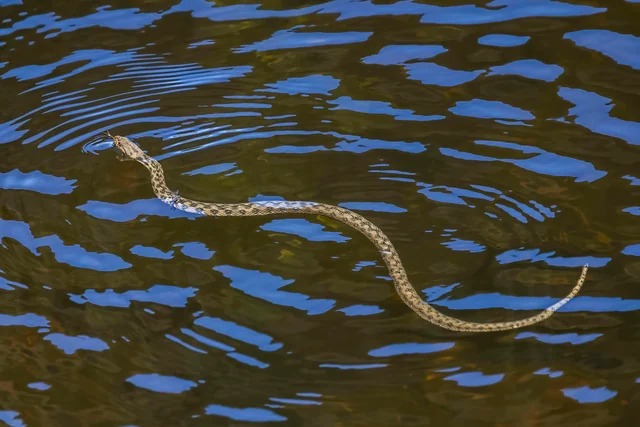
Snake with the body wavy to the surface of the water, between blue reflexes and small ripples.
Viperine water snake swimming in Extremadura, Spain, in 2022. Illustration of the species; not a record of Cabeceiras.
Photography: Charles J. Sharp · CC BY-SA 4.0
About this photograph

Date given at source: . Source consulted in 2026-11-07. EXIF orientation, proportional resize and WebP conversion; no retouching or new clipping of file obtained in Commons.

Request removal or correct the photo credit

The viperine snake’s back does not always have the same pattern.

Includes an activity to try →Explore: The same environment, different ways of life →
Read here and view sources

Natrix maura may present a zigzag stripe, but also a pattern of two clear longitudinal lines. The Spanish biodiversity inventory still describes variation in body tones. A single design does not summarize all individuals of the species.

The chart of the Northern Coastal Natural Park explains the connection to rivers, ponds, streams and other aquatic environments, without excluding displacements on land. It is a general context about the species: it is not an observation in Cabeceiras. Reading compares variation and habitat; it is not a key to identifying snakes found in the field.

The Charcos com Vida project describes a feed mainly in water: invertebrates, larvae and adults of amphibians and small fish enter the menu. The aquatic environment is, thus, a feeding space, besides displacement. The same snake can be preyed on birds and mammals; taking the place of predator does not remove it from the food network.

It is usually daytime, but in summer it can maintain activity at dusk or during the night. Behavior also changes before a threat: the record refers to the expansion of the head and other defensive signs that contribute to the similarity with a viper and to the common name. This explanation of the name does not allow to decide the species or safety of a meeting by the shape of the head.

Words in this story: see explanations →
Source and context

Inventory Español del Patrimonio Natural y la Biodiversidad — Natrix maura, description of the species

Co-management of the Northern Coastal Natural Park — Reptiles and amphibians, record of the viperine water snake

Lived Chargings — Viperine Water Cobra, Feeding and Behaviour

Accessed: . Editorial summary; the date of consultation is not the date of the facts.

Refojos de Basto · local record and general biology

A bird of prey with a varied menu

The common buzzard searches for food from the sky and on the ground.

Includes an activity to try →Explore: From perch to landscape →
Read here and view sources

Ecovore’s photograph shows Buteo buteo perched among branches in a record dated 1 July 2025. Comparing the published location with CAOP2025 places it in the parish of Refojos de Basto. The image lets us observe a perched bird; it does not show a hunt.

Also known in Portuguese as águia-d’asa-redonda, this bird of prey can vary greatly in the amount of white and brown in its plumage. The University of Évora describes a species resident in mainland Portugal, joined by wintering birds from northern Europe. Colour alone does not settle every identification.

The BTO describes a diet that makes use of available prey: rabbits and small mammals, but also birds, amphibians, large insects and earthworms. Searching for food can bring the buzzard down to the ground. Compare it with Montagu’s harrier: two birds of prey can share some foods without having the same way of life.

Source and context

University of Évora — Buteo buteo: plumage and distribution

British Trust for Ornithology — BirdFacts: Buzzard

Accessed: . Editorial summary; the date of consultation is not the date of the facts.

Cavez · local record and general biology

One shell, many patterns

Snails of the same species do not all wear the same pattern.

Includes an activity to try →
Read here and view sources

João Lima photographed this snail on 15 May 2024. The record is identified as Cepaea nemoralis, and comparing its published point with the CAOP2025 boundaries places it in Cavez. In the image, dark bands follow the shell’s whorls among wet leaves.

The Carnegie Museum of Natural History describes a shell that can have bands of different widths or no bands at all. The lip of the opening is usually brown, but not always. The species can also be confused with Cepaea hortensis. Colour, pattern and shape need to be considered together; a photograph that hides the opening leaves some clues out of sight.

Try following the spiral with your eyes. You do not need to move the animal to discover a pattern.

Source and context

Carnegie Museum of Natural History — Cepaea nemoralis

Accessed: . Editorial summary; the date of consultation is not the date of the facts.

YOUR LOCAL GUIDE

What would you like to discover?

Take a closer look.