Discover Cabeceiras de BastoFree independent guide
ViveCabeceirasYOUR GUIDE TO CABECEIRAS
ENEnglish
SearchSaved

Story

Choose a story to start with. You can change the subject or fine tune the search.

6 stories · Travel through time · Search: correio

Travel through time

Documents, details and traditions: there is more to discover than a date on a stone.

Choose a story · 6
Arco de Baúlhe · railway memories

Mail travelled by train too

Van DE.FV 506 carried more than goods.

Read here and view sources

Built in Belgium in 1908, van DE.FV 506 is presented by the Museum as a narrow-gauge vehicle for goods, parcels and mail. It had sheet-metal cladding, electric lighting and a toilet for the employee, accessed from outside. Acquisition by the Companhia dos Caminhos de Ferro de Guimarães is suggested as a possibility. The collection description, published in 2011, does not confirm whether the vehicle is currently on display.

The gauge given by the Museum is one metre. Compared with the railcar, the purpose changes: the ME5 carried passengers, while this van combined freight, parcels and mail. Travelling on the same network could mean carrying people, news or goods.

See Fact sheet: Núcleo Ferroviário de Arco de Baúlhe
Source and context

Land Museum of Basto — Van DE.FV 506, 17/07/2011

Basto Land Museum — Heritage with history: Self-propelled ME5, 22/02/2018

Accessed: . Editorial summary; the date of consultation is not the date of the facts.
Faia · communications in 1758

Letters had their arrival days

Before instant messages, mail helped organise the week.

Read here and view sources

In his 1758 answer, Faia’s abbot records mail arriving on Tuesday and leaving on Thursday. One brief detail reveals the rhythm of communication in a rural community. The document does not identify the building where letters were received here; these days belong to the old account, not current postal services. The abbot placed Braga eight leagues away and Lisbon sixty. These recorded distances, without conversion into modern kilometres, add scale to the wait for news.

The answer belongs to a questionnaire that also asked about distances, fairs and aspects of local life. In the same account, the abbot distinguishes the São Miguel fair from Olela’s fairs and the monthly fair in the municipal seat. Mail and fairs are two rhythms that help explain a community; the text does not say letters were delivered at those markets.

Source and context

Municipality — Memory of Faia, 23/05/1758; transcript of José Viriato Chapel (2003)

Accessed: . Editorial summary; the date of consultation is not the date of the facts.

Cavez · settlement and devotion in 1758

Eight settlements and six chapels

In Cavez, an old list connects villages, residents and monasteries.

Includes an activity to try →
Read here and view sources

On 25 May 1758, vicar Manuel Pacheco da Cunha listed eight settlements: Cavez, Vila Franca, Ponte, Arosa, Rabiçais, Moimenta, Revoriça and Parada. He placed the church in the middle of the parish and described six chapels. The names help reveal a network of settlement; they are not a current list of administrative places.

São Gregório in Vila Franca, São Mamede in Arosa and Santa Maria Madalena in Moimenta were attributed to the abbot of Pombeiro, with their upkeep linked to the Benedictine congregation of Tibães. São Bartolomeu in Ponte had João Correia of Guimarães as patron. Responsibility for São Caetano, in Raviçais in the chapel passage, and Santa Luzia in Revoriça fell to the residents. The transcription itself uses both Rabiçais and Raviçais.

The account also describes five altars in the parish church and a brotherhood of the Souls. The parish emerges as a place of worship and collective organisation, with distinct responsibilities. The São Bartolomeu pilgrimage is mentioned for 23 and 24 August; these dates belong to the historical testimony, not to a current events calendar.

The parish’s connections went beyond its chapels. The vicar wrote that Cavez had no mail service of its own and used Raposeira’s, which he placed one league away. He also stated that the parish had no fair. These clues invite reflection on where news arrived and services gathered at that time; they neither describe current provision nor allow a league to be converted automatically into a road distance.

Getting to know the parish See Fact sheet: Capela de São Bartolomeu de Cavez See Fact sheet: Igreja de São João de Cavez e cruzeiro
Source and context

Municipality of Cabeceiras de Basto — Parish memories of 1758: Cavez

Accessed: . Editorial summary; the date of consultation is not the date of the facts.

Arco de Baúlhe · documentary memory

The station keeps documents too

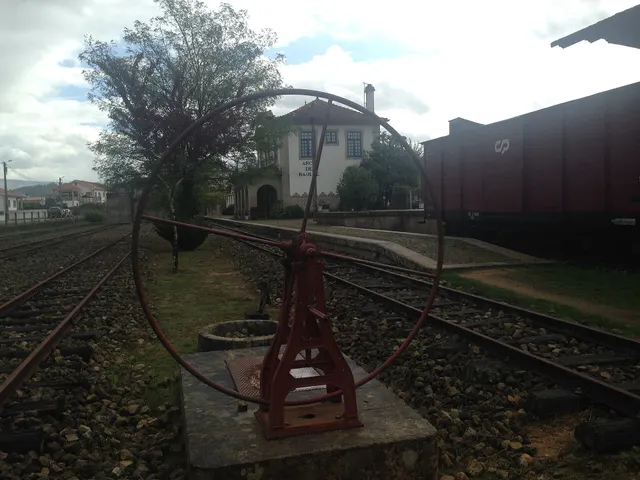
Revolving plate and tracks from the old Arco de Baúlhe station, with buildings and railway equipment at the bottom.
Former Arco de Baúlhe station, where the Basto Land Museum is located.© JP Ribeiroⓘ

Behind the exhibits are books, photographs and archives.

Explore: File gives context to objects →
Read here and view sources

The Museu das Terras de Basto opened to the public on 23 May 2004, based at Arco de Baúlhe station. Its presentation of the Documentation Centre distinguishes two collections: the municipal collection and that of the Railway Museum, owned by the Fundação Museu Nacional Ferroviário and held by the local museum.

Books, periodicals, photographs, maps and archive documents support research into the region. The description recalls the organisation of the collection in 2011; it does not confirm current access arrangements.

In February 2011, the Museum also announced the checking and cataloguing of railway objects, starting from the inventory drawn up by CP technicians and included in the 2000 agreement. Preserving memory meant identifying and recording each object.

See Fact sheet: Núcleo Ferroviário de Arco de Baúlhe
Source and context

Basto Land Museum — Documentation Centre, historical description of the collection

Basto Land Museum — Inventory of collections, 17/02/2011

Accessed: . Editorial summary; the date of consultation is not the date of the facts.

Faia · parish account of 1758

In Faia, the abbot recorded no ruins

The same event left different accounts in the parishes.

Read here and view sources

In the account signed on 23 May 1758, Faia’s abbot stated that the earthquake had caused no destruction. It offers a counterpoint to Alvite’s testimony, which described damage to crosses on a chapel. The absence of ruins in the account does not prove that the earthquake went unfelt: it shows what was recorded in that answer. Reading both documents brings general history closer to local experiences.

It is useful to notice who wrote the answer and when: João de Lima Lobo de Noronha, abbot of Faia, responded to a set of questions also covering settlements, crops, fairs and mail. The earthquake is one subject in that local portrait. The 1758 signature dates the testimony, not the event it recalls.

Source and context

Municipality — transcription of the Parish Memories of Faia, 23/05/1758

Accessed: . Editorial summary; the date of consultation is not the date of the facts.

Vila Nune · settlement described in 1758

One parish, many small settlements

Counting households was not the same as counting people.

Includes an activity to try →Explore: Places, people and paths →
Read here and view sources

In May 1758, Vila Nune’s vicar recorded 55 households and 239 people. He listed fourteen settlements, some with only one resident, and noted uninhabited houses in Serra.

These figures describe different categories in the document. They should not be added together or confused with a current census. The small scale of the settlements evokes dispersed habitation viewed through the parish.

The list allows a closer look: Silva is assigned eight households; Vale and Rossada five each. Fojães and Ribeira da Covilhã appear with just one resident. The church stood in Granja, near Vale. The religious centre was therefore distinct from the place called Vila Nune.

Vicar Domingos Leite de Andrade adds that the households included unmarried women living in poverty and people from other parishes. This is one author’s social description from a particular time; it does not allow every individual life to be reconstructed. By retaining the terms and date, the document offers glimpses of different domestic circumstances within the small settlements.

Source and context

Municipality — Parish Memoirs of Vila Nune, 23/05/1758

Accessed: . Editorial summary; the date of consultation is not the date of the facts.

YOUR LOCAL GUIDE

What would you like to discover?

Take a closer look.