Discover Cabeceiras de BastoFree independent guide
ViveCabeceirasYOUR GUIDE TO CABECEIRAS
ENEnglish
SearchSaved

Animals

Choose a story to start with. You can change the subject or fine tune the search.

4 stories · Life you do not always see · Search: castanho

Life you do not always see

Knowing animals begins by perceiving the territory and respecting the distance.

Choose a story · 4
Biology of the species · Portuguese context

The hind changes its coat
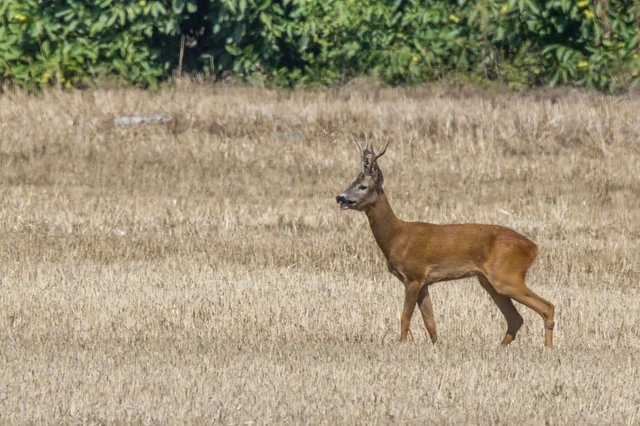
Profile hind in a field, with stems, raised ears and reddish brown coat.
Male hind in Dobruja, Romania, in August 2022. Illustration of the species; it is not a record of Cabeceiras.
Photography: Charles J. Sharp · CC BY-SA 4.0
About this photograph

Date given at source: . Source consulted in 2026-11-07. EXIF orientation, proportional resizing and WebP conversion of the current version in Commons; no retouching or additional clipping.

Request removal or correct the photo credit

A summer coat, a winter coat.

Includes an activity to try →Explore: The same world, different rhythms →
Read here and view sources

In the hind, Capreolus capreolus, the fur is reddish brown in summer to gray in winter. It feeds on plants and also occupies open areas and shrubs. This description of the species does not identify a spot of sighting in the municipality. The hind is a small cervid: the description of the platform points to 30 kg. The males have stems; the white spot on the back has a kidney shape in males and hearts in females.

The stems also follow a cycle: the platform refers to the growth and annual fall in the hind and deer. Therefore, they are not a structure that always remains the same. In the head, the nose and the upper lip mostly black contrast with the lower lip white.

The hours of activity add another difference. Although it is mainly crepuscular and nocturnal, the source presents the hind as the Portuguese cervid with the highest daytime activity. They are trends of the species, not a guaranteed hour to observe it. To know an animal, form, season and behavior need to be read together.

Words in this story: see explanations →
Source and context

Lobo-Iberico platform in Portugal — wolf prey; registration of Cabreira without date indicated

Accessed: . Editorial summary; the date of consultation is not the date of the facts.

Fox · general biology

Between the woods and the countryside

For the fox, a varied landscape offers different environments.

Read here and view sources

The red fox (Vulpes vulpes) occupies many habitats, from coast to mountain. The Virtual Museum of Biodiversity highlights the preference for shrubs and woods interspersed with agricultural fields or pastures. The long, hairy tail and pointed snout help recognize its profile.

The distribution described covers mainland Portugal, but does not replace a register located at Cabeceiras de Basto.

The coat can combine brown, red and grey tones; the tail tip can present a whitish spot. The description also mentions that the cubs are brown until approximately six months. Thus, color and age must enter the animal's reading rather than always expect the same appearance.

Source and context

University of Évora — Virtual Museum of Biodiversity: Vulpes vulpes

Accessed: . Editorial summary; the date of consultation is not the date of the facts.

Abadim · local register and general biology

The wings give a clue to the finch

Males and females have different colors, but share marks on their wings.

Includes an activity to try →Explore: Colors, seasons and food →
Read here and view sources

The common finch, Fringilla coelebs, appears in a record of naturpel of 6 February 2022, located in Abadim by crossing the public point with CAOP2025. The image allows you to look for the contrast of the clear marks on the wings and tones of the chest, although the movement reduces the sharpness.

Birds of Portugal describe the males with bluish barrette and chest and reddish faces. The females have more discrete shades, brown and gray, but retain a contrasting pattern on the wings. The beak is conical and robust. Compare various features is more useful than looking for a single color.

The species is resident in Portugal and receives winter birds in autumn. At that time there may be more individuals, but behave more discreetly than in spring. This general description does not allow determining whether the bird photographed in February was born in the region or arrived from another territory.

Source and context

Birds of Portugal — Common finch

Accessed: . Editorial summary; the date of consultation is not the date of the facts.

Cavez · local register and general biology

A shell, lots of drawings

Not all snails of the same species wear the same pattern.

Includes an activity to try →
Read here and view sources

João Lima photographed this snail in 15 May 2024. The record is identified as Cepaea nemoralis and the published point is in Cavez, at the intersection with the limits CAOP2025. In the image, the dark bands accompany the turns of the shell between wet leaves.

The Carnegie Museum of Natural History describes a shell that can have bands of different widths or not present bands. The edge of the opening is usually brown, but not always. The species can also be confused with Cepaea hortensis. Color, drawing and shape need to be seen together; a photograph that hides the opening leaves part of the clues out of sight.

Try to follow the spiral with your eyes.

Source and context

Carnegie Museum of Natural History — Cepaea nemoralis

Accessed: . Editorial summary; the date of consultation is not the date of the facts.

YOUR LOCAL GUIDE

What would you like to discover?

Take a closer look.