Greens with beans
ⓘ
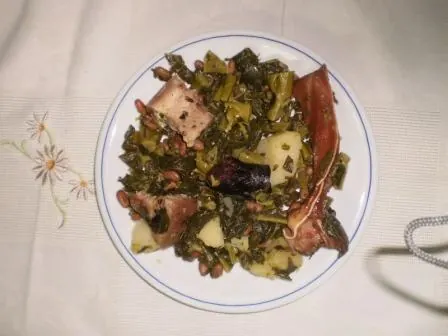
Greens and beans in the Terras de Basto Museum’s account.
Source: Museu das Terras de Basto
Photograph date not stated.
Individual photographer and reuse licence not stated by the source.
ⓘ
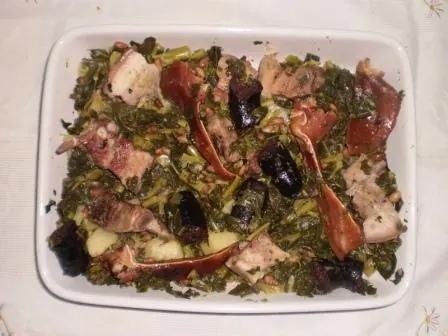
Greens and beans in the Terras de Basto Museum’s account.
Source: Museu das Terras de Basto
Photograph date not stated.
Individual photographer and reuse licence not stated by the source.
A winter dish rooted in rural life.
Text size
Your choice is saved only in this browser.
Cabeceiras chose couves com feijões, greens with beans, for the Referencial Gastronómico do Minho. The description connects couve-galega and yellow beans, also called moleiro, with hearth cooking. For more substantial meals, the cooking liquid from pork and the addition of sausages enriched the dish. The Museum also preserves a family version recorded in February 2010: Maria da Conceição Gonçalves Mouta, born in Cavez and living in Pedraça, had learned the dish from her grandmother. In that preparation, the greens and potatoes used the cooking liquid from the beans and meat; olive oil was added at the table.
Compare this dish with couves com migas: one recipe uses potatoes and assorted meats; the other adds bread at the end. The same voice from Pedraça preserves two ways of bringing greens and beans to the table. Which is closer to your family memories?
Greens with beans: Maria da Conceição’s recollection
Tick off ingredients as you gather them. Checkmarks last only on this page. Any time shown for the reading journey is reading time, not cooking time.
Go to preparation ↓Ingredients
Method at a glance
Back to ingredients ↑Tick off each step as you finish it. You can untick it; checkmarks last only on this page.
Summary of the account recorded by Maria de Fátima Carvalho in February 2010, for five people. Household measures are those given in the account. The advance preparation of the salted meats and beans is not detailed; the 15 minutes mentioned in the original are not a total cooking time.
Read the original recipe →Explore further: words and activities
Explore this story
A kitchen, different moments
Open an option and choose the story.
In spring, new cabbages and broa
Compare the cabbages and beans with a preparation in which the broa is involved in the end.
The broa also entered the cabbages →At Carnival, earpiece and grelos
The cooking water the meat again plays a central role, now in a meal associated with Carnival.
Carnival also went to pot →The bread and memory of the batches
It follows the preparation of the bread that also accompanies other memories of the table.
This bread mixture rye and wheat →
One bookmark per reading journey, saved in this browser.
Source and context
Gastronomic Reference of Minho — Cabeceiras, pp. 214–215
Accessed:
Basto Land Museum — food collections, 2010 and 2011
Accessed:
Editorial summary; the date of consultation is not the date of the facts.