Discover Cabeceiras de BastoFree independent guide
ViveCabeceirasYOUR GUIDE TO CABECEIRAS
ENEnglish
SearchSaved
9 STORIES · CONTINUOUS READING

Life hidden in bread dough

Nine stories follow the cereals to the pasta, the oven, the lunch and the bakery ads. Compare Recovos' recipe, the life of yeasts and the bread rituals. Ingredients and remarkable steps accompany the fountains; in the end, create an advertisement inspired by the memory of 1939.

All stories in the order of the route. You can print this page by the browser; sources and credits follow the reading.

Things to try4 activities · 5 interactive explorations · 7 questions · 2 recipes
Abadim · bread heritage

Before the bread, there was a field

At the Casa do Pão, the story begins with grain.

A great deal of work comes before broa reaches the table. At the Casa do Pão in Moinhos de Rei, Abadim, utensils and farming tools help retrace bread-making and the production of maize and rye. The municipal presentation connects the objects with baking and tasting the bread. It offers a way to understand the journey from field to grain processing and oven. Check the contacts and visiting arrangements on the place page before planning to attend a demonstration.

From field to next batch

Open an option and choose the story.

  1. Water and processing of cerealPeio also made flour →
  2. Ingredients and broa preparationThis bread mixture rye and wheat →
  3. The signals observed in the ovenThe oven gave a sign →
  4. How was another batch preparedThe bread kept the next batch →
Comparing museological heritage and memories of Pedraça. The steps are reading links, not a scheduled demonstration.
Getting to know the parish See Fact sheet: Casa do Pão
Source and context

Visit Cabeceiras — Casa do Pão, Moinhos de Rei

Accessed: . Editorial summary; the date of consultation is not the date of the facts.

Back to index ↑
General biology · yeasts

Some fungi have no cap

From woodland to fermentation, fungi exist on many scales.

Yeasts are fungi too, but many live as a single cell. CCRES gives the example of Saccharomyces cerevisiae and its ability to carry out alcoholic fermentation. Mushrooms are only one of the most visible forms of a group that also includes microscopic organisms. In bread dough, yeasts consume sugars and produce carbon dioxide. The gas is trapped in small pockets and helps the dough rise. This is a general explanation of fermentation, not an identification of the microorganisms in Cabeceiras’s traditional starters. Many yeasts multiply by budding or division: they may form a new cell from a small outgrowth or split into two. They do not depend on producing a mushroom.

From cell to batch

Open an option and choose the story.

  1. The yeast transmitted in memory

    The frequency of the batches changed the way the yeast was prepared and stored.

    The bread kept the next batch →
  2. Grains enter the dough

    Recovos' recipe combines rye and wheat and describes the rest of the dough.

    This bread mixture rye and wheat →
  3. The knowledge of preparing the oven

    The oven and the signals used in the kitchen belong to another stage of the work.

    The oven gave a sign →
Connects the biological explanation to the kitchen memories without identifying the microorganisms in a recipe.
Source and context

Silvestrian Resource Competence Centre — General Mycology
Accessed:

Institute of Food Science & Technology — Raising agents: biological (fermentation)
Accessed:

American Phytopathological Society — Introduction to Fungi: reproduction and growth
Accessed:

Editorial summary; the date of consultation is not the date of the facts.

Back to index ↑
Oral memory · March 2011

The bread kept the next batch alive

A small piece of dough linked one batch to the next.

In an account recorded in March 2011, Maria da Conceição remembered bread being baked every eight days. A piece of dough from the previous batch was kept in a bowl with a little salt, inside the wooden kneading trough. On the eve of the next baking day, warm water and flour were added. The account from Recovos, Pedraça, also describes an adaptation: when baking became less frequent, yeast bought from the bakery was used.

This change is part of a family history. Maria da Conceição was born in Cavez and had learned to make maize broa from her grandmother. When she was interviewed, at the age of 69, she also made mixed-grain broa. The account does not present an unchanging tradition: it shows learning, choices and an adapting routine.

The baking calendar extended to the community too. In the 2011 account, batches of bread were associated with annual celebrations, a longing for homemade bread, the feast of Santa Marinha and Christmas and maize-husking events organised by the Associação D. Nuno Álvares in Pedraça. Keeping dough for the following week made sense in a weekly routine; occasional baking created different needs. These are practices remembered in that account, not a current programme of festivities.

The kneading trough, bowl and piece of dough form a small chain between two batches. In this memory, keeping something meant more than storing finished bread: it meant saving the start of the next loaf. A household object reveals its full function when we understand the home’s routine.

Three ways to look at the same dough

Open an option and choose the story.

  1. Realize why mass growsThere are fungi that do not have hat →
  2. Know the collection ingredientsThis bread mixture rye and wheat →
  3. Follow the signs to the ovenThe oven gave a sign →
Oral memory, biological explanation and documented preparation are completed, maintaining the scope of each source.
Source and context

Basto Land Museum — testimony of Maria da Conceição Gonçalves Mouta, collected by Maria de Fátima Carvalho in 2011

Accessed: . Editorial summary; the date of consultation is not the date of the facts.

Back to index ↑
Pedraça · testimony collected in March 2011

This broa blends rye and wheat

Not every memory of broa begins with maize.

In the recipe recorded by the Museu das Terras de Basto in March 2011, Maria da Conceição Gonçalves Mouta, who lived in Recovos, Pedraça, combined light rye, dark rye and wheat. The account distinguishes the maize broa she learned from her grandmother from the mixed-grain broa she began making later. Tradition changes even within one kitchen. In the same account, she says she no longer baked weekly: she made bread for celebrations and when she missed homemade broa. She also prepared it for Santa Marinha and for Christmas and maize-husking events at the Associação D. Nuno Álvares in Pedraça. Bread connected the kitchen with community gatherings.

The rhythm of baking also changed the leavening. When bread was baked frequently, dough was kept from the previous batch; in the preparation described in 2011, she used baker’s yeast prepared the day before. The change in ingredients accompanied a change in the calendar, from weekly bread to bread for gatherings.

Mixed-grain broa — a batch from Recovos

Tick off ingredients as you gather them. Checkmarks last only on this page. Any time shown for the reading journey is reading time, not cooking time.

Go to preparation ↓

Ingredients

Method at a glance

Back to ingredients ↑

Tick off each step as you finish it. You can untick it; checkmarks last only on this page.

Maria da Conceição Gonçalves Mouta; account recorded by Maria de Fátima Carvalho in March 2011. The source announces eight loaves, gives portions of 1.5 kg and does not explain the difference from the total weight of ingredients. The documented values are retained without recalculating the yield or adapting the recipe to a domestic oven.

Read the original recipe →

Choose another recipe →

The batch continues in other stories

Open an option and choose the story.

  1. What were you saving for next time?

    The dough of a batch connected the one-day bread to the next week.

    The bread kept the next batch →
  2. What was in before the bread?

    Compares another preparation associated with the oven and the cooking sequence.

    Before the bread, this cake would enter →
  3. When bread comes to dessert

    In the scrambles collected in Pedraça, the bread is added to the honey and dried fruits.

    The bread also made the feast →
It compares recipes and memories, maintaining the authorship and time of each collection.
Source and context

Basto Land Museum — testimony of Maria da Conceição Gonçalves Mouta, collected by Maria de Fátima Carvalho in 2011

Accessed: . Editorial summary; the date of consultation is not the date of the facts.

Back to index ↑
Pedraça · 2011 collection

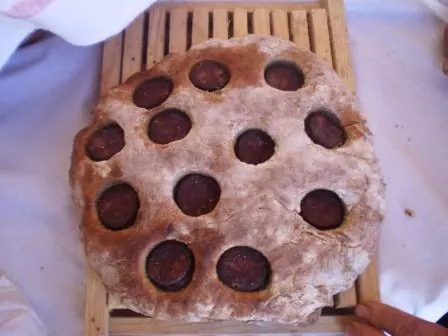
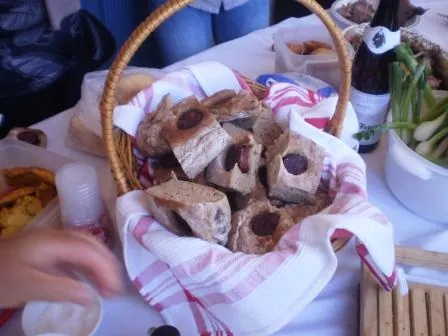
Before the bread, this bolo went in

Bolo entre lenha in photographs accompanying the recipe published by the Museum in 2015.
Source: Museu das Terras de Basto
About this photograph

Photograph date not stated. Source consulted on 2026-11-15. EXIF orientation and proportional WebP resizing; no cropping or upscaling.

Individual photographer and reuse licence not stated by the source.

Request removal or correct the photo credit

See more 1 photos and details
Bolo entre lenha in photographs accompanying the recipe published by the Museum in 2015.
Source: Museu das Terras de Basto
About this photograph

Photograph date not stated. Source consulted on 2026-11-15. EXIF orientation and proportional WebP resizing; no cropping or upscaling.

Individual photographer and reuse licence not stated by the source.

Request removal or correct the photo credit

The same dough could have another destination.

In Pedraça, Maria da Conceição Mouta recalled a bolo made from the broa dough itself. It was topped with small sardines or chouriço and went into the oven before the loaves. More wood then had to be added.

The account recorded in 2011 and published by the Museum in 2015 connects the bolo’s name with the organisation of baking day. The recipe preserves the techniques of a traditional oven, to explore alongside the history of bread.

Bolo entre lenha: ingredients and techniques

Tick off ingredients as you gather them. Checkmarks last only on this page. Any time shown for the reading journey is reading time, not cooking time.

Go to preparation ↓

Ingredients

Method at a glance

Back to ingredients ↑

Tick off each step as you finish it. You can untick it; checkmarks last only on this page.

Maria da Conceição Mouta’s recollection, recorded in 2011. The preparation refers to a traditional oven and gives no temperature or adaptation for a domestic oven.

Read the original recipe →

Choose another recipe →

One batch, several gestures

Open an option and choose the story.

  1. What dough was the cake made from?This bread mixture rye and wheat →
  2. What was left for the next batch?The bread kept the next batch →
  3. How did you recognize the heat from the oven?The oven gave a sign →
Choose a step to know the bread, yeast and oven signals.
Source and context

Basto Land Museum — Cake between sardine or chorizo wood (2015)

Accessed: . Editorial summary; the date of consultation is not the date of the facts.

Back to index ↑
Pedraça · testimony collected in March 2011

The oven gave a sign

Baking also meant paying attention to what you could see.

In the account recorded in Recovos, Pedraça, in March 2011, Maria da Conceição described several signs: the dough rested and increased in volume; a whitish appearance inside the oven indicated enough heat for the batch. She then shaped the dough in a basin, giving it a rounded form. The account shows knowledge built from movements and observation, learned in a kitchen and recorded by the Museum. It does not establish a universal rule for all ovens or doughs.

There is a sequence to those signs. First, resting allows the change in the dough to be observed; then the oven is prepared and the loaves shaped. The record brings together attention to time, volume and the colour inside the oven. Knowing how to bake meant connecting these observations as well as knowing the ingredients.

Source and context

Basto Land Museum — testimony of Maria da Conceição Gonçalves Mouta, collected by Maria de Fátima Carvalho in 2011

Accessed: . Editorial summary; the date of consultation is not the date of the facts.

Back to index ↑
Food memory · rituals documented by the Museum

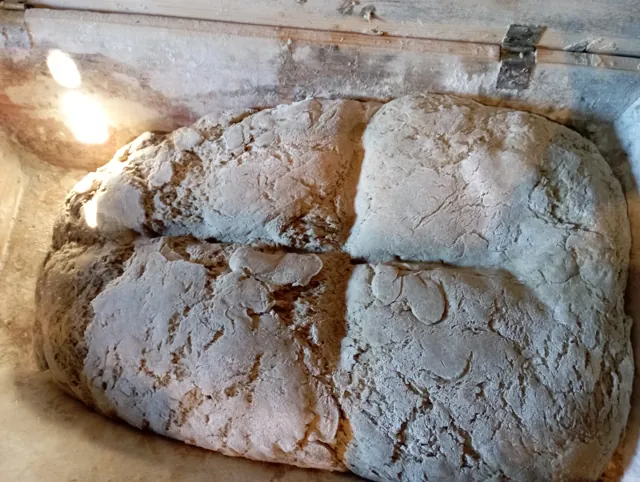
Words went into the bread too

Bread dough in the Terras de Basto Museum’s publication about the bread prayer.
Source: Museu das Terras de Basto
About this photograph

Photograph date not stated. Source consulted on 2026-11-15. EXIF orientation and proportional WebP resizing; no cropping or upscaling.

Individual photographer and reuse licence not stated by the source.

Request removal or correct the photo credit

Kneading, waiting, baking: each moment could have its own ritual.

In a record published in January 2024, the Museum describes religious gestures connected with bread: tracing a cross in the dough, praying and covering the kneading trough while the dough rose. There were also words for putting bread into the oven and finishing the baking. Three small taps on the broa were explained as a way to wake it up. These are practices and beliefs presented by the source, not a scientific explanation of baking or a tradition attributed to every family or a particular parish.

The record organises the gestures into three moments: kneaded dough waiting in the trough, loaves entering the oven and bread just taken out. Utensil and word accompany the food’s transformation. Linking this story with the Recovos recipe and the explanation of yeasts offers three perspectives: the maker’s memory, the preparation sequence and the biological process. None replaces the others.

Source and context

Basto Land Museum — Bread Prayer, 24/01/2024

Accessed: . Editorial summary; the date of consultation is not the date of the facts.

Back to index ↑
Food memory · testimony of 2011

A snack with bread still warm

Sopas de vinho are part of the food memories collected in Cavez and Pedraça.

In an account recorded by Maria de Fátima Carvalho in February 2011, Maria da Conceição Gonçalves Mouta remembers a winter snack made with broa, Vinho Verde and sugar. Freshly baked broa was preferred; on other occasions, a slice was warmed over the embers. It is a family memory published by the Museu das Terras de Basto.

The occasion matters as much as the ingredients: the account places the snack in mid-afternoon and associates it with winter. Broa connected the meal with the oven’s rhythm or with making use of the embers. The recipe had been learned from a grandmother in Cavez; the account was recorded with her granddaughter living in Recovos, tracing a family tradition between places.

Source and context

Basto Land Museum — testimony of Maria da Conceição Gonçalves Mouta, collected by Maria de Fátima Carvalho in 2011

Accessed: . Editorial summary; the date of consultation is not the date of the facts.

Back to index ↑
Cabeceiras · advertisements from 1939

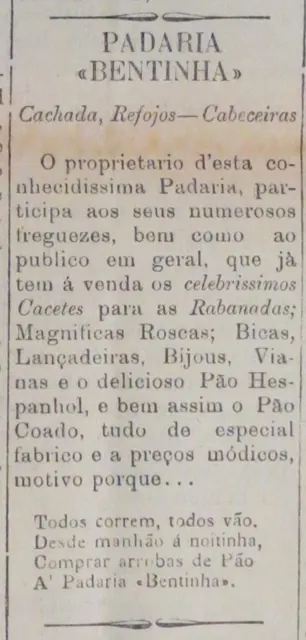
Bread was advertised in verse too

Advertisement for Padaria Bentinha in O Jornal de Cabeceiras, December 1939.
Source: Museu das Terras de Basto
About this photograph

Photograph date not stated. Source consulted on 2026-11-15. EXIF orientation and proportional WebP resizing; no cropping or upscaling.

Individual photographer and reuse licence not stated by the source.

Request removal or correct the photo credit

See more 3 photos and details
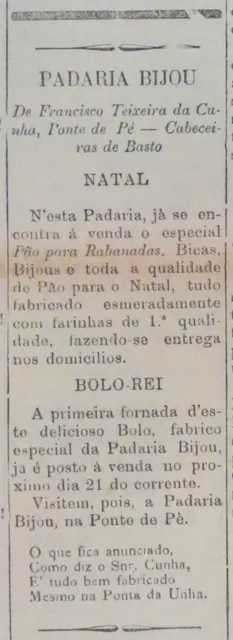
Advertisement for Padaria Bijou in O Jornal de Cabeceiras, December 1939.
Source: Museu das Terras de Basto
About this photograph

Photograph date not stated. Source consulted on 2026-11-15. EXIF orientation and proportional WebP resizing; no cropping or upscaling.

Individual photographer and reuse licence not stated by the source.

Request removal or correct the photo credit

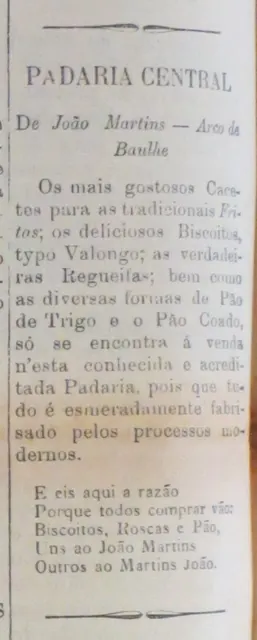
Advertisement for Padaria Central in O Jornal de Cabeceiras, December 1939.
Source: Museu das Terras de Basto
About this photograph

Photograph date not stated. Source consulted on 2026-11-15. EXIF orientation and proportional WebP resizing; no cropping or upscaling.

Individual photographer and reuse licence not stated by the source.

Request removal or correct the photo credit

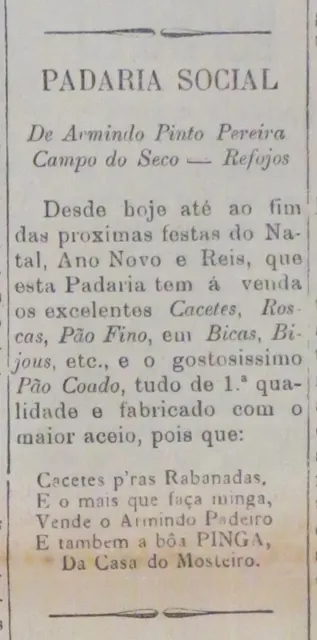
Advertisement for Padaria Social in O Jornal de Cabeceiras, December 1939.
Source: Museu das Terras de Basto
About this photograph

Photograph date not stated. Source consulted on 2026-11-15. EXIF orientation and proportional WebP resizing; no cropping or upscaling.

Individual photographer and reuse licence not stated by the source.

Request removal or correct the photo credit

A newspaper preserves flavours and ways of selling.

In December 2023, the Museum recovered advertisements for four bakeries in the municipality, published in O Jornal de Cabeceiras in 1939. Their Christmas selection included loaves for rabanadas, regueifas, bicas, lançadeiras, biscuits and bolo-rei. The advertisements ended with a four-line verse. Beyond the products, they offer a clue to the language of trade: bread reached the reader accompanied by poetry. This is a window onto the selection of that time, not a directory of current bakeries.

The set mentioned by the Museum also includes bijous, vianas, pão espanhol and pão coado. The variety of names opens a line of enquiry: which were familiar to each generation? An advertisement shows what sellers wanted to sell, but not how much people bought or what reached every home.

The Museum’s article dates from 2023; the advertisements are from 1939. Keeping those dates distinct helps us read a recovered memory: a recent publication can open a much older document.

Source and context

Land Museum of Basto — At Christmastime. Our bakeries for 84 years, 2023-12-22

Basto Land Museum — archive, text from 22/12/2023 on advertisements of 1939

Accessed: . Editorial summary; the date of consultation is not the date of the facts.

Back to index ↑
YOUR LOCAL GUIDE

What would you like to discover?

Take a closer look.