Discover Cabeceiras de BastoFree independent guide
ViveCabeceirasYOUR GUIDE TO CABECEIRAS
ENEnglish
SearchSaved
CHOICE · EXPERIMENTARY · TAKE

A notebook.
Your findings.

Up to six proposals of Cabeceiras, in your own order, to do it at home, in company or on a break.

3 de 6 propostas escolhidas · faça-as ao seu ritmo.

PROPOSTA 1 DE 3 · A vida que nem sempre se vê

Compare two faces

Badger · general biology

A house under the ground

The badger (Meles meles) has mainly nocturnal activity and shelters in extensive underground burrows. The two dark bands on the white head are a striking visual clue; the short legs have strong claws. The Virtual Museum of Biodiversity describes its presence in forests, forests and agricultural landscapes with vegetation. This chart explains the species in mainland Portugal; it does not document an observation in Cabeceiras de Basto. The claws are long and not retractable: they do not collect like those of the cats. The tail is short and clear, another contrast with the fox's long tail. These details help compare descriptions without searching or disturbing burrows.
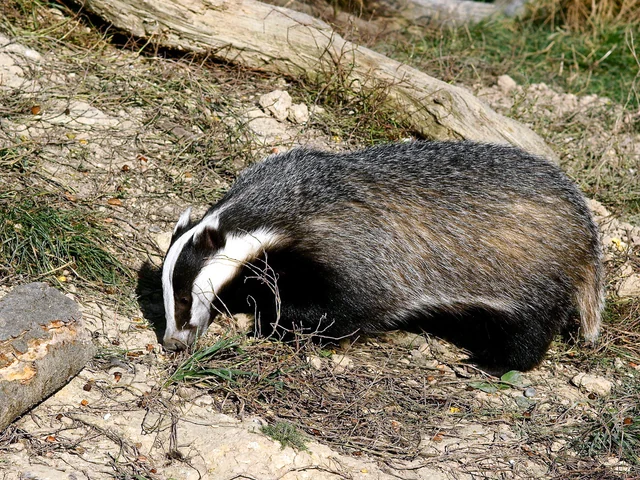
Badger with gray body and head with light and dark bands, next to the ground.
Badger at the British Wildlife Centre in Newchapel, Surrey, UK, in 2011. Animal in fauna park; not a record of Cabeceiras.
Photography: Peter Trimming · CC BY 2.0
About this photograph

Date given at source: . Source consulted in 2026-11-07. EXIF orientation, proportional resizing and WebP conversion of the current version in Commons; no retouching or additional clipping.

Request withdrawal or correct authorship

Vamos experimentar?

  1. In the photograph, it follows the light and dark bands of the head and the contour of the body.
  2. Compare the text with the image: the description of the claws and the den goes beyond what this framework shows.
  3. Open the otter story and compare the snouts in the two photographs, keeping the contexts of each park separate.

The badger was photographed at the British Wildlife Centre in the UK. A daylight photograph in a park does not invalidate the description of the species' mostly nocturnal habits.

Open a história e os seus recursos →
Sources of this proposal

My findings

An idea, a drawing or a question to go on.

PROPOSTA 2 DE 3 · Viajar no tempo

Try watching

Gondiães e Vilar de Cunhas · memory and landscape

A house with three granaries

In Casa de Chouzas, three 19th-century granaries join the solarengo building highlighted by the Municipality. The set approximates two functions: inhabit and guard the harvest. Instead of looking only at the main house, it is also worth recognizing the importance of agricultural support constructions. The presentation of Vilar de Cunhas places this heritage in a plateau and mountain landscape, marked by agriculture and pastoral care. The house and the granaries can be read in this work context, without the source detailing the production of each property. The dating of the house is less firm: the municipality presents it as perhaps 19th century, while assigning the granaries to the 19th century. This difference must remain visible. The photo accompanying the reading shows the portal; it does not show the three granaries. The asset reference does not confirm access to the set.

Vamos experimentar?

  1. Look at the photo of the portal and list only the elements you can see.
  2. Compared to the three granaries mentioned in the text: what depends on the written description?
  3. Imagine a caption that distinguishes the frame of the photograph from the remaining patrimonial set.

A proposal to make at your pace, without collecting copies.

Open a história e os seus recursos →
Sources of this proposal

My findings

An idea, a drawing or a question to go on.

PROPOSTA 3 DE 3 · Um mundo debaixo das folhas

Try watching

General knowledge · national guide

The mushroom is just a part

The mushroom is a reproductive structure; the body of many fungi is a network of filaments, the mycelium. Every filament is called a hipha. The CCRES describes this network to colonize living or decomposing organic matter, from which the fungus obtains nutrients. The fruitful body develops from the mycelium and allows to disperse spores. If they find favorable conditions, they may give rise to a new mycelium. The visible mushroom counts only one part of the cycle; not all fungi produce hat-like structures. In the cultivation of some decomposing species, mycelium can develop in inoculated trunks. The same support can produce mushrooms for several years, while there are conditions and nutrients. This general explanation does not identify a species or document an occurrence in Cabeceiras. The network can also be organized into strings called rhizomorphs. In certain wood fungi, these help to cross branches or trunks and reach for another food. An outer layer protects the interior hyphae during this exploration. Another strategy is to form sclerotia: compact masses of hyphae with a resistant coverage. They allow you to go through unfavorable periods and, when conditions improve, they can originate mycelium or reproductive structures. These are forms of growth and resistance described by the Australian botanical garden, not local records.

Vamos experimentar?

  1. Draw a network of wires on paper and, above, a mushroom.
  2. Tick the net as mycelium and choose a wire to represent a hyphae.
  3. Use the drawing as a scheme: it does not represent the shape or size of a real fungus.

A proposal to make at your pace, without collecting copies.

Open a história e os seus recursos →
Sources of this proposal

My findings

An idea, a drawing or a question to go on.

YOUR LOCAL GUIDE

What would you like to discover?

Take a closer look.