Discover Cabeceiras de BastoFree independent guide
ViveCabeceirasYOUR GUIDE TO CABECEIRAS
ENEnglish
SearchSaved
CHOICE · EXPERIMENTARY · TAKE

A notebook.
Your findings.

Up to six proposals of Cabeceiras, in your own order, to do it at home, in company or on a break.

2 de 6 propostas escolhidas · faça-as ao seu ritmo.

PROPOSTA 1 DE 2 · Time travel

Try watching

Gondiães e Vilar de Cunhas · memory and landscape

A house with three granaries

In Casa de Chouzas, three 19th-century granaries join the solarengo building highlighted by the Municipality. The set approximates two functions: inhabit and guard the harvest. Instead of looking only at the main house, it is also worth recognizing the importance of agricultural support constructions. The presentation of Vilar de Cunhas places this heritage in a plateau and mountain landscape, marked by agriculture and pastoral care. The house and the granaries can be read in this work context, without the source detailing the production of each property. The dating of the house is less firm: the municipality presents it as perhaps 19th century, while assigning the granaries to the 19th century. This difference must remain visible. The photo accompanying the reading shows the portal; it does not show the three granaries. The asset reference does not confirm access to the set.

Vamos experimentar?

  1. Look at the photo of the portal and list only the elements you can see.
  2. Compared to the three granaries mentioned in the text: what depends on the written description?
  3. Imagine a caption that distinguishes the frame of the photograph from the remaining patrimonial set.

A proposal to make at your pace, without collecting copies.

Open a história e os seus recursos →
Sources of this proposal

My findings

An idea, a drawing or a question to go on.
PROPOSTA 2 DE 2 · Time travel

Comparing arc shapes

History of Ponte de Cavez

Five arches, more than a while

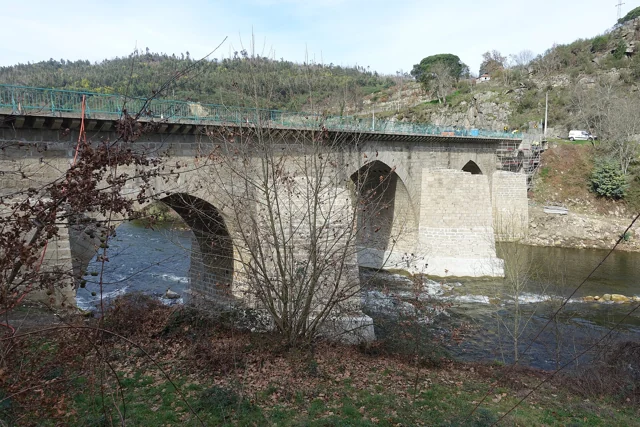
Three broken central arches and two perfect back, next to the banks: the Ponte de Cavez brings together different shapes and times. The Museum located the medieval construction in the second half of the 13th century, at the service of the road between Braga and Vila Pouca de Aguiar. The source attributes the round arches to the works of Philip II's reign and mentions a landmark of 1599. In the 19th century, the road between Fafe and Vila Pouca de Aguiar brought the enlargement of the board. Watching the bridge is looking for changes to an ancient crossing. According to the Museum, the stone bridge replaced a previous wooden bridge, then degraded. The construction is attributed to Frei Lourenço Mendes, a Dominican who gathered alms for the work; the museological text mentions testimonial legacies as support of this connection. The crossing thus involves materials, paths and ways of financing a collective work.

Ponte de Cavez on the river Tâmega, with stone arches, board and wooded banks.
Partial view of the Ponte de Cavez over the Tâmega.© Joseolgonⓘ

Vamos experimentar?

  1. Draw an arc pointed and another semicircular, from the descriptions.
  2. Associate the three central openings and the two sides to the forms indicated in the text.
  3. Note the partial photograph: Mark only the visible arches without completing the frame as if you were seeing them all.

Reading and drawing exercises; schemes do not reproduce the dimensions of the bridge.

Open a história e os seus recursos →
Sources of this proposal

My findings

An idea, a drawing or a question to go on.

YOUR LOCAL GUIDE

What would you like to discover?

Take a closer look.