Discover Cabeceiras de BastoFree independent guide
ViveCabeceirasYOUR GUIDE TO CABECEIRAS
ENEnglish
SearchSaved

Animals

Choose a story to start with. You can change the subject or fine tune the search.

17 stories · Life you do not always see · Search: serras

Life you do not always see

Knowing animals begins by perceiving the territory and respecting the distance.

Choose a story · 17
Rio Douro · animals mentioned in 1758

The animals that remained in the memory of the mountains

A list of 1758 mixes encounters, abundances and passages.

Read here and view sources

The vicar of Rio Douro names rabbits, hares, partridges, wolves, foxes and badgers when describing the mountains in 1758. Adds mountain pigs of passage and places the partridges only in some parts. These language differences are part of the testimony and deserve to be preserved.

The report describes cold, windy and snowy mountains in winter. It brings animals and landscape closer, but does not present counts, observation methods or a scientific inventory. It does not allow to conclude that all the mentioned species continue in the same places today.

Source and context

Municipality — Parish Memoirs of Rio Douro, António Carneiro da Costa, 22/05/1758

Accessed: . Editorial summary; the date of consultation is not the date of the facts.
Bucos · memory 1758

The animals of an ancient portrait

An account of the mountains, written in 1758.

Includes an activity to try →
Read here and view sources

The vicar of Bucos mentions partridges, rabbits, wolves, foxes and wild boars, which he describes as sparsely plentiful. He points out carqueja, heather and tojo on the hills. It is the landscape that recorded at that time, not a current inventory nor a promise to spot these animals.

The memory also mentions goats as the most abundant cattle and some large cattle. Thus, the same document gathers farm animals and fauna that the vicar describes as hunting. Separating the two groups helps to read the rural life of the period.

The expression of little abundance is an appreciation of the author, without method of counting presented. It does not allow directly to compare 1758 with a census of current fauna. The interest of the report is also in what you choose to observe: animals, forests, terrain and uses of the mountains appear together.

Source and context

Municipality — Parish memories of Bucos (1758)

Accessed: . Editorial summary; the date of consultation is not the date of the facts.

Serra da Cabreira · biology of the species

A bird of prey that nests on the ground

The hunting tartaranion is also called the hunting eagle.

Read here and view sources

Visit Cabeceiras includes the tartaranhão-hunter in the fauna of Cabreira. SPEA describes Circus pygargus as a summer bird, which returns to Portugal in the spring to nest. It prefers open spaces, mainly insects hunting and nests in the soil, among high vegetation. The reference covers the mountains; it does not identify nests or sighting points in the municipality.

The annual cycle connects continents. The LIFE SOS Pygargus project describes the winter in Africa and the return to the Iberian Peninsula in the spring, for reproduction, with permanence in breeding territories until September. This general calendar does not mark exact dates of arrival and departure to the Cabreira.

The long and narrow wings and tail are part of the portrait presented by LPN. Its mini-guide includes low mountain woods between habitats and refers to nests in high fields or landings. The menu is also broader than insects: it can include birds, small mammals and lizards. A prey of open spaces thus depends on both prey and vegetation suitable for nesting on the ground.

Words in this story: see explanations →
Source and context

Visit Cabeceiras — natural heritage of Serra da Cabreira
Accessed:

SPEA — Hunting Eagle / Circus pygargus
Accessed:

LPN — Bird guide, Imperial LIFE project: hunting turtle
Accessed:

Palombar / LIFE SOS Pygargus — Identification: migration and breeding period (text consulted in search result)
Accessed:

Editorial summary; the date of consultation is not the date of the facts.

Interpretation equipment

A first meeting in Moinhos de Rei

Learn about the Cabreira before going out to the field.

Explore: From interpretation to discovery →
Read here and view sources

The Núcleo Interpretativo de Vida Selvagem was inaugurated in 31 August 2013, in Abadim. The municipal presentation explains its connection to the fauna and flora of Serra da Cabreira and to the awareness of the forest. See the site chart to prepare the visit.

The building also has a history: the municipal presentation places the core in a small annex previously used by Social Services. The change of function has added the dissemination of animals and plants to the valorization of the forest and local customs and uses.

It is a starting point to ask questions about the landscape: what relations exist between forests, trees and animals? The following readings allow you to continue this discovery at home. Knowing a species or an environment does not guarantee a sighting on a visit.

See Fact sheet: Núcleo Interpretativo de Vida Selvagem
Source and context

Municipality — Núcleo Interpretativo de Vida Selvagem

Accessed: . Editorial summary; the date of consultation is not the date of the facts.

Mammals · local habits and reference

The boar comes out when the light goes down

A long snout and a very varied diet.

Includes an activity to try →
Read here and view sources

The wild boar, Sus scrofa, is omnivorous and has mainly crepuscular and nocturnal habits. During the day it can shelter in dense woods. The Lobo-Iberic Platform documents a wild boar predatored by wolves in Serra da Cabreira, in Cabeceiras, without indicating the date of that record. The elongated snout and abundant fur distinguish it from the domestic pig. Although omnivorous, the source describes a mainly vegetable feed. The food flexibility helps to understand its adaptation to different landscapes.

The platform presents it as a pig-bravo and refers to marked differences between the sexes. It also describes the expansion of the species in Portugal, including areas close to urban centers. This national framework does not allow to calculate how many boars live in Cabeceiras.

The Cabreira register and the description of habits answer different questions: one document a meeting between predator and prey; the other helps to understand the life of the species. We do not know, from this isolated reference, the frequency of predation or the size of local populations.

Source and context

Lobo-Iberico platform in Portugal — wolf prey; registration of Cabreira without date indicated

Accessed: . Editorial summary; the date of consultation is not the date of the facts.

Wolf Ecology · Portuguese context and document reference to Cabreira

A landscape is also food

The wolf is part of a network of relationships.

Explore: Who lives in the landscape? →
Read here and view sources

Javali, deer, deer and mountain goat are the main natural prey of the wolf presented by the platform for Portugal. This national list does not mean that all occur in Cabeceiras. Knowing a predator implies also understanding its prey. The platform explains that the recovery of wild prey depends on both natural expansion and reintroductions. These stories have different scales and origins: recovering one species in one region does not demonstrate its presence in another.

The page includes a photograph whose legend identifies a wild boar predatored by wolves in Serra da Cabreira, in Cabeceiras de Basto, with credit to Ismael Cunha. The legend establishes a local link, but does not indicate the date or allows calculating the frequency of predation. The photograph was not reproduced here.

There is another useful distinction when looking at animals in the mountains: a domestic breed created in freedom, like Garrano, does not become a wild species. The landscape can gather animals with different stories. This comparison does not show that a concrete animal is trapped from the wolf or that all the species mentioned share the same mountain section.

Source and context

Lobo-Iberico platform in Portugal — wolf prey; registration of Cabreira without date indicated

Accessed: . Editorial summary; the date of consultation is not the date of the facts.

Serra da Cabreira · biology of the species

A tail bigger than the body

The salamander-lusitan lives connected to moisture.

Read here and view sources

The salamander-lusitânica, Chioglossa lusitanica, is referred by Visit Cabeceiras for the Cabreira Mountains. It has a small body, longer tail than the body and two golden or orange lists on the dark back.

According to LPN, vegetation influences the way it uses space: in agricultural fields and forests of exotic species tend to get closer to the brooks; in indigenous forests it can move further away from the water. The margin is therefore part of the history of this amphibian. It is a biology of the species, not a spotting point.

It is endemic to the Iberian Peninsula and has nocturnal habits. The front legs have four fingers and the back five: details that help to know the species without handling it.

The Gaia Biological Park describes terrestrial habits along streams of water, abundant vegetation and high humidity, and feeding with small invertebrates. Being connected to the stream does not mean spending all your life swimming. When reading the history of eggs and larvae, compare the phase of life with the environment used: the relationship with water changes throughout development.

Source and context

Visit Cabeceiras — natural heritage of Serra da Cabreira
Accessed:

Gaia Biological Park — Chioglossa lusitanica
Accessed:

Link to Nature Protection — Salamander-lusitan
Accessed:

Editorial summary; the date of consultation is not the date of the facts.

Serra da Cabreira · life cycle of the species

Before the salamander, a life in the water

The stream is also the place where the transformation begins.

Explore: Growing up and being able to reproduce are different moments →
Read here and view sources

The life of the Salamander-lusitan begins with water. LPN often describes eggs attached to the substrate and larvae that remain in quiet areas until metamorphosis, in a development that can last one to two years.

During this phase, they feed on small aquatic animals, including insects, molluscs and crustaceans. Pollution and habitat loss threaten this cycle; water and surrounding vegetation matter together. The reading explains the biology of the species referred to for Cabreira, without locating breeding areas.

Finishing the metamorphosis is not the same as already being able to reproduce. LPN places the sexual maturity of males around three to four years and females between four and five. Transformation of the body and reproductive maturity are therefore distinct moments. The intervals describe the biology of the species; they do not allow for predicting the age of a specimen seen in a photograph.

Words in this story: see explanations →
Source and context

Link to Nature Protection — Salamander-lusitan
Accessed:

Visit Cabeceiras — natural heritage of Serra da Cabreira
Accessed:

Editorial summary; the date of consultation is not the date of the facts.

Serra da Cabreira · regional reference and biology of the species

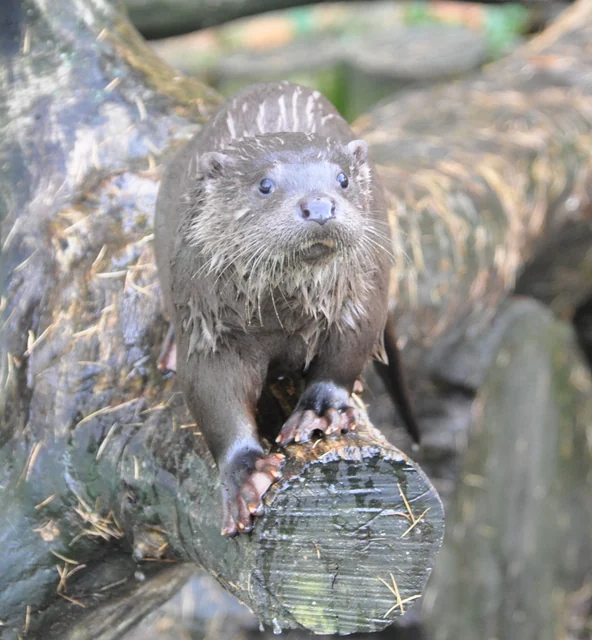
The otter wears the scuba suit

Otter front view over wood, with snout, mustaches and visible paws.
European otter at the Lüneburg Heath fauna park, Germany, in 2009. Animal in fauna park; it is not a record of Cabeceiras.
Photography: Quartl · CC BY-SA 3.0
About this photograph

Date given at source: . Source consulted in 2026-11-07. EXIF orientation, proportional resizing and WebP conversion of the current version in Commons; no retouching or additional clipping.

Request removal or correct the photo credit

By the waterproof and paws that help you swim.

Includes an activity to try →Explore: Body and environment →
Read here and view sources

The European otter, Lutra lutra, has membranes between its fingers and a thick coat that protects it in the water. Its life connects the river to its banks: vegetation offers shelter and roots can hide burrows. It is mainly active at dusk and at night.

The municipal portal of Vieira do Minho includes the otter among the mammals of the Cabreira. This regional reference allows to know the species, but does not indicate a spot of sighting.

The description of the University of Évora also refers to the long tail, tapered at the tip, and the snout with long mustaches. The otter does not depend only on rivers: the species also uses albufeiras, estuaries and, less often, the sea coast. These characteristics help to know the animal without converting the reading into a spot.

Source and context

University of Évora — Virtual Museum of Biodiversity, Lutra lutra; David Germano
Consultations: ,

Vieira Tourism of Minho — fauna of Serra da Cabreira, regional reference
Accessed:

Editorial summary; the date of consultation is not the date of the facts.

Serra da Cabreira · regional reference and biology of the species

A mole connected to the current

Cold water also has its inhabitants.

Explore: The river is also a pantry →
Read here and view sources

The water mole, Galemys pyrenaicus, is associated with cold, clear and well-oxygenated waters, often in rapid mountain rivers. The University of Évora also refers to the use of slower waters, such as canals and lakes: preference is not exclusive. Its natural distribution is limited to the Iberian Peninsula and the Pyrenees. In conservation, there are vegetation margins, shelters and habitat continuity; the chart identifies silting and isolation between threats. The municipal description of the fauna of Cabreira mentions the species, but this reading does not have a geolocalized register in the municipality.

The prolonged snout in a small trunk helps to search for larvae of invertebrates underwater, according to the description of the Generalitat of Catalonia. The technical file housed by ICNF highlights the invertebrates from the bottom of the river as a food base, including groups of tricopters, plecopters, ephemeropters and dipteres. The small animals that look like details of the river are part of the feeding of a mammal.

The profile of the ICNF presents a caveat for Portugal: it considers unfavourable the habitats of standing water, such as albufeiras and small lagoons of altitude. We should not turn the general reference to slow waters into an invitation to search for the species in any lake. Adequate habitat also involves food, shelters on the banks and connection to other sections of the river.

Words in this story: see explanations →
Source and context

University of Évora — Virtual Museum of Biodiversity, Galemys pyrenaicus

Vieira Tourism of Minho — fauna of Serra da Cabreira, regional reference

ICNF — Galemys pyrenaicus, ecology and nutrition (historical references)

Generalitat de Catalunya — Iberian Desmán, description of snout and feeding

Accessed: . Editorial summary; the date of consultation is not the date of the facts.

Serra da Cabreira · regional reference and biology of the species

The wildcat needs a varied landscape

Woods to shelter, open spaces to hunt.

Read here and view sources

The wild cat, Felis silvestris, is associated with forests and woods, often close to rocky areas and water lines. It can seek food in undisturbed meadows. The thick tail, with dark rings and rounded tip, is one of its traits described by the University of Évora. The similarity with domestic cats calls for care in identification.

The municipal source refers to the Cabreira, without locating a population in a parish.

The description of the University of Évora adds retractable claws and especially twilight and nighttime activity: the twilight corresponds to the transition between day and night. The source points to the fragmentation of habitats and hybridization with domestic cats between threats. The outer aspect, by itself, does not solve all identification doubts.

Source and context

University of Évora — Virtual Museum of Biodiversity, Felis silvestris; David Germano
Consultations: ,

Vieira Tourism of Minho — fauna of Serra da Cabreira, regional reference
Accessed:

Editorial summary; the date of consultation is not the date of the facts.

Serra da Cabreira · regional reference and biology of the species

A triton between water and earth

The skin also follows the change of environment.

Includes an activity to try →Explore: From egg to change of environment →
Read here and view sources

The orange triton, Lissotriton boscai, has smoother skin in the aquatic phase and more rough in the terrestrial phase. To reproduce it can use ponds, streams of little current and even tanks. Out of water finds refuge in moist places, between roots, stones and trunks. The orange belly helps explain the name.

It is mentioned among the amphibians of the Cabreira by the municipal portal of Vieira do Minho, without an associated observation point.

The description of the University of Évora refers to four fingers on the front legs and five on the back, besides a flattened tail laterally. They are characteristics of the species, not a reason to remove it from the water. The same source indicates a total length up to nine centimeters and females usually larger and more robust than males.

Also the mating season can change the look. The University of Évora describes a small crest on the tail and, in males, a whitish longitudinal strip, more marked next to the end. Compare two images therefore requires attention to sex and the phase of the year, besides the name of the species. Not all visible differences mean animals of different species.

Food follows the change of environment. According to the Charcos with Life project, larvae and aquatic adults capture small invertebrates from the water; on land, adults eat mostly soft-body animals, such as worms and slugs. The female lays eggs individually on aquatic plants or leaves, over several days. The scheme below connects these phases without assigning them dates of occurrence in the Cabreira.

Source and context

University of Évora — Virtual Museum of Biodiversity, Lissotriton boscai

Vieira Tourism of Minho — fauna of Serra da Cabreira, regional reference

Charcoals with Life / CIIMAR — Orange belly triton, life cycle and feeding

Accessed: . Editorial summary; the date of consultation is not the date of the facts.

Serra da Cabreira · regional reference and biology of the species

There are three-thirty people who spend another winter in the water.

In the cold of altitude, development may take longer.

Read here and view sources

In the palmed triton, or spalmed paw triton, Lissotriton helveticus, mating takes place in the water of ponds. Gaia Biological Park explains that, in higher and colder areas, larvae can cross winter before completing metamorphosis the following year. It feeds on small invertebrates. The municipal description of the Cabreira mentions this species; the cycle here counted is general biology, not the observation of reproduction in a local pond.

Two different times ago. The biological park record indicates about fifteen days to a month between posture and hatching; metamorphosis comes later. hatching is the egg exit, not the completion of larval development. The possibility of crossing another winter in the water shows why a single calendar does not serve all conditions.

Words in this story: see explanations →
Source and context

Gaia Biological Park — Spanked Triton, Lissotriton helveticus

Vieira Tourism of Minho — fauna of Serra da Cabreira, regional reference

Accessed: . Editorial summary; the date of consultation is not the date of the facts.

Serra da Cabreira · general behaviour of the species

A tail that distracts the predator

The Salamander-lusitan has an amazing defense.

Includes an activity to try →
Read here and view sources

In a situation of threat, this salamander can detach the tail and regenerate it later. The loose part continues to move, diverting the predator's attention while the animal seeks shelter. Gaia Biological Park describes this mechanism for the species, referred to by Visit Cabeceiras to the Cabreira. It is a curiosity to know without touching or provoking the animal.

The Gaia Biological Park highlights this capacity as unique among the salamanders of the Iberian Peninsula. The mechanism has two moments: immediate distraction by the loose tail and subsequent regeneration. They are not simultaneous events.

Compare this story with growth: losing part of the tail in defense and going through metamorphosis are different processes. An isolated photograph does not show the complete sequence of any of them. Knowing behavior serves to understand the animal without trying to reproduce the threat situation.

Source and context

Gaia Biological Park — Chioglossa lusitanica
Accessed:

Visit Cabeceiras — natural heritage of Serra da Cabreira
Accessed:

Editorial summary; the date of consultation is not the date of the facts.

Serra da Cabreira · regional reference and biology of the species

Bright color, discreet whistle

The gift-fafe is not only known by plumage.

Read here and view sources

The Pyrrhula pyrrhula male combines pink breast and black twig; the female has more discrete tones. The British Trust for Ornithology describes a soft call, in an isolated whistle, and the consumption of fruit tree shoots in the spring. Vieira municipal portal of Minho includes the gift-fafe among the Cabreira birds. This reference covers the mountains, without confirming an occurrence in a parish or route of this guide.

Reproduction has different stages. In the nesting and nesting data gathered by the BTO, the typical posture has four to five eggs and incubation, ensured by the female, usually lasts 14–16 days. After hatching another phase begins: the development of the cubs until they leave the nest. The published intervals are not a calendar for the Cabreira.

The chart also allows distinguishing a typical value from the observed extremes. A posture outside the most usual number does not automatically belong to another species. To read nature, it is important to know what was measured, in which population and with what variation.

Words in this story: see explanations →
Source and context

British Trust for Ornithology — BirdFacts: Bullfinch, Pyrrhula pyrrhula

Vieira Tourism of Minho — fauna of Serra da Cabreira, regional reference

Accessed: . Editorial summary; the date of consultation is not the date of the facts.

Serra da Cabreira · regional reference and biology of the species

A discreet bird that reveals itself in the corner

In the fig tree, listening can be as interesting as looking.

Explore: Three clues to meeting a bird →
Read here and view sources

Sylvia borin has relatively uniform chestnut plumage and clear lower parts. The British Trust for Ornithology chart highlights the song rich in whistling notes and the connection to dense shrub vegetation and wood edges. Vieira tourist portal of Minho refers to figueira-fellosa for the Cabreira. They are clues to know the species and its habitat, without identifying nests or ensuring sightings in the municipality.

The whole year doesn't happen in the same scenario. BTO describes the winter south of Sara. In the UK, the species is a summer visitor and becomes harder to detect when it stops singing. This helps to perceive an important difference in one observation: hearing less does not necessarily mean that all birds have left. British dates do not serve as the arrival schedule for Cabreira.

In reproduction, the BTO record indicates a typical posture of four to five eggs and incubation shared by the male and female, usually for 10–12 days. After hatching, the cubs still develop in the nest. Compared with the gift-faf, it is possible to find that birds with similar size postures can differently share the care of the eggs.

Words in this story: see explanations →
Source and context

British Trust for Ornithology — BirdFacts: Garden Warbler, Sylvia borin

Vieira Tourism of Minho — fauna of Serra da Cabreira, regional reference

Accessed: . Editorial summary; the date of consultation is not the date of the facts.

Cabeceiras and Serra da Cabreira · documented distribution of the breed

Little horse, mountain pass

Garrano is part of the Northwest's living heritage.

Read here and view sources

The DGAV catalogue includes Cabeceiras de Basto in the Garrana breed breeding area and refers to its presence in Serra da Cabreira. It describes brown horses, sometimes dark, with an adult height of less than 1,35 meters to the garrote. Its movements adapt to the mountain paths. Even when created in freedom, Garrano is a domestic horse. The documented distribution links the breed to the territory, without guaranteeing meetings on a rail or identifying a concrete herd.

The race pattern describes a compact body, short and strong limbs, black manes and tail. Fitness is not limited to saddle: it includes cargo transportation, traction and agricultural work. Horses are part of a landscape also worked by people, where walking mode is of practical importance.

The catalogue distinguishes locked step and walking. In the first describes four beats; in the walk, members on the same side raise and land together, producing two beats per past. They are descriptions of movements, not two names for the same movement. Reading this detail helps to understand why the heritage of a race includes more than appearance.

Words in this story: see explanations →
Source and context

DGAV — Garrana, distribution and pattern of race, p.2

Accessed: . Editorial summary; the date of consultation is not the date of the facts.

YOUR LOCAL GUIDE

What would you like to discover?

Take a closer look.