Discover Cabeceiras de BastoFree independent guide
ViveCabeceirasYOUR GUIDE TO CABECEIRAS
ENEnglish
SearchSaved

Animals

Choose a story to start with. You can change the subject or fine tune the search.

14 leituras · A vida que nem sempre se vê · Pesquisa: peixes

The life you don't always see

Knowing animals begins by perceiving the territory and respecting the distance.

Escolher uma história · 14
Rio Douro · fauna testimony in 1758

The fish of an ancient portrait

Trouts, bogas and scallops appear in the Memories of Rio Douro.

Read here and consult sources

Trouts, bogas and scallops are the names registered by the vicar of Rio Douro in 1758. It highlights trout as more numerous and distinguishes winter fishing from summer. They are assessments of the report, without counting that allow to measure abundance.

The testimony brings fauna closer to the uses of water and the lives of villages. Ancient common names do not equal complete scientific identifications; the practices described also do not establish the current rules of fishing.

Getting to know the parish
Source and context

Municipality of Cabeceiras de Basto — Parish memories of 1758: Rio Douro

Accessed: . Editorial summary; the date of consultation is not the date of the facts.
Cavez · 2016–2017 registration and general biology

A fish can migrate without going to sea

The common barbeque makes its journey into the river.

Explorar: O mesmo rio, diferentes maneiras de viver →
Read here and consult sources

The Mora Fluviary describes the breeding migration of the common barb, Luciobarbus bocagei, to shallow and well-oxygenated waters, on sand, gravel or gravel. It is a trip in fresh water. It feeds on small animals from the bottom, plant matter and debris. The barb was registered in Cavez in the 2016–2017 campaign; the description of its behavior is general biology, not a migration observed at this point.

The trip does not contradict the preference for areas of weaker current and moderate temperature. The place used to live and feed may differ from the one chosen for reproduction. The Fluviary file places the latter between May and June, as a general description of the species.

The barbo is omnivorous: besides the invertebrates of the bottom and vegetable matter, it can occasionally eat small fish. The same source says it can reach about one meter. It is a possible dimension of the species, not the size measured in the specimens of Cavez.

Palavras desta história: ver explicações →
Source and context

Mora Fluviary — Barbo-common, biology of the species
Accessed:

Biosphere / Iberdrola, APA file — Monitoring of ichthyofauna 2016–2017, February 2018; pp. 5, 35 and 40, station record 22 on p. 175 PDF
Accessed:

Editorial summary; the date of consultation is not the date of the facts.

Cavez · 2016–2017 registration and general biology

Not all the fish from the river came from here.

Sunshine tells an introduction story.

Explorar: O mesmo rio, diferentes maneiras de viver →
Read here and consult sources

Sunshine, Lepomis gibbosus, is originally from North America. The Interpretation Center of the River of Águeda describes it as an exotic species, of high body and flattened laterally, which lives in still waters but also in rivers. In breeding season, males may hinder access by juveniles of native species to the shore shelters. It was registered in Cavez in 2016–2017; this record does not measure its local impact.

The bluish bands from the head to the flanks and a dark spot on the tip of the pearl are part of the description. In juveniles, the pattern is simpler, on a greenish or olivaceous background. Age also changes appearance.

The menu includes insects, crustaceans, sea snails, and fish larvae. This diversity helps to realize that food is not limited to a single prey. The chart also distinguishes lentic environments, such as albufeiras, from exotic environments, such as rivers and streams: the species can use both. The geographical origin, presence in a survey and the effect on other species are different information.

Palavras desta história: ver explicações →
Source and context

Águeda River Interpretation Center — Sun Loss
Accessed:

Biosphere / Iberdrola, APA file — Monitoring of ichthyofauna 2016–2017, February 2018; pp. 5, 35 and 40, station record 22 on p. 175 PDF
Accessed:

Editorial summary; the date of consultation is not the date of the facts.

Cavez · 2016–2017 registration and general biology

A fish's menu also has insects

Feeding connects life in and out of water.

Inclui uma atividade para experimentar →Explorar: Quem se alimenta de quê? →
Read here and consult sources

The chart of the ICNF describes the embroidery, complex Squalius alburnoids, as a consumer mainly of insect larvae. In summer and early autumn, it refers to higher consumption of terrestrial insects. It is a small link between the river and its margins. The embroidery appears in the study of Cavez of 2016–2017 under the name Iberocypris alburnoides; the local study did not analyze this seasonal change in feeding.

The same chart describes the use of rivers and streams with diverse characteristics, including small and shallow courses with emerging aquatic vegetation. The habitat is not only water: shelters, vegetation and alternation of zones with different current speeds enter history.

Therefore, a margin totally devoid of vegetation changes more than the view. The chart associates the loss of riverside vegetation with the reduction of shade, shelter and feeding sites. These general ecological relationships help to interpret the river; they are not a current evaluation of a section of Cavez. The local record of 2016–2017 and the biological explanation answer different questions: where the fish was documented and how it relates to the environment.

Source and context

ICNF — embroidery, ecology and riverside vegetation, pp. 2–3 (bibliography up to 2005)
Accessed:

Biosphere / Iberdrola, APA file — Monitoring of ichthyofauna 2016–2017, February 2018; pp. 5, 35 and 40, station record 22 on p. 175 PDF
Accessed:

Editorial summary; the date of consultation is not the date of the facts.

Cavez · 2016–2017 registration and general biology

A fish with a net of scales

On the northern scale, the dark margins of the scales draw a pattern.

Inclui uma atividade para experimentar →
Read here and consult sources

The record of Arouca Geopark describes Squalius carolitertii with elongated body, large and rounded head and scales of darker margins, which create a cross-linked appearance. It presents it as an Iberian endemism: its natural distribution belongs to the Iberian Peninsula, not only to Cabeceiras.

The description refers to mountain and plain rivers, remembering that a species can occupy different contexts along the river network. They are general characteristics, useful to know the fish; they are not enough to identify a specimen from a distance.

The local link comes from another source: the Northern scale is included in the Cavez sampling of 2016–2017. The report documents this survey without establishing current presence or abundance.

Geopark’s chart points to a maximum length of 25 cm and a breeding season between April and June. In the description of the fins, the dorsal has a straight profile and the anal, convex profile. These are details for comparison in an appropriate illustration or photograph, not dimensions or dates measured in the Cavez campaign. The fusiform body — wider in the central area and tapered at the ends — completes this small reading of the shape.

Palavras desta história: ver explicações →
Source and context

Arouca Geopark — Northern scale, Squalius carolitertii: description and biology
Accessed:

Biosphere / Iberdrola, APA file — Monitoring of ichthyofauna 2016–2017, February 2018; pp. 5, 35 and 40, station record 22 on p. 175 PDF
Accessed:

Editorial summary; the date of consultation is not the date of the facts.

Cavez · 2016–2017 registration and general biology

A small fish, many small prey

The gobium links the life of the river to the invertebrates.

Read here and consult sources

The Gaia Biological Park describes Gobio lozanoi as a freshwater river fish that feeds on small invertebrates and usually measures about 12 centimeters. It is a usual dimension indicated in this chart, not the size of all individuals nor a measure collected in Cabeceiras.

In the survey of Cavez of 2016–2017, the gobium is among the six registered species. Adding this evidence to the description of the feed helps to ask a question about the river: which small animals support the fish? The record does not identify the prey consumed at that point or prove a relationship with each insect presented on this site.

Source and context

Gaia Biological Park — Gobio, Gobio lozanoi: habitat, food and size
Accessed:

Biosphere / Iberdrola, APA file — Monitoring of ichthyofauna 2016–2017, February 2018; pp. 5, 35 and 40, station record 22 on p. 175 PDF
Accessed:

Editorial summary; the date of consultation is not the date of the facts.

Biology of the species · document reference in the municipality

A mussel starts by traveling with a fish

Two lives connected under the surface.

Inclui uma atividade para experimentar →Explorar: A viagem do mexilhão com o peixe →
Read here and consult sources

The larvae of Margaritifera margaritifera, called glochides, are attached to the gills of salmonids, such as trout. The fish is host and transports them as they develop.

After the transformation, they drop and pass to the bottom. The success of this stage also depends on where they fall: dispersing and finding conditions to survive are different things. The scheme summarizes general biology, not a reproduction observed in the municipality.

This journey does not end immediately in an adult able to reproduce. The form of the ICNF places sexual maturity between the ages of seven and twenty and refers to great longevity. They are general values presented at that source, not ages measured in copies of Cabeceiras. The presence of adults and the arrival of new generations are therefore different questions when studying a population.

Palavras desta história: ver explicações →
Source and context

ICNF — Margaritifera margaritifera, ecology, reproduction and threats, pp. 2–3
Accessed:

PDM — Environmental Assessment, p. 50
Accessed:

Editorial summary; the date of consultation is not the date of the facts.

Saint Lady · fauna mentioned in 1758

Trouts, scallops and berries in river memory

The names of the fish were also written in local history.

Read here and consult sources

In the memory of Santa Senhorinha of 1758, the abbot mentions trouts, echelons and bogas in the river he describes. The text combines observation of water and appreciation of fish as food. These common names are a historical clue: they do not accurately identify all species or prove their current presence. The old reference to fishing also does not define today's rules.

Source and context

Municipality — Memória de Santa Senhorinha, 23/05/1758; transcript of José Viriato Chapel (2003)

Accessed: . Editorial summary; the date of consultation is not the date of the facts.

Cavez · 2016–2017 registration and general biology

The preferred current changes with age

For a young boga, a quiet area can make a difference.

Explorar: O mesmo rio, diferentes maneiras de viver →
Read here and consult sources

The Northern boga, Pseudochondrostoma duriense, is a species of the Iberian Peninsula. Santa Maria da Feira's municipal record describes adults in sections of strong current and juveniles that prefer waters of lower current and thin backgrounds. It also refers to upstream movements before reproduction. The Cavez record of 2016–2017 confirms the species in that sample; it does not describe the age or behavior of the specimens.

There is a clue in the mouth: the lower lip is right and has a well developed corneal blade. The body may have small dark spots. These features complement the history of the habitat; they do not replace a careful identification of the fish.

The municipal source places migrations upstream between March and June and indicates an approximate longevity of six years. Amount means moving towards the spring. The calendar and life span describe the species in general, without dating a shift or determining the age of the fish sampled at Tâmega.

Palavras desta história: ver explicações →
Source and context

Municipality of Santa Maria da Feira — Northern Boga, fauna catalogue
Accessed:

Biosphere / Iberdrola, APA file — Monitoring of ichthyofauna 2016–2017, February 2018; pp. 5, 35 and 40, station record 22 on p. 175 PDF
Accessed:

Editorial summary; the date of consultation is not the date of the facts.

Reptiles · general biology, no local occurrence confirmed in this form

A snake can have more than one drawing

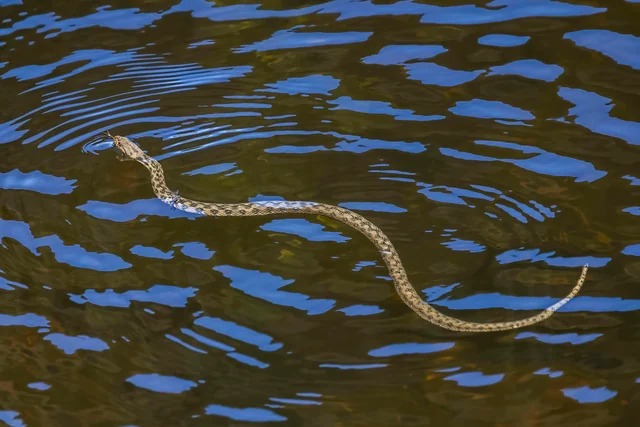
Snake with the body wavy to the surface of the water, between blue reflexes and small ripples.
Viperine water snake swimming in Extremadura, Spain, in 2022. Illustration of the species; not a record of Cabeceiras.
Photography: Charles J. Sharp · CC BY-SA 4.0
About this photograph

Date given at source: . Source consulted in 2026-11-07. EXIF orientation, proportional resize and WebP conversion; no retouching or new clipping of file obtained in Commons.

Request withdrawal or correct authorship

In viperine water snake, the back pattern is not always the same.

Inclui uma atividade para experimentar →Explorar: O mesmo ambiente, modos de vida diferentes →
Read here and consult sources

Natrix maura may present a zigzag stripe, but also a pattern of two clear longitudinal lines. The Spanish biodiversity inventory still describes variation in body tones. A single design does not summarize all individuals of the species.

The chart of the Northern Coastal Natural Park explains the connection to rivers, ponds, streams and other aquatic environments, without excluding displacements on land. It is a general context about the species: it is not an observation in Cabeceiras. Reading compares variation and habitat; it is not a key to identifying snakes found in the field.

The Charcos com Vida project describes a feed mainly in water: invertebrates, larvae and adults of amphibians and small fish enter the menu. The aquatic environment is, thus, a feeding space, besides displacement. The same snake can be preyed on birds and mammals; taking the place of predator does not remove it from the food network.

It is usually daytime, but in summer it can maintain activity at dusk or during the night. Behavior also changes before a threat: the record refers to the expansion of the head and other defensive signs that contribute to the similarity with a viper and to the common name. This explanation of the name does not allow to decide the species or safety of a meeting by the shape of the head.

Palavras desta história: ver explicações →
Source and context

Inventory Español del Patrimonio Natural y la Biodiversidad — Natrix maura, description of the species

Co-management of the Northern Coastal Natural Park — Reptiles and amphibians, record of the viperine water snake

Lived Chargings — Viperine Water Cobra, Feeding and Behaviour

Accessed: . Editorial summary; the date of consultation is not the date of the facts.

The occurrence referred to in the environmental document

The bottom of the river is also a house

The river mussel depends on more than surface water.

Read here and consult sources

The municipal environmental document says Margaritifera margaritifera in the municipality. The file of ICNF explains why the fund matters: young people live buried in the substrate and need oxygen. The species prefers running water and avoids poor oxygen conditions.

Feeding is done by filtration of water particles. Protecting this life involves looking at the bed, water and fish associated with reproduction. Municipal reference does not indicate a current point of observation.

There is a difference between having water and having the environment that this animal needs. The plug distinguishes running water from standing water and describes how river change and habitat fragmentation can harm the species. Filtering particles to feed does not make the mussel resistant to pollution: oxygen availability and background conditions remain essential.

Palavras desta história: ver explicações →
Source and context

PDM — Environmental Assessment, p. 50
Accessed:

ICNF — Margaritifera margaritifera, ecology, reproduction and threats, pp. 2–3
Accessed:

Editorial summary; the date of consultation is not the date of the facts.

Cavez · 2016–2017 monitoring

Six species under the surface

A sample shows a small portrait of the Tâmega in Cavez.

Inclui uma atividade para experimentar →Explorar: Conhece os seis peixes do levantamento →
Read here and consult sources

At station 22, the report of 2016–2017 registered barbo-common, Northern boga-do-north, northern scale, embroidery, gobium and sunroof. The chart places the station in Cavez. These results document that campaign: they are neither a current inventory nor an indication of places to fish.

The six names open six ways to look at the river. The barb leads to migration in fresh water; the boga, the differences between young and adults; the scale, the drawing of scales. The embroidery and the gobium help to explore the food. The sunbath introduces the question of geographical origin. It opens the cards to choose one of these clues and get to the explanation of the species.

Sampling and biological datasheets have different functions.The survey documents the fish registered in that place and period.The datasheets explain the general characteristics of the species, without demonstrating that all these behaviors were observed in Cavez.

Getting to know the parish
Source and context

Biosphere / Iberdrola, APA file — Monitoring of ichthyofauna 2016–2017, February 2018; pp. 5, 35 and 40, station record 22 on p. 175 PDF
Accessed:

Mora Fluviary — Barbo-common, biology of the species
Accessed:

Municipality of Santa Maria da Feira — Northern Boga, fauna catalogue
Accessed:

Arouca Geopark — Northern scale, Squalius carolitertii: description and biology
Accessed:

ICNF — embroidery, ecology and riverside vegetation, pp. 2–3 (bibliography up to 2005)
Accessed:

Gaia Biological Park — Gobio, Gobio lozanoi: habitat, food and size
Accessed:

Águeda River Interpretation Center — Sun Loss
Accessed:

Editorial summary; the date of consultation is not the date of the facts.

General biology · aquatic insects, no local inventory of species

Small shelters underwater

Some larvae use sand and plant remains.

Inclui uma atividade para experimentar →
Read here and consult sources

The larvae of the friganiums, or tricopters, live in the water; many build shelters with sand or vegetable fragments. They integrate the food chains of rivers and streams, serving as food for fish, birds and amphibians. Tagis' guide highlights its usefulness as ecological indicators. Finding a copy, however, does not alone certify the quality of the water.

The underwater shelter is only a part of the story. The adult has hair-covered wings, thin antennas and when he lands, he has wings like a small roof over the body. He may remember a butterfly, but these have scales on the wings. The adult friganiums usually fly at nightfall and live near fresh water masses.

Nor does there exist a single menu for all larvae: according to the group, they can consume algae, plants, organic remains or other invertebrates. They are consumers and, at the same time, food from other animals. A food network better describes these relationships than a row with only one food for each species.

Palavras desta história: ver explicações →
Source and context

Tagis — Insects in Order, Odonata, dragonflies, dragonflies and friganiums (pp. 39–43 and 74)

Accessed: . Editorial summary; the date of consultation is not the date of the facts.

General ecology · how to study a river

The life of the river also tells a story

It is not enough to look at the transparency of water.

Inclui uma atividade para experimentar →Explorar: Lê o rio por diferentes pistas →
Read here and consult sources

To study a river, it is interesting to know which organisms live in it and in what abundance. The Portuguese Environment Agency includes benthic invertebrates among the elements used in biological evaluation, together with other groups, such as fish and plants.

The evaluation also considers chemical, physicochemical and hydromorphological aspects. It is necessary to combine observations, sampling and analysis: transparent water or a single animal is not enough to classify a river. This explanation does not attribute a current state to watercourses of Cabeceiras.

Palavras desta história: ver explicações →
Source and context

APA — Rivers and albufeiras: benthic invertebrates and biological evaluation

APA — Environmental State Report: Water status assessment

Accessed: . Editorial summary; the date of consultation is not the date of the facts.

YOUR LOCAL GUIDE

What would you like to discover?

Take a closer look.