Discover Cabeceiras de BastoFree independent guide
ViveCabeceirasYOUR GUIDE TO CABECEIRAS
ENEnglish
SearchSaved

Traditions

Choose a story to start with. You can change the subject or fine tune the search.

12 stories · Crafts and memories · Search: levadas

Crafts and memories

In the hands, at the table and in the community: little stories of how one lives and what one transmits.

Choose a story · 12
Painzela · irrigation documented in 2008

Seven consorts shared the levada

In Terreiros, the watering left a memory on the ground.

Includes an activity to try →Explore: The water had different jobs →
Read here and view sources

The inventory of 3 of May 2008 describes the Levada da Rebouta, in Terreiros, Painzela, as a channel on natural land. It received water from a small tributary of the Ribeira of Painzela, from the Granja, and belonged collectively to seven consorts. The record recorded deactivation in the decade of 1990. This trace helps to read the irrigation organization in the past, without assuming that the channel remains usable or accessible.

Source and context

Municipality — inventory of levadas, Rebouta, fiche L39 (03/05/2008)

Accessed: . Editorial summary; the date of consultation is not the date of the facts.
Cabeceiras de Basto · hydraulic heritage documented in 2011

The water also had a built path

A levada isn't always a stone-cut channel.

Includes an activity to try →
Read here and view sources

According to the Museum, the levadas lead the water from the dams or from the puddles to the mills. In Cabeceiras, the study describes both granite channels worked as well as streams on firm terrain or dug in the rock. To perceive a mill, it is important to look at the set: building, capture and conduction of the water. It is an explanation of the documented heritage, not an indication of access to the canals.

The materials also tell what has changed. The article of 2011 mentions reconstructions in cement or fiber cement that altered the original configuration of some levadas. Distinguishing the old form of later interventions helps to read this heritage as a history of adaptations, not as a landscape that stood still in time.

Source and context

Basto Land Museum — Mills of Cabeceiras de Basto: water capture and conduction, 07/07/2011

Accessed: . Editorial summary; the date of consultation is not the date of the facts.

Alvite e Passos · irrigation documented in 2008

The water has changed its way

A lance can disappear in sight and remain in memory.

Includes an activity to try →
Read here and view sources

The municipal record of Poça do Monte, raised in 14 April 2008, describes a transformation into Alvite: the canal in natural land was channeled by the consorts in 2001. It was about a kilometer and used water from the source of Ribeiro Furado.

The record identifies seven consorts and refers to a steep slope in the initial part. This story helps distinguish the old open channel from pipe conduction. The document does not allow to conclude how the network is today nor presents a path to walk.

Source and context

Municipality — inventory of levadas, L2, survey of 14/04/2008

Accessed: . Editorial summary; the date of consultation is not the date of the facts.

Painzela · transformation of mills in the 20th century

When the mill changed energy

In Painzela, the story continued beyond the levada.

Includes an activity to try →
Read here and view sources

The municipal inventory of 2008 describes the Lagar do Senhor Novo, in place of the Church, as successor of the Lagar Velho. Built in 1971, it used electric motorization. It was recovered in 2001 and deactivated shortly thereafter.

The change allows us to compare two ways of moving a mill in the same parish. The survey is historical and does not confirm the operation or current visits.

Source and context

Municipality — Lagares inventory, LA13, survey of 06/05/2008

Accessed: . Editorial summary; the date of consultation is not the date of the facts.

Cambezes · Rio Douro · rural memory

The herd was also a village matter

In Cambezes, the inter-help reached the pastures.

Includes an activity to try →
Read here and view sources

The municipal guide presents Cambezes through archaeological remains, legends and a life marked by mutual help. It highlights collaboration in tasks and shepherding instead.

This memory invites you to look at the village beyond the houses: also the relationships between people are part of the heritage. The source does not describe the scale of pastors nor confirms a current calendar.

The turner highlights a way to organize shepherding among inhabitants. To understand how it worked in Cambezes, it would be interesting to know the rules, the participation of houses and changes over time. The guide does not provide these details. The collaboration mentioned is a starting point to collect memory, not a ready scale of tasks.

Compare this story with the water shifts of Levada de Víbora: both speak of collective organization, but only the leva survey describes eleven shifts of twenty-four hours. Transporting this rule to Cambezes' flock would invent a similarity that sources do not demonstrate.

Getting to know the parish
Source and context

Municipality — Village Guide of Serra da Cabreira: landscape, work and heritage

Municipality — Extension of water supply network in Cambezes, Riodouro (place of village)

Accessed: . Editorial summary; the date of consultation is not the date of the facts.

Vilela · Rio Douro

The granite also draws the village

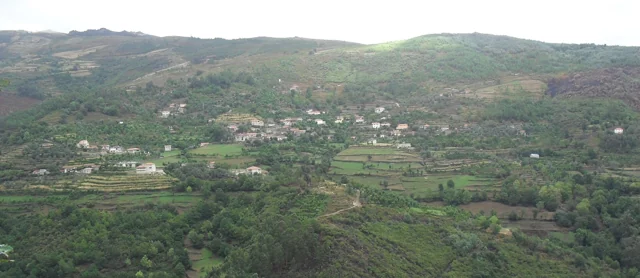
Panoramic view of Vilela, Rio Douro, with houses and agricultural plots on the slopes.
Vilela · architecture and landscape of Rio Douro© Ambcruzⓘ

In Vilela, the walls help to recognize the landscape.

Includes an activity to try →
Read here and view sources

The municipal presentation of the Cavez stream trail highlights the granite masonry in the old streets of Vilela, in Rio Douro. After the levadas and the lameiros, the reading of the territory continues in the houses: the material of the region also participates in the form of the settlement.

The municipal text presents a sequence that unites buildings and agricultural work: levadas, mills and lameiros de regádio precede the description of the streets of the village. Vernacular architecture is here the construction linked to the materials and practices of the place. The granite does not appear only as rock of the landscape; it enters the walls and the visual organization of the settlement.

To explore this relationship, it compares Vilela's photograph with reading on granite grains. A view of the village shows volumes and surfaces; a close look at the rock shows another scale. The municipal description does not date each house nor allows to conclude that all the walls have the same history.

Words in this story: see explanations →Getting to know the parish See Fact sheet: Vilela, Rio Douro See Fact sheet: Trilho da Ribeira de Cavez
Source and context

Municipality — stream of Cavez and agricultural landscape

Accessed: . Editorial summary; the date of consultation is not the date of the facts.

Rural heritage · survey of 2008

Two puddles, shared water

In Beyond Rio, the water also tells a neighborhood story.

Includes an activity to try →
Read here and view sources

The survey of 2008 describes two pools side by side in Levada do Recoucão, in Bucos. The Puddles of Vilela allowed serving two consorts at the same time. They also received water from Veiga, shared by the entire population. The register helps to understand how the space was organized to share a common resource.

The document adds a change with the seasons: in winter there were two consorts; in summer, many. The levada also fed four mills. Thus, the same infrastructure articulated storage, sharing and work throughout the year.

Source and context

Municipality — inventory of levadas, fiche L8, Recoucão (28/01/2008)

Accessed: . Editorial summary; the date of consultation is not the date of the facts.

Rural heritage · survey of 2008

The water had a calendar.

In the Vessada de Baixo, the week organized the irrigation.

Read here and view sources

In Santa Senhorinha, the inventory of 2008 registered three consorts in Levada da Vessada de Baixo, fed by Ribeira de Petimão. Casa da Cerca had water from Monday to Wednesday night; Casa do Prado, from then until Sunday. A third consort used it one day for fortnight. It is a historical portrait of the sharing, not a current time.

The third user appears identified by the Minas Lavora. The chart describes an open channel in the field, used all year round. Reading the weekly distribution helps to realize that sharing water also required organizing the time.

Source and context

Municipality — inventory of levadas, record L5, Vessada de Baixo (11/04/2008)

Accessed: . Editorial summary; the date of consultation is not the date of the facts.

Rural heritage · survey of 2008

One water, several jobs

In Eiró, the work of the mill was linked to the irrigation of the fields.

Read here and view sources

The inventory of February 7, 2008 describes the Lagar da Casa da Portelada, in Eiró, Rio Douro, associated with a mill in the same building, with independent entrance. The water of the Levada de Millos served the equipment before going to the irrigation. This successive use connected food processing and agriculture. Private property registration does not confirm current visiting conditions.

The chart situates the old work of the mill in January and February. It also describes the arrival of water on the west side, through a granite structure, and distinguishes the entrance of the mill, to the north, from the entrance of the mill, to the south. They are clues to read the organization of the building. The document contains contradictory indications about the preserved parts; therefore, it does not allow to state that the set was complete or operational.

Source and context

Municipality — Lagares inventory, LA20 fiche, Portelada House (07/02/2008)

Accessed: . Editorial summary; the date of consultation is not the date of the facts.

Painzela · mill documented in 2008

The stream had the mill working

The Lord's Lagar turned on water and olive processing.

Explore: From watercourse to processing →
Read here and view sources

In Lagar Velho, in Painzela, the survey of 6 of May 2008 identified the Lagar do Lord as a construction of granite moved by water. A levada of its own led it from the Ribeira do Arejal. The record placed the deactivation in the decade of 1970 and then described the building in ruin, with few elements of grinding. It is documentation about a private property equipment, not a confirmation of the current conditions of visit.

Source and context

Municipality — inventory of mills, Lagar do Senhor (Old), record LA12 (06/05/2008)

Accessed: . Editorial summary; the date of consultation is not the date of the facts.

Cabeceiras de Basto · hydraulic heritage documented in 2011

Before grinding, it was necessary to store water

Dams and puddles were part of the work of the mill.

Explore: Four questions before reaching the flour →
Read here and view sources

The Museum distinguishes the dams, which dam the current, the prey or pools used to store water when the flow is not enough to move the mill. In the study published in 2011, identified dams associated with 360 mills and puddles in 11 cases. These numbers belong to the published survey: they do not indicate how many mills are in operation today.

Not all dams had the same origin. The description includes forms supported by the rocky outcrops themselves and constructions made with stone and earth. The relief and availability of water helped determine the solution: the mill was part of a system adapted to the terrain.

Source and context

Basto Land Museum — Mills of Cabeceiras de Basto: water capture and conduction, 07/07/2011

Accessed: . Editorial summary; the date of consultation is not the date of the facts.

Pedraça · industrial heritage documented in 2008

Behind the factory, another time

Souto do Rego guardes the passage from water to electricity.

Includes an activity to try →
Read here and view sources

In Pedraça, the survey of 2008 related two equipments of Souto do Rego. The old mill received water from Levada das Águas Santas; the factory that replaced it had four presses and electric motorization.

The fact sheet placed the decommissioning of the factory in the 1990 decade. It is two moments of olive processing, documented in private properties, without confirmation of current public access.

Source and context

Municipality — Lagares inventory, LA15–LA16, survey of 12/03/2008

Accessed: . Editorial summary; the date of consultation is not the date of the facts.

YOUR LOCAL GUIDE

What would you like to discover?

Take a closer look.