Discover Cabeceiras de BastoFree independent guide
ViveCabeceirasYOUR GUIDE TO CABECEIRAS
ENEnglish
SearchSaved

Animals

Choose a story to start with. You can change the subject or fine tune the search.

11 leituras · A vida que nem sempre se vê · Pesquisa: anfíbios

The life you don't always see

Knowing animals begins by perceiving the territory and respecting the distance.

Escolher uma história · 11
Amphibians · General biology

A skin that also breathes

In amphibians, the skin does more than coat the body.

Explorar: Do corpo ao ambiente →
Read here and consult sources

The naked and permeable skin of amphibians participates in breathing. The Vasco da Gama Aquarium explains that respiratory changes can also involve gills and lungs, according to the phase of life. This permeability helps to perceive the sensitivity of these animals to changes in the environment. It is general biology to better know the frogs, salamanders and newts presented in this collection.

Body temperature follows the conditions of the environment: they are ectothermal animals. This characteristic is different from the permeability of the skin, although both help to understand the relationship with the place where they live. It is also not enough to protect only water: many species use terrestrial environments in other stages of life.

Palavras desta história: ver explicações →
Source and context

Vasco da Gama Aquarium — Thematic Sheets: Amphibians, 2th cycle, pp. 1–2

Accessed: . Editorial summary; the date of consultation is not the date of the facts.
Serra da Cabreira · biology of the species

A tail bigger than the body

The salamander-lusitan lives connected to moisture.

Read here and consult sources

The salamander-lusitânica, Chioglossa lusitanica, is referred by Visit Cabeceiras for the Cabreira Mountains. It has a small body, longer tail than the body and two golden or orange lists on the dark back.

According to LPN, vegetation influences the way it uses space: in agricultural fields and forests of exotic species tend to get closer to the brooks; in indigenous forests it can move further away from the water. The margin is therefore part of the history of this amphibian. It is a biology of the species, not a spotting point.

It is endemic to the Iberian Peninsula and has nocturnal habits. The front legs have four fingers and the back five: details that help to know the species without handling it.

The Gaia Biological Park describes terrestrial habits along streams of water, abundant vegetation and high humidity, and feeding with small invertebrates. Being connected to the stream does not mean spending all your life swimming. When reading the history of eggs and larvae, compare the phase of life with the environment used: the relationship with water changes throughout development.

Source and context

Visit Cabeceiras — natural heritage of Serra da Cabreira
Accessed:

Gaia Biological Park — Chioglossa lusitanica
Accessed:

Link to Nature Protection — Salamander-lusitan
Accessed:

Editorial summary; the date of consultation is not the date of the facts.

Serra da Cabreira · life cycle of the species

Before the salamander, a life in the water

The stream is also the place where the transformation begins.

Explorar: Crescer e poder reproduzir-se são momentos diferentes →
Read here and consult sources

The life of the Salamander-lusitan begins with water. LPN often describes eggs attached to the substrate and larvae that remain in quiet areas until metamorphosis, in a development that can last one to two years.

During this phase, they feed on small aquatic animals, including insects, molluscs and crustaceans. Pollution and habitat loss threaten this cycle; water and surrounding vegetation matter together. The reading explains the biology of the species referred to for Cabreira, without locating breeding areas.

Finishing the metamorphosis is not the same as already being able to reproduce. LPN places the sexual maturity of males around three to four years and females between four and five. Transformation of the body and reproductive maturity are therefore distinct moments. The intervals describe the biology of the species; they do not allow for predicting the age of a specimen seen in a photograph.

Palavras desta história: ver explicações →
Source and context

Link to Nature Protection — Salamander-lusitan
Accessed:

Visit Cabeceiras — natural heritage of Serra da Cabreira
Accessed:

Editorial summary; the date of consultation is not the date of the facts.

Species biology · registered at Rio Douro

A small frog, a large water connection

There are lives that depend on both the shore and the brook.

Inclui uma atividade para experimentar →Explorar: Uma fotografia abre outras perguntas →
Read here and consult sources

The Iberian frog lives naturally on the Iberian Peninsula: that is what it means to be an endemic species of this territory. With slender body and pointed snout, it can reach about 5,5 centimeters. Reproduction happens in the water, and the species prefers mountain streams with vegetation on the shores and rocky bottom.

The photograph recorded in Rio Douro opens a window for this discreet life. It does not in itself demonstrate the quality of water: pollution and the change in riverside habitats are among the threats described by the University of Évora.

The description also highlights a dark strip that crosses the eye zone, with a narrower stripe underneath. They are details to enjoy in a photograph, without handling the animal.

Source and context

University of Évora — Virtual Museum of Biodiversity

Accessed: . Editorial summary; the date of consultation is not the date of the facts.

Serra da Cabreira · regional reference and biology of the species

A triton between water and earth

The skin also follows the change of environment.

Inclui uma atividade para experimentar →Explorar: Do ovo à mudança de ambiente →
Read here and consult sources

The orange triton, Lissotriton boscai, has smoother skin in the aquatic phase and more rough in the terrestrial phase. To reproduce it can use ponds, streams of little current and even tanks. Out of water finds refuge in moist places, between roots, stones and trunks. The orange belly helps explain the name.

It is mentioned among the amphibians of the Cabreira by the municipal portal of Vieira do Minho, without an associated observation point.

The description of the University of Évora refers to four fingers on the front legs and five on the back, besides a flattened tail laterally. They are characteristics of the species, not a reason to remove it from the water. The same source indicates a total length up to nine centimeters and females usually larger and more robust than males.

Also the mating season can change the look. The University of Évora describes a small crest on the tail and, in males, a whitish longitudinal strip, more marked next to the end. Compare two images therefore requires attention to sex and the phase of the year, besides the name of the species. Not all visible differences mean animals of different species.

Food follows the change of environment. According to the Charcos with Life project, larvae and aquatic adults capture small invertebrates from the water; on land, adults eat mostly soft-body animals, such as worms and slugs. The female lays eggs individually on aquatic plants or leaves, over several days. The scheme below connects these phases without assigning them dates of occurrence in the Cabreira.

Source and context

University of Évora — Virtual Museum of Biodiversity, Lissotriton boscai

Vieira Tourism of Minho — fauna of Serra da Cabreira, regional reference

Charcoals with Life / CIIMAR — Orange belly triton, life cycle and feeding

Accessed: . Editorial summary; the date of consultation is not the date of the facts.

Serra da Cabreira · regional reference and biology of the species

There are three-thirty people who spend another winter in the water.

In the cold of altitude, development may take longer.

Read here and consult sources

In the palmed triton, or spalmed paw triton, Lissotriton helveticus, mating takes place in the water of ponds. Gaia Biological Park explains that, in higher and colder areas, larvae can cross winter before completing metamorphosis the following year. It feeds on small invertebrates. The municipal description of the Cabreira mentions this species; the cycle here counted is general biology, not the observation of reproduction in a local pond.

Two different times ago. The biological park record indicates about fifteen days to a month between posture and hatching; metamorphosis comes later. hatching is the egg exit, not the completion of larval development. The possibility of crossing another winter in the water shows why a single calendar does not serve all conditions.

Palavras desta história: ver explicações →
Source and context

Gaia Biological Park — Spanked Triton, Lissotriton helveticus

Vieira Tourism of Minho — fauna of Serra da Cabreira, regional reference

Accessed: . Editorial summary; the date of consultation is not the date of the facts.

Serra da Cabreira · general behaviour of the species

A tail that distracts the predator

The Salamander-lusitan has an amazing defense.

Inclui uma atividade para experimentar →
Read here and consult sources

In a situation of threat, this salamander can detach the tail and regenerate it later. The loose part continues to move, diverting the predator's attention while the animal seeks shelter. Gaia Biological Park describes this mechanism for the species, referred to by Visit Cabeceiras to the Cabreira. It is a curiosity to know without touching or provoking the animal.

The Gaia Biological Park highlights this capacity as unique among the salamanders of the Iberian Peninsula. The mechanism has two moments: immediate distraction by the loose tail and subsequent regeneration. They are not simultaneous events.

Compare this story with growth: losing part of the tail in defense and going through metamorphosis are different processes. An isolated photograph does not show the complete sequence of any of them. Knowing behavior serves to understand the animal without trying to reproduce the threat situation.

Source and context

Gaia Biological Park — Chioglossa lusitanica
Accessed:

Visit Cabeceiras — natural heritage of Serra da Cabreira
Accessed:

Editorial summary; the date of consultation is not the date of the facts.

Amphibians · comparison between groups

The tail gives a clue

Compare an adult frog with an adult salamander.

Inclui uma atividade para experimentar →
Read here and consult sources

The frogs and frogs belong to the anurans: in adulthood they have no tail and the hind legs are developed for the jump. In the urodeles, such as salamanders and tritons, the tail remains in adulthood. The life stage matters in this comparison: a tadpole has a tail. This distinction between groups is not enough to identify a species.

The comparison should begin at the same stage of life. A tadpole and an adult frog are not two different groups; they are forms of development. The comparison between an adult frog and an adult triton allows us to appreciate the difference between anurans and urodels. The Vasco da Gama Aquarium also describes the members of the urodels as fit for gait, in contrast to the developed hind legs of the anurans.

Source and context

Vasco da Gama Aquarium — Thematic Sheets: Amphibians, 2th cycle, pp. 1–2

Accessed: . Editorial summary; the date of consultation is not the date of the facts.

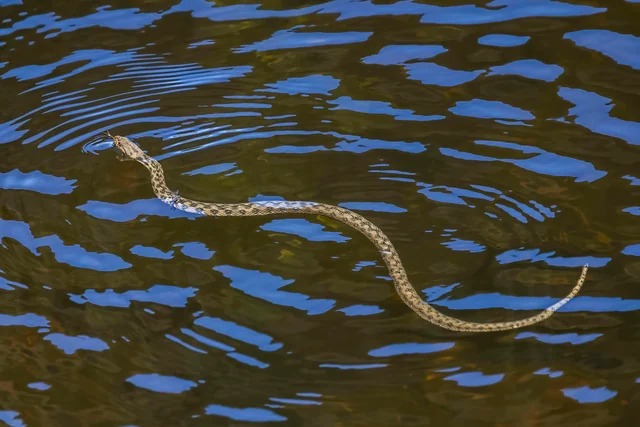
Reptiles · general biology, no local occurrence confirmed in this form

A snake can have more than one drawing

Snake with the body wavy to the surface of the water, between blue reflexes and small ripples.
Viperine water snake swimming in Extremadura, Spain, in 2022. Illustration of the species; not a record of Cabeceiras.
Photography: Charles J. Sharp · CC BY-SA 4.0
About this photograph

Date given at source: . Source consulted in 2026-11-07. EXIF orientation, proportional resize and WebP conversion; no retouching or new clipping of file obtained in Commons.

Request withdrawal or correct authorship

In viperine water snake, the back pattern is not always the same.

Inclui uma atividade para experimentar →Explorar: O mesmo ambiente, modos de vida diferentes →
Read here and consult sources

Natrix maura may present a zigzag stripe, but also a pattern of two clear longitudinal lines. The Spanish biodiversity inventory still describes variation in body tones. A single design does not summarize all individuals of the species.

The chart of the Northern Coastal Natural Park explains the connection to rivers, ponds, streams and other aquatic environments, without excluding displacements on land. It is a general context about the species: it is not an observation in Cabeceiras. Reading compares variation and habitat; it is not a key to identifying snakes found in the field.

The Charcos com Vida project describes a feed mainly in water: invertebrates, larvae and adults of amphibians and small fish enter the menu. The aquatic environment is, thus, a feeding space, besides displacement. The same snake can be preyed on birds and mammals; taking the place of predator does not remove it from the food network.

It is usually daytime, but in summer it can maintain activity at dusk or during the night. Behavior also changes before a threat: the record refers to the expansion of the head and other defensive signs that contribute to the similarity with a viper and to the common name. This explanation of the name does not allow to decide the species or safety of a meeting by the shape of the head.

Palavras desta história: ver explicações →
Source and context

Inventory Español del Patrimonio Natural y la Biodiversidad — Natrix maura, description of the species

Co-management of the Northern Coastal Natural Park — Reptiles and amphibians, record of the viperine water snake

Lived Chargings — Viperine Water Cobra, Feeding and Behaviour

Accessed: . Editorial summary; the date of consultation is not the date of the facts.

General biology · aquatic insects, no local inventory of species

Small shelters underwater

Some larvae use sand and plant remains.

Inclui uma atividade para experimentar →
Read here and consult sources

The larvae of the friganiums, or tricopters, live in the water; many build shelters with sand or vegetable fragments. They integrate the food chains of rivers and streams, serving as food for fish, birds and amphibians. Tagis' guide highlights its usefulness as ecological indicators. Finding a copy, however, does not alone certify the quality of the water.

The underwater shelter is only a part of the story. The adult has hair-covered wings, thin antennas and when he lands, he has wings like a small roof over the body. He may remember a butterfly, but these have scales on the wings. The adult friganiums usually fly at nightfall and live near fresh water masses.

Nor does there exist a single menu for all larvae: according to the group, they can consume algae, plants, organic remains or other invertebrates. They are consumers and, at the same time, food from other animals. A food network better describes these relationships than a row with only one food for each species.

Palavras desta história: ver explicações →
Source and context

Tagis — Insects in Order, Odonata, dragonflies, dragonflies and friganiums (pp. 39–43 and 74)

Accessed: . Editorial summary; the date of consultation is not the date of the facts.

Refojos de Basto · local register and general biology

A rapture with a varied menu

The common-buthium seeks food in the landscape sky and also on the ground.

Inclui uma atividade para experimentar →Explorar: Do poiso à paisagem →
Read here and consult sources

The photograph of ecovore shows Buteo buteo landed among branches, in a record of 1 July 2025. The published point, crossed with CAOP2025, is located in the parish of Refojos de Basto. The image allows to observe the inn bird; it does not show a hunt.

Also called eagle-d’asa-round, this prey may show marked differences in the amount of white and brown plumage. The University of Évora describes a species resident in mainland Portugal, with reinforcement of winter birds from northern Europe. Color alone does not solve all identifications.

The BTO describes a feed that takes advantage of available prey: rabbits and small mammals, but also birds, amphibians, large insects and earthworms. The search for food can take you to the ground. Compared with the hunting tartaranion helps you realize that two prey can share some food without having the same way of life.

Source and context

University of Évora — Buteo buteo: plumage and distribution

British Trust for Ornithology — BirdFacts: Buzzard

Accessed: . Editorial summary; the date of consultation is not the date of the facts.

YOUR LOCAL GUIDE

What would you like to discover?

Take a closer look.