Discover Cabeceiras de BastoFree independent guide
ViveCabeceirasYOUR GUIDE TO CABECEIRAS
ENEnglish
SearchSaved
6 STORIES · CONTINUOUS READING

Pedraça: houses, names and documents

Six readings to discover Pedraça: ancient names, links to Coimbra, houses, oral tradition, an object of wine and the change of energy in the mills. A route of reading, without presupposing access to the properties.

All stories in the order of the route. You can print this page by the browser; sources and credits follow the reading.

Things to try6 activities · 2 interactive explorations · 3 questions
Pedraça · medieval documentation

Pedraça once had another written name

The 1258 royal inquiries record it as Pedraços.

The municipal introduction recalls this old form of the name. It opens a small window onto medieval documents: a place we know today may be written differently in the sources. The reference locates Pedraça in the record of 1258 without making that date the settlement’s beginning.

Pedraços and Pedraça are two forms worth placing side by side. A written name is also a clue for finding documents: searching only the current spelling may miss old references. The municipal introduction provides this variant but does not explain here when or why the spelling changed.

The same care applies to house names. At Casa do Paço, the municipal introduction draws attention to place names. A name can open an investigation; alone, it identifies neither a construction date nor the function a building served in every period.

Getting to know the parish
Source and context

Municipality — Pedraça, history and heritage

Accessed: . Editorial summary; the date of consultation is not the date of the facts.

Back to index ↑
Pedraça · Parish Memories of 1758

A link from Pedraça to Coimbra

In 1758, choosing the parish priest involved a connection beyond the municipality.

The parish account describes the church as dedicated to Santa Marinha and says its rector was presented by the rector of the Colégio de São Jerónimo in Coimbra. This historical bond shows how a small parish belonged to relationships extending beyond the Terras de Basto.

The same transcription places Pedraça in the jurisdiction of Cabeceiras de Basto and the comarca of Guimarães. It records 96 households and 322 souls admitted to communion, alongside a stipend of 50 thousand réis for the rector. These are the document’s categories: households are not people, and souls of communion do not automatically equal the total population.

The figures and the connection with Coimbra show two aspects of parish life: the community described and the organisation framing its priest. The municipal version identifies José Viriato Capela’s transcription, published in 2003, from the 1758 Memories.

The municipal page also distinguishes the account from its accompanying references: it points to memory 296 in volume 42 and lists an obligation to the fabric fund of the chapel of Santa Bárbara from 1624, and another connected with the Blessed Sacrament from 1722. These are archive clues. Their presence does not mean the two documents’ full texts are reproduced on the page, nor does it make 1624 the chapel’s construction date.

Read a document, ask questions

Open an option and choose the story.

  1. The name of the land in an older record

    The spelling Pedraces opens the investigation of a record prior to the Parish Memories.

    Pedraça already had another name written →
  2. Another parish and another count

    It compares counting categories and avoids adding fires as if they were people.

    How was a parish counted? →
  3. The houses in another presentation of the heritage

    The buildings enter another presentation, with names and descriptions that do not all have the same date.

    Pedraça is also counted by houses →
Compare names, numbers and heritage, keeping dates of each source.
Getting to know the parish See Fact sheet: Igreja paroquial de Pedraça See Fact sheet: Santa Bárbara de Pedraça — capela e miradouro
Source and context

Municipality — Parish Memories of Pedraça (1758), transcript of José Viriato Chapel (2003)
Accessed:

Municipality — Parish Memories of Pedraça, 1758; transcription of José Viriato Chapel (2003)
Accessed:

Editorial summary; the date of consultation is not the date of the facts.

Back to index ↑
Pedraça · residential heritage

Pedraça can be told through its houses too

Beyond the church lies a landscape of homes.

Pedraça’s history can also be read through its houses. The municipal presentation highlights Casa do Paço, Casa de Parada and the houses of the Baron of Basto and Paço de Vila. It describes Parada as Brazilian in style, while drawing attention to the place name for Casa do Paço. These are different clues: one points to architecture, the other to place naming.

The houses belong to a parish the municipality describes as fertile and rich in water, connected with agriculture and flax growing. Bringing housing together with the working landscape helps us look at heritage beyond religious buildings.

The municipal description gives no construction dates for this group and does not identify who was responsible for each building. The reference to Brazilian taste is also insufficient to reconstruct an owner’s biography. The houses are starting points for learning about the parish; inclusion here does not imply public access.

Houses, persons and work in Pedraça

Open an option and choose the story.

  1. A tradition linked to the Constable

    The Municipality introduces this narrative as a tradition; the formulation is part of the information.

    A house between memory and proof →
  2. People and learning flax

    A bowl of seeds binds people, cultivation and transmission of a knowledge.

    A bowl of seeds, a knowledge that continues →
  3. Work equipment

    The inventory distinguishes the old hydraulic mill from the factory powered by electricity.

    Behind the factory, another time →
Explore other entries for the history of the parish.
Source and context

Municipality — parish presentation of Pedraça

Accessed: . Editorial summary; the date of consultation is not the date of the facts.

Back to index ↑
Pedraça · tradition recorded by the municipality

A house between memory and evidence

The Constable’s tradition deserves to be told as tradition.

The municipality presents as tradition the story of a riding ground beside Casa de Pedraça, associated with Nuno Álvares Pereira, and of the time spent there after his marriage to Leonor de Alvim. It is a memory attached to the place; the source’s own wording does not turn it into a proven event. Distinguishing these two levels helps us explore history without erasing local imagination.

See Fact sheet: Casa de Pedraça
Source and context

Municipality — parish presentation of Pedraça

Accessed: . Editorial summary; the date of consultation is not the date of the facts.

Back to index ↑
Pedraça · object inventoried in 2015

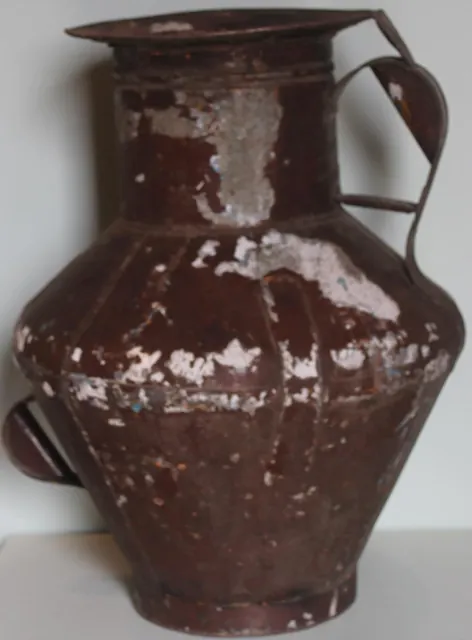
One almude, two colours remembered

Almude measure photographed in the Museum’s publication about tinsmithing.
Source: Museu das Terras de Basto
About this photograph

Photograph date not stated. Source consulted on 2026-11-15. EXIF orientation and proportional WebP resizing; no cropping or upscaling.

Individual photographer and reuse licence not stated by the source.

Request removal or correct the photo credit

The inventory records more than an object’s shape.

Almude L023, associated with Casa de Passo de Vides in Pedraça, was used to carry and measure wine. The 2015 record gives it a capacity of 28 litres and describes sheet zinc painted brown, with flaking paint; the original colour was blue. The capacity belongs to this inventoried piece, not to every almude. Even a layer of paint helps tell an object’s life story.

The record gives a height of 55 centimetres and a diameter of 28, identifying Jacqueline Vilela Passos as its owner. External dimensions, capacity and ownership are different kinds of information: together they make the description more useful than the object’s name alone.

The brown paint and traces of blue also show that a piece may have changed through use. The inventory does not date the repainting. Observing the paint reveals a change, but cannot reconstruct every episode in the almude’s life.

Source and context

Basto Land Museum — Latoaria in Cabeceiras de Basto (05/11/2015), L023

Accessed: . Editorial summary; the date of consultation is not the date of the facts.

Back to index ↑
Pedraça · industrial heritage documented in 2008

Behind the factory, another time

Souto do Rego holds the shift from water to electricity.

In Pedraça, the 2008 survey connects two installations at Souto do Rego. The old oil mill received water from the Levada das Águas Santas; the factory that replaced it had four presses and electric motors.

The record placed the factory’s closure in the 1990s. These are two stages of olive processing, documented in private properties, without confirmation of current public access.

Source and context

Municipality — Lagares inventory, LA15–LA16, survey of 12/03/2008

Accessed: . Editorial summary; the date of consultation is not the date of the facts.

Back to index ↑
YOUR LOCAL GUIDE

What would you like to discover?

Take a closer look.