Discover Cabeceiras de BastoFree independent guide
ViveCabeceirasYOUR GUIDE TO CABECEIRAS
ENEnglish
SearchSaved
7 STORIES · CONTINUOUS READING

Fungus: the work you don't see

Seven stories to follow the life of the mycelium, understand the food and discover who takes advantage of the wood. Draws a network that explores resources, compares the decomposition and opens the photograph of a beetle observed in the municipality.

All stories in the order of the route. You can print this page by the browser; sources and credits follow the reading.

Things to try7 activities · 7 interactive explorations · 6 questions
General knowledge · national guide

The mushroom is only one part

There is a network we do not always see.

A mushroom is a reproductive structure; the body of many fungi is a network of threads called mycelium. Each thread is a hypha. CCRES describes this network colonising living or decaying organic matter, from which the fungus obtains nutrients.

The fruiting body develops from the mycelium and allows spores to disperse. If conditions are favourable, they can give rise to new mycelium. The visible mushroom tells only part of the life cycle; not all fungi produce cap-shaped structures.

When some decomposer species are cultivated, mycelium can develop in inoculated logs. The same log can produce mushrooms for several years while conditions and nutrients remain suitable. This general explanation neither identifies a species nor documents its occurrence in Cabeceiras.

The network can also form cords called rhizomorphs. In certain wood-inhabiting fungi, these help bridge gaps between branches or logs to reach another food source. An outer layer protects the inner hyphae during this exploration.

Another strategy is to form sclerotia: compact masses of hyphae with a resistant covering. They allow fungi to survive unfavourable periods and, when conditions improve, can produce mycelium or reproductive structures. These are forms of growth and survival described by the Australian botanic gardens, not local records.

WHAT YOU SEE AND WHAT STAYS HIDDEN

  1. 1 · Fruiting body

    A reproductive structure that develops from the mycelium. It can take forms other than the cap drawn here.

  2. 2 · Mycelium and hyphae

    Mycelium is the network; hyphae are the threads that form it.

  3. 3 · Spores

    They take part in dispersal. In favourable conditions, they can give rise to new mycelium.

    Follow the spores’ journey →
Original educational illustration, not to scale; threads and spores are enlarged. It does not depict a local species or observation. Explanations are based on this story’s sources.
Source and context

DGADR / ICNF — Mushroom Collector's Guide, June 2013
Accessed:

Centre for Silvestre Resources Skills — production mushrooms
Accessed:

Silvestrian Resource Competence Centre — General Mycology
Accessed:

Australian National Botanic Gardens / Centre for Australian National Biodiversity Research — The mycelium
Accessed:

Editorial summary; the date of consultation is not the date of the facts.

Back to index ↑
General biology · growth of fungi

Why do mushrooms grow in a circle?

The pattern of hidden growth appears on the surface.

Some mycelia spread out from a starting point, seeking nutrients in the outer areas. Mushrooms may emerge along that growing edge and form a ring. The visible circle thus follows the fungus’s expansion through its substrate. Not all fungi make these patterns; this general explanation does not confirm a ring observed in the municipality.

The network grows as hyphae lengthen and branch. Connections between the threads also allow nutrients to move through the mycelium. Imagine several interconnected paths: a ring of mushrooms, when it appears, does not reveal the whole underground pattern.

Growth does not have to trace a perfect circle. Nutrient distribution and environmental conditions influence its direction. The Australian botanic gardens describe greater development in favourable areas; the circle is a way to understand the process, not a compulsory pattern.

The circle is just the beginning

Open an option and choose the story.

  1. Know the filament netThe mushroom is just a part →
  2. Understanding how you get foodA meal prepared outside →
  3. Follow sporesA journey that hardly anyone sees →
Follow the net, feed and reproduction.
Source and context

Australian National Botanic Gardens / Centre for Australian National Biodiversity Research — The mycelium

Accessed: . Editorial summary; the date of consultation is not the date of the facts.

Back to index ↑
General biology · feeding of fungi

A meal prepared on the outside

Fungi do not need a mouth to obtain food.

A fungus does not need to swallow a leaf to use its nutrients. The mycelium releases enzymes outside itself; these break organic matter into simpler compounds, which the hyphae then absorb.

The network of threads also grows and branches. Connections between hyphae allow nutrients to travel to other parts of the mycelium. Something that seems motionless may therefore be exploring new spaces and redistributing resources without a mushroom appearing on the surface.

Growth also follows the distribution of food. The Australian National Botanic Gardens describe more branching and slower advance in nutrient-rich areas; where nutrients are scarce, hyphae may lengthen faster and branch less. The network does not always need the same density.

Some fungi form cords of hyphae called rhizomorphs. These can help cross gaps between food sources, such as two separate pieces of wood. On reaching fresh wood, the hyphae may branch and occupy it. This explains growth strategies, not a confirmed description of any thread found on a walk.

A MEAL IN THREE STEPS

Open each step to follow the nutrients’ path.

  1. 1 · Break down outside

    Enzymes released by the fungus break down organic matter into simpler compounds.

  2. 2 · Absorb through the hyphae

    The compounds pass through the hyphal walls. The fungus obtains food by absorption.

  3. 3 · Distribute through the network

    Connections between hyphae allow nutrients to reach other parts of the mycelium.

Diagram of feeding and transport in mycelium, based on the Australian National Botanic Gardens. It is not a microscopic image and does not identify a local species.
Source and context

Australian National Botanic Gardens / Centre for Australian National Biodiversity Research — The mycelium

Accessed: . Editorial summary; the date of consultation is not the date of the facts.

Back to index ↑
General ecology · decomposition

A fallen leaf still has a journey ahead

In the soil, matter changes hands.

A fallen leaf can become food for decomposer fungi. They absorb nutrients from dead organic matter and help recycle it. The material matters: some fungi are associated with leaves, wood or humus. Decomposition describes a feeding relationship; the shape of a cap alone does not explain that way of life.

Protecting this underground life also involves how soil is treated. In the Gulbenkian Garden interview, Susana Gonçalves explains that excessive soil disturbance and compaction can damage mycelial networks. This is general conservation guidance, not an assessment of any particular piece of land in the municipality.

Names offer clues to the growing surface too: foliicolous fungi grow on fallen leaves, lignicolous fungi on wood and humicolous fungi in decaying plant remains. These words describe where they live, not species names. In the same landscape, different materials offer different food possibilities; leaving a leaf or branch in place also preserves part of that context.

WHERE DOES THE FOOD COME FROM?

Open each relationship and compare.

  1. Dead leaves and wood · decomposition

    Saprophytes use dead matter and help recycle nutrients.

    Explore life in a log →
  2. Living roots · partnership

    In mycorrhizas, the plant supplies organic compounds; the fungus helps obtain water and nutrients.

    Discover the partnership →
  3. A host · parasitism

    The fungus uses another organism’s resources, harming it.

    Explore this relationship →
A simplified comparison of ways of life. It neither identifies species nor depicts a local observation.
See local fungal records
Source and context

Silvestrian Resource Competence Centre — General Mycology
Accessed:

Gulbenkian Garden — ecology of fungi, with Susana Gonçalves (17/04/2023)
Accessed:

Editorial summary; the date of consultation is not the date of the facts.

Back to index ↑
General ecology · wood and biodiversity

A log can be a little home

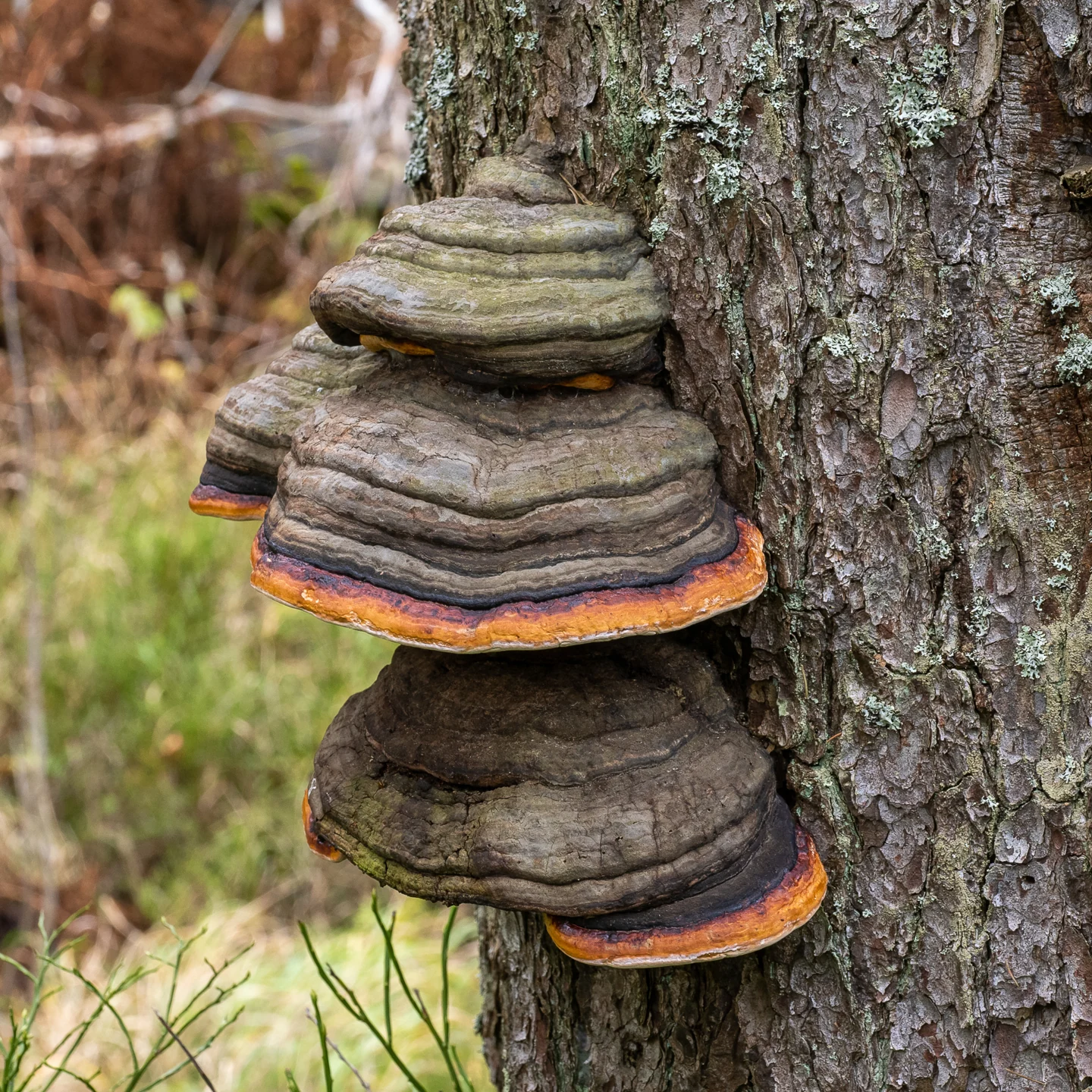
Fomitopsis pinicola on a tree trunk.
Fomitopsis pinicola on a tree trunk.Illustrative photograph
Piotr Lukasik
ⓘ

Fomitopsis pinicola on a tree trunk.

Photography: Piotr Lukasik · CC BY 4.0

View source

Date given at source: .

Request removal or correct the photo credit

Decaying wood is still full of connections.

A fallen log remains part of woodland life. Fungi break down its wood, which also supports other organisms, including insect larvae. Researcher Susana Gonçalves explains that some tree cavities result from fungal activity and can later shelter animals. A standing tree with cavities and a log on the ground offer different things to observe. In green spaces, retaining veteran trees requires assessment and monitoring of the risk of falling. This ecological explanation does not confirm a connection between the beetle photographed in Cabeceiras and a particular tree.

But wood does not always decay in the same way. In white rot, fungi break down lignin and cellulose; the wood may become pale, fibrous or spongy. In brown rot, decay mainly affects cellulose and hemicellulose, leaving a brownish residue rich in lignin. Wood may become brittle and break into small blocks. The University of California distinguishes these processes by their effects on wood components.

White and brown describe the decay, not the colour of a mushroom cap. They are not species names either. A visible reproductive structure on a trunk reveals only part of the story: decay may extend upwards or downwards and remain hidden. A photograph cannot measure that extent or assess a tree’s stability.

A log opens several stories

Open an option and choose the story.

  1. How to get foodA meal prepared outside →
  2. Larvae and woodAn old trunk still feeds life →
  3. The importance of sheltersA different house throughout the year →
  4. An example of brown decompositionShelf growing in a trunk →
  5. From wood to leaves on the groundA fallen leaf still has way →
These relationships are explanations of general ecology; they do not demonstrate who occupies a concrete tree.
See local fungal records
Return to observation proposal ↑
Source and context

Gulbenkian Garden — ecology of fungi, with Susana Gonçalves (17/04/2023)

University of California — Wood Decay Fungi in Landscape Trees (revised August 2019)

Accessed: . Editorial summary; the date of consultation is not the date of the facts.

Back to index ↑
Species recorded in the municipality · general ecology

An old trunk still nourishes life

For beetle larvae, decaying wood can be both home and food.

The larvae of Dorcus parallelipipedus live and feed in decaying wood, according to The Wildlife Trusts. The catalogue photograph documents an adult observed in the municipality; it does not show larvae or confirm the tree in which they developed. Connect this story with wood fungi: an ageing trunk can support different forms of life. There is no need to dismantle an animal’s shelter to observe it. In adults, The Wildlife Trusts highlights the broad head, jaws and entirely black wing cases. These are clues to compare with the available photograph, without concluding that every dark beetle belongs to this species.

A photograph, several phases of history

Open an option and choose the story.

  1. Why do you change the texture of the wood?

    Wood can sustain different organisms throughout decomposition.

    A log can be a small house →
  2. How the fungi get food

    The fungi transform the food out of the body before absorbing it.

    A meal prepared outside →
  3. Decomposition continues on the ground

    Fallen leaves and branches continue to be part of the life of the ground.

    A fallen leaf still has way →
The adult was photographed in the municipality. Links explain ecological relationships; they do not identify the wood where this individual grew up.
Return to observation proposal ↑
Source and context

The Wildlife Trusts — Lesser stag beetle, Dorcus parallelipipedus
Consultations: ,

Editorial summary; the date of consultation is not the date of the facts.

Back to index ↑
Fungi · cultivation conditions, general context

More water is not always better

Fungi need the right conditions, not just rain.

When saprophytic mushrooms are cultivated, moisture in the substrate and air influences their development. The Centro de Competências dos Recursos Silvestres explains that dry conditions can restrict mycelium and deform mushrooms, while excessive moisture encourages contamination. Temperature, available food and ventilation also matter. This explains cultivation; it is neither a forecast for wild mushrooms nor guidance on choosing edible species.

It also helps to distinguish two stages: the mycelium spreading through the substrate and the production of reproductive structures. In the cultivation described by CCRES, temperature and lighting conditions may change between stages. Not carrying out photosynthesis does not make light irrelevant: it can influence the shape and colour of mushrooms.

The substrate provides both support and food. Its composition and acidity help explain why one species grows well on a material while another does not. Giving two substrates the same amount of water does not make them equivalent. These factors interact; a rainy afternoon alone cannot predict fruiting.

From invisible net to mushroom

Open an option and choose the story.

  1. How the body of the fungus is organizedThe mushroom is just a part →
  2. How you get nutrientsA meal prepared outside →
  3. What happens to sporesA journey that hardly anyone sees →
It explores structures, feeding and dispersion in three complementary readings.
Source and context

Centre for Silvestre Resources Skills — production mushrooms

Accessed: . Editorial summary; the date of consultation is not the date of the facts.

Back to index ↑
YOUR LOCAL GUIDE

What would you like to discover?

Take a closer look.